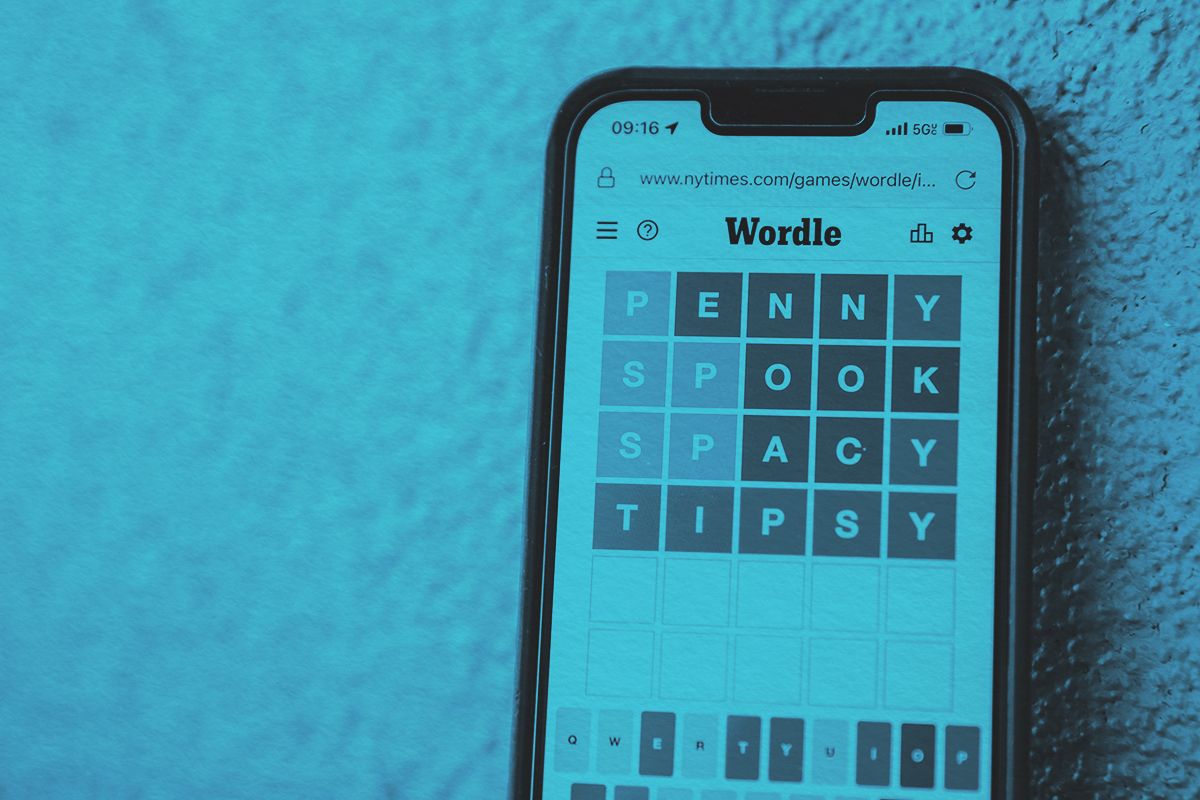
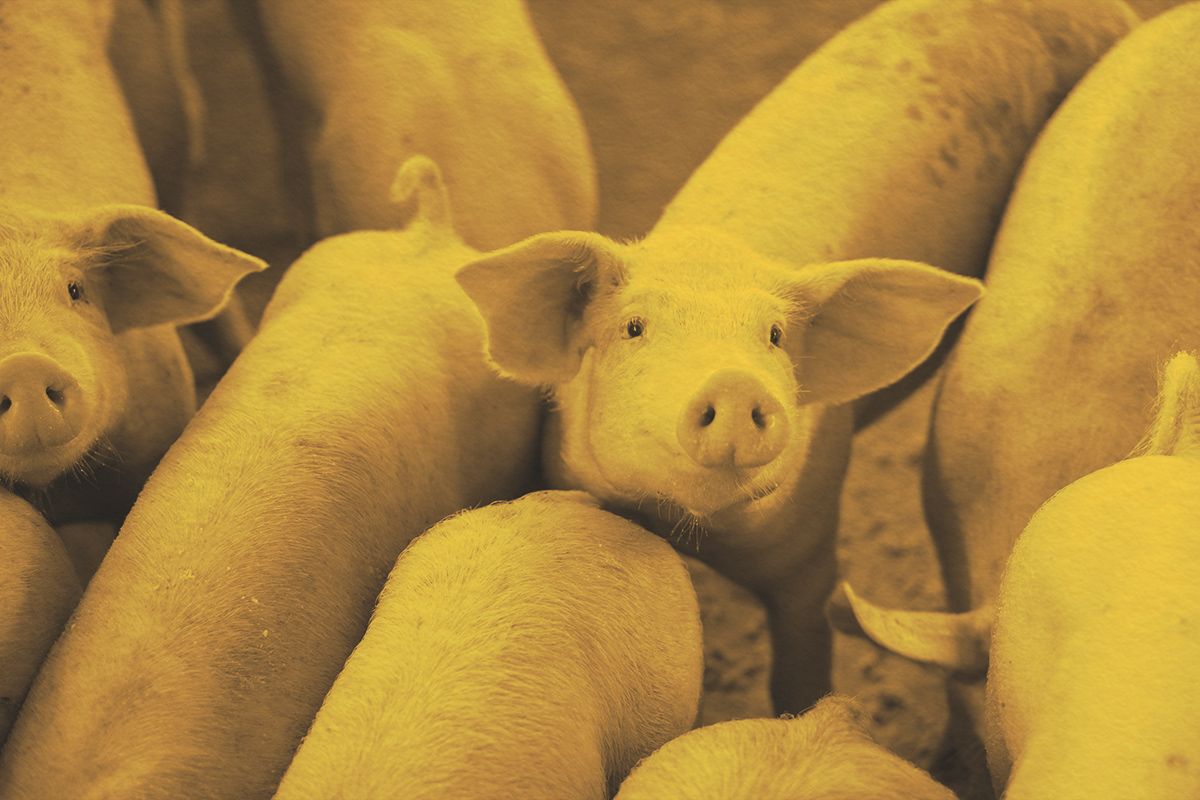
Some porcine-related phrases make clear sense, such as “pigging out” or “happy as a pig in mud.” Pigs also have a reputation for excessive perspiration, given the popularity of the phrase “I’m sweating like a pig!” However, this seems to be just bad press. According to 4-H Agent Matthew Newman, while swine do have some sweat glands, as all mammals do, they have relatively few for their size. As such, they have to roll in the mud or do another similar activity to cool their bodies on a hot day. So, where did “sweating like a pig” come from? The idiom actually has to do not with the animal but with the process of iron smelting. More specifically, it comes from the term “pig iron.”
“Pig iron,” going back to 1665, refers to the “crude iron that is the direct product of the blast furnace.” It’s known as “pig iron” because of the way iron used to be cast. Hot iron was poured into sand molds in a way that visually resembled tiny piglets suckling at their mother’s teat. When the ingots cooled and were broken off, they were sometimes referred to as “pigs,” hence the term “pig iron.”
As for the “sweating” element of the phrase, it has to do with the cooling process. Dr. Joe Schwarcz from the McGill University Office of Science and Society explains that as iron cools, the surrounding air begins to hit its dew point. In turn, this causes moisture to form on the iron, which looks like little droplets of sweat beading down the ingots (the pigs); this is where we get “sweat like a pig.”
Advanced smelting techniques have largely rendered pig iron a thing of the past, though the phrase maintains its impressive staying power. Today it can be a reminder of older smelting techniques, but it has nothing to do with Porky or Babe.
Featured image credit: Prot/ Adobe Stock
Advertisement
More from our network
Word Smarts is part of Inbox Studio, which publishes content that uplifts, informs, and inspires.
From sea turtles to steaks and “more cowbell,” Word Smarts readers have strong opinions on the emojis still missing from our keyboards. Here’s the wish list of animals, foods, moods, and more they’d like to see added next.
We all have our favorite emojis, whether it’s a Heart ❤️, a Hand 👋, or something new every day. (The Melting Face 🫠 is easily my top emoji of the summer.) The options are plentiful — there are at least 3,790 official emojis in the Unicode Standard — but we can think of thousands more we wish we had. Who among us hasn’t searched for a specific image to punctuate a text, only to discover it doesn’t exist?
Word Smarts writers put together a list of emojis we’d like to add to our keyboards, including an acoustic guitar and a dumpster fire. But we still wanted more, so we asked our readers for suggestions on what emojis they would add to their library.
Emojis are created by a global nonprofit called the Unicode Consortium. They added eight new emojis in April 2025, including a Leafless Tree and a Fingerprint . Anyone can submit an emoji proposal, so if you’re feeling inspired, Unicode starts accepting emoji proposals again on April 2, 2026. In the meantime, let’s take a look at the emojis that Word Smarts readers are wishing for.
Animals
Perhaps the most common request is for more animals. “How about different dog breeds and not a standard boring dog?” Debbie A. asked. The Dog emoji 🐕 and Dog Face emoji 🐶 appear to be a Shiba Inu and a beagle, respectively, and the Poodle emoji 🐩 is the only other dog breed represented.
The keyboard could use more cats and birds, too. “Get rid of the bugs and add a hummingbird and a cardinal,” reader Linda wrote. Reader Don D. suggested adding a sea turtle emoji, since the existing Turtle emoji 🐢 looks more like a tortoise.
“Portmanteaujis”
When the perfect emoji doesn’t exist, we get creative with combinations. Reader Kim K. said, “I want to be able to overlay the on whatever it needs.” Reader Janine H. suggested using the word “portmanteaujis” to describe those times when one emoji just isn’t enough.
Advertisement
Foods
Word Smarts readers are hungry for some new food emojis, too, including Buffalo chicken wings, Philadelphia cheesesteaks, candy canes, and a “sizzling steak.” “Those of us who indulge in white wine are still awaiting our emoji,” Judie K. said. (The Wine Glass emoji 🍷 is filled with red.)
Hobbies
Pickleball players are impatiently waiting for their emoji, while cheerleaders want to see their moves or maybe some pompons. Other reader requests include fly fishing, horse jumping, and a deck of playing cards. Several suggested more vehicle options, including different car styles, a jet ski, and a dirt bike. Sports fans would love a collection of team logos, and Matthew would like to add the “Star Trek Tribble,” for when the Vulcan Salute emoji 🖖 is not enough. And Kathryn K. said, “We need a grandma emoji that doesn’t look like she came from the 1800s. 👵”
Feeling Moody
Some readers described moods they don’t see on their keyboards, including jealousy, impatience, and “a combination of sad and angry.” Beth D. wants to see “pulling out one’s hair,” or “screaming at the top of one’s lungs.” And other readers requested some moods that aren’t so easily explained:
“I’d like one that says, ‘I got your message and I hear you,’ without agreeing or disagreeing,” Susan C. said.
“I’d like to see a ‘crying hearts’ emoji instead of crying tears to denote something that touched me so deeply, it made me cry (in a good way),” Patricia M. wrote.
“A hug emoji that is empathetic and not happy,” Angela K. suggested.
“There is a ‘like’ emoji. But I need one to say, ‘I like that you are raising money for cancer (for instance) but I don’t like cancer,’” Kathe explained.
“I wish we could convey in an emoji that what you just said is NOT what your face is saying!” Mary B. said.
Whether you’re creating an epic space saga or trailing off dramatically in a text, an ellipsis is a tiny punctuation powerhouse with many practical uses.
Have you ever noticed how three little dots can say so much? Just look at Star Wars, which kicks off its opening crawl with the legendary line, “A long time ago in a galaxy far, far away…” — and boom, the audience is hooked. In this context, an ellipsis builds suspense and sparks curiosity, so it’s a useful tool for screenwriters, authors, speechwriters, poets, and other areas of creative writing.
The ellipsis also has a place in professional and academic settings, where it is used to omit superfluous words in direct quotes. The rules for using it this way are stricter than in creative writing, but sometimes it’s as simple as replacing words within a sentence with the ellipsis. Consider the following quote from a BBC article, alongside its shortened version.
Original: “The original 1977 cinematic release of ‘Star Wars’ will be shown on the big screen this summer in London, marking its first public screening in decades.”
Shortened: “The original 1977 cinematic release of ‘Star Wars’ will be shown … in London, marking its first public screening in decades.”
(Editor’s note: We follow AP style, which calls for a space on either side of an ellipsis. You may choose not to use spaces. Pick your style and stay consistent.)
Other contexts have more complicated rules. When an omission closes out a sentence, most style guides, including MLA, advise adding a fourth dot to mark the end of a sentence.
The BBC stated, “The original 1977 cinematic release of ‘Star Wars’ will be shown on the big screen this summer in London. …”
(AP does advise against using ellipsis at the beginning and end of direct quotes. If you’re not writing a news story, you should be OK, but it’s worth knowing the guidelines.)
When a quote begins midsentence, the use of an ellipsis depends on the context. If the first word of the quote isn’t capitalized, no ellipsis is necessary:
BBC states that the film “will be shown as part of the British Film Institute (BFI)’s Film on Film festival on 12 June.”
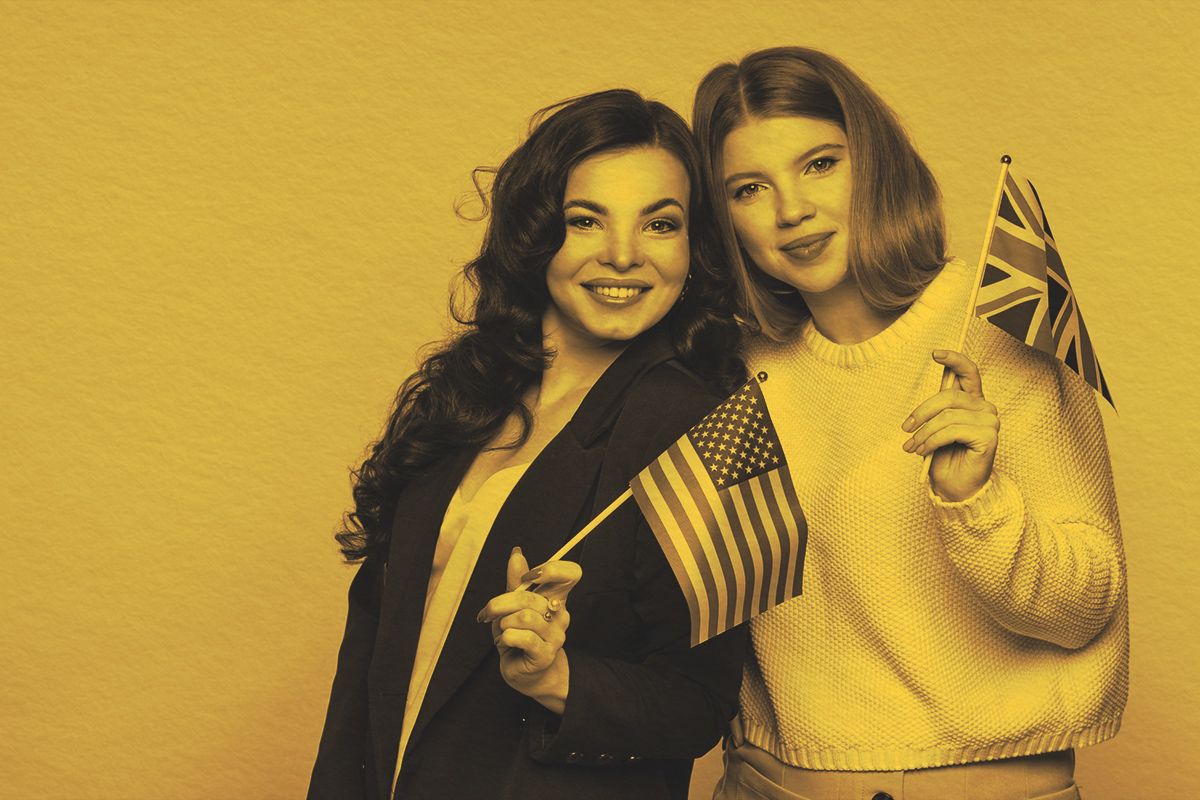
Brits blow their own trumpets while Americans toot their own horns — and that’s just the beginning. Here are some common idioms that share the same meaning but sound entirely different depending on which side of the Atlantic you’re on.
English may be a shared language, but American and British speakers often diverge in the words and expressions they use. And while many of their idioms share the same meaning, some vary in their wording. While these idiom pairs are historically connected, they’ve evolved to fit the everyday language of their respective regions. Some differences are subtle, while others are more pronounced, reflecting cultural differences on either side of the Atlantic.
American: Toot One’s Own Horn
British: Blow One’s Own Trumpet
Depending on where they live, English speakers refer to different instruments when boasting about themselves. To “toot your own horn” in American English is the equivalent of “blowing your own trumpet” in British English. Both expressions describe talking about oneself in a prideful way, though often in a self-aware manner. In essence, you’re giving yourself credit for being right about something or having accomplished something impressive. For example, someone might say, “Not to toot my own horn, but that presentation was pretty great.”
In Britain, on the other hand, they might say, “I don’t mean to blow my own trumpet, but I think I secured the deal.” One of the earliest records of the origins of this expression comes from a translation of “…In Praise of Folly” by Desiderius Erasmus, first published in 1511: “…And indeed what is more befitting than that Folly should be the trumpet of her own praise, and dance after her own pipe?” Here, the author likens self-praise to a trumpet or dancing to one’s own music.
American: Not Touching Something With a 10-Foot Pole
British: Not Touching Something With a Barge Pole
Americans and Brits express their desire to distance themselves from something using slightly different poles. The expression means to refuse to associate with someone or something because it’s unpleasant, risky, suspicious, or controversial in nature and refers to literally maintaining a distance.
For instance, a picky American eater might say, “I wouldn’t touch Brussels sprouts with a 10-foot pole.” But a Brit? They wouldn’t touch those sprouts with a “barge pole.” The American version dates to the mid-18th century, while the British version emerged during the early 19th century. The British version refers to long poles employed on a barge (a flat-bottomed boat) for propulsion, docking, or fending off objects.
Advertisement
American: Threw a (Monkey) Wrench in the Works
British: Threw a Spanner in the Works
If something disrupts or impedes your day, you might say a “monkey wrench was thrown into the works.” This idiom essentially describes something that ruins a plan or causes you to approach things differently: “The rain threw a wrench in our beach day.” Informal American English tends to shorten the expression, omitting “monkey” and/or the second half (“in the works”), while British English typically sticks with the full expression. A “spanner” is the British equivalent of a wrench.
The idiom’s origin lies in the notion that a small metal tool such as a wrench or spanner can really wreak havoc when lost in a machine, just as a metaphorical wrench (e.g., bad weather, delays, or illness) can make plans go awry. One of the earliest printed records of this expression appears in a 1907 edition of the Chicago Tribune: “It should look to them as if he were throwing a monkeywrench into the only market by visiting that Cincinnati circus upon the devoted heads of Kentucky’s best customers.”
American: Skeleton in the Closet
British: Skeleton in the Cupboard
Brits and Americans keep their metaphorical skeletons in different places. WhereasAmericans store them in the closet, Brits keep theirs in the cupboard. These expressions refer to an embarrassing or potentially ruinous secret from the past, as in, “Journalists dug to see if the Hollywood star had any skeletons in his closet/cupboard.”
This turn of phrase has existed since the early 19th century, though its exact origins are unclear. One of the earliest documentations of the actual idiom is from an 1816 edition of the British periodical The Eclectic View, which highlighted societal fears of uncovering uncomfortable truths, in this case genetic diseases. The author writes, “In these, as in many other highly important questions, men seem afraid of enquiring after truth; cautions on cautions are multiplied, to conceal the skeleton in the closet or to prevent its escape….”
Advertisement
American: Beat a Dead Horse
British: Flog a Dead Horse
“Flogging” may sound medieval on this side of the pond, but for the Brits, it’s a common alternative for the American term “beating.” This expression means to waste time, effort, and/or conversation on something that’s already been decided or is impossible. It originated from the noun “dead horse,” which in the 1830s denoted “an exhausted or profitless topic or issue.”
“Flog” is a mainly British term dating to the 17th century. Its earliest definition is “to beat or strike with a rod or whip.” When this idiom first emerged, “flog” was more common than “beat” in Britain, resulting in the altered wording. Today, “flog” is often used differently in modern British English, as slang for selling something illegally, quickly, or cheaply.
The Brits take a gentler approach to this idiom, which is said to ward off misfortune and prevent jinxing something. Instead of the American “knock,” British speakers use a different verb: “touch.” For example, Americans might say, “The weather looks great for this weekend — knock on wood!” In contrast, the Brits would say, “The weather has been nice lately; I hope it stays like this — touch wood!”
This phrase has been around since at least the 19th century, but it’s unclear who started it, the British or the Americans. The practice of knocking on wood for luck is found in various cultures worldwide, though its origins remain uncertain. It may stem from an ancient Celtic tradition, or perhaps something more modern — a 19th-century children’s game of tag called “Tiggy Touchwood.”
Regardless of the origins of all these idioms, they highlight the deep connections between traditions, superstitions, and language across different cultures.
Featured image credit: Vagengeym_Elena/ iStock
Advertisement
More from our network
Word Smarts is part of Inbox Studio, which publishes content that uplifts, informs, and inspires.
Unlike chicken or turkey, crow isn’t among the birds considered to be a culinary delicacy. But in a figurative sense, people have been eating crow since the mid-1800s.
When dining out, you may order a plate of charbroiled chicken or decadent duck. But there are other birds you’ll almost never see on a menu, such as crow, which is consumed only in a figurative sense. “To eat crow” means “to admit that one was wrong or accept that one has been defeated.” But of all the animals in the menagerie, how did crows in particular come to be associated with this idiomatic walk of shame?
One popular theory can be traced back to the mid-19th century. The phrase purportedly comes from a series of similar yet slightly different versions of the same parable, which first appeared in an 1850 edition of Knickerbocker Magazine.
In summary, the story focused on a boarding house patron complaining about the food he was being served. In response, the housekeeper called the patron “too perticeler” and then bragged about their own appetite, saying, “I kin eat anything; I kin eat a crow.” Frustrated, the boarder then went on to catch and prepare a crow, which he served to the housekeeper to see if he’d follow through on his claim.
The housekeeper took several bites before grabbing his stomach and running to the door with a terrible case of nausea, and he was forced to admit he was wrong. Why the author of that original story chose crow remains a mystery, but it does explain the purported origins of this popular phrase.
The story was apparently so humorous, it was worthy of being picked up by other publications and republished. By the 1870s, there were examples of “eating boiled crow” in other publications, showing the story had turned into an idiom.
Featured image credit: landbysea/ iStock
Advertisement
More from our network
Word Smarts is part of Inbox Studio, which publishes content that uplifts, informs, and inspires.
It’s tempting to while away the hours matching up brightly colored blocks on your phone or even playing a digital version of your favorite card games, but smartphone games have gotten, well, smarter. One of the most popular word games out there, Wordle, involves guessing a five-letter word of the day within six guesses. If you’re familiar with the gray, yellow, and green squares that signify a Wordle series of guesses, you might be one of the millions of people who play the word game daily. Whether you’re a Wordle superfan or a complete novice, here are some tips and strategies to improve your daily guesses.
Choosing a Starting Word
The game started as a small project for developer Josh Wardle’s friends and family. He set it up online to be played for free on any computer or mobile device. It was sold in 2022 to TheNew York Times, where it can now be played alongside the paper’s other popular games.
It exists in exactly the same original format, retaining the simplicity that made it so popular. The rules are simple: Players have six guesses to discover the five-letter mystery word of the day. If you see a green letter in your guess, it means that letter is in the word and in the correct spot. If a letter appears in yellow, it means it’s in the word but in the wrong spot. If a letter turns gray, that means it’s not part of today’s word and it shouldn’t be used in future guesses.
Part of what made Wordle a viral hit is that it can be played only once a day. A new puzzle is generated every 24 hours, and every person in the world gets the same word to solve. Once they uncover the word of the day, players can share a graphic of their colored-square guesses to show off how well (or poorly) they performed. The words are not displayed, so the green, yellow, and gray squares that began popping up all over social media feeds generated excitement for the simple game.
Advertisement
Choosing a Starting Word
While it’s an extremely simple premise, wordsmiths know a few strategies can increase the odds of success. There are 14,855 five-letter words available as potential answers, but it’s best to narrow down your guesses to more commonly used words. The New York Times “WordleBot” (a tool that will rate your guesses based on skill and luck) scored a list of 3,150 five-letter words on their probability of being a Wordle word. The more common a word is, based on its appearance in TheNew York Times since 2000, the more likely it is that it will be a selected word. However, words with lower probability scores have shown up as words of the day in the past — for example, “ANODE” had a 67.9% probability of showing up and “MATEY” had a 73.2% chance, and both have been featured in the daily puzzle.
Interestingly, while the original URL of the game ended with a “co.uk,” Wordle is played with American English spellings. So, players from Canada or the U.K. could be tripped up with words such as “FAVOR” and “COLOR.”
When thinking of possible words, don’t be afraid to use the same letter twice. Previous solutions of “ABBEY” and “GORGE” were trickier because they repeated letters.
That said, with only six guesses, the first word is crucial, and repeating letters in that initial guess won’t give you as much information as a word with five different letters. A player might hit a stroke of luck, but the first guess should generally contain a few of the most popular letters: the vowels “A,” “E,” “I,” and “O,” along with the consonants “N,” “S,” and “T.” While it’s always fun to hit the jackpot, the odds aren’t great to guess the winner with the first guess by using less common letters — in particular the letter “J.”
Advertisement
Choosing a Starting Word
Probably the most heated topic of debate among Wordle players is which starting word to use. While some choose a random starting word each day, others fiercely debate the merits of specific five-letter words. If you want to commit to the same word every day, here are some options:
SOARE: This word, which means “a young hawk,” contains three useful vowels. However, it is not an especially common word, so if you commit to this starting word, you’ll have to resign yourself to the fact that you will likely never guess the Wordle on the first try.
RAISE: Personally, this is our favorite. Several analysts say this is the ideal starting word if you want to reveal lots of potential letters and have a chance of guessing the word on the first try. Use “ARISE” as a variation if you’re in the mood for something different.
SLATE, CRANE, TRACE: While they have only two vowels, these are called out by the WordleBot as being some of the most efficient first words, leading players to guess the winning word in the fewest number of guesses.
Not liking any of these ideas? Here are some other starting words with two vowels and three power-packed consonants:
ROAST
STARE
SHADE
PLANE
PLATE
Want more vowels? Try these three vowel and two consonant combos:
If you really love vowels, you can these starting words with at least four vowels. However, WordleBot warns that these words tend to be less efficient. Players may solve the puzzle but with a slightly higher average number of guesses.
ADIEU
AUDIO
OUIJA
AUREI
LOUIE
Once you choose your starting word and begin improving your score, make sure to share your Wordle triumphs far and wide.
Featured image credit: Nils Huenerfuerst/ Unsplash
Advertisement
More from our network
Word Smarts is part of Inbox Studio, which publishes content that uplifts, informs, and inspires.
The BBQ world is full of impassioned debates: ribs vs. brisket, dry vs. wet rubs, and even “barbecue” vs. “barbeque.” Regarding the latter, let’s get to the meat of the matter.
When you have sauce all over your fingers and a belly full of ribs, the last thing on your mind is probably the minutiae of the English language. But once you’ve had ample time to digest the food, you might find yourself wondering whether it’s spelled “barbecue” or “barbeque.” In some cases, a single letter can make a huge difference — take “champ” vs. “chump,” for instance. But when it comes to good old-fashioned BBQ, many people use the spellings interchangeably, though most dictionaries and style guides argue one is technically more correct. (The AP style guide specifically says not to use “BBQ” or “barbeque,” and Merriam-Webster lists “barbeque” as an alternative spelling for the noun, but it provides a “less common” label.)
However you spell it, the word is derived from American Spanish — specifically the term barbacoa, which is “the wood framework for supporting cooked or dried meat.” English speakers began using the word as a verb around 1689, referring to the process of cooking meat. By the 1730s, it was more commonly used as a noun for the food being cooked or the event itself.
As for the spelling, “barbecue” appeared first, as it was derived from the similar Spanish word that contains the letter “C.” But according to the Online Etymology Dictionary, the word was shortened to “BBQ” by many restaurants and advertisers around the 1950s 1956, based on the term’s phonetics. At some point along the way, the spelling “barbeque” emerged.
While we know the spelling of “barbecue” came first, “barbeque” is acceptable (but less common), according to Merriam-Webster. However, you won’t see both spellings everywhere — sociologist John Shelton Reed says the spelling “barbeque” is particularly popular in the Southern U.S. compared to elsewhere. In that region you’re likely to find many opinions on what exactly counts as barbecue — such as if it’s a food or an activity — but we’re not touching the debate on what kind of sauce to use on your barbecue/barbeque.
Featured image credit: Andrew Itaga/ Unsplash
Advertisement
More from our network
Word Smarts is part of Inbox Studio, which publishes content that uplifts, informs, and inspires.
5 Grammar Rules Native English Speakers Tend To Ignore
From using dangling modifiers with abandon to turning “literally” into its opposite, these examples reveal how native English speakers treat grammar rules — by kicking them to the curb.
How many of the lessons you learned in English class do you remember? Many people who grow up speaking English learn to do so “by ear” — picking up speech patterns and flow naturally. As such, native English speakers bend the rules of grammar every day. Although these rules are taught in classrooms and enforced by style guides, everyday English speaker often follow a different set of standards, with a focus on clarity, emphasis, and natural flow. While some may label these modifications as “mistakes,” they actually serve a purpose in casual conversation, making them valuable for non-native English speakers to learn and understand.
Using Dangling Modifiers
Dangling modifiers are created when the subject being described is not explicitly stated in the sentence. Although this is technically a grammatical error, native English speakers use dangling modifiers all the time. For example, consider this sentence: “While eating dinner, the phone rang.” Obviously, the phone was not eating dinner, so this sentence structure might puzzle someone who learned English in a classroom or with a textbook. To native English speakers, the intention is clear: The phone rang while someone was eating dinner.
Another example: “Having worked hard all semester, the final exam was a relief.” Who worked hard all semester? The intended subject is the unnamed student, not the exam. While native English speakers likely grasp the intended meaning, those new to English might find these constructions confusing.
To correct these dangling modifiers, we could rephrase the examples by rearranging the words or adding subjects:
The phone rang while we were eating dinner.
After I worked hard all semester, the final exam was a relief.
Advertisement
Overusing Intensive Adverbs
Teachers and style guides alike warn against overusing adverbs. As the MLA Style Center notes, “intensive” adverbs — “very,” “truly,” “really,” “actually,” and “extremely” — in particular are frowned upon. Nonetheless, we use them in daily conversation. In fact, the latter three adverbs are among the 3,000 most common English words.
Native speakers, in particular, favor intensive adverbs over flowery ones. For instance, saying, “Can you turn the music down? It’s really loud,” sounds natural, while “It’s thunderous” might feel awkward or pretentious. Similarly, telling a friend you’re “very excited” for their party sounds more sincere than saying you’re “exhilarated” or “overjoyed.” While intensive adverbs may not always fit formal writing, they remain a staple of everyday speech.
Using Sentence Fragments
Sentence fragments — incomplete sentences missing a subject or verb — are often listed as a supreme slipup among grammar mistakes. But in modern communication, from emails to advertisements, sentence fragments are effective. Many corporate slogans, for example, are sentence fragments valued for their brevity and impact. Wheaties and BMW drop off the verb with their respective trademark taglines, “Breakfast of champions” and “The ultimate driving machine.” Other companies use an implied subject, such as Nike’s “Just do it,” where the implied subject is “you.”
Fragments also occur in everyday expressions: “Be there soon.” “Not my problem.” “No idea.” The “incorrect” abruptness of these phrases is what makes them work. One-word sentence fragments — “Absolutely,” “Nope,” and “Maybe” — are commonplace in everyday chatter because they’re simple and convey meaning instantly. Fragments are also effective as an afterthought: “I loved that movie. A little long, though.”
Fragments are perhaps most prevalent in commands and instructions: “No running.” “Inside voices.” “Exit here.” We avoid using complete sentences in these contexts to prioritize simplicity and readability.
Advertisement
Applying "Literally" Figuratively
Combatants of the figurative usage of “literally” complain of its incorrect placement and overuse. It is, after all, one of the most common English words. Its traditional definition means “in a literal sense” or “a completely accurate way” — so why do so many native English speakers use it to convey the opposite?
According to Merriam-Webster, the figurative definition of “literally” — “used in an exaggerated way to emphasize a statement or description that is not literally true or possible” — is recognized as a valid usage due to its popularity. Native speakers often use it as hyperbole for emphasis, as in, “It’s literally freezing in here!” Even if the temperature isn’t freezing, this exaggeration effectively communicates just how cold it feels.
Some grammar purists might bewail this secondary usage of literally, but it’s hardly new. The meaning of “virtually; in effect” can be found in the writings of some of the most well-respected writers of the 19th and 20th centuries, including Charles Dickens, Mark Twain, Charlotte Brontë, and James Joyce.
An English grammar textbook might tell you that starting a sentence with a coordinating conjunction — “for,” “and,” “nor” “but,” “or,” “yet,” and “so” (the mnemonic FANBOYS) — is a no-no. A topic of much debate, this “rule” persists in many style guides. But as an Oxford Dictionaries blog (quoted by MLA — backed up by double grammar experts!) points out, it’s merely a stylistic preference, not a hard-and-fast rule.
Starting a sentence with a conjunction has benefits, from adding a touch of drama to creating urgency. Examples include dramatic openings like “And so it begins…” or conversational phrases such as “So, now what?”
Historical and literary figures have long embraced this use of conjunctions to kick off their writing. Leo Tolstoy wrote, “We can know only that we know nothing. And that is the highest degree of human wisdom.” During his inaugural address, John F. Kennedy famously said, “And so, my fellow Americans: Ask not what your country can do for you — ask what you can do for your country.”
So, while the rule book has its place, native English speakers prove every day that sometimes, the most powerful — and practical — choice is to break the rules.
Featured image credit: SDI Productions/ iStock
Advertisement
More from our network
Word Smarts is part of Inbox Studio, which publishes content that uplifts, informs, and inspires.
Some English words have pretty limited use. Take, for instance, “caboodle,” which exists as part of the phrase “the whole kit and caboodle.” Here’s what it means and why this unusual phrase exists.
Much like “peanut butter and jelly” or “do’s and don’ts,” some English words are forever intertwined. These paired phrases are called “binomial expressions” — they consist of two terms, often joined by “and” or “or,” and the order of the terms is almost always fixed. Think of “black and white,” “more or less,” or “safe and sound.” Those classic binomial expressions use familiar words, but the phrase “kit and caboodle” — meaning “a number of things considered as a unit” — spotlights a word that is almost exclusively used as a part of this expression.
Let’s talk about each individual component. According to Merriam-Webster, “kit” has a wide array of meanings, all of which largely refer to a collection or set of individual components (e.g., tools, parts). “Caboodle” has a very similar definition, meaning “all the things of a group.” Essentially, the terms are synonyms and now exist as two similar parts of one common phrase.
Gary Martin of the blog Phrase Finder notes that many similar phrases existed prior to “the whole kit and caboodle” being coined. For instance, “the whole kit” referred to the contents of a soldier’s knapsack no later than 1785. The Online Etymology Dictionary adds that the phrase “the whole kit and boodle” was in use by 1855 — “boodle” meaning “lot, collection,” which is perhaps derived from the Dutch boedel, meaning “property.”
It was only in the late 19th century that “the whole kit and caboodle” rose to prominence as a popular phrase in the United States. “Caboodle” most likely came from the word “boodle,” as its use appeared after “boodle” in the late 19th century. It’s likely that “kit” and “caboodle” were paired phonetically because of their similar “K”- sounds, which helped the phrase become popular and stick around to this day.
People who grew up in the early-to-mid-1990s might remember “Caboodles” as the name of a popular, brightly colored plastic makeup and accessory case — imagine a Crayola-colored tackle box. The folks who invented the product must have been familiar with the etymology, as it fits well with the original usage.
Featured image credit: Evgeniy Skripnichenko/ iStock
Advertisement
More from our network
Word Smarts is part of Inbox Studio, which publishes content that uplifts, informs, and inspires.
The Funniest Words in the English Language, According to the Experts
Language is a funny thing, and we mean that quite literally. Keep reading to learn more about the funniest English words, according to those who truly know comedy.
Physical comedy will always get a laugh, but some of the funniest jokes involve clever wordplay or layers upon layers of storytelling. And then there are other occasions where all it takes is one silly-sounding word to make someone chortle. Some humorous English terms sound hilarious on their own without any additional context, though everyone has a different opinion when it comes to which one is funniest. Here’s a look at some rib-tickling contenders, according to experts in both language and comedy.
Booty
In a 2017 study, researchers assigned subjective “humor ratings” to 4,997 English words in an effort to determine the funniest terms. More than 800 participants were polled, with the results showing a clear winner: “booty.” The word can refer to a pirate’s plunder or a person’s butt, but in either case, “booty” received a humor rating of 4.32/5. That beat out other strong contenders including “tit,” “booby,” and “nitwit.”
That same study provided some interesting findings broken down by sex and age. Men found sexual terms such as “bondage” and “orgy” to be funniest, whereas women preferred sillier, more benign terms such as “giggle” and “circus.” For younger folks, “goatee” and “joint” were the most riotous; compare that to older respondents, who found “burlesque” and “pong” to be particularly humorous.
Alka Seltzer
In his 1972 play The Sunshine Boys, comedic playwright Neil Simon mentions the brand “Alka Seltzer” as one of the funniest terms in English. The character Willy Clark expresses a belief about how words containing the letter “K” (or even a “K” sound) simply sound funnier than others. He provides some contrasting examples: “Casey Stengel, that’s a funny name. Robert Taylor is not funny. ‘Cupcake’ is funny. ‘Tomato’ is not funny. ‘Cookie’ is funny. ‘Cucumber’ is funny. ‘Car keys.’ Cleveland… Cleveland is funny. Maryland is not funny.”
Advertisement
Hippopotomonstrosesquippedaliophobia
In an interview with The Guardianin 2019, English stand-up comic Chris McCausland claimed the funniest English word is “hippopotomonstrosesquippedaliophobia.” Not only is this a silly word to say, but it also has a humorously ironic meaning, as it refers to a fear of long words.
Upchuck
In a 2019 study, psychologists Chris Westbury and Geoff Hollis of the University of Alberta determined “upchuck” to be the funniest word. This term — which is American slang for “vomit” — topped a list of 45,516 contenders, winning over runners-up including “bubby” and “wriggly.” The abstract of their paper claimed, “Words are judged funnier if they are less common and have an improbable orthographic or phonological structure.” In layman’s terms, that means that words are funnier if they are rare and have an unusual spelling or sound. As part of the same study, “harassment” was deemed to be the least funny English word.
Advertisement
Fart
It may be simple, but “fart” is considered to be the funniest word by many children and even some adults — including Scott Aukerman, an American comedian known for his work on TV’s Mr. Show and the podcast Comedy Bang! Bang! In a 2020 interview, Aukerman claimed “fart” is “not only a funny word, but also a funny sound. And they smell funny, too. The trifecta! How many words are all three?” In terms of pure comedy, it’s hard to argue with that logic.
Absquatulate
In 2009, Bucknell University linguistics professor Robert Beard published a book titled The 100 Funniest Words in English. When creating his list, Beard took into account several factors, including pronunciation, meaning, usage, and history. In the end, Beard determined “absquatulate” (an intransitive verb meaning “decamp” or “abscond”) to be one of the funniest words, along with “collywobbles” (“stomach pain”), “gongoozle” (“to idly observe”), and “snollygoster” (a shrewd, unprincipled person”).
While some words have fallen out of style, their humorous nature persists today. The team at Merriam-Webster highlighted the term “flummadiddle” as one of the funniest English words from the 19th century. The word means “something foolish or worthless,” though it’s funny to use even if you don’t know its exact definition. “Flummadiddle” was originally used in reference to fringe on dresses, though it evolved to refer to something nonsensical by the 1840s.
Featured image credit: Goodboy Picture Company/ iStock
Advertisement
More from our network
Word Smarts is part of Inbox Studio, which publishes content that uplifts, informs, and inspires.
Enter your email to receive daily lessons that dive into what makes English so fascinating. Each email is packed with odd rules, etymologies, and the tools you need to be a better communicator.
Sorry, your email address is not valid. Please try again.
Sorry, your email address is not valid. Please try again.













 on whatever it needs.” Reader Janine H. suggested using the word “portmanteaujis” to describe those times when one emoji just isn’t enough.