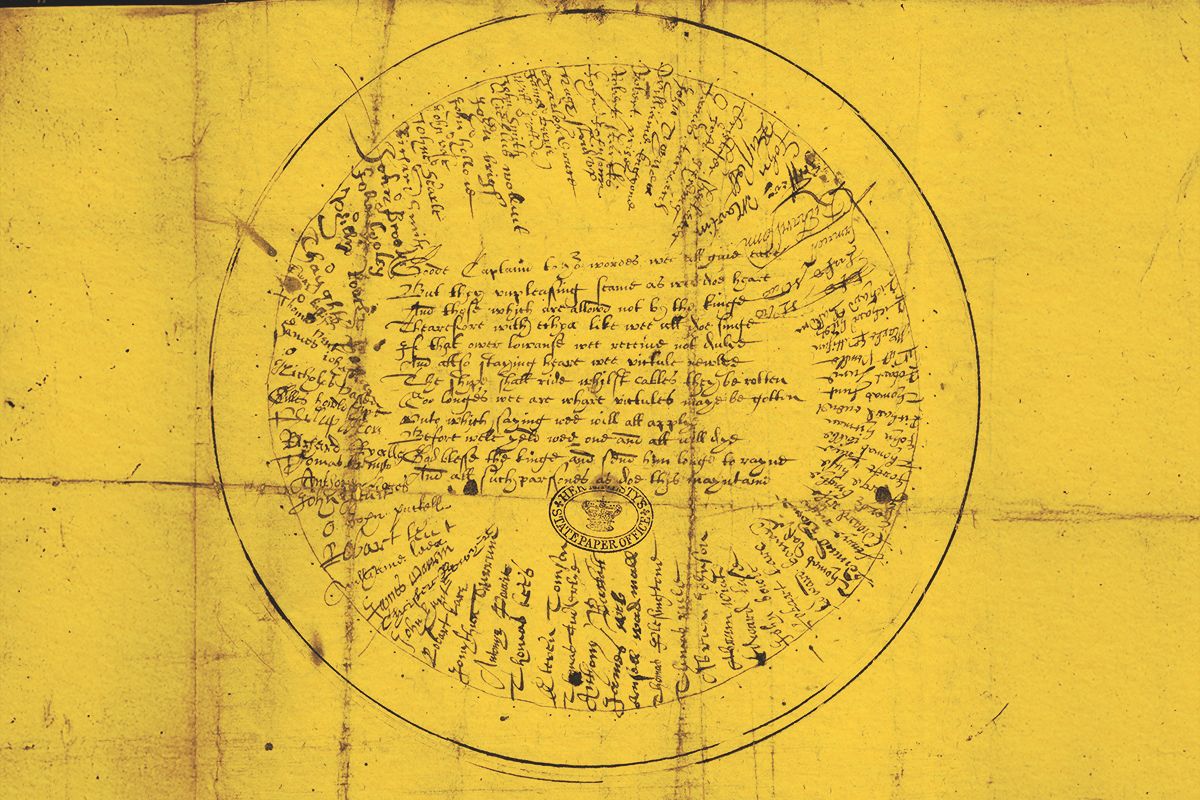
“Round robin” is a versatile noun phrase in modern English, but it has a long history. It originated in the late 17th century as a nautical term for a document signed by sailors. The signatures were arranged in a circle to disguise the order of signing. This process was detailed in a witness deposition from a maritime case in England, published in 1698: “Some of them drew up a paper commonly called a Round Robin, and signed the same whereby they intimated that if the Captaine would not give them leave to goe a shore, they would take leave.” This form of round robin seems like an early method of collective bargaining.
By the mid-18th century, the term took on a more general definition: “Any document signed by many people, sometimes in a way that conceals their order.” It is still used this way today, as well as in a context for editing documents within a group.
The most common modern usage, however, refers to a round robin sports tournament in which each contestant who is entered in a competition meets every other participant in turn. This sports and competition usage originated in the United States during the late 19th century, and it remains popular for tournaments. The FIFA World Cup begins with a round robin group stage, followed by single-elimination matches.
The “round” comes about from the circular nature of the activities, but why “robin”? The Oxford English Dictionary proposes that alliteration has played a role in the success of the phrase, but its exact origin is not well documented. A leading theory is that it originated in the French phrase rond ruban, or “round ribbon,” a different type of written petition with names signed on a ribbon for anonymity. This tradition was then likely adapted for English maritime use, and its pronunciation shifted. The phrase’s long history — from French tradition to its use across the English Channel and, eventually, its key role in professional sports — reminds us just how versatile language can be.
Featured image credit: piemags/AN24/ Alamy Stock Photo
Advertisement
More from our network
Word Smarts is part of Inbox Studio, which publishes content that uplifts, informs, and inspires.
While it takes years of training to become an Olympian, it takes much less time to learn the lingo. Here are some words you should know as you watch the Winter Games.
As someone who finds the Winter Olympics much more entertaining than the Summer Games, I’m excited to plop down and spend the next two weeks watching endless hours of ice hockey and curling. But unless you participate in these winter sports yourself, you may find certain terms to be unfamiliar or confusing. Here’s a look at words and phrases that you should know while you watch the 2026 Winter Olympic Games.
Salchow
You’re most likely to hear the term “salchow” while watching figure skating. It refers to a jump where a skater leaps into the air using the back inside edge of one skate, performs one or more full turns in the air, and then lands on the back outside edge of the opposite skate. The jump is called a double, triple, or quadruple salchow based on how many full revolutions are completed.
The term was coined by 1921 and is named for Ulrich Salchow, a Swedish figure skater who, in 1908, won the first Olympic gold awarded in men’s figure skating. It is one of many common figure skating jumps named for preeminent figures in the sport’s history. For instance, “axel” comes from Norwegian figure skater Axel Paulsen, and“lutz” is believed to be in honor of Swiss American figure skater Gustave Lussi.
Slalom
Since the 1948 Winter Olympics, slalom has been an individual skiing event. The word “slalom” can refer generally to zigzagging movement or more specifically to a timed race in which athletes zigzag around a series of markers (e.g., flags). The word made its way into the English language in the early 1920s, and it’s derived from the Norwegian slalam, which literally translates to “sloping track.”
Another hurdle that Olympians may encounter on the slopes are moguls. In this context, they’re not titans of industry; they’re bumpy, elevated piles of snow. “Mogul” is derived from the Norwegian mugje, meaning “heap” or “mound.”
Piste
While we’re on the topic of skiing, we’d be remiss not to mention “piste” — a term that refers to a hard-packed ski trail. The word originated in French by 1696, though it comes from the Old Italian pista, which is derived from the verb pistare, meaning “to trample down.” Today, it accurately describes the downhill ski trails used by Olympians.
Advertisement
Skeleton
When you hear the term “skeleton” on a Winter Olympic broadcast, the announcers are probably referring to small sleds ridden by single riders lying headfirst in a prone position. “Skeleton” also names the sport, which has existed since 1882. The name may be derived from the appearance of early sleds that resembled human skeletons, though an alternative theory suggests it’s a mistranslation of the Norwegian kjelke, meaning “sled.”
Bonspiel
The term “bonspiel” refers to a match or tournament in the sport of curling. Its earliest use dates to around 1772, though its precise etymological origins aren’t certain. One theory is that it comes from the Dutch bond (meaning “league”) and spel (“game”), even though the sport itself was invented in Scotland.
As for why the sport is called “curling,” the name refers to the fact that in curling games, the stones spin in a curved trajectory as they travel down the ice, curling inward toward a more central target.
Hat Trick
“Hat trick” is a term in ice hockey referring to when a single player scores three goals in one game. But long before it applied to hockey, the phrase originated in another sport — British cricket. If a bowler retired three batsmen with three consecutive balls, the team would buy that bowler a new hat to commemorate their impressive feat. You might also hear the term “hat trick” in Olympics broadcasts if a certain athlete earns three medals.
In the world of Olympic snowboarding (and other board sports such as skateboarding), athletes have either a “regular” or “goofy” stance. This refers to whichever foot they put forward on the board — a regular stance involves putting the left foot forward, while a goofy one is putting the right foot forward. It’s important to clarify that “regular” and “goofy” aren’t meant to be synonymous with “correct” and “incorrect.” Instead, the origin of the word “goofy” can be traced to the 1937 Disney cartoon “Hawaiian Holiday,” in which the character Goofy rides on a surfboard with his right foot forward.
Featured image credit: Lsantilli/ Adobe Stock
Advertisement
More from our network
Word Smarts is part of Inbox Studio, which publishes content that uplifts, informs, and inspires.
Different religions hold sacred different things. In Hinduism, for example, the cow is considered to be representative of the divine and is therefore venerated. Understanding that, it’s easy to make the leap to thinking that the phrase “holy cow” is inspired by Hindu beliefs.
But not all etymological histories are what they appear to be on the surface. While there is some potential truth to the theory, it isn’t necessarily the entire story. Here’s what we can tell you about the roots of the exclamatory phrase “holy cow!”
“Holy cow” is a late entry in a long line of similar phrases used to express surprise. For example, “holy Moses” dates back to the 1850s, according to the Oxford English Dictionary, while “holy smoke” and “holy mackerel” were in use by the 1890s. These are examples of minced euphemisms, meaning they’re replacement words used to avoid profanity. “Holy cow” was used as slang by 1905, with an example appearing in a humor column in the Minneapolis Journal.
That entry — with dated language by today’s standards — mentioned a local dairy farmer and made reference to the fact that cows are sacred among Hindus. The dairy farmer credited the Hindu religion for the phrase “holy cow” but also cited the exclamations “by hen!” and “cat’s foot!” as related alternatives. From this example we know the Hindu respect for cows was understood by Americans at this early date, but we don’t know if the words “holy” and “cow” were originally paired in the slang term because of an actual connection to the religion. Others suggest that “holy cow” is an anglicized version of the Gaelic phrase holy cathu, meaning “holy sorrow.” If this theory holds water, it’s probable that American English speakers heard Irish immigrants saying “holy cathu” and misinterpreted it.
We can trace how “holy cow” gained popularity thanks to several 20th-century American baseball broadcasters. Halsey Hall — a Minneapolis-based broadcaster — popularized “holy cow” as a home run call while calling games in the 1960s. The legendary Harry Caray and Phil Rizzuto also uttered the catchphrase during their broadcasts. Because baseball is such an important part of American culture, these broadcasters helped bring this exclamation to the masses.
Featured image credit: cococinema/ iStock
Advertisement
More from our network
Word Smarts is part of Inbox Studio, which publishes content that uplifts, informs, and inspires.
Sometimes, the substitution of a word can throw off the meaning of an entire sentence or idea. False synonyms are closely related words that don’t always function as appropriate replacements.
Just because two words are synonyms doesn’t necessarily mean they’re interchangeable. In fact, some substitutions can subtly — or seriously — impact your writing. Consider if Louis Armstrong’s song “What a Wonderful World” were titled “What a Fantastic World.” While “fantastic” has a similar definition to “wonderful,” it conveys a different meaning. In addition to the meaning “excellent; superlative,” it has a connection to the fantasy world. It means “based on fantasy” or “marked by extravagant fantasy or extreme individuality.”.
“Wonderful” is more based in reality, with the definition “unusually good; admirable.” Despite being listed as such in the thesaurus, “wonderful” and “fantastic” aren’t true substitutes. Instead, they’re examples of “false” or “near” synonyms.
False synonyms feature closely related definitions and may even look or sound alike, but they behave differently. They may differ in tone, connotation, or formality. For example, “persistent” and “stubborn” share similar definitions, yet “she’s persistent” has a more neutral tone, while “she’s stubborn” sounds negative.
Likewise, the choices between “help” versus “assist” and “buy” versus “purchase” show how formality can shift meaning. Consider the difference between “How can I help you?” and “How may I assist you?” The first is casual, and the latter is more formal.
Similarly, false synonyms might have different emotional connotations. Neil Diamond’s “Sweet Caroline” would evoke different feelings if its title used a different synonym: “Dear Caroline,” “Lovely Caroline,” or “Precious Caroline.” While these descriptors have similar tones and formalities, they elicit different feelings than “sweet.”
So, are there any “true” or “absolute” synonyms? They’re rare — in fact, many linguists argue that absolute synonyms do not exist. Most of the words we refer to as synonyms are actually false (or near) synonyms. Due to the nuances of English, different words almost always carry subtle distinctions.
Why do false synonyms matter? Because word choice matters when it comes to shaping tone, clarity, and even credibility, further demonstrating how one small word can change everything.
Featured image credit: bubaone/ iStock
Advertisement
More from our network
Word Smarts is part of Inbox Studio, which publishes content that uplifts, informs, and inspires.
When Should You Use ‘Each Other’ vs. ‘One Another’?
These seemingly simple terms describe the way we connect with one another — or is it “each other”? While some textbooks and teachers may recommend a distinction between the two terms, one was never firmly established.
Sometimes we say something in a certain way because we’ve always heard it that way, but another person may say the same thing in slightly different wording. Such is the case with “each other” and “one another” — is there a difference? Pop culture might give us a hint. Take Ben E. King’s 1981 hit “Made for Each Other,” a love song about two people. Or the 1939 movie “Made for Each Other,” which stars two young newlyweds navigating married life. You might notice a pattern: two people = “each other.”
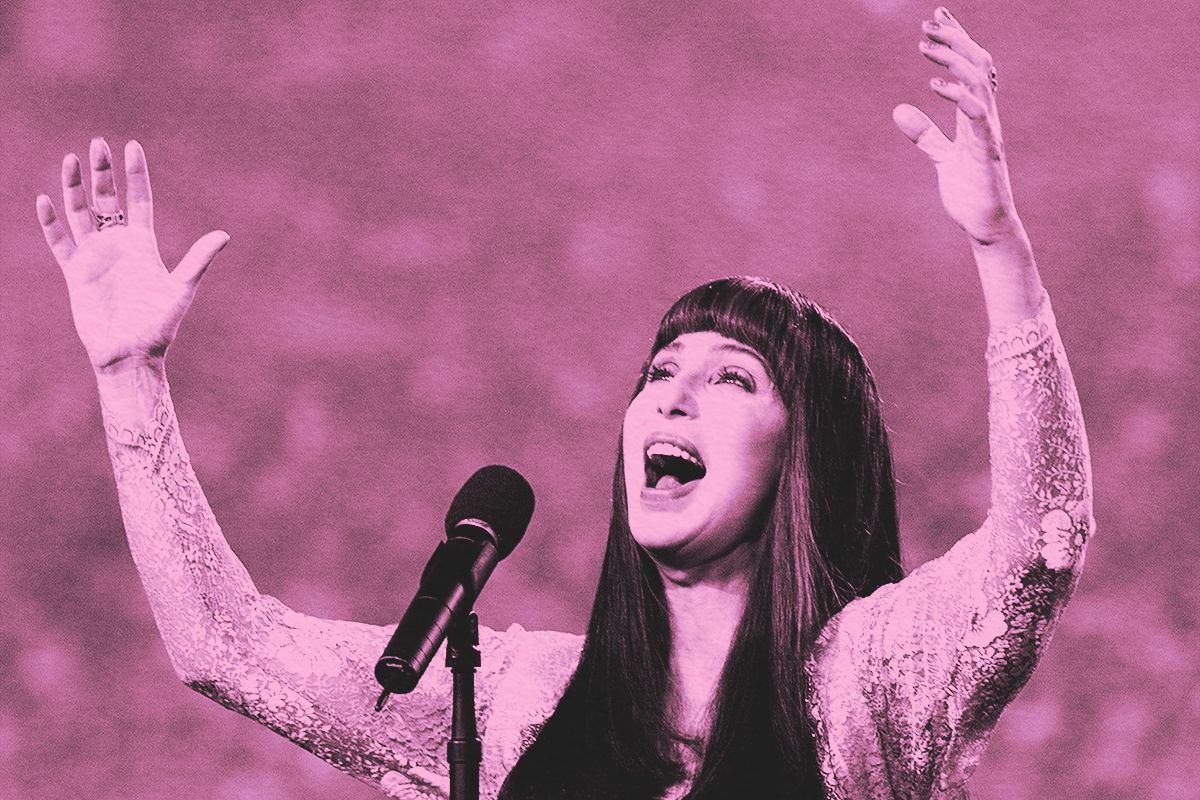
A different pattern emerges with a similar term: “one another.” Cher’s song “Love One Another,” featuring the lyrics “love one another, sisters and brothers,” isn’t about a couple; it’s a call to action to humanity as a whole. Here, “one another” includes three or more people.
These usages aren’t random choices. They reflect what many learners were taught in school: “Each other” is for a pair, and “one another” is for more than two people. Today, this distinction endures in classrooms and style guides, but is it set in stone? Based on the etymology, there is some leeway.
According to Merriam-Webster, the nuance between the terms has never been a hard-and-fast rule. They have been used interchangeably since at least the 16th century. “Other” derives from the Old English pronoun oþer, meaning “one of the two.” When paired with “each,” meaning “one of,” it creates a reciprocal pronoun that refers to a pair.
However, “another,” which also derives from oþer, originally meant “a second of two.” This led to its use as the reciprocal pronoun “one another,” which was used to mean “one out of a pair” by the early 16th century. Today, “another” is a pronoun that can mean “one of a group of unspecified or indefinite things” (in addition to other pronoun usages including “one more” and its use as an adjective). To some, this makes it more acceptable for use with larger groups.
In most situations, it’s fine to use “each other” and “one another” interchangeably, but in formal usage — or if you enjoy practicing traditional English grammar skills — you may choose to differentiate between them for precision.
Featured image credit: JEFF HAYNES/ AFP via Getty Images
Advertisement
More from our network
Word Smarts is part of Inbox Studio, which publishes content that uplifts, informs, and inspires.
Whether you’re a “card sharp” or a “card shark,” you’re probably not welcome at many casinos. Here’s a look at the origins of these two similar terms for swindling card players.
There are several ways to refer to someone who cheats at card games, many of which are too profane to use in polite company. But there are two terms we can discuss — “card sharp” and “card shark.” Along with similar spellings, these terms have similar definitions, as both refer to a skilled card player who often makes money by cheating at card games.
Each term, while primarily applied to card cheats, has a secondary usage of “someone who is skilled at card games.” An onlooker might admiringly call a player a card shark after a string of wins, while an opponent might use one of the terms to call out the winner for suspected cheating.
You might assume that one of these phrases is an eggcorn, referring to new terms that are sometimes created when a person mishears or misinterprets a word that previously exists. That may be true — after all, “card sharp” appeared in print in the 1840 Henry Downes Miles novel Claude du Val, while “card shark” didn’t appear until almost four decades later in an 1877 edition of the Sandusky Daily Register. However, it’s impossible to say for sure if the second term is an eggcorn.
Another theory suggests the terms were coined independently, though both were likely derived from 17th-century British slang. At the time, Brits used “sharping” as a noun to refer to swindling, and “sharking” as an adjective for any underhanded cheating. Thus, tricksters in general were sometimes referred to as “sharps” or “sharks,” and it’s safe to assume that those terms were specifically applied to fraudsters who cheated at card games.
Today, “card shark” (sometimes “cardshark”) tends to be the more popular terminology in the U.S., and those in the United Kingdom use “card sharp” (sometimes “cardsharper”). But no matter where you’re located in the English-speaking world, the terms are largely synonymous and can be used interchangeably.
Featured image credit: Pablo Merchán Montes/ Unsplash+
Advertisement
More from our network
Word Smarts is part of Inbox Studio, which publishes content that uplifts, informs, and inspires.
Unless you’re talking about a small child tugging on their parent’s pant leg for attention, “pulling someone’s leg” most often refers to joking around. You may wonder how we landed on “pulling” and “legs” instead of “stretching someone’s arm” or “tugging on someone’s toes,” and while there are several theories as to how the phrase came to be, none is definitive.
Here’s what we do know — the idea of pulling a person’s leg (in the idiomatic sense) can be traced back to around the mid-19th century. The Oxford English Dictionary cites an early printed example in the 1852 book Arctic Miscellanies. But while we have this evidence of the phrase in use by the 1850s, we lack a clear understanding of why.
One theory posed by the American Heritage Dictionary of Idioms is that it’s “thought to allude to tripping someone by so holding a stick or other object that one of his legs is pulled back,” with the idea that the act would throw that person into a state of disarray or confusion. Another theory is that thieves in Victorian England would pull at the legs of passersby to trip and disorient them, after which the thieves would run off with their loot. Similarly, a third theory posits that the idiom refers to beggars tugging at the pant legs of passersby to get their attention on the street, after which they’d trick the person into giving them money.
There’s an additional (and relatively morbid) theory that many linguists mention, which is thathe idiom may be derived from public hangings in London, where executioners would sometimes pull at the condemned’s legs to hasten their execution. A dark practice to be sure, especially given the phrase’s lighthearted meaning today.
Featured image credit: Deagreez/ iStock
Advertisement
More from our network
Word Smarts is part of Inbox Studio, which publishes content that uplifts, informs, and inspires.
Have you ever wondered how your favorite stories cross languages without losing their magic? Let’s pull back the curtain on literary translation to reveal the research, creativity, and careful choices that bring books to life in a new language.
A reader probably rarely thinks about book translation until something sounds “off.” When there’s a translation mistake, it can be glaring, which is why the role of a literary translator is so important. Translators are the unsung heroes behind countless classic tales, including French author Victor Hugo’s Les Misérables and The Hunchback of Notre Dameand Miguel de Cervantes’ Spanish masterpiece Don Quixote, as well as modern novels such as The Girl with the Dragon Tattoo by Swedish author Steig Larsson and The Alchemistby Paulo Coelho, originally written in Portuguese.
A book translator is both a reader and a writer who uses a finely tuned set of skills to give life to an existing story in a new language. To discover more about the behind-the-scenes process of book translation and the role of a literary translator, we interviewed Sofia Huitron, an English and Spanish translator specializing in children’s books and graphic novels.
The First Step
When faced with translating an entire book, most translators, including Huitron, start by reading the book from beginning to end, often more than once. As Huitron explained, “It’s essential to understand the full story, tone, and overall feel so I can recreate that same experience in the translated version.”
Literary translators create by recreating. Knowing the author’s voice and personality, the rhythm and pacing of the prose, and the emotional tone helps a translator capture not just the words on the page, but also the essence of the story. The goal is for the new translation to give English readers the same experience as reading in the original language.
More Than Words: Research
Translators must also conduct thorough research on the context of the book. They become experts on all aspects of the story, whether it’s the geography of a contemporary West Coast romance novel or the historical landscape of a World War II thriller. Mistranslations can occur if the translator is uninformed on key details.
For instance, a translator working on the aforementioned romance novel may need to research coastal California’s microclimates, local slang, and even surf culture to avoid subtle inaccuracies. Confusing Northern and Southern California’s particular nuances could undermine the setting’s authenticity for readers familiar with the area.
In the case of the WWII thriller, a translator would brush up on the timeline of events, as well as military terminology, ranks, and city names, as these can vary across languages. For instance, an English-to-French translation might call for the name of Poland to be changed to Pologne — it would be a major faux pas to use the English version of a country name.
Cultural references are often key to storylines, and missing or misusing one can undermine the author’s intentions. As Huitron put it, “It’s not just about translating words, but about preserving meaning, voice, tone, and cultural nuance so a story can truly live in another language.”
Research is also conducted on the author’s background so that the translator has a better sense of their voice and why they might write or think a certain way. To accomplish this, Huitron explained, “I immerse myself in the author’s voice and experiment with different versions of a passage until I find the one that feels most natural and true to the story.”
Advertisement
The Process
After hours of reading and research, it’s time to start translating. But literary translation is not a one-to-one swap. “Translation goes far beyond replacing words,” Huitron said. “Idioms, humor, and expressions don’t work literally, so my job is to capture the meaning and cultural context behind them and recreate the same impact in the target language.”
Translation involves constant, active choices; there is nothing passive or mechanical about it. It’s a careful balance between staying faithful to the original material while making the text feel natural in the new language. “It requires fluency not just in languages, but in cultures,” as Huitron put it.
Book translation requires heavy revision and editorial collaboration — it’s a lengthy process. Translators refine for clarity and consistency, ensuring a good fit in the new language. This attention to detail often goes unnoticed, but for translators, it’s everything.
According to one seasoned literary translator with the American Translators Association, recreating a 70,000-word novel (approximately 250 pages) might take about 70 days, or 14 weeks. She estimates an average translation of 1,000 words per day, with her work days including writing multiple drafts, coordinating with editors, and proofreading.
Advertisement
Real Examples of Literary Translation
Literary translation is often overlooked, but it’s all around us. Without it, we couldn’t share stories on a global scale. No other story has translated quite as well as The Little Prince. Antoine de Saint-Exupéry’s famous children’s book (Le Petit Prince in the original French) is the most translated work of fiction in the world.
Since its 1943 publication, The Little Prince has amassed 600 translations that resonate with audiences worldwide for its deep themes of human connection, packed into an easy-to-read short story. But these translations didn’t come without missteps.
In 1943, Katherine Woods created the original and most famous translation of The Little Prince from French into English. Though this version is well loved, she mistranslated the French word ami (“friend”) as “sheep” (actually le mouton in French) in a crucial passage. This created the famous “Sheep Test” for other translations of The Little Prince, in which a reader can tell whether the translator has read the original French version or if they translated it from the English version.
For better or worse, mistakes such as these are common in translations. J.R.R. Tolkien, author of The Hobbit and The Lord of the Rings, was famously disappointed in early translations of his works, especially when it came to the mistranslation of names inspired by Old English, which Tolkien took special care in creating. Tolkien was a skilled linguist, and to preserve the accuracy of his works, he published A Tolkien Compass (1975), which included his own notes on the meaning and origin of names in The Lord of the Rings. It has become an irreplaceable tool for Tolkien translators.
All of this meticulous work might go unnoticed by a casual reader, but its impact becomes clear when we look at some of the world’s most famous translated books. When asked what she hopes readers take away from literary translation, Huitron said, “I hope this leads to a deeper appreciation for translated books and for the translators who make our favorite stories accessible to readers around the world.”
Featured image credit: New Africa/ Adobe Stock
Advertisement
More from our network
Word Smarts is part of Inbox Studio, which publishes content that uplifts, informs, and inspires.
Personality is nuanced: A simple “nice” or “mean” very rarely suffices to capture someone’s essence. Consider some of the most beloved literary and film characters of all time. Is James Bond merely calm, or is the famous secret agent imperturbable? Is Gandalf wise, or is a better description “sagacious”? Adjectives bring depth to characters and their personalities, allowing us to describe them more accurately. Let’s explore a curated selection of uncommon vocabulary terms you can use to paint a more vivid picture with your words.
Gregarious
(Adjective) Enjoying the company of others; marked by or showing a liking for companionship.
Those with a gregarious personality are social butterflies — think of Lydia Bennet (Pride and Prejudice) or Anne Shirley (Anne of Green Gables). Both vibrant, talkative, and friendly, these characters often form new connections and easily win people over. Nowadays, most social media personalities and reality television stars are best described as gregarious.
This term appeared in English during the 17th century, but at the time, it referred to groups of animals. It derives from the Latingregarius, meaning “pertaining to a flock; of the herd, of the common sort, common.” It’s still used today to describe animals that live in groups. The definition of the word “starling,” for instance, is “dark gregarious oscine birds.”
Mercurial
(Adjective) Characterized by rapid and unpredictable changeableness of mood.
A mercurial personality is characterized by rapid shifts in mood, thought, actions, or all of the above. It also means “very lively and quick” or “changing often” as in, “Springtime brings mercurial weather.” As for personality types, famous literary figures such as Jay Gatsby (The Great Gatsby) and Hamlet are known for their mercurial tendencies. From Gatsby’s passionate yet unpredictable nature to Hamlet’s rapidly shifting emotions (grief, anger, melancholy, etc.), these characters embody the personality type.
This word also has a lesser-known definition that points to its origin: “Having qualities (as of eloquence, ingenuity, or thievishness) attributed to the god Mercury or in astrology to the influence of the planet Mercury.” Mercury was the messenger of the Roman gods, characterized by his swiftness. The Romans named the fastest-moving planet, Mercury, after him. During the mid-17th century, English speakers began using “mercurial” as an adjective to describe those whose moods shift quickly between extremes, laying the groundwork for the modern definition we use today.
Advertisement
Winsome
(Adjective) Generally pleasing and engaging often because of a childlike charm and innocence.
Alice (from Alice’s Adventures in Wonderland) has a winsome personality. Author Lewis Carroll relies on his character’s profound curiosity to create charm and whimsy, capturing the hearts of audiences who root for her in Wonderland.
While some may use this adjective as synonymous with a winning (meaning “tending to please or delight”) personality, it is not etymologically related to the word “win.” Instead, it derives from the Old English wynsum, from the noun wynn, meaning “joy” or “pleasure.” Though popular in Old English, it was all but extinct until the 18th century, when it experienced a revival as Scottish poets Robert Burns and William Hamilton used it to mean “pleasing or attractive in appearance.”
Imperturbable
(Adjective) Marked by extreme calm, impassivity, and steadiness.
An imperturbable person doesn’t crack under pressure. Think of the Unsinkable Molly Brown in the Titanic film. Based on Margaret Brown — a real survivor of the sinking of the RMS Titanic — the character in the movie is unflappable. During one instance, she insists that her lifeboat turn back to search for survivors, maintaining her composure amid widespread panic. Another cool, calm, and collected character is James Bond, a suave secret agent who always remains poised.
“Imperturbable” is a French loanword that entered English during the 15th century. It stems from the Latin verbperturbare, meaning “to agitate, trouble, or throw into confusion.” Its base word, “perturb” — meaning “to cause to be worried or upset” — is commonly used in English today.
Advertisement
Taciturn
(Adjective) Temperamentally disinclined to talk.
The opposite of a yapper is someone who is taciturn: quiet and reserved. One of America’s favorite superheroes fits the description — Batman, Gotham City’s stoic defender, is taciturn, offering few words but being known for his actions. Plenty of other famous characters are taciturn, too, though for various reasons. Mr. Darcy (Jane Austen’s Pride and Prejudice) is taciturn, but at first he seems arrogant. His habit of remaining quiet stems not from arrogance but from pride and social anxiety.
“Taciturn” comes from the Latin verb tacēre, meaning “to be silent” — an apt origin. It was first adopted into French as taciturne during the 15th century, and was later borrowed into English sometime in the mid-17th or early 18th century.
Sagacious
(Adjective) Having or showing an ability to understand difficult ideas and situations and to make good decisions; marked by keen and farsighted understanding and judgment.
A wise person who shows good judgment is sagacious. This type of wisdom conjures images of profound literary guides, from Gandalf (Lord of the Rings) to Atticus Finch (To Kill a Mockingbird). But it can also describe a highly logical person with a keen intellect and strong observational skills. You might consider your professor, a parent, or a mentor “sagacious.”
“Sagacious” comes from sagire, a Latin verb meaning “to perceive keenly.” It’s been used in English since the 17th century, though at first, it referred to sensory perception, especially smell, sight, and taste. By the mid-17th century, its usage to describe someone “skilled at discovering truths” emerged.
(Adjective) Sharply or bitingly critical, sarcastic, or ironic in temper, mood, or tone.
While “acerbic” may sound like a negative personality trait, it doesn’t always have to be. When combined with other qualities, it can bring humor and even charm. Sherlock Holmes, for instance, is famous for his acerbic dry wit and frequently shows his distinctive personality when clues he deems “obvious” are missed, especially by Dr. Watson.
The adjective “acerb” first appeared in English during the 17th century, though it was generally used to describe foods with a sour taste. It stems from Latin acerbus, meaning “harsh to the taste, sharp, bitter, sour.” During the 19th century, English speakers added the suffix “-ic,” forming the modern adjective we use today to describe people.
Featured image credit: Ada daSilva/ iStock
Advertisement
More from our network
Word Smarts is part of Inbox Studio, which publishes content that uplifts, informs, and inspires.
Weather reports with forecasts of snow will tell you when and where the precipitation is likely to land and give an estimate of how much will accumulate, but there are more words in the lexicon for the type of snow you can expect. It might be a snowstorm, a snow squall, snow flurries, sleet, graupel (granular snow), a whiteout, or a blizzard. Some of these terms are more obvious than others, but “blizzard” stands out for its unique spelling. Why do we call a certain type of snowstorm a blizzard, and where did the word come from?
According to the National Weather Service, the definition of “blizzard” is “a storm containing large amounts of snow or blowing snow, with winds in excess of 35 miles an hour and visibility of less than a quarter mile for at least three hours.” The word “blizzard” entered the lexicon before this technical meaning was developed — as early as 1859 — but it didn’t come into general use until the hard winter of 1880 to 1881.
Beginning with an unusually early mid-October blast, blizzard after blizzard slammed the Midwest, unrelenting through April 1881. Due to extreme cold during that period, the snow hardly melted. The accumulation was so deep that snow covered single-story buildings, and farmers had to dig tunnels to get to their barns to care for their livestock.
Trains stopped running to the Midwest, stranding many communities. Locals were required to use their already low food supplies, and fuel was scarce, hardly enough to get through the repeated blizzards. A February blizzard brought Omaha to a standstill for days. While fictional, the children’s classic The Long Winter by Laura Ingalls Wilder provides an accurate depiction of what those months were like for Midwesterners.
Two newspaper citations from 1881 reveal that “blizzard” was then a relatively new word: “The region is swept by those fearful blasts known as ‘blizzards’ which send … dry snow whirling in icy clouds.” Another: “The hard weather has called into use a word that promises to become a natural Americanism, namely ‘blizzard.’ It designates a storm (of snow and wind) which men cannot resist away from shelter.”
Note the quotes around the word “blizzard,” signifying that, as of 1881, it was a relatively new term. This is just one example of how language development is sometimes influenced by historical events. There are no clear etymological ties to a foreign language root, but the word “blizzard” is likely onomatopoetic. It’s based on the fierce sound of that wintery blast. Say it aloud, and you’ll get the idea.
Featured image credit: sergeyryzhov/ iStock
Advertisement
More from our network
Word Smarts is part of Inbox Studio, which publishes content that uplifts, informs, and inspires.
Enter your email to receive daily lessons that dive into what makes English so fascinating. Each email is packed with odd rules, etymologies, and the tools you need to be a better communicator.
Sorry, your email address is not valid. Please try again.
Sorry, your email address is not valid. Please try again.