Crocodiles have a biological process that makes them shed tears. But do they actually cry tears of sadness, or is the phrase “crocodile tears” more figurative in nature?
Why have crocodiles — and specifically their tears — received the reputation of insincerity? With so many animals to pick from, why not dogs, worms, or parrots? Let’s dig into the history of “crocodile tears” and why people chose crocodiles in particular for this idiom about a superficial display of performative emotion.
Crocodiles do indeed have a biological mechanism that lubricates the eyes when they’ve been out of water too long, but that moisture has nothing to do with shedding tears of sadness. Instead, this idiom can be traced back to the ancient notion that crocodiles cry while devouring their prey.
The ancient Greek philosopher Plutarch wrote about crocodiles weeping in the first century CE. This same story was referenced in a 14th-century book titled The Travels of Sir John Mandeville. The blog Phrase Finder loosely translated the Middle English story: “In that country — there are many crocodiles — These serpents slay men, and then, weeping, eat them.” The exact term “crocodile tears” came about in 1563, when it was used by Edmund Grindal, the Archbishop of York and of Canterbury, in a similar context to how we use it today, referring to a “counterfeit humility.”
It’s possible the meaning of insincerity developed from the stories of ancient crocodiles because they continued to enjoy their meal even as they wept. As such, the animals couldn’t have been that sad about their crimes.
The indelible connection between crocodiles and tears was further entrenched by Shakespeare. In Act 4, Scene 1 of Othello, the Bard wrote, “If that the Earth could teem with woman’s tears, Each drop she falls would prove a crocodile.” The idea of crocodile tears thus became part of the collective English lexicon.
Featured image credit: phototrip/ iStock
Advertisement
More from our network
Word Smarts is part of Inbox Studio, which publishes content that uplifts, informs, and inspires.
What’s the Difference Between ‘Pallet,’ ‘Palette,’ and ‘Palate’?
Much like how it’s tough to tell identical twins apart, homophones can be difficult to distinguish. Here’s one etymological situation in particular that may be plaguing you.
Though the words “pallet,” “palette,” and “palate” sound very similar, they couldn’t be more different in their individual meanings. Think of identical twins with vastly different personalities — they may look the same, but while one listens to pop music and eats sushi every night, the other prefers classical music and Italian. But let’s go back to the linguistic topic at hand — while it may be hard to tell these words apart by ear, each has a unique definition, and once you learn the differences between them, you’ll be able to distinguish them with ease the next time you read them.
“Pallet” has a few usages: It originally meant “straw mattress” or “crude makeshift bed.” However, its far more common definition today is “a portable platform on which goods can be moved, stacked, and stored, especially with the aid of a forklift.” You’re likely to see wood pallets littered throughout any warehouse, or lining the shelves of your local Costco.
“Palette” is more common in the artistic world. It describes the thin slab that painters hold to lay and mix their colors. The term was coined in the early 17th century — though to make matters more confusing, it was originally spelled “pallet.” As the term evolved, so did the spelling. Not only does “palette” refer to the physical item that a painter uses, but it also refers to the range of colors contained in a given image.
Finally, there’s “palate,” which you’re most likely to hear in the context of human biology or culinary pleasure. “Palate” refers to the roof of the mouth that separates it from the nasal cavity — we have a hard and a soft palate. But “palate” can also refer to a person’s appreciation for taste and flavor. Someone with a sophisticated palate may enjoy fine-dining restaurants, whereas someone described as having “the palate of a child” may request buttered, unseasoned noodles for dinner.
Given their different meanings, these identical-sounding terms are rarely used in tandem, but keep an eye out for those rare instances where these homophones could trip you up. For example, if you’re telling a story about a painter getting a pallet of palettes delivered while they snack on something that delights their palate — how will your audience tell the homophones apart? As always, context clues help us out.
Featured image credit: BravissimoS/ iStock
Advertisement
More from our network
Word Smarts is part of Inbox Studio, which publishes content that uplifts, informs, and inspires.
f Italian. The English language is rife with many Italian loanwords, including “macaroni,” “paparazzi,” and the topic of today’s lesson, “ditto.” The Italian ditto is a dialect variant of detto, meaning “said” — as in, “already said.” Its use in English has spanned almost every part of speech, though today, “ditto” is almost exclusively used in its adverbial form as an informal synonym for the word “same.”
According to the Oxford English Dictionary, “ditto” came into English as a noun in the early 17th century, meaning “in or of the month already named.” In other words, if someone wrote “20th of June,” later dates could be written as “25th ditto” and “17th ditto.”By the late 17th century, people began using “ditto” more generally as a way to avoid writing repetitive words in the same text. It was a handy tactic that became popular in speech as well.
Merriam-Webster adds that by the 1710s, “ditto” began to function as both an adverb (meaning “same”) and a verb (e.g., “He dittoed what the other person said”). “Ditto” gained traction thereafter in the context of science and commerce, as people used the term as a way to avoid repeating mundane and complex terminology. In the 19th century, authors including Charles Dickens and Louisa May Alcott began to use “ditto” in a more colloquial context, thus broadening society’s overall familiarity with the term.
However, as the English language modernized, 20th-century speakers began to rely on “ditto” less. It was rarely, if ever, used as a noun as originally intended, and the verb “to ditto” diminished in popularity as well. But the adverbial form — meaning “same as what has been said” — stuck around, primarily as a way to express informal agreement. This form of “ditto” saw a resurgence after the release of the 1990 film Ghost, in which Patrick Swayze’s character Sam uses it as a way to say “I love you too” to Demi Moore’s Molly. Since then, “ditto” has remained a part of our collective lexicon as an alternative for “same” or “agreed.”
Featured image credit: lexiconimages/ Adobe Stock
Advertisement
More from our network
Word Smarts is part of Inbox Studio, which publishes content that uplifts, informs, and inspires.
Why Is ‘Ye Olde’ Pronounced Differently Than It’s Spelled?
Hear ye, hear ye! Old English speakers wouldn’t have pronounced “ye olde” how you might pronounce it with your modern tongue. Let’s sound out this classic expression.
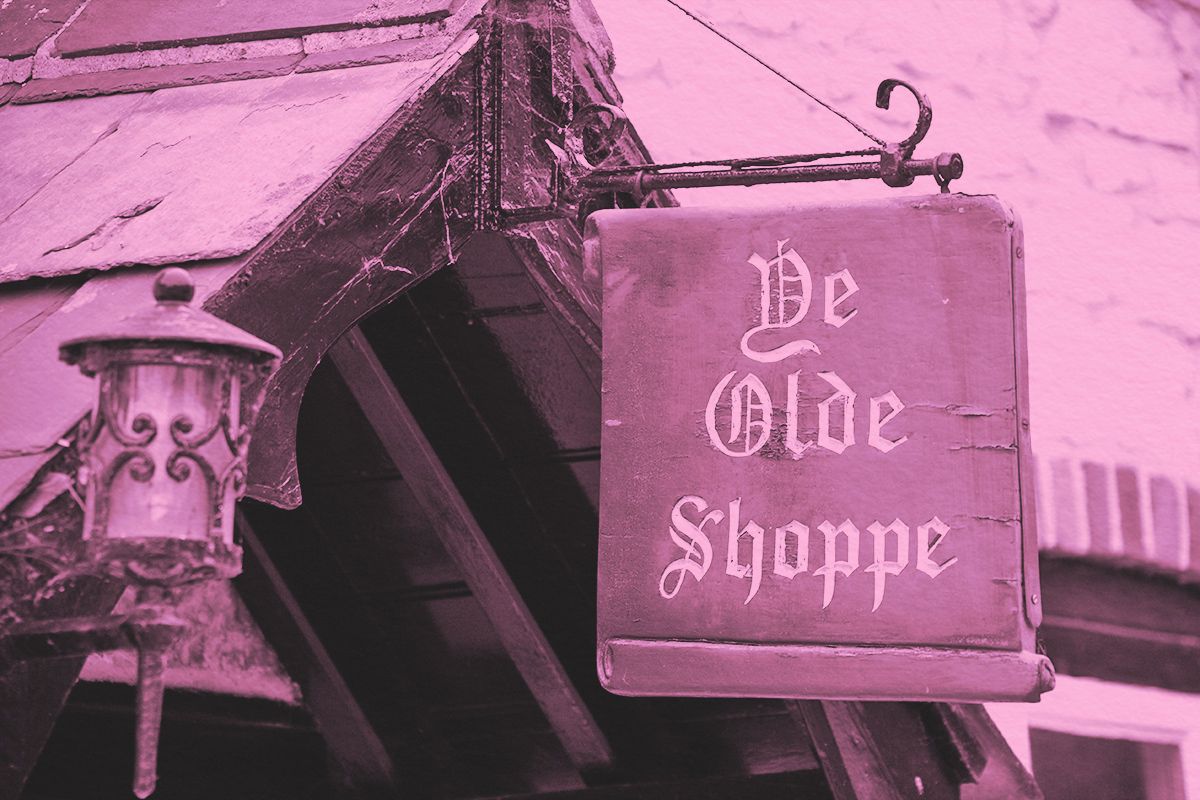
When a business wants to evoke a sense of nostalgia, they might pick the name “Ye Olde Shoppe.” Similarly, a pint in “Ye Olde Tavern” is sure to be accompanied by some old-timey decorations. The use of “ye olde” as an advertising tactic is appropriate because even though it seems like something from the lexicon of Old English speakers, it was actually coined in the 1850s for commercial purposes.
There’s also the issue of pronunciation. To our modern eyes and ears, “ye olde” seems like it would be pronounced “yee old” or even “yee old-ee.” But if we followed Old English rules, from which this expression originated, it would be pronounced with the “y” sounding like “th”: “thee old.” In Old English, the alphabet was different than it is today. Instead of a “Y,” a letter called a thorn (þ) was used in many words, and it was pronounced with a “th” sound. While “ye olde” wasn’t in use until the 1850s, the word þe, pronounced “thee,” was in Old English.
When it comes to “olde,” the “-e” at the end is silent, just as it is in “shoppe,” another word that’s been given the old-fashioned treatment for the sake of advertising.
Featured image credit: Andrew Holt/ The Image Bank via Getty Images
Advertisement
More from our network
Word Smarts is part of Inbox Studio, which publishes content that uplifts, informs, and inspires.
Don’t Judge These Words By Their Cover: 7 Misleading Terms
From a color that’s named after fleas to a fancy term for throwing someone out a window, these seven words prove that looks (and sounds) can be deceiving.
Some words have definitions that perfectly align with how they look or sound. For example, “hullabaloo” flawlessly evokes the idea of a commotion, and “snicker” undoubtedly calls to mind a stifled, scornful laugh. However, other words don’t match up to their meanings, because of either a misleading spelling or pronunciation. Learn why “pulchritudinous” is actually quite flattering, how “puce” isn’t a sickly green, and a few other words that don’t seem to match up to their definitions.
Pulchritudinous
Adjective: Beautiful.
Describing someone or something as “pulchritudinous” is a compliment. The word might conjure up images of similar-sounding negative words like “putrid” (“of or characteristic of rotting matter”) or “turpitude” (“depravity; wickedness”), but “pulchritudinous” is far from those words. It was derived from the Latin word for “beauty,” pulchritudo, and it was first recorded in American English in 1877, meaning “beautiful, fine, or graceful in any way.”
Suffrage
Noun: The right to vote in political elections.
The term “suffrage” has long been part of the political lexicon of the United States. At first glance, it might suggest suffering — somewhat opposite to its meaning. The real definition is “the right to vote in political elections,” but it has taken a journey from a more religious usage. In the late 14th century, “suffrage” referred to prayers (especially on behalf of another). Both the religious version of the word and its modern definition stem from the Latin word suffragium, which meant “support” or “ballot” but was also the word for a voting tablet. It first appeared in English as “the political right to vote” in the U.S. Constitution in 1787.
Advertisement
Puce
Noun: Dark red or purple-brown color.
Some words have a certain feeling about them. One of them is “puce.” We took a poll of the Word Smarts team, and the consensus about “puce” was that it sounds like a drab, brownish-green color. In fact, puce is a purplish-brown color, similar to mauve. The word came into English in the late 18th century from the French word puce, meaning “flea-color; flea,” which comes from the Latin word for “flea,” pucilem. Fleas aren’t typically depicted as purplish-brown, but there might be a connection between “puce” and the color of a flea bite (or a scab).
In a similar case of mistaken color identity, chartreuse is a pale yellowish-green color (not purple). It is named for its resemblance to the liqueur of the same name, which was first produced at La Grande Chartreuse, a Carthusian monastery near Grenoble in the French Alps.
Crepuscular
Adjective: Of, resembling, or relating to twilight (especially animals that are active in twilight).
This has nothing to do with creepy-crawlies. Most often, “crepuscular” is used in zoology to describe animals that appear during twilight (or at dusk). Crepuscular animals have evolved this way for a variety of reasons, including avoiding predators (or hunting competition) and staying cool in warm environments. Examples of crepuscular animals include domestic cats, rabbits, deer, bears, skunks, bobcats, and opossums.
Advertisement
Lackaday
Interjection: An expression of surprise, regret, or grief.
“Lackaday” has nothing to do with laziness, despite sounding and looking very similar to “lackadaisical” (“lacking enthusiasm and determination”). Instead, it is used as an interjection to express feelings of regret or surprise. “Lackaday” emerged in the 17th century as a shortening of the phrase “alack the day” or “alack-a-day” — “alack” is a Middle English word to express sorrow or regret.
“Lackadaisical” and “lackaday” are related, although they have different definitions. In the 18th century, “lackadaisical” was derived from “lackaday” when it emerged as an adjective to describe people who were having a miserable day (those who cried “lackaday!”). Eventually, this “lack of enthusiasm” definition turned into “lazy.”
Defenestration
Noun: The act of throwing someone out of a window.
This has nothing to do with defense — it’s quite an offensive maneuver. Have you ever watched an action film where the bad guy is thrown from a window? That’s a classic case of “defenestration,” which is derived from the Latin word for “window,” fenestra. It was likely coined due to the events of May 21, 1618, which became known as the “Defenestration of Prague.” On that day, two Catholic deputies and a secretary were tossed out of a window by Protestant revolutionaries. Fortunately, they landed in piles of trash and survived, but the event marked the beginning of the Thirty Years’ War in Europe.
“Defenestration” maintains its political undertones today; another usage is for the dismissal of someone from a political party or authoritative office, as in, “They discussed the defenestration of corrupt judges.”
When reading this word, your brain likely connects “noisome” to “noisy.” However, this term relates to the sense of smell, not hearing. “Noisome” originated in Middle English from “noy,” a shortened version of “annoy,” which makes sense because foul odors are indeed annoying. It can also be used to describe something as “disagreeable or unpleasant,” as in, “She made a noisome remark about the long ceremony.”
Featured image credit: Andy.LIU/ iStock
Advertisement
More from our network
Word Smarts is part of Inbox Studio, which publishes content that uplifts, informs, and inspires.
Like many writers, I have a strong affinity for Nora Ephron. Her witty prose, acidic descriptions, and heartwarming surprises set a standard for writers who wish to share their personal lives and use them to inform their own fiction writing. The big question I had to answer for myself was how much I was inspired by her work and how much I aspired to have a body of work like hers. Inspirational and aspirational targets can overlap, but they’re not exactly the same.
Inspiration is “the process of being mentally stimulated to do or feel something, especially to do something creative.” It comes from the Latin compound verb inspirare, combining “in” and the verb spirare, meaning “to breathe.” You can also translate the verb spirare as “to breathe the spirit of.” When you find someone inspirational (the adjective form), it’s like a transfer of the spirit of creativity into you.
Aspiration, on the other hand, looks upward. “Aspiration” means “a hope or ambition of achieving something.” Its Latin verb root, aspirare, comes from combining spirare with the Latin preposition ad,meaning “to, up to, toward.” An aspirational figure is someone that you view on a pedestal. Their work gives you a goal to work toward.
Inspirational figures tend to be those who tell you that you already have the power within you to do what you want. Take, for example, Angela Duckworth. She’s a psychologist and author of the popular book Grit — she advocates for people to pursue their passions with perseverance and achieve their long-term goals.
The Oxford English Dictionary identifies “aspirational” in the context of Christianity, but also in the case of marketing. In 1981, TheWall Street Journal identified the phenomenon of “aspirational TV advertising” to present viewers a vision of how they could get to the top of a pedestal. Think of all the beautiful celebrities who act as brand ambassadors for perfume or beauty products — their images are a goal to work toward.
Both inspirational and aspirational figures can be helpful. Nora Ephron’s pithy quote “everything is copy” is inspirational to writers because it encourages them to look within to write. Her career highs are aspirational for writers who want to achieve cultural cachet. Whether you’re looking inward or upward, you’ll find something motivating.
Featured image credit: razihusin/ iStock
Advertisement
More from our network
Word Smarts is part of Inbox Studio, which publishes content that uplifts, informs, and inspires.
Is your first name one of the most popular names in the United States? These lists change over time, but the meanings of the names have stayed the same.
If you were in elementary school in the 1980s, your classrooms were filled with Jennifers, Amys, Heathers, Michaels, Jasons, and Christophers. Boys in the 1990s were still named Michael and Christopher, but girls were Jessicas, Ashleys, and Emilys. These names seem dated by today’s standards, but some of the most popular baby names of today call back to names that were fashionable a century ago.
The Social Security Administration tracks baby names going back to the 1880s, when John and Mary were the most common monikers. It recently released its list of the most popular baby names from 2024. Here’s a look at the most popular first names for babies in the United States and the history and meaning behind them.
Liam
The most popular boy name last year was Liam — a name that’s held the top spot in the United States since 2017. Liam is a name of Irish origin that comes from the Gaelic Uilliam, which itself is derived from the Frankish Willahelm. It means “strong-willed warrior” or “protector.” While common in Ireland for centuries, Liam didn’t become a known first name in the United States until the 19th-century Irish migration. It jumped in popularity in 2010, and it’s been in the top 10 of boy names since 2012.
Olivia
Olivia is the most popular girl name in the U.S., and is widely used in other English speaking countries, such as Canada, the United Kingdom, and Australia. It’s derived from the Latin oliva,meaning “olive tree,” and it’s been used as a name since the 13th century. Some attribute the name’s popularity, in part, to the character Olivia from Shakespeare’s Twelfth Night. It’s been in the top 10 girl names since 2001.
Noah
The name Noah is an important biblical name, coming from the story of the famous ark keeper in the Book of Genesis. It’s derived either from the Hebrew word Noach or the Babylonian nukhu, both of which mean “rest” or “repose.” From 2013 to 2016, Noah was the most popular boy name in the U.S., and it’s been the second most common since 2017.
Emma
The name Emma can be traced back to Emma of Normandy — an 11th-century noblewoman who married Æthelred the Unready, the king of England. This first name comes from the Germanic Ermen, which means “whole” or “universal,” and the name is considered to be a sign that the child means everything to their parents. Emma’s enduring popularity is partially due to its prominence in pop culture — it’s the name of the title character in an 1815 Jane Austen novel, and in more modern times, it’s the name of Ross and Rachel’s daughter on the TV sitcom Friends. It’s been in the top 5 girl names since 2002, but it was also popular around the early 20th century. From 1900 to 1922, it was in the top 50 girl names.
Oliver
Traditionally, Oliver is the masculine variation of the feminine name Olivia. Some say it’s derived from the Latin olivarius, meaning “olive planter.” It may also come from the French olivier, meaning “olive tree,” and it can be connected linguistically to the Old Norse name Áleifr, which translates to “ancestor’s descendant.” Oliver has been the third most popular boy name since 2019.
Amelia
Given the trailblazing legacy of the most famous Amelia of all time — Amelia Earhart — it’s appropriate that this first name means “industrious” or “work.” Amelia comes from the Hebrew amal, and it can also be traced back to ancient Rome, where Aemi’lia gens was the title of an elite Patrician family in society. Amelia is currently ranked third for girl names, but has been in the top 10 since 2016.
Theodore
Theodore means “gift of God.” It comes from the Greek Theodoros, which combines theos (“God”) with doron (“gift”). The name was once popular among English speakers in the Middle Ages, and it saw a resurgence in the 1910s just after the presidency of Theodore Roosevelt. Theodore jumped in popularity throughout the 2010s, hitting the top 10 boy names in 2021.
Charlotte
Charles comes from the Old English ceorl, which was used in contrast to thew (meaning “enslaved person”) and eorl (meaning “noble person”). Charlotte became a popular feminine form of Charles in the 18th century, as -otte is a feminine diminutive suffix. It’s likely that Charlotte became a popular name in recent years after the birth of Princess Charlotte in 2015. It’s been in the top 10 girl names since 2014, and it was in the top 100 girl names from 1908 to 1953.
James
As the name of biblical figures, English kings, and U.S. presidents, the first name James rarely goes out of style. It’s believed to be derived from the Hebrew Yaakov, meaning “supplanter,” and it has etymological connections to the name Jacob. James was once the most popular U.S. boy name from 1940 to 1952, and it remains in the top 5.
Mia
The name Mia comes from the name Maria, which itself is derived from the Hebrew Miryam. That name can be traced to ancient Egypt, specifically the word mery, meaning “beloved.” In the U.S., Mia was largely considered to be just a nickname until the 1960s, when it became viewed as a name on its own. It has held a firm place in the top 10 most popular U.S. girl names since 2009.
Featured image credit: Liudmila Chernetska/ iStock
Advertisement
More from our network
Word Smarts is part of Inbox Studio, which publishes content that uplifts, informs, and inspires.
Artificial intelligence is on the rise, and becoming an increasingly prevalent part of our daily lives. Here’s one way that you can prepare for how it may impact your writing.
“I search-engined it” just doesn’t have the same ring as “I Googled it.” This is a perfect example of how language catches up with technology — people started using the most popular search engine in the world so much that it became the de facto verb for the activity itself. (Fun fact: The first time “Googling” appeared as a verb on TV was in a 2002 episode of Buffy the Vampire Slayer.)
Now we’re in the middle of the next wave of tech: the AI explosion. While there’s not a verb equivalent to “Googling” in the common lexicon yet, it leads us to wonder: Should we be crediting AI when we use it?
The short answer is yes — you should credit AI if you use it, just as you’d credit a book, article, website, or any other source. If it’s a casual usage, you might just say, “I asked ChatGPT for recommendations,” or “I used AI to research this,” and that would be enough. If you’re doing professional or academic writing however, we can turn to style guides (AP, APA, or MLA, for example) for guidance.
The recommendations differ between style guides, but there are some fundamental basics when it comes to citing AI. If you reference an exact quote or paraphrase any AI-generated output, cite the tool you used (e.g., ChatGPT). It’s critical to do this for transparency, as attempting to pass off AI-generated content as an original idea compromises your integrity as a writer.
The same goes if you use AI to help edit, translate, or generate ideas for a piece, even if you don’t quote the output verbatim. In this case, you should include a sentence in the introduction or appendix to generally explain how AI was used to help produce the piece, rather than a bunch of specific citations. For example, you could write, “Ideas for this article were generated with the help of ChatGPT.” Doing this helps promote transparency and maintain integrity.
For specific citations, refer to whatever style guide you use, as each has specific formatting guidelines and requirements. For example, APA recommends treating AI as an author, while MLA recommends leaving the author section out of the citation.
We don’t use AI tools to write our content on Word Smarts, but we love learning how to use new technology, and keeping up with the language that goes along with it. And we do use AI tools to help us brainstorm new topic ideas and fine-tune headlines and email subject lines. As the technology continues to evolve, we expect there will be more ways to use it and better recommendations for writers. While there’s no equivalent for “Googling” yet, it’s just a matter of time.
Featured image credit: Laurence Dutton/ iStock
Advertisement
More from our network
Word Smarts is part of Inbox Studio, which publishes content that uplifts, informs, and inspires.
The legacies of NASA and the space program are great: the Mars Rover, Tang, freeze-dried ice cream … and popularizing the abbreviation “A-OK.”
“OK” became a popular abbreviation in the 1840s thanks to the presidential campaign of Martin Van Buren, whose nickname was “Old Kinderhook.” “OK” was used on campaign posters as shorthand, and it evolved into a synonym for “good.” The first printed appearance of “A-OK” seems to be in a 1952 advertisement for Midvac Steels, though its meaning at the time wasn’t explicitly clear. The ad promoted durable steel products that could withstand the intensity of any launch: “A-OK FOR TOMORROW’S MISSILE DEMANDS.” The appearance in an ad implies that “A-OK” may have been commonplace in either general slang or perhaps the rocketry field as early as the 1950s, though we can’t know for sure. What we do know, however, is that “A-OK” became widely popular in the 1960s thanks to one particular NASA employee.
John “Shorty” Powers worked at NASA during Project Mercury from 1959 to 1963 as the “voice of the astronauts,” often communicating important mission details to the press. During a press briefing after the first U.S. suborbital space flight on May 5, 1961, Powers used the term “A-OK” when he told the press astronaut Alan Shepard said it upon return to Earth, perhaps as a way to suggest “all is OK.” However, mission transcripts revealed Shepard never said it, so Powers was mistaken about the “A-OK” quote.
It’s not some secret NASA cover-up plot. In the book The Right Stuff by Tom Wolfe, the author suggests that Powers borrowed the phrase from NASA engineers, who regularly used it during radio transmission tests. Given the high amount of static during radio transmissions, engineers found that “A” produced a sharper and clearer sound than “O.” So while “OK” could have easily gotten lost amid the loud static, saying “A-OK” ensured additional clarity.
Even though it may be hard to pinpoint exactly when “A-OK” or any spelling variation was first coined, we can thank NASA for popularizing the term.
Featured image credit: PeopleImages/ iStock
Advertisement
More from our network
Word Smarts is part of Inbox Studio, which publishes content that uplifts, informs, and inspires.
American customs don’t always align with the rest of the English-speaking world. Take, for instance, the unique way that Americans pronounce the last letter of the alphabet.
Americans have our own unique way of doing things. For example, we measure with feet instead of yards and Fahrenheit instead of Celsius. The American identity extends to the world of linguistics, too, as American English speakers use different pronunciations and spellings from the rest of the English-speaking world. One prime difference: the final letter of the alphabet, which Americans pronounce as “zee” and other English speakers call “zed.”
The letter “Z” comes from the Greek letter “zeta.” The Romans borrowed that letter from the Greeks when creating the Latin alphabet, which in turn inspired the creation of the modern English alphabet centuries later. “Zed” was adopted as a similar-sounding pronunciation to the original “zeta,” and remains popular today in most English-speaking countries, including the United Kingdom, New Zealand, Australia, Ireland, and more.
But “zed” has little use in the United States, where “zee” is far more common. Part of the reason may have to do with Americans trying to create a unique identity shortly after declaring independence. Lexicographer Noah Webster worked to standardize American English in the early 19th century, and when he created his American English dictionary, he declared the official pronunciation of the letter to be “zee” — one of many examples of how his conception of English differed from the one spoken by the British.
The American pronunciation was solidified in 1835 when music publisher Charles Bradlee copyrighted a song called “The A.B.C., a German air with variations for the flute with an easy accompaniment for the piano forte.” — but you likely know it as “The Alphabet Song.” Bradlee included the “zee” pronunciation in his lyrics, as it rhymed with the “vee” sound that came shortly before it, as well as the letter pronunciations “bee” and “dee.” This song has been used to teach generations of American children the alphabet, so the “zee” pronunciation has become fully entrenched in the American consciousness. That said, other English-speaking countries have swapped out “zee” for “zed” when they sing “The Alphabet Song,” as it more closely aligns with their customs.
Featured image credit: Vladimir Voronin/ Adobe Stock
Advertisement
More from our network
Word Smarts is part of Inbox Studio, which publishes content that uplifts, informs, and inspires.
Enter your email to receive daily lessons that dive into what makes English so fascinating. Each email is packed with odd rules, etymologies, and the tools you need to be a better communicator.
Sorry, your email address is not valid. Please try again.
Sorry, your email address is not valid. Please try again.