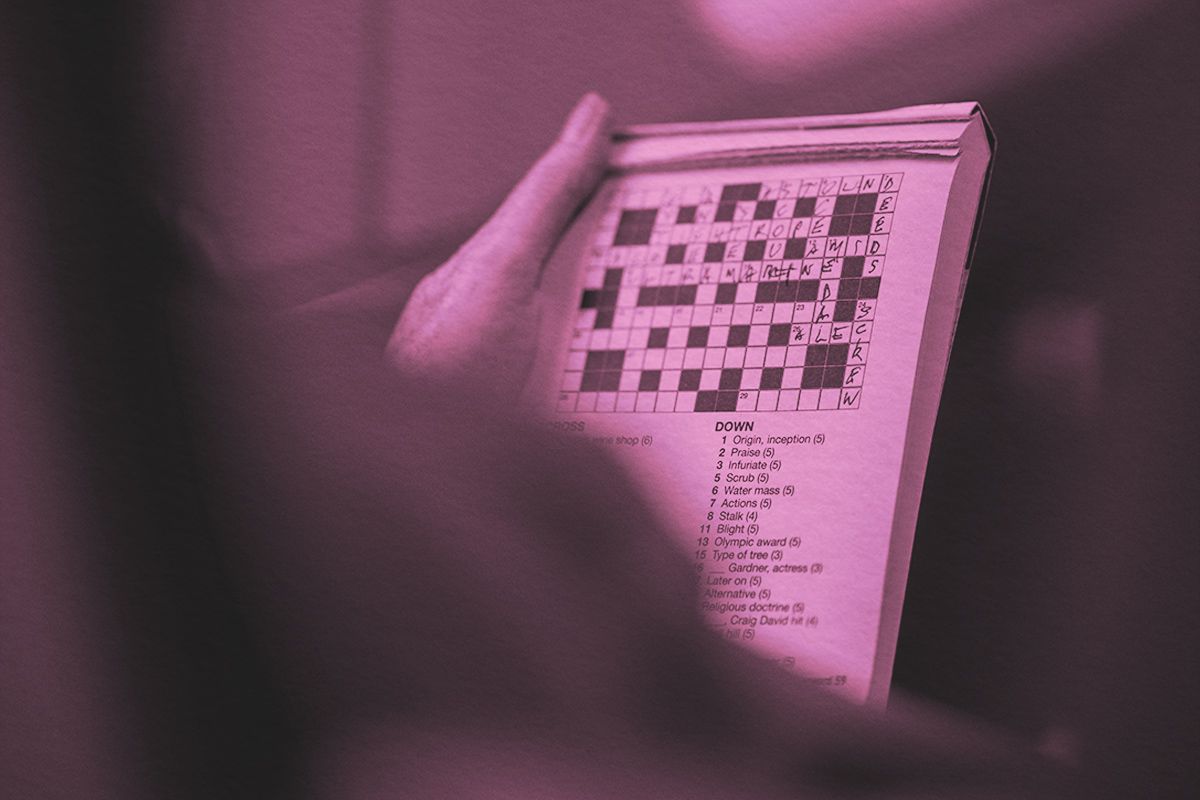
Today’s cruciverbalists (people who play crossword puzzles) might prefer a smartphone version over filling in the boxes on paper, but the origin of these word puzzles is found in the newspaper. A version of crossword puzzles appeared in England during the 19th century, but they were simple games targeted at children. Most likely a development of existing word squares — groups of words arranged so the letters read the same vertically and horizontally — they were mainly printed in children’s puzzle books.
Crossword puzzles as we know them today were a later invention, widely credited to Arthur Wynne, a journalist at the long-defunct New York World newspaper. In 1913, Wynne was managing the “Fun” section of the paper’s Sunday edition and needed something new for the Christmas issue. Perhaps inspired by memories of word puzzles he’d solved back in England, Wynne created what he called a “Word-Cross Puzzle.”
His puzzle used a diamond-shaped grid with a hollow center and the letters F-U-N already filled in. Unlike modern crosswords, Wynne’s original puzzle had no black squares to separate words. The clues were mostly of average difficulty — for example, “A day dream” (“reverie”) and “To govern” (“rule”). Others required quite specialized knowledge: “An aromatic plant” (“nard”) and “The fibre of the gomuti palm” (“doh”).
Wynne’s first puzzle was published on December 21, 1913, and the feature soon became hugely popular with readers. A few weeks after that initial publication, an illustrator accidentally changed “Word-Cross” to “Cross-Word,” and the name stuck permanently. According to the Oxford English Dictionary, the spelling “crossword” was in use by the 1920s. By that time, readers were clamoring for the word puzzles, and when Simon & Schuster printed The Crossword Puzzle Book in 1924, it became an immediate bestseller. It wasn’t long before almost every newspaper in the United States and Great Britain contained some kind of crossword.
As for Wynne, he tried to patent the puzzle, but the editors at the New York Worldrefused to pay the associated costs. His only consolation, perhaps, is his legacy: He created one of the world’s most popular pastimes.
Featured image credit: Ross Sneddon/ Unsplash
Advertisement
More from our network
Word Smarts is part of Inbox Studio, which publishes content that uplifts, informs, and inspires.
Rushed memos and multitasking have led to more grammar faux pas than ever before in emails. But it’s worth catching these common mistakes before sending your message.
Have you ever clicked “send” on an email and immediately spotted a typo? These mistakes happen to everyone, but some are more common than others. From accidentally writing “your welcome” to forgetting a comma, we all slip up from time to time.
It’s important to remember that not every email needs to sound like a legal document. A quick note to a friend or co-worker can be informal, and minor mistakes aren’t much of a worry. But a job application, professional request, or formal complaint? Those require clear language and precise grammar. When the stakes are higher, flawed grammar might affect how seriously your message is taken.
Subject-Verb Agreement
Subject-verb agreement issues are common in emails because we frequently refer to teams, departments, and groups. This rule seems simple: A singular subject takes a singular verb, and a plural subject takes a plural verb. Easy enough, right? Not so fast.
Certain sentence structures can obscure this otherwise obvious rule, especially when additional words separate the subject and verb. For example, “The list of items are attached” is incorrect. One might mistakenly pluralize “are” because of confusion caused by the plural word “items,” but the subject is actually singular: “list.” So, the correct statement is “The list of items is attached.” Similarly, “The box of files was delivered yesterday” calls for the singular verb “was.” Don’t let the plural “files” distract you from finding the main subject of the sentence: “box.”
Another common issue is the use of collective nouns, which generally take singular verbs in American English (with a few exceptions). Words such as “company,” “team,” “class,” “group,” and “committee” all require singular verbs, as in, “The team is meeting first thing in the morning.” (“The team are meeting” is incorrect.) However, there are some exceptions to this rule, including “police” and “people,” which take plural verbs, as in “People are loving the new campaign.” The best way to get these right is through familiarity and memorization.
Advertisement
Homophone Confusion
Homophones and near-homophones — words that sound alike but have different meanings — are frequent offenders in email writing. Spell-check often won’t catch these mistakes because the words are spelled correctly, but they’re being used in the wrong context.
One of the most common mix-ups is between “your” (a possessive adjective) and “you’re” (a contraction of “you are”). Even experienced writers sometimes overlook this error, whether due to a typo or a very rushed note.
Some homophone pairs are especially relevant in professional correspondence. For instance, you might “happily accept” an invitation — you wouldn’t “except” it. “Accept” means “to receive or agree to,” while “except” means “excluding something,” as in, “Everyone has responded to the invite except Susan.”
Another commonly confused pair is “insure” (“to provide insurance coverage”) and “ensure” (“to make sure, certain, or safe”). For instance, “We need to insure the package before shipping” means the writer needs to purchase insurance coverage for the package. Conversely, “ensure” has a wider scope: “Please ensure the attachment opens correctly” or “I want to ensure we’re on the same page.”
Comma Splices
Comma splices are very common because email writing tends to mirror speech. For example, in places where we naturally pause while talking, we tend to add commas in emails. But a comma doesn’t do the same job in writing as a pause does in speech. This grammar mistake occurs when joining two complete sentences together with a comma instead of a semicolon, conjunction, or period. While this mistake doesn’t change the meaning or intention in casual emails, it is incorrect grammar and should be avoided in formal settings.
Consider these comma splices: “I reviewed the report, it looks good,” and “Thank you for checking in, let’s chat tomorrow.” This type of writing is extremely common in casual emails, but it’s grammatically incorrect. While each half of those sentences can stand alone, in formal grammar, a comma should not hold them together. Instead, a semicolon could join them, as in, “I reviewed the report; it looks good.” You might also use a conjunction (“and,” “but,” “so,” etc.), as in, “I reviewed the report, and it looks good.”
Even better, use a period to separate the two ideas: “Thank you for checking in. Let’s chat tomorrow.” This is often the easiest and best choice.
Advertisement
Joint Possessives
Joint possessives aren’t as common in everyday English, but they pop up in emails more often. The guidelines for writing joint possessives say that when two people own something together, only the second name needs to show ownership. However, when they own things separately, both names need an apostrophe and “s.” This is why the ice cream brand “Ben & Jerry’s” — which refers to a single shared company — shows possession on only the name “Jerry” (not “Ben’s & Jerry’s”).
Consider this situation in an everyday office email: “Mark and Susan’s project is nearly complete.” This wording describes a single project owned by both Mark and Susan. However, if Mark and Susan submit separate reports on that project, each of their names needs an apostrophe and “s”: “I’ve attached Mark’s and Susan’s reports.”
Things can get more confusing when personal pronouns are used instead of names. For example, “John and I’s office” is incorrect; it should be “John’s and my office.” However, it’s best to avoid this construction whenever possible, as it can be confusing. Simply saying “our office” is best.
Advertisement
Word Choice Errors
Some mix-ups aren’t about spelling — they’re about choosing the right word for the situation. In casual emails, these slipups don’t matter as much, but they can make your writing seem less polished in formal situations.
Take “good” and “well,” for instance. “Good” is an adjective that describes a noun, while “well” is typically an adverb that modifies a verb or adjective. For example, “I hope you’re doing well” is grammatically correct because “well” is acting as an adverb. Conversely, “He did a good job” is correct because “good” is describing the noun “job.”
Another often-confused pair is “fewer” and “less.” The general rule of thumb is to use “fewer” for countable items and “less” for noncountable items. You might say to your manager, “We have fewer applicants than last year,” because applicants are countable. But you might add, “And we have less time to complete interviews,” because time is more abstract. Generally speaking, if you can put a number in front of it (“three emails,” “five reports,” “two invitations”), use “fewer” and reserve “less” for abstract amounts (“time,” “money,” “energy,” etc.).
Lastly, “between” and “among” are frequent in emails, boasting similar yet distinct uses. “Between” refers to two specific people or things, while “among” refers to three or more. You might say to a colleague, “This update is between us,” which is correct grammar. You would not say, “This update is among us,” because there are only two people involved. In another correct example, you might say, “This contract is between my company and the vendor,” because both nouns are singular entities. For greater quantities, use “among,” as in, “We’re dividing the work among five departments,” or “There is a consensus among all involved parties.”
While some of these guidelines may seem tedious, following them will ensure your professional emails read as confident and polished rather than rushed and disjointed, allowing your message — not your grammar — to take center stage.
Featured image credit: Africa Studio/ Adobe Stock
Advertisement
More from our network
Word Smarts is part of Inbox Studio, which publishes content that uplifts, informs, and inspires.
You don’t need to be a thespian to use the phrase “winging it” — an expression that was first coined in theatrical performance spaces during the late 19th century.
It might make sense to think that the phrase “winging it” — which is defined as “doing or trying something without much practice and preparation” — relates to birds or planes. But in reality, it’s a term that was coined by thespians and stagehands of the late 19th century.
Recorded mentions of “wing” as a verb (in this context) date back to the 1880s, when it appeared in a theater periodical called Stage magazine: “‘To wing’.. indicates the capacity to play a rôle without knowing the text.” The writer further specified that it has to do with a performer receiving help from a prompter located off to the side of the stage — an area hidden from the audience and known as the wing of the stage. (“Waiting in the wings” refers to performers in preparation to enter the stage.)
“To wing” gave rise to the idiom “winging it,” which first appeared in a 1933 text, Back-stage: a survey of the contemporary English theatre from behind the scenes. “He must give a performance by ‘winging it’ — that is, by refreshing his memory for each scene in the wings before he goes on to play it,” author Philip Godfrey wrote. In other words, if an unprepared actor hadn’t memorized their lines, they would hide in the wings and quickly go over the next scene before returning to the stage and trying their best.
As the decades went on, the term was adopted by those outside of the theatrical world, ignoring the idiom’s direct correlation with the wings of a stage. The phrase is now used far more commonly in nontheatrical contexts than in a theatrical one.
Featured image credit: joshblake/ iStock
Advertisement
More from our network
Word Smarts is part of Inbox Studio, which publishes content that uplifts, informs, and inspires.
Storytelling has been part of the human experience for millennia, but the novel emerged as a distinct form in literature. A novel is, by definition, “an invented prose narrative of considerable length and a certain complexity that deals imaginatively with human experience through a connected sequence of events involving a group of persons in a specific setting.”
The Epic of Gilgamesh is often cited as the first book ever written, but it’s technically a highly exaggerated biographical history, not a fictional novel. It drew on the kind of communal storytelling that also inspired the epic poems theIliad and the Odyssey.
Traditionally, a novel needs a location, a recognizable character, and ideally a lesson. Contemporary novels push against the form, but the standard requirements haven’t changed much over the centuries. Many scholars identify the first English-language novel as The Life and Strange Surprizing Adventures of Robinson Crusoe by Daniel Defoe, first published in 1719. It tells the story of a man who was shipwrecked and had to figure out how to survive on an island.
Robinson Crusoe might be the most well known early novel, but there are many other titles in contention for the original novel. The Tale of Genji by Murasaki Shikibu is a satire that follows the exploits of Japanese high courtiers. It was written and published in Japan in the early 11th century. Beware the Cat by William Baldwin was written in 1553, so, while lesser known and sometimes overlooked, it’s an earlier English novel than Robinson Crusoe. Don Quixote (full title: The Ingenious Gentleman Don Quixote of La Mancha), published in Spanish in two parts in 1605 and 1615, is often named as the first novel of the modern era. And the first science-fiction novel is thought to be The Description of a New World, Called The Blazing-World by Margaret Cavendish, published in 1666.
One thing is clear: Novels changed the world. The ability for people to read and discuss the same story (outside of religious and historical stories) meant they were able to expand their minds and empathize with different characters in ways that were previously unheard of. While the first novel is hard to pin down, new and exciting examples are published every day.
Featured image credit: Pixabay/ Pexels
Advertisement
More from our network
Word Smarts is part of Inbox Studio, which publishes content that uplifts, informs, and inspires.
English Words That Mean Something Completely Different Abroad
English words can take on some strange meanings abroad, whether you’re calling a friend on your handy, wearing a fashionable body bag, or eating a massive Viking.
English is the most widely spoken language in the world, with the total number of speakers — both native and nonnative — estimated at around 1.5 billion. English words have even been adopted into other languages, but not always in the way native speakers expect. Many languages have borrowed English words and given them entirely new meanings, creating what linguists call pseudo-anglicisms. These linguistic mutations reveal the interesting ways in which languages can evolve.
Here are eight common English words that mean something completely different in other countries and languages.
Oldtimer (German)
In German, Oldtimer refers not to a person of an advanced age, but to a vintage or classic car — officially, a historic motor vehicle that is 30 years old or more. Up until the 1970s, it was also quite common in Germany to hear a classic car referred to by another English word: Veteran. But today, you’re far more likely to hear Oldtimer.
Mansion/Manshon (Japanese)
In English, “mansion” conjures up images of a spacious, elegant home, perhaps surrounded by a sprawling country estate. But in Japan, a mansion or manshon is a concrete apartment building, often relatively modern and mid- to high-rise. The word was borrowed from the English “mansion” during the post-World War II period, when Western-style concrete buildings were being constructed. The Japanese word apaato, meanwhile, comes from the English word “apartment” and usually refers to a building two to three stories high and constructed of wood or light gauge steel.
Advertisement
Slip (French)
If a French person mentions their slip, they’re talking about their underwear — typically men’s briefs or women’s panties. The word comes from the English verb “to slip” (into clothing), but English speakers reserve “slip” for a woman’s undergarment worn beneath a dress or skirt. French also uses slip de bain for swimming trunks, further cementing the word’s association with lower-body garments.
Handy (German)
In English, the adjective “handy” can mean that something is convenient, or refer to someone who is good with their hands. In German, Handy turns into a noun, and the meaning is very different: It’s a common name for a cellphone. It’s not entirely clear why the word was adopted, but it might have come fromHandfunktelefon (a German word for the first handheld mobile phones), or possibly from the Motorola HT 220 Handie Talkie — a type of walkie-talkie used during World War II. Either way, the word stuck and even extended its reach — if you want to get a German’s cell number, for example, you simply ask for their Handynummer.
Smoking (Multiple Languages)
In a handful of European languages, including French, German, and Portuguese, smoking does not refer to the act of smoking a cigarette, cigar, pipe, or anything else that can produce smoke or be smoked. Instead, it refers to a tuxedo or dinner jacket. The term derives from the smoking jackets — elegant menswear worn while smoking cigars or pipes — that were popular in 19th-century England. The term was picked up in other parts of Europe but evolved to refer to formal evening wear in a more general sense. So, when Europeans talk about going to an event in a smoking (or, in Spanish-speaking countries, an esmoquin), they mean they’re wearing black-tie formal wear — and not anything to do with cigarettes or tobacco.
Advertisement
Wáter/Váter (Spanish)
In Spanish, wáter or váter (both spellings exist) means “toilet” or “bathroom” — not “water” (which is agua). The Spanish word derives from the English “water closet.” So, when a Spanish speaker asks for the wáter, they don’t want a drink of water — they want to go to the restroom. Wáter can also refer more specifically to a toilet bowl.
Bodybag (German)
Another common Scheinanglizismus — that’s “pseudo-anglicism” in German. A Bodybag is a shoulder bag or messenger bag worn across the body — a trendy accessory, often mentioned in casual conversation. For English speakers, of course, “body bag” is the bag used to transport corpses (which, in German, is Leichensack).
It’s not often that you say, “I feel like eating a Viking today” — but in Japan you can do just that. Since the 1950s, eating Vikings has been a common occurrence in Japan, where a viking is an all-you-can-eat buffet. This came about when a restaurant manager from Tokyo’s Imperial Hotel traveled to Sweden in 1957. Impressed by the Swedish smörgåsbord buffets, he took the concept back to Japan. The new all-you-can-eat buffet was a hit, and the hotel changed the name of its restaurant to the Imperial Viking in honor of the buffet’s Scandinavian roots. Other restaurants copied the format, and viking soon became synonymous with unlimited buffet-style dining.
Featured image credit: Geri Tech/ pexels
Advertisement
More from our network
Word Smarts is part of Inbox Studio, which publishes content that uplifts, informs, and inspires.
Red hair comes with many nicknames and a reputation for certain personality traits, but the most common association comes from a spice. How did we start calling redheaded people “ginger”?
The color of ginger root, the spice, is yellow or light brown. However, when we use the word “ginger” to refer to a person, we’re talking about the color of their hair (and sometimes their skin tone and freckles). A ginger is a redhead, but the spectrum of the hair color can include hues that are reddish-brown, more orange, strawberry blond, or copper. Think of the diversity among some famous redheads, such as Julianne Moore, Rupert Grint, and Prince Harry.
Despite the highly recognizable nature of red hair, there are relatively few redheads around the world. Gingers make up about 1% to 2% of the population, and the hair color is most common in people of Northern European ancestry. Going back to genetics lessons and a Punnett square, red hair is a recessive gene. Two parents may have brown hair and end up with a ginger child because they both carry the recessive red hair gene. Ginger-haired people usually also have pale skin and freckles.
“Ginger,” as it pertains to red-haired folks, is a colloquial term that originated in British English. It first appeared in Francis Grose’s 1785 compendium, A Classical Dictionary of the Vulgar Tongue(“vulgar” meaning “slang”). He documented the term “ginger-pated,” which referred to red-feathered chickens.
The term itself is not inherently rude, but it’s sometimes used offensively. In Edinburgh in 2013, a redheaded comedian named Shawn Hitchins organized a ginger pride march. His reasoning was that 19% of the world’s redheads lived in Scotland, and they deserved to have their voices heard and address anti-redhead bias in British culture. However, in Ireland there are more redheads than in most other locations, and people often use “ginger” as a source of pride as well.
Nowadays, “ginger” is more often an affectionate term or used to describe one’s own appearance. But be careful with the usage, in case someone finds it offensive.
Featured image credit: carles miro/ iStock
Advertisement
More from our network
Word Smarts is part of Inbox Studio, which publishes content that uplifts, informs, and inspires.
Multiple pronunciations abound in English, and the answer to why lies in colonial history, westward expansion, and the fascinating way regional accents took root — and are still evolving — across America.
The classic Gershwin brothers song “Let’s Call the Whole Thing Off” highlights different acceptable pronunciations of common English words. The lyrics contrast “to-MAY-to” with “to-MAH-to,” “pih-JAY-mas” with “pih-JAH-mas,” and “OY-sters” with “ER-sters.”
So why do some words have multiple acceptable pronunciations? The answer involves an understanding of English spoken in the American colonies more than 200 years ago and the historical expansion of settlements in America.
Many words that we still use regularly are affected by the differences in English from that time (or even earlier). Consider the options for “pecan,” “data,” “either,” “coupon,” “route,” “adult,” “almond,” “apricot,” “envelope,” “jewelry,” and “leisure.” Each of these has more than one acceptable pronunciation, and it usually affects the vowel.
Influence of British English
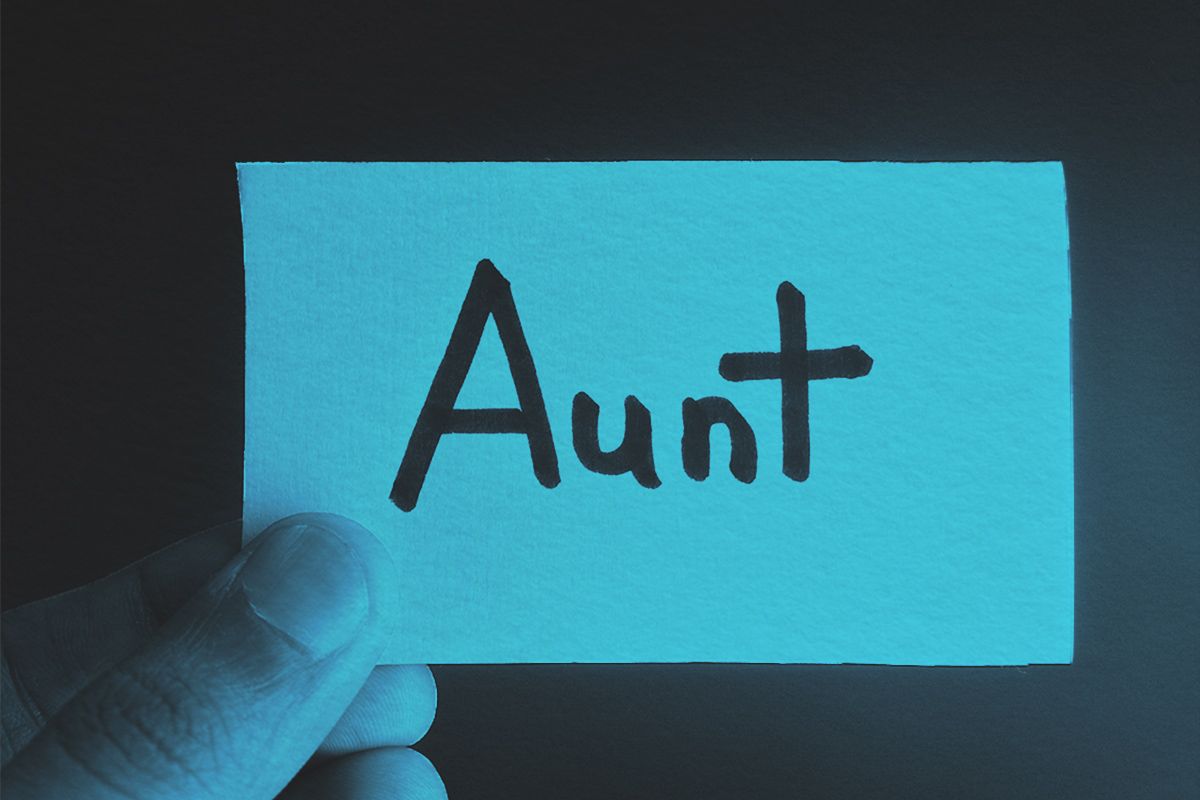
The great majority of settlers in the original 13 colonies were from the British Isles. They brought with them their traditions, customs, and way of speaking. For example, the pronunciation of “aunt” as “ahnt” is a holdover from that British influence, indicating a higher social status and stronger ties to England. During westward expansion, “ant” evolved as a more casual, simplified pronunciation.
Similarly, consider the “t” in “often.” Even though it was pronounced in Middle English, Queen Elizabeth didn’t pronounce that “t,” so the “offen” pronunciation was adopted as the standard, first by the upper class and then in 17th-century British English. That pronunciation was carried over to the American colonies.
Advertisement
American Regional Accents
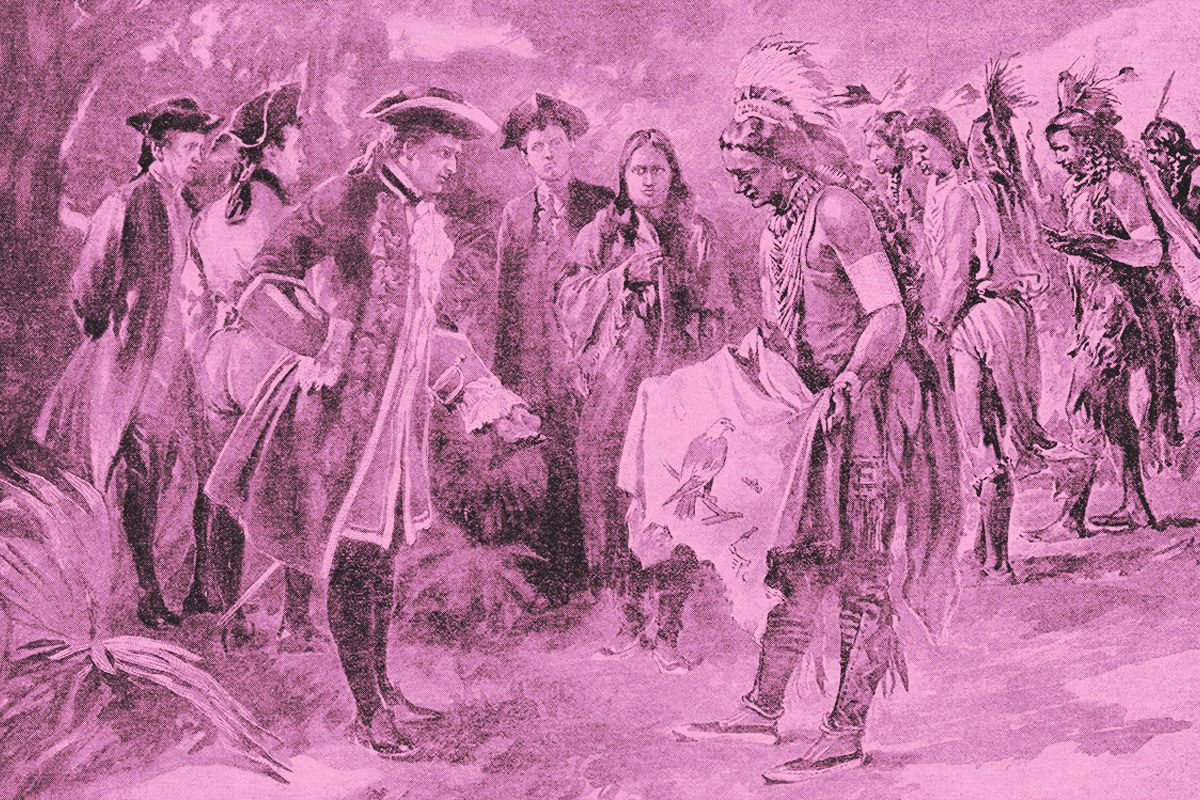
As British settlers and their offspring expanded westward, they encountered people who spoke languages other than English. Settlers speaking Dutch, French, and Spanish introduced their own languages as they colonized different parts of the continent. Without telephones, television, radio, and the Internet, those settlers weren’t exposed to a homogenized English pronunciation.
In the 19th century, westward expansion also influenced the development of accents and regional dialects. Since travel was easier in the American West, accents mixed more freely. As a result, to this day, differences in Western varieties of English are more subtle than in the North and South.
For example, John F. Kennedy spoke with a Boston accent, dropping the “r” at the end of words. If asked where he parked his car, he may have responded, “I pahked my cah in Havid Yad” (“I parked my car in Harvard Yard”).
Speech in which the “r” sound is retained is described as “rhotic” (from the Greek letter rho), and accents that discard it are non-rhotic. For example, in non-rhotic accents, the “r” is not pronounced in “hard,” “card,” “far,” and “bar.” Non-rhotic speech is found most notably in Boston, New York City, and coastal areas of the South. Think of the accents of Robert De Niro, Bernie Sanders, Matt Damon, and Joe Pesci.
Linguists have determined that English has four broad regional accent categories: Northern, Southern, Midland, and Western. A more in-depth analysis reveals many local variations as well, including New England, New York City, Philadelphia, Pittsburgh, Appalachian, Inland North, North-Central, Californian, and Pacific Northwest.
American accents remain so distinctive that the way you say just a few words can reveal where you’re from. Linguists use this test quite successfully in pinpointing a person’s accent. Is “drawer” pronounced in one or two syllables? Are “cot” and “caught” pronounced the same? Are “Mary,” “merry,” and “marry” pronounced the same? When saying “Oregon,” is the emphasis on the first syllable? Is “aunt” pronounced “ant” or “ahnt?” Does “creek” rhyme with “creak” or “crick”? Do you pronounce “New Orleans” so it sounds like “NOR-leens”? Is it “New Jersey” or “New Joisey”? Do you pronounce “Florida” so the first syllable rhymes with “sore” or “sock”? Do you pronounce the first letter in “huge” or is it silent? Do you pronounce “been” the same as “bin”?
People tend to maintain local accents as part of their cultural identity and belonging, but the trend in America is toward greater homogenization. Digital media contribute to more standardized speech, causing younger generations to speak much the same. Population mobility is another significant factor in flattening regional accents.
Despite this trend, regional accents are here to stay, and some are growing even more distinctive. As a result of a recent huge migration to the South and Southwest, and the popular appeal of country music, Southern speech is now the largest accent group in America.
Listen to any recording of country singers, such as Merle Haggard, Lucas Black, Willie Nelson, Blake Shelton, Johnny Cash, Reba McEntire, or Carrie Underwood, and you’ll hear that distinctive, twangy, Southern drawl with the intact “r.”
Featured image credit: SSG PHOTO/ Adobe Stock
Advertisement
More from our network
Word Smarts is part of Inbox Studio, which publishes content that uplifts, informs, and inspires.
How Did ‘You’ Become a Singular and Plural Pronoun?
Most languages treat “you” differently than English does. In English, instead of separate words for the plural and singular, “you” covers everything. Why?
Languages other than English distinguish between the singular “you” and the plural “you.” They even distinguish between male and female contexts, and between informal and formal settings. Why is English an outlier?
The Italian singular for “you” is tu, and the plural is voi. In Spanish, the singular “you” is tú or usted and the plural is vosotros or ustedes. The Chinese singular is ni and the plural is nǐ men. In Hebrew, the singular for “you” is ata for males and at for females; the corresponding plurals are atem and aten.
French distinguishes between tu for the informal singular “you” and vous when more formal. Likewise, the German du is informal for the singular you and Sie in more formal usage.
To explain how“you” became the catchall for any “you” that you may ever encounter in English, we need to get into the weeds a bit. Starting with Old English, there was the obsolete letter “þ,” known as “thorn” (unrelated to prickly bits on a plant) and pronounced “th,” as well as references to the nominative and the accusative. The nominative is the subject in a sentence (“You are smart”) and the accusative is the direct object in a sentence (“I love you”). The Old English singular “you” was þu (pronounced “thoo”) for the nominative case and þe (pronounced “thee”) for the accusative case. The corresponding plurals were ge” and eow.
In Middle English, the thorn letter dropped out, and the singular “you” was “thou” for the nominative and “thee” for the accusative. The corresponding plurals were “ye” and “yow.”
During the Middle English period (1150 to 1500), in situations requiring more politeness and respect, the plural “ye” and “you” applied when addressing just one person (compare to the royal “we”). By the 14th century, the pronunciation of “ye” and “you” merged into “you.” By the 17th century, as that usage increased, “thou” and “thee” evolved to be used only in a personal or superior-to-inferior relationship. And so “you” evolved to apply in the singular and the plural.
That ambiguity has spawned various ways to distinguish one “you” from many, so now we have “you guys,” “youse,” and “you-uns” in the U.S., and British English distinguishes “you lot” from the singular “you.” In Northern England, Scotland, and Ireland, the plural is “yous.”
Southern English may have the best solution: “y’all” for the plural and “all y’all” for even more plurality.
Featured image credit: FREDERICA ABAN/ iStock
Advertisement
More from our network
Word Smarts is part of Inbox Studio, which publishes content that uplifts, informs, and inspires.
From “bean juice” to “rocket fuel,” coffee has its fair share of nicknames. You may also refer to it as a “cup of joe,” though the origins of that phrase are uncertain.
Whether you prefer it hot and black or poured over ice, mixed with milk and sugar, and topped with whipped cream, there are countless ways to enjoy your coffee. There are also countless nicknames for the beloved beverage, one of the most popular being “cup of joe.” But as common as this phrase is, its etymological origins are as murky as dark roast. Let’s examine some possible theories about its coinage.
There are several strong, albeit unverifiable, theories behind the origins of the phrase “cup of joe.” Linguist Michael Quinion argues that the most reputable theory is that “joe” is shorthand for “jamoke,” a portmanteau of “java” and “mocha” — referring to Java, Indonesia, and Mocha, Yemen, two places known for producing high-quality coffee beans. Quinion calls this “the most boring, but most probable, suggestion.” He also cites a 1931 text called the Reserve Officer’s Manual that references “Joe” alongside “Jamoke” and “Java” as synonyms for coffee. Whether “joe” is related to the place names is up in the air, but “cup of joe” did gain popularity around the 1930s.
According to the fact-checking site Snopes, however, there are a few other potential origin stories. One possible theory is that “joe” refers to coffee being the drink of the common man — an average joe. An entry in the Random House Dictionary of Historical Slang links it to the 1860 song “Old Black Joe” by Stephen Foster, but the song isn’t about coffee, so that claim is less likely. A third oft-repeated, albeit unlikely, theory is that it’s named after Secretary of the Navy Josephus “Joe” Daniels, who banned alcohol on ships in 1914, thus leaving coffee as the most potent beverage to drink while at sea.
Despite the propagation of those three theories, each is flawed in one way or another. Quinion’s “jamoke” idea holds the most water.
Featured image credit: Katelyn Perry/ Unsplash
Advertisement
More from our network
Word Smarts is part of Inbox Studio, which publishes content that uplifts, informs, and inspires.
Much like the internet itself, the idiom “surfing the web” has been around for only a few decades. Its recent coinage helps us trace its exact origins.
Given the potential for water and sand damage, the risks associated with bringing your laptop to the beach are not insignificant. Furthermore, you’ll never see a surfer answering emails while paddling their board out into the ocean. So why do we call it “surfing the web” when it’s most often done from homes or coffee shops? The answer is back in the 1980s.
Before it was ever associated with the internet, the verb “surfing” was used in a figurative sense in the context of other technological phenomena. It was borrowed from the sport of surfing to convey performing tasks with fluidity and ease, much like a surfer riding from wave to wave. For instance, the term “channel surfing,” to describe switching between TV channels, appeared in a 1986 article in TheWall Street Journal. And in 1988, futurist writer Paul Saffo wrote about “information surfing,” which is the idea of using computer technology to easily compile information.
The idea of “surfing the internet” made its first known appearance in text in 1992. The Oxford English Dictionary cites the earliest known example as a 1992 online post regarding size limits for text files. Librarian Jean Armour Polly helped popularize the term more widely in the 1992 book Surfing the Internet: An Introduction. These early mentions helped to establish an early definition for the idiom, meaning “to use the internet skillfully and/or competently.”
It wasn’t long until the phrase incorporated synonyms for “internet” (e.g., “surfing the net,” “surfing the web,” etc.). In the case of the word “web,” it comes from the World Wide Web, which was created in 1989. “Web” was chosen to convey interconnectivity between the various sites on the internet (also called “websites”), much like how webs of any kind are woven together using multiple components.
Featured image credit: Giorgio Trovato/ Unsplash
Advertisement
More from our network
Word Smarts is part of Inbox Studio, which publishes content that uplifts, informs, and inspires.
Enter your email to receive daily lessons that dive into what makes English so fascinating. Each email is packed with odd rules, etymologies, and the tools you need to be a better communicator.
Sorry, your email address is not valid. Please try again.
Sorry, your email address is not valid. Please try again.