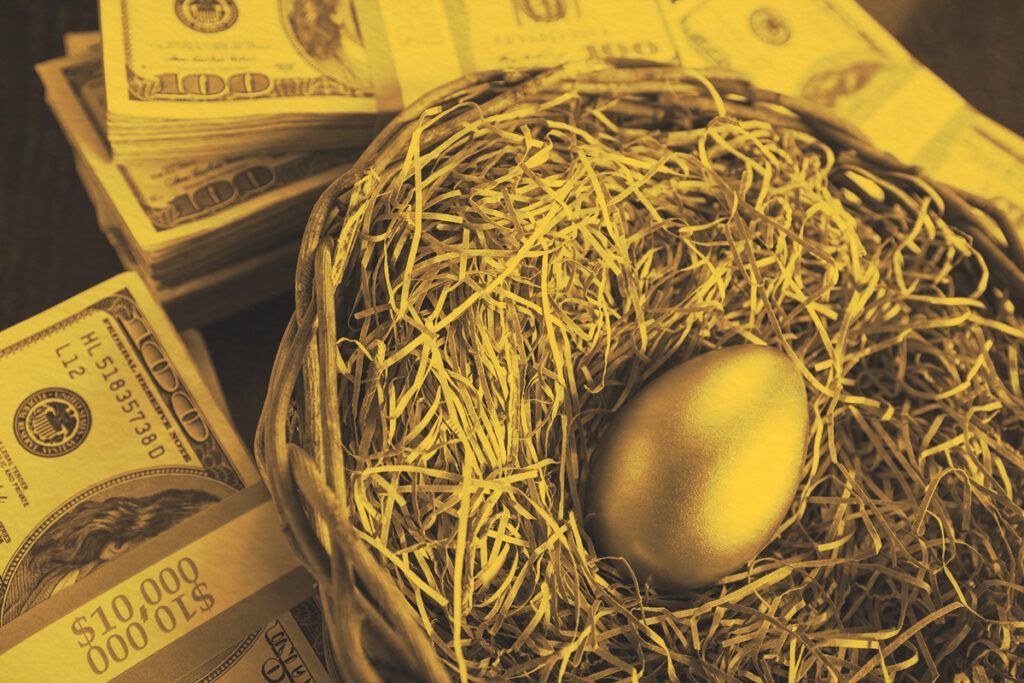

If you know your idioms, you know that a “gravy train” can be a sweet place to be. This expression refers to a job or situation that provides easy money with little or no effort. By definition, “gravy train” means “a much exploited source of easy money,” as in, “He’s been riding the gravy train ever since joining that startup.”
The idiom is typically used to suggest that the rewards might not be entirely deserved, or that something questionable is happening behind the scenes. But it can also simply mean that someone is being well paid for relatively little effort. So, when did a metaphorical train come into the picture?
The phrase “gravy train” lacks a well-documented origin, but several sources suggest that it originated among railway workers in the early 20th century. Since “gravy” was already slang for “easy money” or “something easy,” the term “gravy train” likely described a short-haul railway job that paid well. Over time, it evolved into the broader idiom we use today for any situation that brings steady, effortless profit.
The word “gravy” itself can mean “something additional or unexpectedly pleasant or valuable,” as in, “This new gig is gravy!” While it’s unclear where or when this connection originated, it likely relates to the idea that gravy is a bonus or an enhancement to an already satisfying meal. But “gravy” isn’t only tied to money. In slang, you’ll hear it as a synonym for “fine,” “good,” or “awesome.” For instance: “It’s going to rain during the concert? That’s OK — it’s all gravy.”
Featured image credit: FotoBob/ Adobe Stock
Advertisement
More from our network
Word Smarts is part of Inbox Studio, which publishes content that uplifts, informs, and inspires.
From bowl cuts to skinny jeans, some trends are best left in the past. But when it comes to language, there are some older slang terms that we’d love to start using again.
With every new generation comes a fresh set of slang. For instance, Gen Z can’t stop talking about having rizz, spilling tea, and being sus. But there was a time when now-older generations were also in their teens and 20s, communicating in a language full of code words and made-up sayings of their own. While most of those phrases have fallen into disuse, we think some of them are worth bringing back. Here’s a look at vintage vernacular that deserves a comeback.
Gas
“Gas” was once widely used for a thing or person thought to be outrageously fun. For example, you could say, “That guy at the party last night was a real gas,” or, “The trip I went on was an absolute gas from start to finish.” The word has been used in Irish culture as a figurative substitute for enjoyment since as far back as the early 1900s. It jumped into U.S. slang in the mid-20th century — meaning “someone or something that is very appealing or enjoyable” — after appearing in James Baldwin’s 1957 short story “Sonny’s Blues” and the lyrics of the 1968 Rolling Stones song “Jumpin’ Jack Flash.”
Wallflower
Some people feel shy at social gatherings and stay along the outskirts. In 1820, those people — the ones who sat by the wall at parties waiting for a partner to dance with — became known as “wallflowers.” We’d like to bring that back with a more positive spin, attributing it to folks who hang out on the edges of a party playing with the dogs and cats.
Beat Feet
According to the Oxford English Dictionary, the phrase “beat feet” first became popular in the early 1940s, when it was largely used on U.S. college campuses. It means “to walk or run somewhere in a hurry” — an act that involves literally and rapidly beating your feet against the ground. This slang became popular in North America and New Zealand.
Advertisement
Made in the Shade
This catchy bit of slang is from an early 20th-century children’s rhyme describing someone who’s living the perfect life: “ice-cold lemonade, made in the shade, stirred with a spade, by an old maid.” A person who has a nice car, big house, and a loving family is 100% made in the shade.
Pad
In the early 20th century, “pad” was used by criminals as a slang term for a room that hosts illicit trysts. But by the 1930s, it was used in a more general sense by noncriminals to describe any type of lodging or residence. For instance, in the 1960s, you might have invited friends over to your pad to listen to the latest vinyl record. This one has remained in the modern lexicon in the form of “bachelor pad.”
Peepers
This slang term dates way back to the late 17th century, when it was first recorded in the 1691 work A Voyage Round the World by John Dunton. It refers to a set of eyes and is almost always used in its plural form. However, you could also say “peeper” when talking about a single eye.
As a slang term, “square” originated in jazz circles around the mid-1940s. It referred to a person who held old-fashioned views, though in time, it evolved to suggest that someone was nerdy, or just completely normal. You might’ve heard friends in the 1950s say, “I hope her boyfriend doesn’t come to the party — he’s such a square!” These days, nerdy is cool, and maybe “square” can get an upgrade.
Shindig
A shindig is a lively party with lots of music and dancing. However, when it was first coined in the early 1870s, the term originally described a specific type of country dance. It’s now applicable to everything from backyard barbecues to Christmas soirées.
Featured image credit: BillionPhotos/ Adobe Stock
Advertisement
More from our network
Word Smarts is part of Inbox Studio, which publishes content that uplifts, informs, and inspires.
The phrase “15 minutes of fame” is a well-known expression, but it has multiple meanings and a disputed origin story. The full statement, “In the future, everyone will be world-famous for 15 minutes,” has long been attributed to eclectic pop artist Andy Warhol. It’s usually taken to mean that everyone will become notorious for something, at some point. Another interpretation is that fame is fleeting, and anyone who is in the spotlight should expect it to pass quickly.
Which version is correct? Either is possible, depending on how the user intends their message. But an exploration of the origin of the phrase may help us understand the idiom.
In English, we can find the earliest example of the phrase in print in an October 1967 edition of Time magazine. An article about a sculpture show in Washington, D.C.’s Corcoran Gallery quoted Warhol in the context of the then-rapidly changing art scene: “Whole new schools of painting seem to charge through the art scene with the speed of an express train, causing Pop Artist Andy Warhol to predict the day ‘when everyone will be famous for 15 minutes.’”
However, Warhol might not deserve credit for the coining of the phrase. Photographer Nat Finkelstein claimed he originated the expression in 1966. While he was photographing Warhol for a proposed book, a crowd gathered in an attempt to get in the picture. Warhol supposedly remarked that everyone wants to be famous, to which Finkelstein replied: “Yeah, for about 15 minutes, Andy.”
But an earlier precedent for this expression was set almost a hundred years prior to that anecdote, in a different language. In 1879, French writer Alphonse Daudet published an article discussing young writers experiencing ephemeral fame; it included the phrase quart-d’heure de célébrité (“15 minutes of celebrity”).
Of course, Warhol enjoyed far more than 15 minutes of fame. He became an iconic pop figure before his death in 1987, almost 40 years ago. Today, his artwork continues to be highly valued (his depiction of Marilyn Monroe went for $195 million at auction in 2022), and his artwork is displayed in such major art institutions as the Museum of Modern Art, the Guggenheim Museum, the Whitney Museum of American Art, and the National Gallery of Art. His 15 minutes have been long extended.
So, which interpretation of the phrase is correct? There’s no knowing, because of the evanescence inherent in the concept of celebrity. When Warhol (and others) made this memorable observation about fame, the concept of fleeting internet fame had not yet been invented. Perhaps he was prescient.
Featured image credit: Robert Daly/ iStock
Advertisement
More from our network
Word Smarts is part of Inbox Studio, which publishes content that uplifts, informs, and inspires.

It may give you a sugar high, but root beer won’t get you drunk. The “beer” name comes not from its boozy content but from a mixture of how it’s made and how it was marketed.
Unless you mix it with some harder stuff, there’s no booze to be found in a typical can, bottle, or mug of root beer. So why do we call it “root beer” instead of a seemingly more accurate alternative such as “root soda”? The answer is twofold — it has ties to how it was once prepared, and it relates more directly to a bit of 19th-century marketing.
First, let’s touch upon the “root” aspect of the drink’s name. Root beer’s distinct flavor is thanks to the root of the sassafras tree, which was once a key ingredient. However, the root was banned by the FDA in 1960 over fears it caused cancer. While that root has since been replaced by artificially flavored syrups, the name stuck.
As for the “beer” part of the name, some early root beers did have trace amounts of alcohol. This was because yeast was sometimes added to produce a foamy head, which was desirable in glasses of lager. The yeast fermented over time, leading to root beers having a very low alcohol content.
But the true popularity of the term “root beer” is owed to Philadelphia-based pharmacist Charles Elmer Hires. He’s regarded as an early pioneer of commercial root beer, though he considered naming it “root tea.” He switched the name to “root beer” in an effort to market it to Pennsylvania coal miners.
The Hires Root Beer Co. even held the rights to the “root beer” name until 1879, when Congress passed a now-repealed law declaring that no word in the dictionary could be registered as intellectual property. Based on the success of Hires’ operation, other drink manufacturers began marketing their beverages as root beer by the late 19th century.
Featured image credit: bhofack2/ iStock
Advertisement
More from our network
Word Smarts is part of Inbox Studio, which publishes content that uplifts, informs, and inspires.

Holiday cards may spread cheer, but they also spread some truly spectacular grammar slipups. Here’s how to keep your seasonal sentiments merry and correct.
The modern Christmas card industry took shape in Kansas City in the early 20th century when the Hall Brothers’ printing company began distributing holiday cards of a particular format: paper folded once into 4 by 6 inches and inserted into an envelope. Later, the company changed its brotherly name to Hallmark. But even before then, holiday letters of all formats were a cherished way to send warm wishes to friends and family. This enduring tradition tugs at our heartstrings, reminding us that sometimes the smallest gestures really do mean the most.
Today, approximately 1.3 billion holiday cards are sent annually in the United States. But among the heartfelt sentiments and well-wishes for the new year lie some inevitable grammar mistakes. Capitalization errors and unnecessary apostrophes, in particular, run amok. Of course, it’s the thought that counts — but if you pride yourself on keeping a pristine spell-check record, these tips are for you. Here’s what the grammar elves have to say about seasonal greeting cards.
Perfect Pluralization: Last Names
We’d wager that of those 1.3 billion cards sent each holiday season, at least a billion are signed using a family’s last name. It’s the most common holiday sign-off, and yet, it’s often misused. Grammar purists everywhere cringe as they open envelopes filled with apostrophes and pluralizations where they don’t belong. Keep these rules in mind when pluralizing your last name:
No apostrophes for simple plurals.
Happy Holidays from the Smith’s!
Happy Holidays from the Smiths!
If the name ends in “s,” “x,” “z,” “ch,” or “sh,” add “es.”
Love, The Rodriguezs
Love, The Rodriguezes
Apostrophe Avalanche
Holiday greeting cards are chock-full of superfluous apostrophes, and not just when pluralizing last names. Remember that apostrophes should be used only to indicate possession or contractions. Avoid using them for decoration or pluralization. Here’s how to correctly write some common holiday greetings that tend to get an extra (and incorrect) embellishment.
Avoid a rogue apostrophe-“s” in “happy new year.”
Happy New Year’s!
Happy New Year!
The phrase “happy holidays” is not possessive.
Happy holiday’s from the Joneses!
Happy holidays from the Joneses!
However, there are some instances where apostrophes should be used.
For last names ending in “s,” add an apostrophe at the end to show possession.
The Morris’s/Morris year in review …
The Morris’ year in review …
The phrase “season’s greetings” is possessive.
Seasons greetings!
Season’s greetings!
Some holidays require an apostrophe-“s” because they are possessive.
New Years Eve and New Years Day
New Year’s Eve and New Year’s Day
Contractions require apostrophes.
Tis the season!
’Tis the season! (“’Tis” is a contraction of “it is.”)
Its the most wonderful time of the year!
It’s the most wonderful time of the year!
Advertisement
Capitalization Confusion
Holiday cards are a hodgepodge of capitalization. Even generic phrases — such as “Happy Holidays” or “Merry and Bright” — often appear in uppercase letters, reflecting stylistic choices more than grammatical accuracy. Technically, these phrases should be lowercase (“happy holidays,” “merry and bright”), unless a word begins a sentence, but these tend to get a pass in the spirit of creative license on holiday cards.
However, if you’re interested in staying grammatically correct this holiday season, the Associated Press has weighed in on the matter. According to its guidance, the first letters of words in generic phrases are not capitalized unless they begin a sentence or include a proper name, such as a person’s name or a specific holiday.
Perhaps most importantly, in the context of greeting cards, this includes capitalizing holidays and events such as Advent, Black Friday, Boxing Day, Christmas, Christmastime, Hanukkah, Kwanzaa, New Year’s Eve and New Year’s Day, and Yule. The same goes for proper names, including Grinch, Kris Kringle, North Pole, Jesus, and Santa Claus.
Flipping the calendar to the new year deserves a set of rules all its own. Use capitals in the exclamation “Happy New Year!” But if you’re using a more sedate phrase such as “I’m wishing you and your family a happy new year,” the standard rules of capitalization and punctuation apply.
However, card writers tend to overdo capitalization, and often, it’s the words that shouldn’t be capitalized that are the issue. This includes common words and phrases such as dreidel, hallelujah, happy, menorah, merry, mistletoe, and season. Here are some capitalization rules in action with common holiday greetings.
Adjectives are not capitalized, even if they accompany proper nouns:
merry Christmas
Example: “We want to wish you a merry Christmas!”
feliz Navidad (Spanish for “merry/happy Christmas”)
Example: “From our family to yours — feliz Navidad!”
baby Jesus
Example: “This season, we celebrate the birth of baby Jesus.”
happy Hanukkah
Example: “We wish you a happy Hanukkah!”
Common terms and phrases are not capitalized:
happy holidays
Example: “The Smiths are dropping in to say happy holidays!”
No matter what message you write in your holiday cards, or how you write it, your hard work won’t go unnoticed. And don’t worry — Santa won’t swipe you from the “nice” list for forgetting an apostrophe or capitalizing “merry” in the middle of a sentence. Still, by sticking to these guidelines, you’re sure to impress any English teachers or grammar enthusiasts on your mailing list this holiday season.
Featured image credit: Diane Labombarbe/ iStock
Advertisement
More from our network
Word Smarts is part of Inbox Studio, which publishes content that uplifts, informs, and inspires.
New dialects and merged languages have developed around the world as a function of people working together, yet speaking different languages. Pidgins and creoles are examples of natural language evolution.
Imagine people from different cultures, speaking different languages, but still needing to work together. How do they communicate with one another? They improvise and simplify, by using a smaller vocabulary, stripped-down syntax, and short sentences. It’s not a formal language per se, but it is functional. Now imagine generations of people using this bare-bones form of communication. The dialogue will evolve and expand, and children will grow up hearing it spoken.
These two examples describe a pidgin dialect and the development of a creole language, respectively, two linguistic phenomena that have occurred around the world for millennia.
A pidgin dialect emerges when people speaking different languages need to communicate, often in the context of social inequality, such as colonialism and slavery, as when Africans and Europeans first interacted. Pidgins endure to this day. In Nigeria, for example, pidgin enables communication among that country’s more than 500 ethnic groups.
Pidgins are spoken by millions worldwide, in ports, at trading posts, on farms, in factories, and anywhere large numbers of people from different countries and cultures work together.
Advertisement
There’s not one form of pidgin; rather, a dialect develops out of necessity from stripped-down elements of the speakers’ languages. The word “pidgin” itself is an example of a pidgin that developed in the early 19th century among Chinese workers in the United States. It comes from a Chinese alteration of the English word “business.”
A creole language is a more advanced stage of a pidgin, arising when increased numbers of people begin to use a pidgin as their principal means of communication. When that occurs, their children hear it more than any other language, so it gradually takes on the status of a mother tongue for them. As a result, within a generation or two, that language use becomes consolidated and widespread. By this process, which linguists refer to as “nativization,” the result is a creole.
The difference between a pidgin dialect and a creole language is that a creole features a more complex, expanded vocabulary and a more consistent syntax, and it’s more stable than a pidgin. As a common noun, “creole” means “a mother tongue formed from the contact of two languages through an earlier pidgin stage.” A specific creole language may be referred to as a proper noun, such as French Creole or Louisiana Creole.
“Creole” has also been used as a proper noun and as an adjective to refer to people with mixed European and Black ancestry, or to the descendents of the European settlers in the Caribbean and Central and South America.
Emojis have become part of our day-to-day lives and a common feature of our digital communications. But can we actually consider emojis a language? In Face With Tears of Joy: A Natural History of Emoji, author Keith Houston explores this very question. He points out how the Face With Tears of Joy emoji was chosen as Oxford Dictionaries’ Word of the Year in 2015 — the first time a pictograph had been selected for the honor. At the time, Caspar Grathwohl, the president of Oxford Dictionaries, explained the choice by saying that “emoji are becoming an increasingly rich form of communication, one that transcends linguistic borders.” But where exactly do these borders lie when it comes to emojis — and can they be seen as a language in their own right?
Houston takes a deep dive into the subject and, after considering various studies, notes that most experts “hesitate to deem emoji a language.” He highlights some key areas in which emojis differ from formal language: “Inasmuch as there are grammatical rules for emoji,” he writes, “the scholarly consensus is that they are implicit, not formal; that they are limited, not exhaustive; and that they are variegated, not universal.”
So, it’s hard to call emojis a language. What, then, can we call them? One option, according to Houston, is to think of them as a script — as the written expression of a spoken language, rather than a language itself. This could place emojis alongside writing systems such as cuneiform, hieroglyphics, and Chinese characters. However, these examples are tied to specific spoken languages, while emojis are universal and capable of being interpreted in myriad ways.
Emojis, fundamentally, are iconic rather than symbolic — they represent their pictured object or activity, and while people might interpret the emoji icon in numerous different ways (which in itself is problematic in terms of regarding emojis as a language), it is still just a picture.
Linguists Gretchen McCulloch and Lauren Gawne offer an alternative, and very compelling, way of seeing emojis — not as a language, but as digital gestures. They note how most emojis are used to augment the meaning of the words they accompany — and in this sense, emojis act as the body language of the web. So, a language of sorts, but not — at least yet — any kind of formal, recognized language in the true sense of the word.
Featured image credit: Mego-studio/ Adobe Stock
Advertisement
More from our network
Word Smarts is part of Inbox Studio, which publishes content that uplifts, informs, and inspires.
What Presidential Campaign Coined ‘Keep the Ball Rolling’?
The idiom “keep the ball rolling” has ties to one of America’s most inconsequential presidents. Let’s travel back to the mid-19th century to learn more.
Some presidents leave their mark on the world of geopolitics, while others reshape how the average American lives their life. But William Henry Harrison died on his 32nd day in office, meaning he had little time to leave a notable impact on the country. However, Harrison’s legacy can be felt in the common lexicon, as the idiom “keep the ball rolling” has a very literal origin story tied to his 1840 presidential campaign.
In an early example of a grassroots campaign, Harrison’s campaign supporters crafted a leather and tin 10-foot-tall ball that was inscribed with slogans, including “Fare well Dear Van, not the man” (referring to Harrison’s opponent, incumbent Martin Van Buren) and “To Guide the ship, Old Tip” (referring to Harrison’s nickname “Old Tippecanoe”). The ball was rolled from town to town, where his supporters would urge fellow campaigners to keep the ball rolling into the next town.
This publicity stunt was done once more in 1888 to support the presidential campaign of Benjamin Harrison — William’s grandson. The phrase was adopted into the lexicon after the first campaign, likely spurring the re-enactment in the second campaign. That ball was built with steel and canvas and inscribed with phrases such as “Old Allegany in 1840 started the ball for Harrison; In ’88 as they did then, We roll it on for Gallant Ben” (a bit wordy, as campaign slogans go). This second ball was rolled 5,000 miles from the creator’s Maryland home to Benjamin Harrison’s home state of Indiana. In both campaigns, the balls played a small role in getting the Harrisons elected, and they left us with the now-popular idiom.
Featured image credit: Glasshouse Images/ Alamy Stock Photo
Advertisement
More from our network
Word Smarts is part of Inbox Studio, which publishes content that uplifts, informs, and inspires.

Your spell-check isn’t broken — these English words don’t follow the rules. Learn how tricky spellings such as “fuchsia” and “segue” came into our language.
Which word made you slip up the most during grade-school spelling tests? One that confuses a lot of folks is “Wednesday,” the only day of the week with a silent letter. While the spelling seems like it was invented to trick kindergarteners, there’s actually a perfectly good reason “Wednesday” is spelled with a silent “d” in the middle. It comes from the Old English Wōdnesdæg (“Woden’s day”), reflecting the ancient Germanic practice of naming the days of the week after prominent gods — in this case, Woden (also known as Odin).
As it turns out, other strange English spellings also have good reasons for looking so, well, wrong. Whether staying true to ancient roots or hearkening back to surprising origin stories, these words have fascinating stories to tell with their spelling.
Bellwether
Noun: One that takes the lead or initiative; an indicator of trends.
“Bellwether” is often used in a sense of forecasting, as in, “This state is a bellwether for national elections.” Because of this, it’s frequently misspelled as “bellweather,” forming a connection to weather forecasting. Additionally, “wether” itself is a very uncommon (at least in modern usage) English word — it refers to a castrated male sheep. But this definition is precisely where the term “bellwether” originated.
“Bellwether” comes from the Middle English term bellewether or belleweder, referring to said castrated sheep wearing a bell around its neck, encouraging other sheep to follow it. This was the leader of the flock. By the 15th century, the term’s literal sense had diminished and transformed into a metaphorical term for a leader, trendsetter, or indicator.
Colonel
Noun: A rank of a commissioned officer in the army, air force, or marine corps.
Certain military rankings have complex spellings. “Lieutenant” and “brigadier general” are mouthfuls, but they can be parsed out fairly easily by their spelling. But “colonel” — pronounced “kernel” — strays from the conventional rules of English spelling. In fact, it’s the only common English word with an “l” pronounced as an “r.”
This curious case of spelling results from the influence of two foreign languages: French and Italian. When the Italian word colonello was adopted into French, it became coronel and its pronunciation changed. Later, a spelling variant that reflects its Italian roots, colonel, became popular, but by then, the pronounced “r” was well established, resulting in a French pronunciation with an Italian spelling.
Advertisement
Fluorescent
Adjective: Bright and glowing as a result of fluorescence; very bright in color.
“Fluorescent” is an adjective describing something that emits light brightly, such as the fluorescent lights in a shopping mall. It originates from the noun “fluorescence,” which was coined during the 19th century by physicist Sir George G. Stokes, who first observed the glowing phenomenon in the mineral fluorite.
While a more common English spelling pattern would pair the vowels as “ou” instead of “uo,” the mineral, sometimes called “fluorspar,” was named after the Latin fluor, meaning “a flow,”from fluere, meaning “to flow.”
Fuchsia
Noun: Any of a genus (Fuchsia) of ornamental shrubs of the evening-primrose family; a vivid reddish purple.
Not all color names are as easy to spell as “red” and “green” — take “chartreuse” and “ochre.” Another sneaky name that breaks from English spelling norms is “fuchsia,” pronounced “FYOO-shuh.” Frequently misspelled as “fuschia” or “fushia,” the correct spelling (“fuchsia”) features a rare “chs” consonant combination.
While English does employ the vowel pair “ch” to sound like “sh” sometimes, as seen in “parachute” and “crochet,” it’s rarely followed by an “s.” This noun’s unique spelling came about because the term was named after Leonhart Fuchs, a German botanist. The oldest version of the term referred to the genus of plants, and it became Fuchsia after the Fuchs surname. The color was named after the plant.
Famous playwrights such as William Shakespeare are best known for doing just that: writing plays. So why, then, isn’t it spelled “playwrite”? The use of “wright” is no accident — it’s been spelled this way since the term was coined in Middle English. It refers to “a worker skilled in the manufacture, especially of wooden objects,” such as a “shipwright.”
In Middle English, “wright” also meant “builder” or “architect,” not just a woodworker. It comes from the Old English wyrhta or wryhta, meaning “worker” or “maker.” So, a playwright is literally a builder of plays. The term emphasizes the craftsmanship, not just the act of writing.
Segue
Verb:To make a transition without interruption from one activity, topic, scene, or part to another.
Often misspelled and mispronounced, “segue” was originally a musical term (“proceed to what follows without pause”) that has become a common word for transitioning to something new. Pronounced “seg-way,” it can confound even native English speakers because the vowel duo “ue” does not traditionally sound like “way.” Further compounding the confusion, the word “way” itself seems to support the definition, indicating a path or transition.
However, there’s a perfectly reasonable explanation for the spelling of “segue”: The original musical term comes from the Italian word seguire, meaning “to follow.” Per Italian pronunciation norms, the verb combination “ue” is often pronounced “way.” Perhaps capitalizing on the spelling-pronunciation mismatch, the American brand Segway produces two-wheeled transportation devices that act as a segue between landmarks during sightseeing tours.
Verb: To cause to be set aside; to force out of use as inferior.
“Supersede” (pronounced “SOO-per-seed”) has superseded many older spelling variations of the word. It first came from the Latin supersedēre, literally meaning “to sit on top of” (sedēre means “to sit”) but also “to be superior to” or “to refrain from.” In Middle English, the word transformed into “superceden,” a synonym for “defer.” While the correct spelling in modern English is “supersede” — preserving the Latin spelling — an alternative, “supercede,” is fairly common and listed as an acceptable variant in the dictionary.
This variation likely comes from the English spelling practice of ending words with “-cede,” as in “precede,” “recede,” and “concede.” “Supersede” is the only common English word that ends with the suffix “-sede,” making writers think twice when sounding it out.
Featured image credit: Gustavo Muñoz/ Adobe Stock
Advertisement
More from our network
Word Smarts is part of Inbox Studio, which publishes content that uplifts, informs, and inspires.
Your last name is shared with your family members, but it might go back hundreds of years to an ancient ancestor. Certain last names — patronyms and matronyms — are created from an ancestor’s first name.
If you live in a very small community, first names alone might suffice to differentiate one person from another. Almost 1,500 years ago, this was exactly how people identified themselves. But as clans grew larger, surnames (literally meaning “additional names,” coming from Anglo-Norman French) were required.
Surnames (last names) were not widely used in England until the Norman Conquest in 1066. Then the introduction of parish registers in 1538 fostered the use of hereditary surnames. By the end of the 16th century, in many parts of Western Europe, surnames had been passed down through generations and become fixed in spelling and use. The common practice in many cultures was to create a surname based on the first name of an ancestor — these familial names are called patronyms and matronyms.
A patronym is a surname based on a father’s first name, and a matronym is based on a mother’s. “Patronym” is from the Latin pater (“father”),the source of words such as “patriarch,” “patron,” “paternity,” “patronize,” and “paternalism.” “Matronym” is from the Latin mater (“mother”), the root of “matrimony,” “matron,” “maternity,” “matriarch,” and “matrix.”
You might be able to reasonably guess that someone with the last name O’Sullivan has Irish heritage — many last names that clearly indicate a certain country or culture are patronyms. In England, it was common to add an “s” to a name, giving us patronyms such as Peters, Phillips, Rogers, and Williams. The prefixes “O-,” “Mac-,” “Mc-,” and “Fitz-” generally indicate an Irish patronym, such as O’Reilly, MacCormack, and McDonald. Scandinavian patronyms, such as Carlson, Jensen, and Gibson, are recognized by a “-son” or “-sen” suffix.
Advertisement
Patronyms aren’t exclusively an Anglo-Saxon legacy. “Di-” or “D-” indicates Italian heritage, as in D’Agostino and DiMarco. An “-ez” suffix indicates a Hispanic patronym, as in Dominguez, Fernandez, and Enriquez. Adding “-ov” to a Russian first name creates patronyms such as Ivanov, Popov, and Petrov. “Ben” and “Bin” are used for patronyms in Hebrew and Arabic-speaking cultures, such as Ben-David and Bin Youssef.
Matronyms as a modern last name are much less common. Historically, in some cultures they were given to children of unwed mothers, children whose fathers died before they were born, when a father’s name was foreign or difficult to pronounce, or when a woman was especially well known.
However, matronyms are more common in certain cultures. In the Eastern European Ashkenazi Jewish culture, many surnames come from the matrilineal line: Rochlin (Rachel), Rivlin (Rivka), Sorkin (Sorka), Zeitlin (Zeitl), Feiglin (Feige), and Dworkin (Dvora). Most traditional Icelandic surnames are patronyms, but some are matronyms: Helguson (“Helga’s son”), Minervudóttir (“Minerva’s daughter”), and Helgadóttir (“Helga’s daughter”).
Given names are a special identifier chosen for each person, while surnames connect family members. Those with patronyms and matronyms are sharing a piece of their ancestral story every time they say their names.
Featured image credit: vulkanismus/ Adobe Stock
Advertisement
More from our network
Word Smarts is part of Inbox Studio, which publishes content that uplifts, informs, and inspires.

Enter your email to receive daily lessons that dive into what makes English so fascinating. Each email is packed with odd rules, etymologies, and the tools you need to be a better communicator.
Sorry, your email address is not valid. Please try again.