


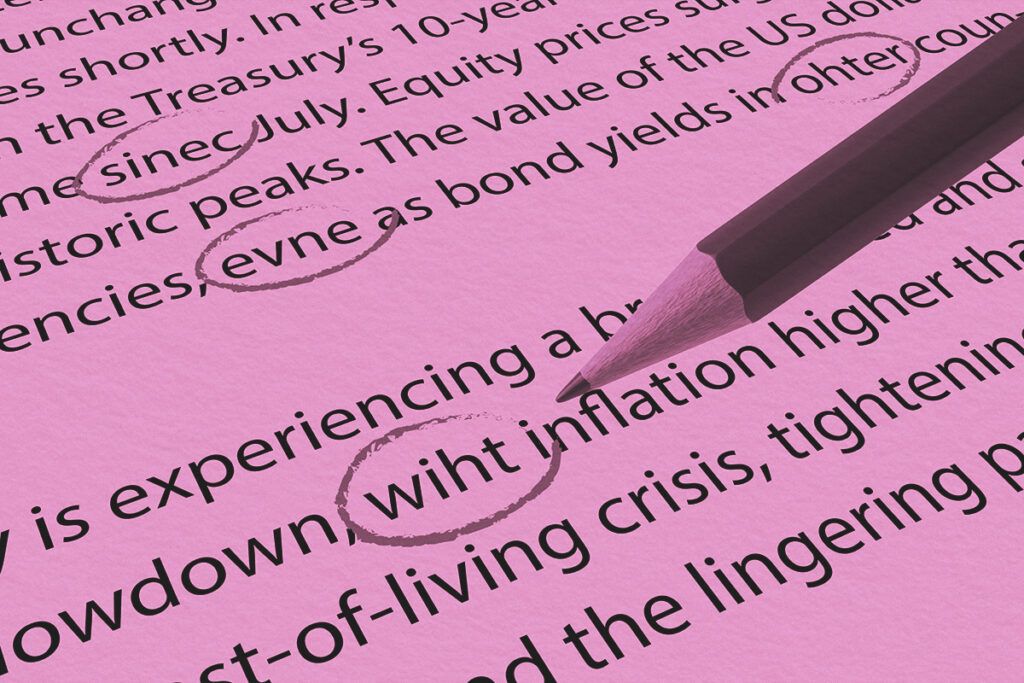
Why can we still decipher phrases such as “ths sntnc s mssng vwls” and “tihs senetnce si all jeubmld up”? Humans can understand typos and incomplete words because our brains process language through patterns, context, and prediction, not perfect spelling. Instead of reading letter by letter, the brain takes in whole words and sentences simultaneously, allowing it to fill in gaps when letters are missing or rearranged. This means that while reading, the brain constantly makes educated guesses, and it’s surprisingly good at them.
The brain looks for patterns in everything we do. Musicians use pattern recognition to read music, mathematicians use patterns to solve equations, and physicians rely on patterns for accurate diagnoses. The same is true for language comprehension. Instead of parsing out every single letter in a word, the brain makes predictions. Even if a word is misspelled, the brain can typically decipher it because it processes multiple letters at once and quickly matches them to familiar patterns.
This process develops as children learn to read. It allows us to recognize patterns in speech and text to understand their meaning. We also use it to detect grammatical structures and predict upcoming words. This supports many communication skills, such as reading comprehension and learning new languages.
To recognize a word pattern, the brain sends information to the fusiform gyrus, a structure that plays a crucial role in processing complex visual information. A specialized area on the left side of the fusiform gyrus, known as the visual word form area (VWFA), processes letter patterns and words. Regions on the right side handle face and object recognition.
Language is highly redundant — a driving principle behind the brain’s ability to decipher missing letters using pattern recognition. According to American polymath Claude Shannon’s The Mathematical Theory of Communication, English is about 50% redundant, meaning not every letter or word carries entirely new information. In fact, most languages are around 50% redundant.
This means that when communicating via text or speech, about half of the letters or words are chosen freely, while the other half are constrained by the language’s statistical structure. In other words, if up to half of the words of this article were removed at random, you could probably still understand it — though this depends on other factors, such as context.
Similarly, if “hlf of te ltrs r rmvd in stnce,” the sentiment can still be understood. However, if more than 50% of the words or letters are removed, comprehension begins to break down, and it is much harder to decode.
Typos with missing vowels are often easier to read than those with missing consonants because the brain is better at recognizing vowel patterns than consonants. Moreover, some experts propose that consonants are more important than vowels for word processing. In many languages, consonants provide the core structure of most words.
When reading altered words, the brain uses common letter combinations, many of which involve vowels. Common examples include bigrams (“er” and “in”) and trigrams (“ion” and “ing”). Because these letters are closely associated with each other, the brain can fill in the gaps to reconstruct words like “fnd” (“find,” using the bigram “in”) and “actn” (“action,” using the trigram “ion”).
In everyday use, abbreviations rely mostly on consonants, and we rarely struggle to interpret them. This includes professional titles such as “Dr.,” “Mgr.,” and “Asst.,” as well as common internet abbreviations like “nvm” (never mind) and “bc” (because).
Along with pattern recognition, the brain relies heavily on context in a process called top-down processing. Context includes surrounding words, prior knowledge, social context, visual context, and the topic of conversation. For example, take the misspelled word “blnk.” Alone, it could mean “blank” or “blink,” but in context the meaning becomes clear: “He was off in the blnk of an eye.” This is what makes crossword puzzles and word games such as Wheel of Fortune possible. Without the helpful clues — context — participants would have a more difficult time deciphering the puzzles.
Context also helps us spot tricky typos. “Typoglycemia” — a neologism combining“typo” and “glycemia” — is a term referring to the idea that words remain readable if their first and last letters remain intact. Try to read this example: “The barin reiles on paetrtn rocognitien.” While it is helpful to have the first and last letters remain the same, this method relies heavily on context and familiarity, as individual words are difficult to decipher when isolated.
Together, pattern recognition, prediction, and context allow us to communicate efficiently without being slowed down by minor typos. We easily breeze past misspellings and intentional abbreviations without even noticing them in text messages, social media, emails, and autocorrect errors. Even with missing or scrambled letters, your brain focuses on the story, not the spelling.
More from our network
Word Smarts is part of Inbox Studio, which publishes content that uplifts, informs, and inspires.