

You’ve probably heard the fanciful phrases “a murder of crows,” “a conspiracy of lemurs,” or even better, “a flamboyance of flamingos.” These are known as terms of venery — collective nouns that refer to groups of animals. When outside of the animal kingdom, there are collective nouns that apply to physical objects or people of various persuasions. Some of these collective nouns are surprising, so let’s look at 10 strange examples.
This collective noun first appeared in the 1486 Book of St. Albans, where it was written in Middle English as neuthriuyng of iogoleris. (The letter “J” was the final letter added to our alphabet in the 17th century, so an “I” is seen in older writings.) Use of this noun is rare and humorous in nature, as it implies that jugglers have a reputation for failing to thrive financially in the pursuit of their hobby.
The term “misbelief of painters” was specifically coined in reference to portrait artists. It comes from the idea that these artists were hired by wealthy patrons, and it was the duty of the painter to portray their patron in a positive light — even if it meant exaggerating a feature or two. Many portrait artists drew excessively flattering depictions of their subjects, thus creating a sense of misbelief.
Though the word “abominable” is most often used to describe the mythical Himalayan snowman, it was once used in reference to large companies of monks. Back in the 15th century, monks were highly unpopular, as they tended to eat well and live more comfortable lives than the general population. Hence, groups of monks were considered to be an abominable sight, defined as something “worthy of causing disgust or hatred.”
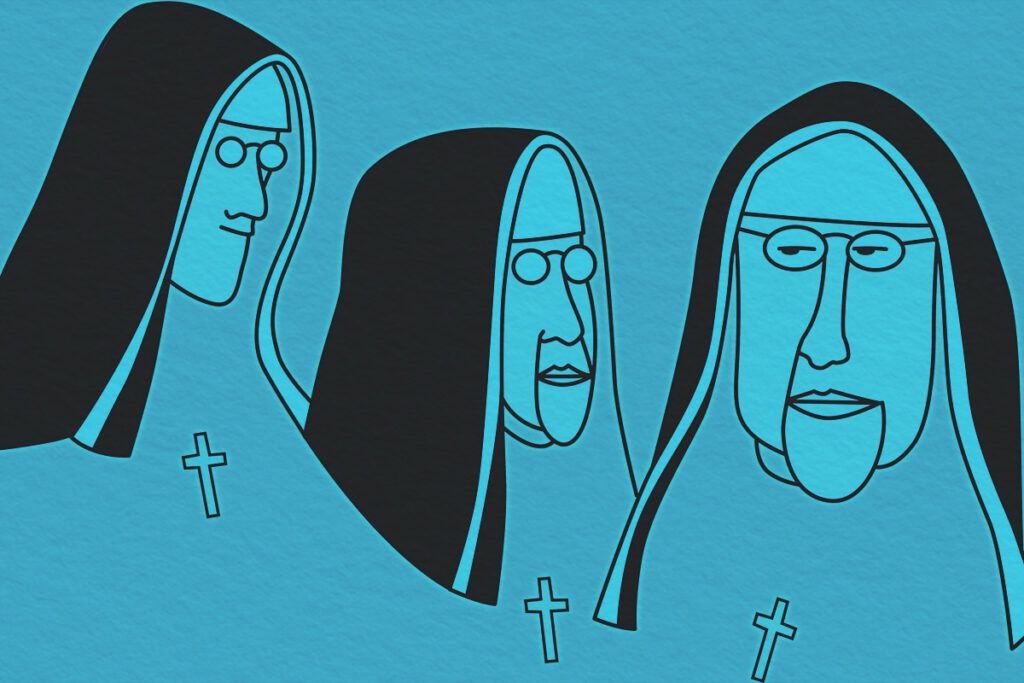
In the 15th century, nuns weren’t as unpopular as monks, but the sheer number of them contributed to their collective noun. In fact, it’s estimated that there were 142 nunneries in England, housing over 2,000 nuns by the 1530s. The unusual collective noun “superfluity” is defined as “excess” or “oversupply.”
The term “claque” comes from the French claquer, meaning “to clap,” and it refers to a group hired to applaud at a performance. In the 19th century, these hired hands were tasked with crying out and shouting during performances to influence the rest of the audience to do the same. However, many composers, including Wagner and Mahler, despised claques. Their unsavory reputation eventually led to the coining of “a shriek of claques,” with “shriek” meaning “to cry out in a high-pitched voice.”
If you’re afraid of clowns, you’re not alone. So it’s only appropriate that a group of clowns is called a shudder — as in a shudder down your spine when you see a clown. Another humorous way to refer to a group of clowns is with the collective noun “carload,” a play on the old circus trope where a large group of clowns crammed into a tiny car for humorous effect.
This collective noun was made especially popular by British fantasy author Jodi Taylor, who used it as the title of a 2018 book. The word “argumentation” is defined as “the act or process of forming reasons and of drawing conclusions” — something that historians must do while debating and determining the validity of past events.
In modern parlance, a luddite is a person who adheres to old standards and is opposed to technological change. However, the term was first coined in reference to 19th-century members of the English working class who destroyed labor-saving machinery in an act of protest. This collective noun pays homage to the origin of the word “luddite.”
Children’s author Alastair Reid wrote the delightful work Ounce, Dice, Trice in 1958. In that book he coined several collective nouns, including “a grumbling of buses.” This refers to the reverberating grumble that buses frequently make as they idle in traffic and barrel down city streets.
Generally, the term “stampede” conjures images of an oncoming and unstoppable throng. But in this case, the stampede is most likely to be wandering around a stamp-collecting convention. The word “philatelist” means “someone who collects stamps,” so a stampede of philatelists has less to do with the traditional meaning of “stampede” and more to do with a punny take on the stamp-collecting hobby.
More from our network
Word Smarts is part of Inbox Studio, which publishes content that uplifts, informs, and inspires.