


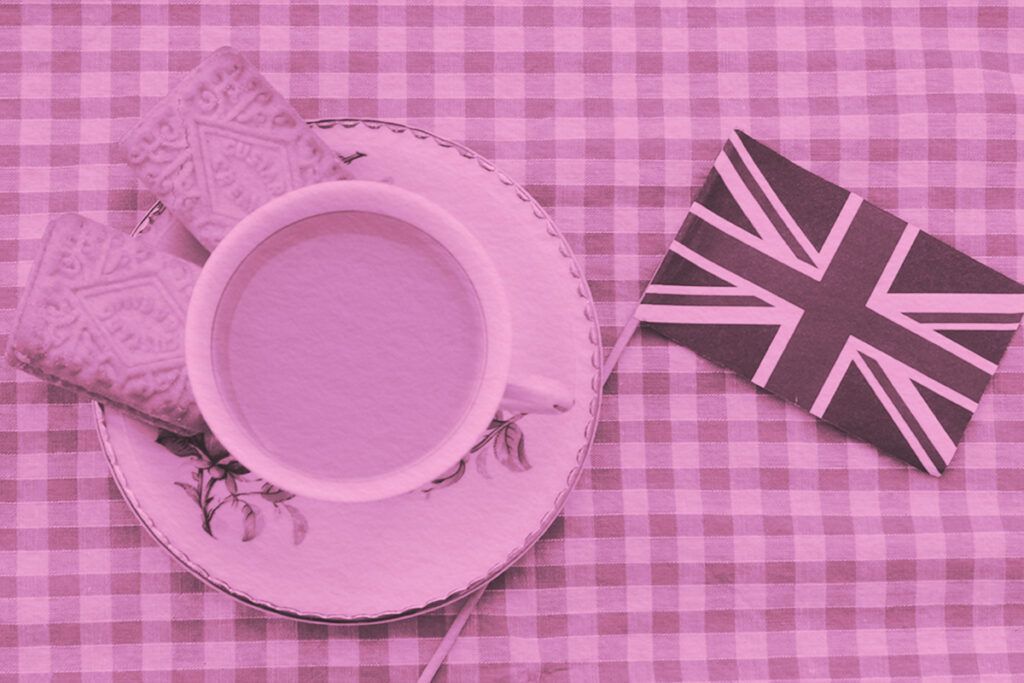
Language can get complicated when we travel across the pond, despite the prevalence of English on both sides of the Atlantic. For American travelers, underwear suddenly becomes pants, a car’s trunk is called a boot, and an apartment is a flat. It can all be a little confusing and potentially embarrassing. And when it comes to food, more problems can arise. French fries are chips, chips are crisps, and eggplant and arugula are aubergine and rocket, respectively. And then there’s this food-related conundrum: Is it a cookie or a biscuit — or both?
To understand the international confusion that arises with biscuits and cookies, it’s worth first having a look at the etymologies of both words. They tell you exactly what the terms originally meant — and neither meaning is quite the same as how the words are used today.
“Biscuit” comes from the Old French besquit or biscuit (derived from Latin), in which the prefix bes means “twice” or “doubly,” and cuit means “to bake” or “to cook” — therefore giving “biscuit” a literal meaning of “twice baked.” This referred to an ancient, precise method in which dough was first baked as a loaf, then cut into slices and baked again until it was completely dry and hard. The result was a shelf-stable ration that was eaten by Roman soldiers, sailors on months-long voyages, and Arctic explorers, precisely because the twice-baked biscuits contained almost no moisture and therefore didn’t spoil. So, a biscuit, in its original sense, was often a survival food (sometimes known as “hardtack”) — not exactly what your average Brit dunks in their afternoon tea.
The word “cookie,” meanwhile, comes from the Dutch koekje of the 17th century, literally meaning “little cake.” The word was brought to America by Dutch settlers and became established in American English during the 18th century. In 1796, Amelia Simmons wrote about cookies in her book American Cookery: The Art of Dressing Viands, Fish, Poultry, and Vegetables. These were not double-baked like biscuits — instead, they were half an inch thick, cut to “the shape you please,” and baked for 15 to 20 minutes in a “slack oven,” after which they were apparently “good [for] three weeks.” Simmons’ cookies were soft, rich, and cakelike — not quite the same as modern American cookies, but entirely different from the hard, twice-baked biscuits of the time.
Now that we know the origins of both words, we can turn our attention to the cookies and biscuits of today. In the United Kingdom, the hard, double-baked biscuit of old evolved into something sweeter, crumblier, and more luxurious. The word “biscuit” increasingly began to refer to small, flat, sweet baked goods that are hard (but not that hard) and rigid — something you’d nibble and dunk in a cup of tea.
Today, these biscuits include digestives, rich tea biscuits, custard creams, jammie dodgers, ginger nuts, Hobnobs, and many more — and they are all what Americans would call cookies. But in Britain, “cookie” means something far more specific. It refers either to shop-bought chocolate chip cookies — hard, but crumbly, and sold in packets — or to soft, large, chewy treats, traditionally containing chocolate chips or nuts, that are sold in bakeries. In the U.K., both can be referred to as cookies but fall more broadly under the label of biscuits.
In the United States, meanwhile, small, sweet baked goods of many different flavors are nearly always called cookies. What Americans call a biscuit is an entirely different food altogether — a soft, fluffy, quick-leavened bread product. These biscuits are a staple of Southern cuisine, typically served hot with butter or jelly, alongside fried chicken, or smothered in gravy. The closest British equivalent to an American biscuit is a scone — which, as any British person will tell you, is emphatically not a biscuit but rather its own type of baked good, normally eaten with jam and cream.
To summarize: What Britain calls a biscuit, America calls a cookie. What America calls a biscuit, Britain calls a scone. And what Britain calls a cookie — the chocolate chip or large, chewy variety, both falling under the wider biscuit label — America also calls a cookie, but in a far more general sense. And now that that’s cleared up, it’s time to have a nice cup of tea and a biscuit — or maybe coffee and a cookie.
More from our network
Word Smarts is part of Inbox Studio, which publishes content that uplifts, informs, and inspires.