


America is celebrating its semiquincentennial, and within that word we find a clue as to its meaning, the 250th anniversary. That clue is also present in “centarian,” “centigrade,” “century,” “percent,” “centimeter,” “centipede,” “centennial” (100th anniversary), and “bicentennial” (200th anniversary).
All of these words are based on the Latin centum, meaning 100. From this, you can understand why a penny is called a cent: 100 cents make up one dollar. Of course, ours is not the only currency divided into units of a hundred. The euro has a cent, Swiss currency has the centime, Bolivia and Brazil have the centavo, Ecuador has the cent, and Peru and Venezuela have the céntimo.
In 1776 Thomas Jefferson proposed doing away with the complex British system of coinage (pound, shilling, pence) in favor of a decimal system. He issued a formal report in 1784, proposing the word “cent” for one one-hundredth of a dollar.
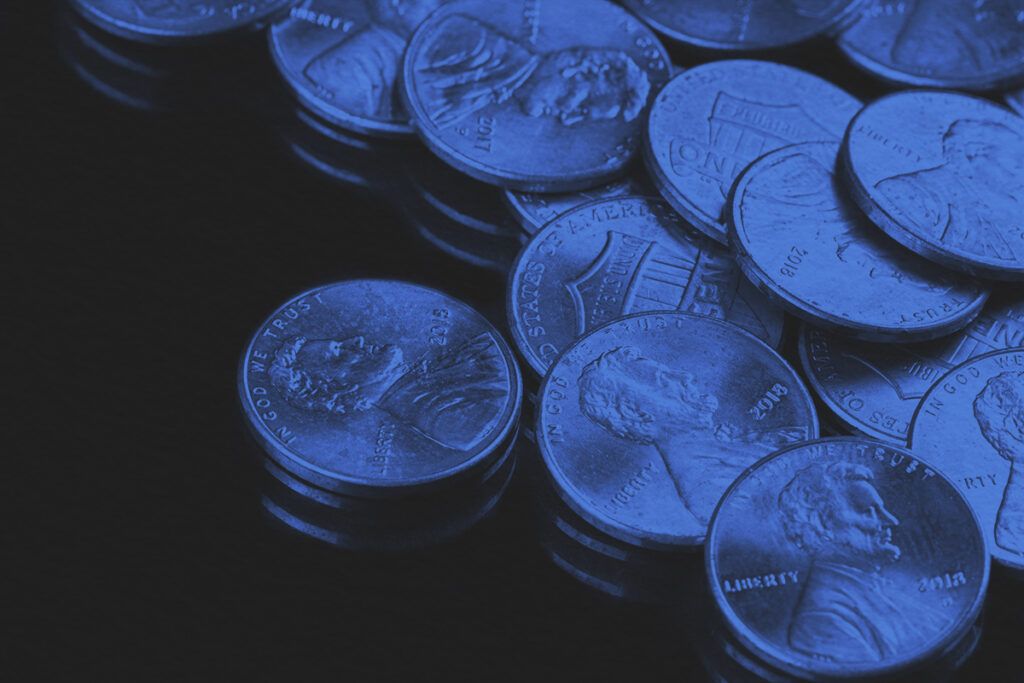
The word “cent” first appeared on U.S. currency after President George Washington signed the Coinage Act of 1792 (which established the U.S. Mint), authorizing a design suggested by Benjamin Franklin. It was made of 100% copper, provided by Paul Revere. The front featured a woman with flowing hair (perhaps symbolizing liberty), and the reverse proclaimed “ONE CENT” with the words “UNITED STATES OF AMERICA” and the fraction “1/100,” signifying 1% of a dollar.
It’s common to refer to the one-cent coin as a penny, even though the official word for one one-hundredth of a dollar is “cent.” So where did “penny” come from?
In Old English, a small coin was a pening, or penig, which evolved into Middle English as “peni.” It comes from Germanic, with related words in Swedish (penning) and German (Pfennig). In Middle English, any coin could be called a penny, with the plural “penies,” which eventually turned into “pence” (now used singularly and collectively). A pence was worth one-twelfth of a shilling. After the introduction of decimal currency in Britain in 1971, shillings were abandoned, but 5-pence and 10-pence coins were introduced.
In America, “penny” was used for the U.S. cent starting in the early 19th century, as a carryover from the British colonial era. It’s just a nickname and not official. As of 2025, the U.S. Mint is no longer producing pennies, as the cost to produce one coin has risen to 3.69 cents. Hold on to your pennies, because they’re soon to be collectors’ items.
More from our network
Word Smarts is part of Inbox Studio, which publishes content that uplifts, informs, and inspires.