


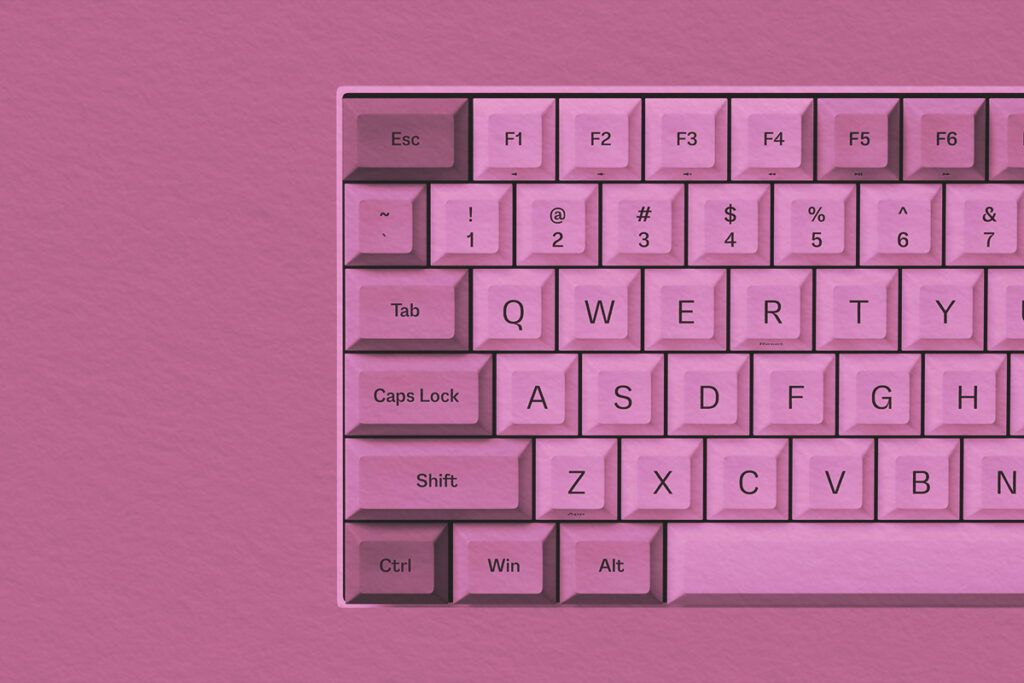
Take a look at the keyboard on any standard English-language computer or smartphone — instead of finding keys laid out in alphabetical order, you’ll see the letters of the alphabet scattered without any distinguishable pattern. And yet, despite the randomness of the arrangement, it’s probably very familiar to you, as this layout — called QWERTY, referring to the first six letters of the second row of the keyboard (below the first row of numbers) — has been in use since the 19th century.
The QWERTY keyboard was a feature of the first typewriter that came to market for customers in 1874. About a decade earlier, Christopher Latham Sholes had invented an automatic page-numbering machine, and a fellow inventor, Carlos Glidden, encouraged him to translate that technology into letter printing. Sholes, Glidden, and inventor Samuel W. Soulé were granted a patent for a typewriter in 1868, which was followed by many iterations, including the QWERTY keyboard. In 1873, the technology was sold to the Remington Arms Company, a manufacturer with the experience and scale to bring the first typewriter to market.
Since that first typewriter, alternatives to the QWERTY layout have been proposed and tested. Yet we’re still typing on the same keyboard as our ancestors from more than 150 years ago. There are two major reasons why QWERTY has been so persistent: mechanics and brand.
For most countries that use the Latin alphabet, QWERTY is the standard keyboard layout for typists. Long before computers, mechanical typewriters were built with ink ribbons and small hammers attached to each key. Pressing a key would cause the hammer to hit the ink ribbon and leave an imprint of the associated letter, number, or punctuation mark on the piece of paper. This was a major innovation over the printing press and granted regular people the ability to type instead of handwriting everything.
Sholes, Glidden, and Soulé went through at least 30 layouts before they arrived at QWERTY. Instead of laying keys out alphabetically, they considered how to ensure that the keys were arranged to reflect the most common letter combinations in English while using a variety of tapping fingers spread across the keyboard. At one point, the period was placed where the “R” key is now, so it could have been the QWE.TY keyboard.
You might have heard the story that the QWERTY arrangement was created to slow down typists to avoid jamming the hammers and keys. However, this theory was questioned and debunked by the 2010 study “On the Prehistory of QWERTY” by Koichi Yasuoka and Motoko Yasuoka. They argued that the keyboard was designed to align with the testers who would benefit the most from an intuitive typing setup: telegraph operators.
In the second half of the 19th century, Morse code was crucial for communication. Telegraph operators had to listen to a dash-dot message, decode it in their head, and transcribe it as quickly as possible before moving on to the next message. They were early testers during the development of the QWERTY keyboard and found that setup easier to use than an alphabetical layout.
After the inventors set up a deal with the Remington Arms Company, the typewriter — priced at $125 (equivalent to $3,651 in today’s money) — was sold to the public and immediately became very popular. Remington claimed that there were 100,000 typewriters around the country in 1891. After they merged with competitors in 1893, the newly formed Union Typewriter Company continued to manufacture the QWERTY keyboard and consolidate the product market for typewriters.
However, competition remained, even from the original inventor. Sholes sought to patent a keyboard with an XPMCH layout in 1889, but it never moved forward because he passed away in 1890. Then, in the 1930s, August Dvorak developed the Dvorak Simplified Keyboard to increase efficiency. The top left of the keyboard includes punctuation instead of letters and numbers, and the row of home keys (the central row where you rest your fingertips) includes vowels and common consonants. Though some tech enthusiasts have adopted it even today, it never overtook QWERTY in the mainstream.
When the first personal computers became available in the 1970s, they too used the QWERTY layout. Today, virtually all computers that use the Latin alphabet are programmed to recognize the QWERTY keyboard. The overall brand adoption is unimpeachable.
Mobile devices with full keyboards, like the Blackberry, also embraced the QWERTY setup. As an alternative for users who mostly type on touchscreens, researchers at the Max Planck Institute in Germany attempted to create the KALQ keyboard, which is optimized for holding your phone in two hands and using only your thumbs to type. However, it never caught on, and the dominant smartphone platforms (iPhone and Android) still employ the QWERTY keyboard in both the vertical and horizontal orientation. Even ergonomic keyboards that are divided in half (to let your wrists rest more comfortably) generally follow the QWERTY setup.
The one truly strong alternative to the QWERTY layout is language-based. The AZERTY layout has been adopted by French-speakers in France, Belgium, and the Quebec province in Canada. It allows for typing accented vowels (such as “é” and “ü”) and diphthongs (“œ” and “æ”).
When English-speaking people are learning how to type, the QWERTY keyboard is still the standard. Strategies like touch typing encourage memorization of the layout, so the placement of the keys becomes second nature. Even a small keyboard change can interrupt a typist’s flow. QWERTY’s endurance through technological change is a reminder that the modes and habits of communication can last for centuries.
More from our network
Word Smarts is part of Inbox Studio, which publishes content that uplifts, informs, and inspires.