


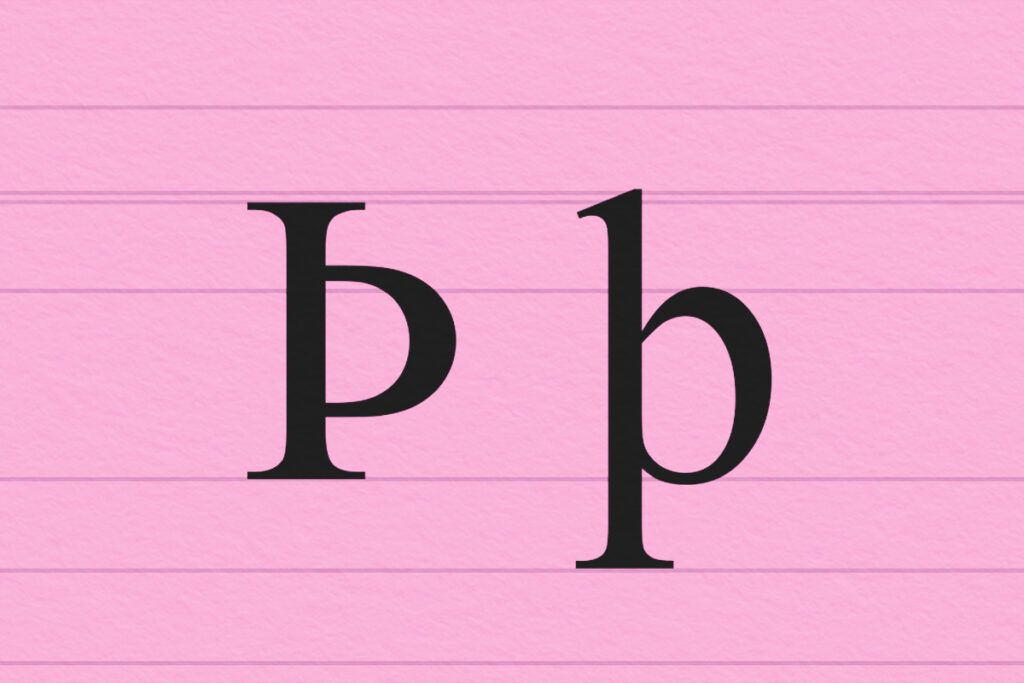
Every word in the English language is made up of some combination of the 26 letters of the alphabet. However, the alphabet has undergone some changes since its inception sometime around 600 BCE. The letter “j” wasn’t added as the final letter until the 17th century, and one letter is notable for its absence in the modern alphabet: thorn (þ). This character, which once held a prominent place in Old English writing, survives today in a curious way, its ghostly presence in the most frequently used word in the English language: “the.”
Thorn — written as “þ” in its lowercase form and “Þ” when capitalized — represented the “th” sound (as in “thin” or “they”) in Old English. It originated from the runic alphabets used by early Germanic peoples, specifically the Elder Futhark rune ᚦ (Thurisaz). Old English, spoken and written in England up to approximately 1150 CE, employed thorn extensively. Even when Old English was written using the Latin alphabet, scribes continued using thorn because Latin lacked dedicated symbols for the “th” sounds common in Germanic languages.
Many words we now recognize instantly once appeared with thorn at the front. The definite article “the,” for instance, was commonly written as “þe.” “Thou” was spelled “þū” and “thee” as “þē.” Thorn featured all across the Old English vocabulary — in “three,” “thing,” “think,” and countless other words — as a practical way to represent native phonetics.
Thorn worked perfectly well as a letter until the beginning of the Middle English period and the Norman Conquest of England in 1066. When William the Conqueror took the English throne, scribes trained in France came to England, replacing their English counterparts in many positions of power and influence. These Norman scribes did not use thorn — instead, they preferred the “th” spelling they were familiar with from Old French.
Over the following centuries, “th” gradually replaced thorn in many documents, especially in official or formal writing. But thorn did not disappear immediately — it remained common in handwriting throughout much of the Middle English period and well into the 1400s. In Scotland, thorn managed to survive even longer, appearing — albeit rarely — in handwritten documents as late as the 18th century.
The death knell for thorn came with the arrival of the printing press in England. In 1476, William Caxton, an English merchant and translator, established the country’s first printing press in London. Because the first printing presses came from continental Europe, they featured characters for the printing of Latin and other European languages, such as German and French. Thorn was not among them.
By this stage, despite “th” being well established, thorn was still in use, but primarily for only the most common words such as “þe” (“the”). Early English printers weren’t willing to do away with thorn completely, so they used the letter “y” to represent “þ.” It was a logical choice, as in some medieval scripts the thorn looked quite similar to “y,” especially in handwritten form, making it an easily understood substitute.
Interestingly, it was this substitution that gave rise to the famous — and frequently misunderstood — “Ye Olde” construction often used in the names of pubs, cafes, and shops in England, and mimicked around the English-speaking world (for example, Ye Olde Curiosity Shop in Seattle and Ye Olde College Inn in New Orleans). When you see a business called “Ye Olde Tea Shoppe” or “Ye Olde Dog and Duck Tavern,” the “ye” should be pronounced not with a “y” sound but as “the” — it is, after all, a typographical fossil that comes from thorn.
Despite the early use of “y” in English printing presses, the digraph “th” (two letters working together) remained dominant. Eventually “th” fully replaced thorn (as well as its substitute “y”) in printed English, aligning English orthography (spelling) more closely with French and Latin while simplifying and standardizing the printing procedure.
Today, thorn no longer exists in English — but it hasn’t vanished entirely. Thanks to its Old Norse origins and the highly conservative nature of the Icelandic language, thorn is still used in Iceland. And, in a sense, the letter thorn still lingers in everyday English — albeit only phonetically — in our most common word, “the.”
More from our network
Word Smarts is part of Inbox Studio, which publishes content that uplifts, informs, and inspires.