


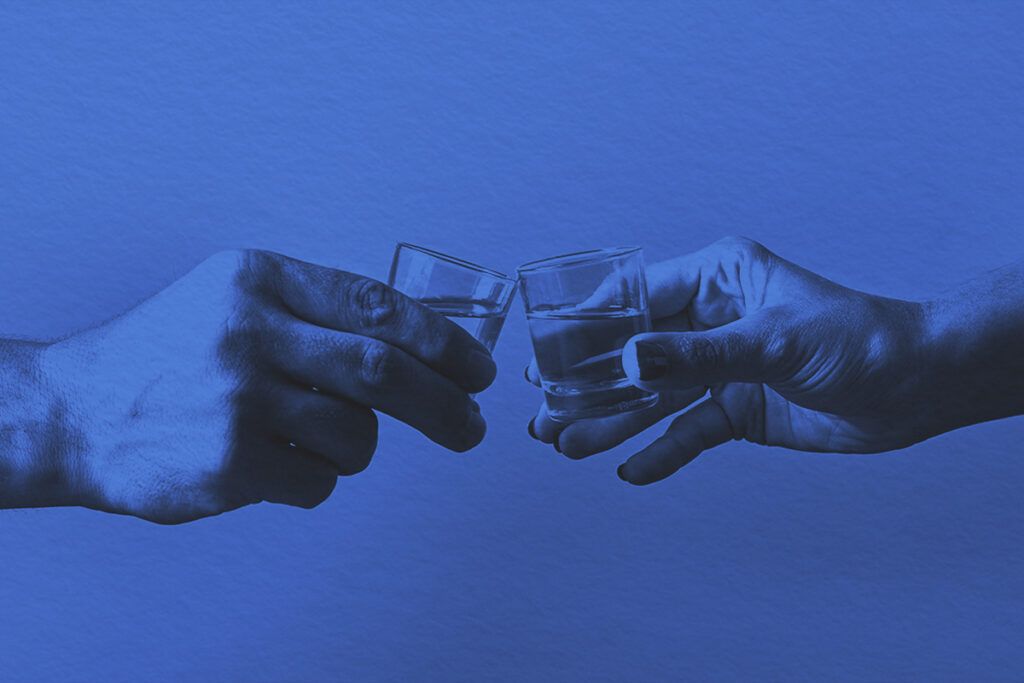
Doing too many shots at the bar can leave your brain feeling fuzzy and your vision a little blurry. So it’s only fitting that the origins of the term “shot” are similarly hazy. One of the most common theories is that it’s derived from Old English, though others believe that the word came about in the Old West. Here’s a look at those theories, and several others, which may shine some light on this bit of boozy terminology.
The earliest known example of “shot” referring to a measure of drinking appears in the 16th-century autobiography of Rev. Oliver Heywood, which includes the phrase “their vain way of drinking shots.” However, what it means in that context isn’t entirely clear.
We find an early definition for “shot” in the 1721 work An Universal Etymology English Dictionary by Nathan Bailey: “a Flagon which the Host gives to his Guest if they drink above a Shilling.” A flagon, defined as “a large usually metal or pottery vessel (as for wine) with handle and spout and often a lid,” is traditionally a much larger drinking vessel than a shot glass, but this at least puts “shot” in the context of alcohol.
Elsewhere in Bailey’s work we find the definition for “Ale-Shot,” meaning “a reckoning, or Part to be paid at an Ale-house.” In other words, “ale-shot” was a term for any bar tab back in the day. Again, this isn’t exactly the definition of “shot” as we know it today, but these examples show that the word was commonly used bar language — at least enough to record its definition — by the early 18th century.
Linguists theorize that somewhere along the way, the definition of “shot” evolved from a flagon of booze or a bar bill into what we know today. However, why or how that evolution occurred remains a bit of a mystery. According to the Etymology Online Dictionary, the precise meaning for “shot” as “a small drink of liquor” came about by the year 1928.
Other theories claim that “shot” was coined in the Old West and comes from the idea that gunslingers would trade bullet cartridges for shots of liquor, as they were roughly equal in value. But according to Snopes, this theory — despite being popular — holds little to no validity.
There are other theories related to the term “shot glass,” referring to the small glass you drink a shot out of. One says that it comes from the idea that hunters would put a small glass on the table for their families to discard any buckshot found in the meat they were eating. Another claims that shot glasses were first used by writers, who would fill small glasses with lead shot to hold them in place on a table, and then use the glasses to store their quills and ink. A third theory says that “shot glass” is named for German chemist Otto Schott, whose work primarily centered around glass. However, all of these theories are more likely just fun ideas than reality.
Similarly, it’s difficult to say for sure why small amounts of liquor are called shots, though it very likely has to do with the definitions mentioned in Nathan Bailey’s 1721 dictionary. But beyond the connection to drinking, the truth is as hazy as a long night spent at the bar.
More from our network
Word Smarts is part of Inbox Studio, which publishes content that uplifts, informs, and inspires.