


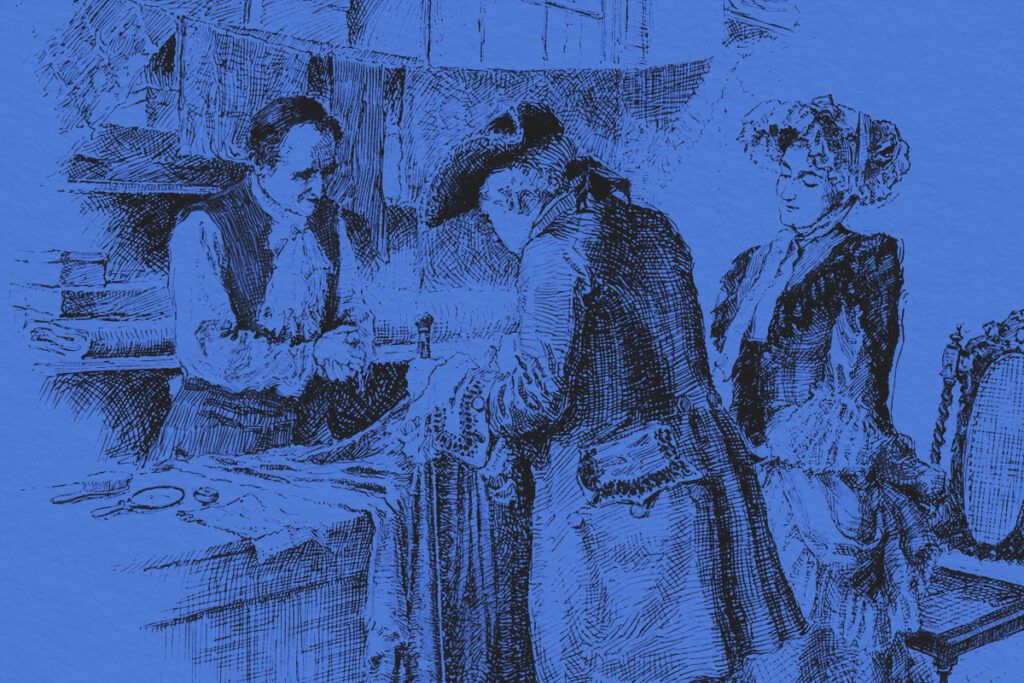
As English settlers laid down roots in the Americas, their language started to deviate from British English. During this linguistic evolution, new slang emerged among those living in the American colonies. While many popular examples from that era have since fallen by the wayside, the 250th birthday of the United States is a good opportunity to examine the colloquialisms that people back then used in their everyday lives. Many examples can be found in Colonial American English, a lexicon compiled by Richard M. Lederer in 1985. Here are some that stood out.
The colonial usage of this word had nothing to do with cheese or pasta. A clue can be found in the song “Yankee Doodle,” in which the titular character “stuck a feather in his hat and called it macaroni.” In this case, the slang “macaroni” means “fop,” or “a man who is devoted to or vain about his appearance.” The song has been around since the 1750s, likely written by an English physician to mock the colonial soldiers after the French and Indian War. The original context for “macaroni” was not complimentary. He was calling them “doodle” (a country hick) and “dandy” (a conceited jerk), and “macaroni” fit right along with those insults.
British soldiers were known to play “Yankee Doodle” as they traveled the countryside, apparently to rile up the colonists. But legend has it that after the American victory at Lexington and Concord, the colonial soldiers turned the tables and played “Yankee Doodle” to taunt the Brits about their defeat at the hands of the doodles and dandies. After that, the song became a rallying cry for the American Continental Army.
The adjective “plaguey” sounds a bit ominous, but it has nothing to do with illness. This slang was used in the colonies as a synonym for “exceedingly.” Let’s say you were eating an especially delicious meal — you may have said, “This dinner is plaguey tasty.”
If you were to walk into a pub and order Adam’s ale, you wouldn’t be handed a tall glass of beer. Instead, you would receive a cup of water — “Adam’s ale” was used to mean “water” starting in 1643. The slang references Adam from the biblical Garden of Eden, where the only drink available (presumably) was water.
Back in colonial times, you would have been just as likely to see a goose in a tailor’s shop as in the sky. “Goose” was slang for a heavy iron used by tailors to smooth out thick fabrics. The name comes from the handle shaped like a goose’s neck.
The term “kedge,” meaning “to be in good health and spirits,” was a regionalism primarily found in New England colonial towns. If a person asked how you were doing, you might have replied, “I am kedge.” The etymology of this word is uncertain, but it’s also used in an entirely different context related to moving a ship along a line attached to an anchor.
Riding the wooden horse was an uncomfortable punishment for colonial soldiers. If a soldier were to act out of line, their captain may have told them to hop on a rail known as the wooden horse. Misbehaving soldiers would have been forced to straddle the wooden horse until their punishment ended.
If you call someone a pig today, you’re probably commenting on their lewd behavior. But American colonists used “pig” as a verb meaning “to squeeze together,” based on how pigs were packed into their pens. A colonial soldier forced to cram into tight sleeping quarters with other soldiers was pigging.
In modern contexts, “slop” is either a pile of mushy food or low-quality AI-generated content. But back in the 18th century, the term “slop” referred to the baggy trousers worn by sailors. If you were a “slop seller,” you were known for selling and outfitting sailors with the lower halves of their uniforms.
The slang “feeze” referred to “a state of fretful excitement or alarm.” It’s derived from the Middle English “fesen,” meaning “to drive away.” “Feeze” could be used as a noun, as in “to put someone in a feeze.” It was also used as a verb, such as in a 1689 text by Puritan clergyman Cotton Mather: “A devil would … make her laugh to see how he feaz’d ’em about.”
“Chapel” (sometimes spelled “chappel”) was a nickname for a printing house long before colonial America existed, but the term “chapel ghost” was popularized in the Americas as slang for “the gremlin who mixes things up in a printing house.” The gremlin is a fanciful figure, used as a scapegoat for all the things that may have gone wrong in a printing house. Benjamin Franklin wrote about how “chappel ghosts” haunted him and caused mischief when he worked as a printmaster’s apprentice.
More from our network
Word Smarts is part of Inbox Studio, which publishes content that uplifts, informs, and inspires.