It’s one of the most commonly used words in the English language — so ubiquitous and so short that it slips by almost unnoticed. But “is” is important, and it does some heavy lifting.
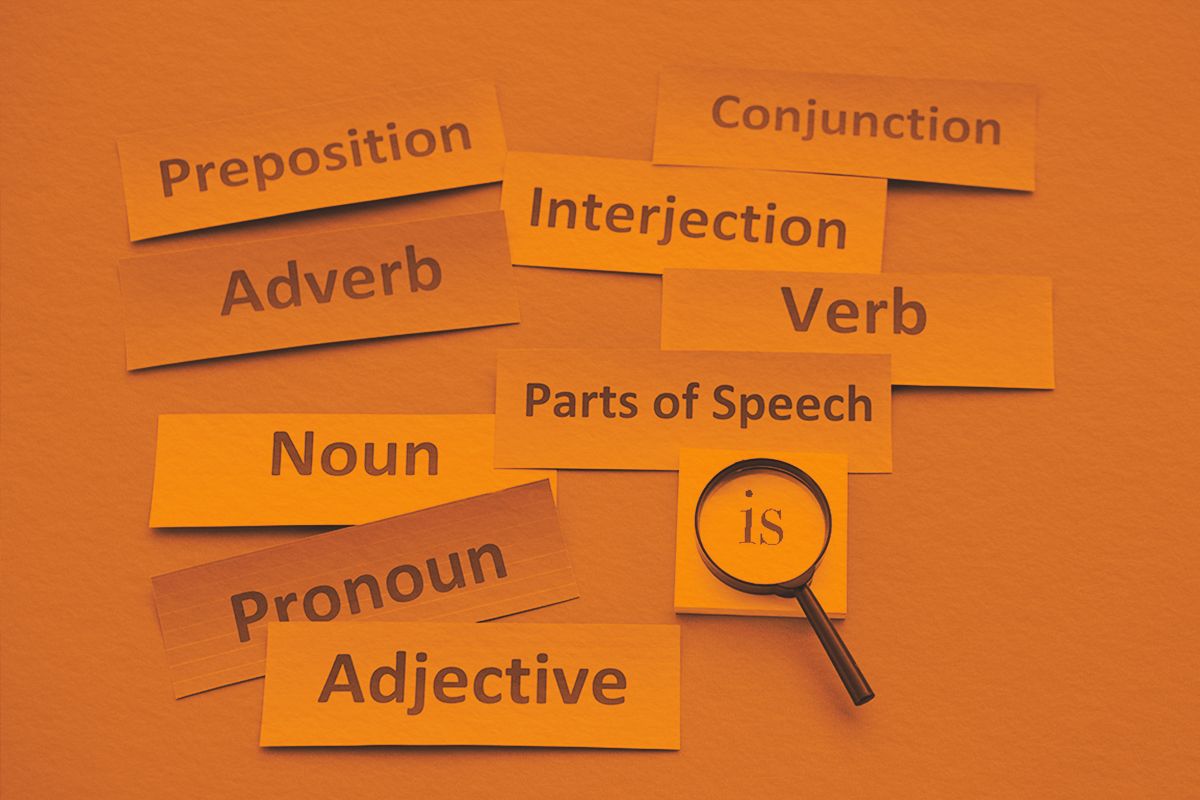
Most people have probably said the word “is” more times than their own name (it’s in this edition 30 times). It’s such a common term, in fact, that you might not have stopped to think about what “is” really … is. Thankfully, the answer is rather simple. In English, there are eight basic parts of speech: nouns, pronouns, verbs, adverbs, adjectives, articles, prepositions, and conjunctions. “Is” falls squarely into the verb category, as it’s a conjugation of the verb “to be.”
Advertisement
“To be” is one of those irregular verbs that you just have to memorize. In the present tense, the conjugation is: “I am,” “you are,” “we are,” “they are,” and “he/she/it is.” “Is” is the third-person singular form.
“Is” commonly acts as a linking verb — a type of verb that doesn’t describe an action, but still builds a bridge between the subject and the predicate. Take these examples: “Mona is my cousin,” “Your dress is beautiful,” and “She is 25 years old.” In these instances, “is” links the subject (“Mona,” “dress,” “she”) to another noun (“my cousin”), adjective (“beautiful”), or longer clause (“25 years old”).
When “is” serves as an auxiliary verb, it’s a helper verb that lends support to the main verb of a sentence. For instance: “It is going to rain on Saturday” and “Mom is buying a cake for the party.” In both of these cases, “is” is not the main verb, but rather a verb that lends support to the main verbs “going” and “buying.” The purpose of using the auxiliary verb is to add meaning, clarify tense, or shape mood.
Watch out for “is” and tipping your sentences into passive voice. We’ll cover this more in a future edition, but for now, if “is” is the main verb in your sentence, try to rework it to use a more active verb. (Example: “The guitar is being played by Jaime” vs. “Jaime played the guitar.”) Sentences that rely on “is” and passive voice can be unnecessarily confusing. This simple act of self-editing can bring your sentences into an unmistakably clear and active voice.
Featured image credit: tawanroong/ Shutterstock
Advertisement
More from our network
Word Smarts is part of Inbox Studio, which publishes content that uplifts, informs, and inspires.
Starting about 10 to 15 years ago, “cutting the cord” became a big phrase in regard to technological independence. We were saying goodbye to wired internet connections, eschewing cable services in exchange for streaming platforms, and replacing home phones with mobile-only lines. “Cut the cord” has long been an idiom used to describe a greater sense of independence, but it is not limited to and didn’t start with technology (even though “cord” may imply as such).
The word “cord” first appeared in English during the 1300s, long before cable television existed. It came from the Old French corde, and it meant “a string or small rope composed of several strands twisted or woven together.” During the late 14th century, “cord” took on a more figurative meaning, referring to anything that binds or restrains. In a technological sense, many materials have been used for cords. In the 1720s, scientists discovered that electricity could travel along metal, but the first power distribution system wasn’t invented until 1882, by Thomas Edison. He used copper rods, wrapped in a natural jute fiber, overlaid with a coal-like substance. The next progression came from Charles Goodyear: He patented vulcanized rubber in 1844 and it was applied to electricity in the late 19th century through the 1940s. The most current iterations of cords use PVC to insulate the metal wires. With the advent of battery technology, the word “cordless” became a popular term in 1905, specifically with regards to items that were battery-powered.
Advertisement
The first recorded use of the expression “cut the cord” was in 1950 in Roosevelt in Retrospect, a book by John Gunther. In that work, Gunther wrote, “Step by step, little by little, FDR became free [of his mother’s influence.] In a sense, it was the paralysis that cut the cord.” This usage referred to a mother’s umbilical cord, and a metaphorical attachment to a child later in life. A similar idiom, “cutting the apron strings,” also refers to an extended (sometimes unhealthy) attachment to a mother.
Idioms tend to have a life of their own, though, and while the original usage was related to mothers and children, the wording was too perfect not to be imbued with a stronger technological connotation in the 21st century. This was due to the very literal shift away from the cords of physical electronics. When somebody cancels their cable subscription and signs up for a streaming service, or finally unplugs that last telephone jack, that person has “cut the cord.”
Featured image credit: GoodLifeStudio/ iStock
Advertisement
More from our network
Word Smarts is part of Inbox Studio, which publishes content that uplifts, informs, and inspires.
Sometimes shorter is better, especially when it comes to lines at the airport or how long you wait on hold with the cable company. Shakespeare wrote in Hamlet that brevity is the source of wit; it’s also the key component of abbreviations. Certain abbreviations have become an indelible part of the English lexicon, and some of these newly coined phrases have superseded their original meaning altogether. For instance, if you say, “répondez s’il vous plaît,” you’re likely to get confused stares. But write “RSVP” on an invitation, and people will know exactly what you mean.
The point of abbreviations is to make things more concise and easy to understand, but there are different types, and the distinctions affect how they are used. Any shortening of a word or term is an abbreviation (from the Latin brevis, meaning “short”), but two of the more popular forms are acronyms and initialisms. Let’s take a look at what makes each one unique.
Advertisement
An acronym is a word formed from specific letters of the individual words it represents. Most often this means taking the first letter of each of those words — for example, “NASA” stands for “National Aeronautics and Space Administration.” Another defining trait for acronyms is how they’re pronounced: An acronym sounds like a word in itself instead of a series of individual letters. Other familiar acronyms include “POTUS” (president of the United States), “VIN” (vehicle identification number), and one of the most recent, “YOLO” (you only live once). Occasionally, an acronym will become so ubiquitous that it’s adopted as a standard word in the dictionary — “radar” (radio detection and ranging) and “scuba” (self-contained underwater breathing apparatus), for example.
Initialisms are formed in the same way as acronyms, often using the first letters of each word. (An exception might be if a second letter is chosen, or an article is skipped.) The major difference, however, is that each individual letter of the initialism is pronounced. Common examples include “USA” (United States of America), “HTML” (Hypertext Markup Language), and “BTW” (by the way). BTW, there are a few, albeit rare examples of abbreviations that can be treated as both acronyms and initialisms. One prime example of this is “ASAP,” which is commonly pronounced as either “EH-sap” or “A-S-A-P.”
Featured image credit: WINDCOLORS/ Shutterstock
Advertisement
More from our network
Word Smarts is part of Inbox Studio, which publishes content that uplifts, informs, and inspires.
Grammar 101 tells us that a common noun is any person, place, or thing. But when does a noun become a proper noun? Despite what the name may suggest, proper nouns have nothing to do with good etiquette, wearing a tuxedo, or having a British accent. Instead, the term refers to a noun that’s one-of-a-kind — a specific and individual person, place, or organization. Take, for instance, the Taj Mahal. There’s only one in the world. This means “Taj Mahal” is a proper noun, whereas the words “mausoleum” and “landmark” are more generic common nouns that could refer to the Taj Mahal, or a number of other places.
Advertisement
Proper nouns include people’s names, even if several folks share the same moniker. While there may be hundreds of individuals in the world named “Sandra Jones,” only one of them sits next to you at work. That level of specificity is enough to have their name classified as a proper noun. Brand names are proper nouns because there’s a distinction between “cookie” (a common noun referring to anything under the cookie umbrella) and “Oreo” (a proper noun designating the specific chocolate sandwich cookie originally made by the Nabisco company).
The easiest way to spot a proper noun in English is to look for capitalization. If someone writes the phrase “I like dolphins,” you can assume they’re referring to the animal in general. But if you see “I like the Dolphins,” it’s fair to assume they’re referring to the very specific NFL team called the Miami Dolphins. At the end of the day, specificity is the defining factor for proper nouns. If you’re talking about a person you know, a unique location, or the Big Mac you’re about to eat, chances are you’re using a proper noun.
Featured image credit: prashant1717shinde/ Shutterstock
Advertisement
More from our network
Word Smarts is part of Inbox Studio, which publishes content that uplifts, informs, and inspires.
When a certain nonsense word or spelling variation gets used often enough, it gains the attention of lexicographers and might eventually get the “official” dictionary seal of approval.
What do abominable snowmen and umpires have in common? Neither was supposed to be a real word. These terms — and others, including “nickname,” “syllabus,” and “expediate” — are the result of spelling errors or mistranslations that made their way into mainstream English. When a certain word or spelling variation gets used often enough, it gains the attention of lexicographers and might eventually get the “official” dictionary seal of approval. Let’s take a closer look at some words that started their journey into English as mistakes.
Advertisement
Nickname
We venture to say that as long as humans have been giving each other names, they’ve been shortening and familiarizing those names. In Middle English, the word for this familiarization was “ekename,” which literally meant “also-name.” The modern English word “nickname” evolved as a misdivision (a linguistic term that describes when spelling mix-ups occur between syllables over time) of the two words “an ekename.” By the 15th century, the word “nekename” was solidified into English, and eventually, the spelling evolved into the modern English variation of “nickname.”
Abominable Snowman
The name for the mythical mountain beast arose as a mistranslation of a Tibetan name in the 1920s. A journalist was interviewing members of a 1921 Mount Everest expedition and incorrectly reported a name as metoh kangmi, meaning “filthy snowman.” The true name that the explorers gave the yeti (a Sherpa term) was likely a combination of mi (“person”) and dom (“black bear”). The word “abominable,” meanwhile, is a Middle English word meaning “causing moral revulsion” — quite a harsh mistranslation for the hairy Himalayan creature.
Advertisement
Scandinavia
Roman philosopher Pliny the Elder changed European geography — or at least its spelling — forever when he called northern Europe “Scandinavia,” rather than “Scadinavia” (sans the first “n”). Pliny’s misspelling soon became commonplace, and the original name was left behind.
The name for this region (traditionally referring to Denmark, Norway, and Sweden) comes from the Germanic word Scadinavia, which evolved from skadinaujo, meaning “Scadia Island,” in which aujo means “thing on the water.” At the time of its Germanic naming, Scandinavia might have been an island, because the coastlines of the Baltic Sea have changed dramatically due to drainage, ice cap melt, and other natural events.
Syllabus
If it weren’t for a reading error, we would be checking our class “sittybos,” not “syllabus.” The word for a course outline originated in ancient Greece as sittybos, but when the Romans adopted the word into Latin, it was apparently misread and entered into official sources as syllabus. One of the earliest examples of this appears in Cicero’s At Atticum, a collection of letters between Cicero and his friend Titus Pomponius Atticus. Within the next few centuries, syllabus was inscribed into Late Latin, with no sight of the original sittybos.
Advertisement
Umpire
“Umpire” entered English as a mistranslated French loanword. It stems from the Old French nonper, meaning “odd number, not even,” in reference to a third-party authoritative judge. When it was brought into English, the initial “n” was incorrectly dropped because the word was heard as “an oumpere.” The misdivision result, “umpire,” became the official English version of the word by the mid-14th century, when it was used as legal jargon. It was eventually brought into gaming and sports (where it’s most commonly used today) in the early 18th century.
Ingot
An ingot (a block made of a metal such as steel, gold, or silver) should be a “lingot.” When this word was adopted into English from French in the late 14th century, the “l” at the beginning of the word was dropped. English speakers thought that the French were saying l’ingot (or le ingot, where le means “the”), so they dropped the “l” because they assumed it was an article. “Lingot” originally came from the Old English goten, meaning “to pour.”
Featured image credit: Vitalii Vodolazskyi/ Shutterstock
Advertisement
More from our network
Word Smarts is part of Inbox Studio, which publishes content that uplifts, informs, and inspires.
Cataracts in the forest, rhubarbs on the baseball field — what’s going on here? These phrases might sound like the makings of a nursery rhyme, but they’re in the context of little-used definitions of common words. In some cases, these obscure definitions are older than the words’ current primary uses, and they influenced the evolution of their modern definitions. Let’s learn more about how a cut can smart, why a stroll may be constitutional, and other lesser-known definitions.
Advertisement
Rhubarb
Primary definition: The thick leaf stalks of a cultivated plant of the dock family, which are reddish or green and eaten as a fruit after cooking.
Lesser-known definition: A heated dispute.
Better known as a vibrantly red garden vegetable, “rhubarb” can also refer to an intense argument or controversy. This peculiar bit of American slang was popularized by sports broadcaster Red Barber in 1943 when he described a heated scuffle between baseball players. Even earlier, sports reporter Garry Schumacher used “rhubarb” when he compared an on-field baseball squabble to a tangled mess of stringy cooked rhubarb. Schumacher furthered the comparison while reminiscing about his childhood, when neighborhood children used rhubarb sandwiches as ammunition during food fights. To Schumacher, “rhubarb” was a shoo-in for sportscasting slang.
Across the pond, “rhubarb” has another industry-specific usage: In British theater circles, “rhubarb” is the sound from a group of background actors, intended to simulate indistinct conversation and general crowd noise.
Cataract
Primary definition: A medical condition in which the lens of the eye becomes progressively opaque, resulting in blurred vision.
Lesser-known definition: A large waterfall. A sudden rush of water; a downpour.
Today, it’s much more common to talk to an older relative about their cataract surgery than about an impressive waterfall, but the latter was the original usage of the word “cataract.” You might say, for example, “The log traversed the cataracts of the Niagara River,” or, “The storm brought cataracts of rain.” This original usage stems from the Latin cataracta, meaning “waterfall.” Cataracta has a secondary definition in Latin as well: portcullis, the word for a heavy iron gate found in medieval fortresses. The modern term for the ocular condition likely evolved from this definition — a gate is a blockage, just as a cataract blocks vision.
Advertisement
Constitutional
Primary definition: (adjective) Relating to an established set of principles governing a state.
Lesser-known definition: (noun) A walk, typically one taken regularly to maintain or restore good health.
As a political buzzword, “constitutional” relates to set principles that govern a state. However, the wellness-related definition has been around longer. Since the 1680s, “constitutional” has been used as an adjective meaning “relating to someone’s physical or mental condition.” This evolved into the noun “constitutional” to describe a walk that had health benefits, as in, “The sunny autumn day was perfect for a constitutional.” Using “constitutional” in reference to being allowed by a state’s constitution came about in the mid-1800s.
Smart
Primary definition: (adjective) Having or showing a quick-witted intelligence.
Lesser-known definition: (verb) Feel or cause a sharp stinging pain.
“She tried to distract herself from the smarting of the bee sting.” Even if you had never heard of this usage of “smart,” you can tell from the context that it describes something painful. This less-common usage of “smart” is actually the oldest, found in Old English (as smeart) since at least the 12th century to describe a stinging action or feeling. The Old English variation smeortan meant “to be painful.” “Smart” wasn’t used to describe intelligence until the 17th century, perhaps stemming from the notion of using cutting or witty words — words that sting. In both usages — intelligence and pain — “smart” can be used as an adjective, noun, verb, and adverb.
Advertisement
Husband
Primary definition: (noun) A married man considered in relation to his spouse.
Lesser-known definition: (verb) Use (resources) economically; conserve.
A husband is a married man, but if someone husbands their resources, it means that they are frugal, conservative, or thrifty. To use both versions in context: “My husband husbanded his strength during the first half of the marathon,” means the speaker’s spouse saved some energy for the final part of the race. “Husband” has been used as a synonym for “conserve” since the 15th century, but the definition of a male spouse is slightly older, from the Old English husbonda.
Mean
Primary definition: (verb) Intend to convey, indicate, or refer to (a particular thing or notion); signify.
Lesser-known definition: (adjective) Poor in quality and appearance; shabby.
“Mean” takes on many uses in English: a synonym for “malicious” or “unkind,” a mathematical average, and a word to convey intention (“You know what I mean?”), to name a few. Perhaps the least-used definition of “mean” refers to something as “inferior” or “of poor quality,” as in, “The roadside motel was mean, but we just needed a place to sleep for the night.” “Mean” has been used in this sense since the 14th century, when it was first used to describe people of lower rank or social class and evolved into describing objects and things as “run-down” or “lowly.”
Tattoo
Primary definition: (verb) Mark (a person or a part of the body) with an indelible design by inserting pigment into punctures in the skin.
Lesser-known definition: (noun) An evening drum or bugle signal recalling soldiers to their quarters.
The oldest definition of “tattoo” is also now the the least commonly used. Today, the word (used as a noun and a verb) is synonymous with decorative ink markings on the skin, but the original version of “tattoo” evolved from the 17th-century Dutch term taptoe. It meant “close the tap (of the cask),” from tap (“the faucet of a cask”) and toe (“shut”). The expression referred to the practice of police turning off tavern taps at closing time, and the phrase was adopted for the signal (drumming or trumpeting) used to call soldiers or sailors to quarters at the end of the night, as in, “The evening tattoo was heard throughout the barracks.” From that, “tattoo” came to mean any sort of rhythmic tapping.
“Tattoo” in the sense of body art has an entirely different etymology. It entered English in the mid-18th century from the Tahitian, Tongan, and Samoan word ta-tau.
Featured image credit: narvikk/ iStock
Advertisement
More from our network
Word Smarts is part of Inbox Studio, which publishes content that uplifts, informs, and inspires.
There are some ongoing debates where it’s impossible to come to a consensus — cats vs. dogs, Coke vs. Pepsi, summer vs. winter … the list goes on and on. But when it comes to grammar, there’s an explanation for every argument, no matter how confusing it may seem. Take, for instance, the debate over when to use “who” vs. “whom.” Some say that “whom” is archaic and outdated, while others insist that it still has an important role in the English language. Read on for a handy trick that will ensure you always know which “w” word to use, no matter the context.
Advertisement
Here’s the technical rule: “Who” is used when referring to the subject of the sentence, and “whom” is used when referring to the object of a verb or preposition. But let’s try to explain that in a way that you’ll remember when you’re mid-conversation.
If a person has completed an action or is being discussed, that means they’re the subject of the sentence. In this case, you should use “who” — for example, “Who ate all the cake?” or “Who wrote this article?”But if a person is having (or has had) something done to them, they’re no longer the subject, but rather the object of the verb. “Whom” is more appropriate in these contexts: “Whom do you like best?” and “Whom are you going to meet?”
As for that simple trick to help you get “who vs. whom” right each and every time? If the question can be answered with “he,” “she,” or “they,” you should use “who.” For example: “Who ate all the cake? / He ate all the cake.” But if the question is better answered using “him,” “her,” or “them,” then “whom” is the right choice. As a memory aid, remember that if the potential answer could be “him” (even if it actually is “her”), use “whom,” because they both end in a letter “m.” “Whom are you going to meet? / I’m going to meet him/her/them.”We hope that clears things up, so go out there and spread the word of your mnemonic who/whom trick.
Featured image credit: Steve Johnson/ Unsplash+
Advertisement
More from our network
Word Smarts is part of Inbox Studio, which publishes content that uplifts, informs, and inspires.
Prepositions are important building blocks of your sentences, but they often go unnoticed. But what’s so special about this part of speech and when do we need to use it?
Prepositions are a funny thing — not “haha” funny like your favorite stand-up comedian, but funny in the sense of wondering what they are and why you need them. A preposition isn’t a noun or verb; however, it adds plenty of context and nuance to a sentence. Prepositions can be a two-letter word or lengthy in the form of a prepositional phrase. But these vague descriptions probably don’t help to clear things up, so let’s review exactly what prepositions are and how they’re used. You’ll find that these words and phrases have been helping you communicate more clearly in almost everything you say.
Advertisement
The secret to understanding prepositions lies in the word itself: pre-position. Each one indicates the position of something or someone in relation to something else. Common examples include in, on, above, underneath, through, across, with, near, and between. Prepositional phrases combine one of these words with a noun or pronoun: for example, “in Paris” or “above her.” Prepositional phrases on their own aren’t complete sentences, however, and you still need to add a subject or verb to flesh things out: “The dog was lost in Paris”and “the light flickered above her” are complete clauses.
Prepositions can replace certain parts of speech. If you say, “The lollipop in the jar is for Barry,” then the prepositional phrase “in the jar” is being used to describe a noun, thus placing it in the position of an adjective. Let’s put a true adjective in that example. “The red lollipop is for Barry” — notice that “red” is serving the same purpose as “in the jar” in this context. We can do the same thing with an adverb. In the example sentence “The man danced across the room,” we could replace the prepositional phrase “across the room” with any number of adverbs to describe how he danced, including “vigorously” or “badly.”
Why would we do this? It’s the same reason we use prepositions at all: They provide context and nuance to communication by giving more information about something’s position. Maybe you want to tell someone the color of Barry’s lollipop, or maybe you want to let the babysitter know where it is located for an after-dinner treat. Thanks to the flexibility of language and the multiple parts of speech, you get to decide.
Featured image credit: Iryna Kalamurza/ Shutterstock
Advertisement
More from our network
Word Smarts is part of Inbox Studio, which publishes content that uplifts, informs, and inspires.
You likely learned this in high school English class, but do you remember what an idiom is? We’re not calling names — we’re talking about figurative language.
Did you know that you likely use idioms every day? The word “idiom” may sound like an element from the periodic table or a derisive term that you’d call a buffoon, but it’s actually an example of figurative language. Idioms are phrases that add color to conversation but are impossible to understand based solely on their literal meanings. Common examples include being “over the moon” and “killing two birds with one stone.” You probably understand these expressions because you’ve heard them a million times (an exaggeration, not quite an idiom), rather than because of how each individual word is defined.
In a strictly literal usage, idioms rarely make sense. This makes it especially difficult for non-native speakers to understand the approximately 20,000 (and growing) idioms found in the English language. To properly comprehend an idiom, intent and context are required. The more those elements are understood, the more likely you are to wrap your head around these fantastical phrases.
Advertisement
Four types of idioms are commonly used in English. A pure idiom is an expression for which it is impossible to determine intent from the words alone. One example of a pure idiom would be telling someone to “break a leg” when you mean “good luck.” A binomial idiom is two words joined by a conjunction — for example, “black and blue” or “fair and square.” Next up are partial idioms, which occur when a pure idiom is so well known that only a portion of the phrase is required to be understood. One of the most common examples is saying “when in Rome” while leaving off the second half of the idiom: “do as the Romans do.” Lastly, prepositional idioms combine a verb and a preposition to create phrases such as “arrive in” or “report on.” While these expressions are grammatically flawed, we still understand them as idioms.
Featured image credit: ersinkisacik/ iStock
Advertisement
More from our network
Word Smarts is part of Inbox Studio, which publishes content that uplifts, informs, and inspires.
We’ve all experienced déjà vu, but what about the opposite feeling of something familiar suddenly being completely unrecognizable? There’s a name for that, too.
The phenomenon of déjà vu — French for “already seen” — occurs when you walk into a new situation and find it oddly familiar, despite never having experienced it before. This unusual sensation can make your head spin until it dissipates in the blink of an eye. Most of us have experienced this before, but there’s another, lesser-known concept called jamais vu — it’s the exact opposite of déjà vu, in experience and literal translation, as it means “never seen” in French.
Advertisement
Jamais vu occurs when you’re in a familiar situation but suddenly feel as if you’re experiencing it for the very first time. This might manifest as a brief mental hiccup in your daily routine. Imagine, for instance, you’re driving on the same road you take to work every day when all of a sudden you aren’t sure if you should turn left or right. Normally making the correct turn is muscle memory, but this brief moment of forgetfulness is a prime example of jamais vu. Verbal slips — such as when you have a word on the tip of your tongue, or you can’t remember the name of a colleague of five years — also fall under the umbrella of jamais vu. Similarly, take the word “shampoo” and repeat it 15 to 20 times until it sounds like it’s lost all meaning. Logically, you still know what shampoo is, but jamais vu swoops in when the word seems to become unfamiliar.
The best way to understand jamais vu is by viewing it as a glitch in the system. There’s nothing wrong with getting flustered from time to time, as everything should return to normal shortly. If you’re feeling forgetful, just take a deep breath and remind yourself that it’s probably nothing more than a moment of jamais vu.
Featured image credit: YinYang/ iStock
Advertisement
More from our network
Word Smarts is part of Inbox Studio, which publishes content that uplifts, informs, and inspires.
Enter your email to receive daily lessons that dive into what makes English so fascinating. Each email is packed with odd rules, etymologies, and the tools you need to be a better communicator.
Sorry, your email address is not valid. Please try again.
Sorry, your email address is not valid. Please try again.