6 MIN READ

7 Literary References That Make You Sound Smarter

Some of our sharpest turns of phrase come with a literary pedigree. Here are classic references that add wit, depth, and a hint of erudition to everyday conversation — if you know how to use them.

by Rachel Gresh
ALICE IN WONDERLAND film, 1951 showing Alice and Hatter

If you want to add some literary flair to your writing, or simply sound more well-read, learning a few clever quotes and cerebral idioms goes a long way. From witty Shakespearean lines to references to classical mythology and timeless novels, these expressions can be used in modern conversation, bringing their rich history into daily life. Knowing their precise meanings can make your everyday speech sharper and more interesting. Whether contemplating bold decisions or acknowledging thankless tasks, these phrases replace dull words with more meaningful ones.

Cross the Rubicon

Meaning: To pass a limit or point that is reached when the results of one’s actions cannot be changed. 

Example: “The age of AI has crossed the Rubicon — there is no going back.” 

To cross the Rubicon is to take a decisive step at a critical moment. It comes from a real historical event: In 49 BCE, Julius Caesar and his army crossed the Rubicon River, which formed the border between Italy and Gaul. This violated Roman law and marked the start of a civil war. “Crossing the Rubicon” (or “passing the Rubicon”) has been used to refer to a metaphorical boundary since at least the 17th century, as seen in this 1626 letter cited in the Oxford English Dictionary: “Queen Dido did never more importune Æneas’s stay at Carthage, than his mother and sister do his continuance here at London … But now he is past the Rubicon.” 

The die is cast

Meaning: A process or course of action has been started and it cannot be stopped or changed.

Example: “The die was cast when the company announced the merger today.”

The Rubicon wasn’t the only metaphor born from Julius Caesar’s famous river crossing. As the legend goes, Caesar waded into the water and said, “alea jacta est,” meaning “the die is cast.” This saying refers to the literal action of rolling a die or dice. Once it is rolled, the outcome cannot be changed. Caesar was possibly quoting a line from a Greek play by Meander: anerriphtho kybos, meaning “let the die be cast.”

Mad as a hatter

Meaning: Severely mentally unsound. 

Example: “I can feel mad as a hatter when I’ve worked 10 days in a row with no break.”

Mad as a hatter” is an old-fashioned saying that describes someone as mentally unsound, though today it can be an idiom for calling someone or something unpredictable or absurd. The saying has a grim origin, dating back to the 18th-century hat-making industry. Safety standards were nonexistent at the time, and workers were exposed to toxic substances that resulted in physical symptoms and hallucinations. Though the saying predates the novel, Lewis Carroll popularized the idea in 1865 as a metaphor in Alice’s Adventures in Wonderland. The Hatter character, as he is called in the book, became known popularly as the Mad Hatter, furthering the phrase’s association with unpredictable behavior.

Advertisement
Quixotic

Meaning: Foolishly impractical especially in the pursuit of ideals. 

Example: “Her plan to save the old theater from demolition was quixotic, yet noble.” 

The word “quixotic” is actually an eponym, from the name of Don Quixote, the protagonist in Spanish author Miguel de Cervantes’ 17th-century novel of the same name. This adjective describes something that is “foolishly impractical, especially in the pursuit of ideals.” It can also carry an air of lofty or extravagant romantic ideas, marked by rash actions that are doomed to fail. Don Quixote was known for these very traits. “Quixotic” has been used in English since at least the 18th century.

It was the best of times, it was the worst of times

Meaning: The outcome is mixed.

Example: “Today was eventful. I lost my phone on the train, but then I got a promotion. It was the best of times, it was the worst of times.” 

In the opening line of the 1859 novel A Tale of Two Cities, Charles Dickens’ clever phrasing captures contradictions in a way that has withstood the test of time. This saying is still used when both good and bad things are happening at the same time. The rest of the opening is often discarded, but in it, Dickens continues to make contrasting comparisons: “It was the best of times, it was the worst of times, it was the age of wisdom, it was the age of foolishness, it was the epoch of belief, it was the epoch of incredulity, it was the season of Light, it was the season of Darkness, it was the spring of hope, it was the winter of despair …”

There's method to the madness

Meaning: There are good reasons for one’s actions even though they may seem foolish or strange.

Example: “I keep a dozen tabs open on my computer, but trust me, there’s method in my madness.”

This Shakespearean saying is a clever way to say, “There’s a reason behind these actions.” It likely comes from a line in Act 2, Scene 2 of Hamlet: “Though this be madness, there is method in’t.” Polonius says this in reference to Hamlet’s strange behavior since his father’s death, and the “method” in the idiom refers to Hamlet’s plan to feign madness to gain revenge. Later, Oscar Wilde used the phrase “method in his madness” in reference to the protagonist in his 1890 novel The Picture of Dorian Gray, further popularizing the saying.

Sisyphean task

Meaning: A task requiring continual and often ineffective effort. 

Example: “Trying to clear my inbox after the holidays is a Sisyphean task.”

A Sisyphean task is something that requires continual effort, though it is often unsuccessful. It comes from a story in Greek mythology, derived from the name of King Sisyphus of Corinth. When condemned to Hades, Sisyphus was given a grueling, eternal sentence: to roll a large boulder up a long, steep hill in the underworld. However, the boulder would roll back down every time, making the task endless and impossible. The adjective “Sisyphean” has been used metaphorically in English since the mid-17th century. 

Featured image credit: Allstar Picture Library Ltd/ Alamy Stock Photo
2 MIN READ

Why Is ‘Z’ the Last Letter in the Alphabet?

The letter “Z” has roots in the Greek letter “zeta,” the sixth letter of that alphabet. What happened to put “Z” at the tail end of our alphabet?

by Stewart Edelstein
Close-up of the alphabet letter Z

There are many ways to organize a list of terms. You could arrange them from shortest to longest, or vice versa. You could also list the terms alphabetically (the adjective for that is “abecedarian”), or you could arrange them in order of frequency. If the letters of the alphabet were arranged in order from most frequently used to least frequently used in the English language, it would look like this:   ETAOINSRHDLCUMFPGWYBVKXJQZ

But that’s not why “Z” comes in last place in the alphabet. The real explanation is historical, based on the relative superfluousness of the letter.

“Z” originated as the Phoenician “zayin,” the seventh letter of that alphabet, pronounced like our “Z.” It was initially depicted as an arrow, then reduced to three lines, similar to our “Z.” It was a glyph (a symbolic depiction) for a weapon or for two armies confronting each other, represented by two parallel lines. 

In the Greek alphabet, “zayin” became “zeta,” the sixth letter. When Latin borrowed “zeta” from Greek, it was listed in the alphabet in the same place as in Greek. 

 Then around 300 BCE, “zeta” was removed from the Latin alphabet under the Roman Censor Appius Claudius Caecus. Through the linguistic process of rhotacism, the “Z” sound had morphed to sound like an “R,” already represented by the letter “rho,” rendering “zeta” superfluous.

But around 200 years later, “Z” was reintroduced to the Latin alphabet in loanwords from Greek. By then, though, the position of “Z” in the alphabet had been taken by “G,” and “Z” was tacked on at the end.

Even though “Z” was once deemed superfluous, it would be catastrophic if it disappeared from our alphabet today. You couldn’t apologize, criticize, fantasize, incentivize, optimize, organize, prioritize, sympathize, or theorize. Do you realize or even recognize the problem? 

No zucchini, pizza, mozzarella, zest, zeal, zones, zippers, quizzes, sizzle, razzle-dazzle, or ZIP codes. No zero, which would create numerical havoc. Zowie!

Even some country names would disappear from the map: No Azerbaijan, Belize, Brazil, Czech Republic, Mozambique, New Zealand, Switzerland, Venezuela, or Zambia, not to mention Kazakhstan, Kyrgyzstan, and Uzbekistan. And what about Zanzibar, part of Tanzania?  

As you see, we need “Z,” even though it was once evicted from the alphabet.

Featured image credit: Kitch Bain/ Adobe Stock
2 MIN READ

What Is the Origin of ‘It Takes the Cake’?

This idiom has a surprisingly literal past — and an ironic twist that lets tone do all the work.

by Stewart Edelstein
Slices of cake on table with sprinkles

“Well, that takes the cake!” This statement, said with different intonations in two different contexts, can be interpreted as either high praise or derision. How can the exact same words convey such disparate meanings with only a shift in tone? 

“It takes the cake” can mean something is ranked first — or something is foolish or annoying. Let’s take a look at how this idiom has been used over the decades.

The earliest recorded use is from 1839, when a Lexington, Mississippi, newspaper alluded to cakes being offered as prizes at a fair: “We have been shown some [cotton bolls] that we thought hard to beat, yet this takes the cakes.”

That usage seems to be literal, but less than a decade later, the phrase was being used metaphorically, still referencing a prize. In 1846, an account of a horse race reported, “The winning horse take [sic] the cakes.”

The wording “takes the cake” expanded in meaning over the next few decades to refer to skill, not just winning prizes. This usage is seen in an 1886 article in the Pall Mall Gazette, a London-based newspaper: “As a purveyor of light literature, Mr. Norris takes the cake.”

As early as 1900, however, “takes the cake” acquired negative connotations. Read these next examples with a derisive tone, as opposed to the complimentary examples above. In Sister Carrie, published in 1900, Theodore Dreiser wrote: “Pack up and pull out, eh? You take the cake.” And in her 1938 book A Blunt Instrument, British author Georgette Heyer wrote: “I’ve met some kill-joys in my time, but you fairly take the cake.” This shift evolved out of the positive prize-winning, skillful sense being used ironically in negative contexts. 

As you see, “takes the cake” can refer either to something remarkably excellent, or to something outstandingly negative. Either way, it’s something extraordinary.

Featured image credit: Maryam Sicard/ Unsplash+
2 MIN READ

When Should You Use ‘Disinterested’ vs. ‘Uninterested’?

Despite their similarities, these words are not synonyms. Discover why you might be using “disinterested” incorrectly.

by Rachel Gresh
business team showing signs of boredom and fatigue

For 25 years, Judge Judy reigned as TV’s most famous courtroom reality star, presiding over small-claims cases with a hardball approach to her sentencing. Like any good arbitrator, Judge Judy was never uninterested, but she did remain disinterested. The courtroom context highlights the differences between these seemingly similar words. “Uninterested” means “not interested” — something Judge Judy certainly was not. However, “disinterested” means “unbiased,” which is a key characteristic of her success. Although these two terms are often used interchangeably, they have distinct meanings and should be used appropriately.

While “uninterested” conveys the commonly used meaning of “not interested” or “not having the mind or feelings engaged,”  “disinterested” is a bit more nuanced. It means “free from selfish motive or interest,” as in, “A disinterested third-party must stand as a witness.” Here, the prefix “dis-” means “apart from” or “away from.” However, “dis-” can sometimes mean “the opposite of,” as in “dislike.” This alternate usage could be why “disinterested” is often misused to mean “not interested.”

These terms have been intertwined since they entered English in the 17th century. Back then, “disinterested” meant “not interested,” and “uninterested” meant “unbiased” — the reverse of their modern meanings. Why the switch? The French word desinteresse, meaning “impartial,” was first translated into English as “uninterested.” Shortly after, “disinterested” came into use with the meaning of “not concerned.” By the late 18th century, their meanings had swapped, as the prefix “un-” became a common way to express the opposite of something, and “disinterested” aligned more closely with the original French spelling and sense of neutrality.

Here’s a mnemonic to help you remember the difference: “Disinterested” adds an “i” in the prefix, like the “i” in “impartial,” so a disinterested person is impartial, while an uninterested person just doesn’t care. 

Featured image credit: Jose carlos Cerdeno/ iStock
3 MIN READ

What Is the Origin of ‘Silver Bullet’?

The magical powers of the silver bullet are found in supernatural tales of werewolves, but the idiom extends to common usage as well. Where did this metaphor come from?

by Stewart Edelstein

In werewolf myths, silver is one method to kill the powerful creatures, so a silver bullet is sometimes the hero’s weapon of choice. When “silver bullet” is used in everyday English, however, it is usually in the negative sense: “There is no silver bullet for …” You can complete that sentence with any seemingly intractable, complex problem.

How did a silver bullet earn a reputation as an all-powerful weapon? There’s a long tradition in folklore and literature. 

The ancient Greeks believed that silver was a gift from the moon goddess, Selene, and that it had mystical powers. In Norse mythology, silver was believed to have protective properties, useful for warding off evil spirits. And in medieval European folklore, silver was imbued with magic used to repel werewolves and other supernatural creatures.

Silver’s reputation of mystical powers has endured through the centuries. In 1804, American poet Thomas Green Fessenden wrote about killing a witch: “how a man, one dismal night, / Shot her with a silver bullet.”

In the Grimm brothers’ 1812 fairy tale “The Two Brothers,” a huntsman shoots a witch with a lead bullet, but it has no effect. Then, the story continues, he “knew what to do, tore three silver buttons off his coat, and loaded his gun with them, for against them her arts were useless, and when he fired she fell down at once with a scream.”

A few decades later, in 1858, French writer Élie Berthet authored a novel based on the true story of the Beast of Gévaudan, a wolf that killed about 80 people in south-central France. In the real occurrence, a local hunter killed the beast using lead bullets, but in the novel, the facts were embellished by the use of silver bullets.

More recently, starting in 1949, the TV series The Lone Ranger featured a masked lawman who left a silver bullet for grateful law-abiding frontier folks before moving on to capture more desperadoes. Although the Lone Ranger used lead bullets to injure the bad guys, he named his horse “Silver.”

All these myths tell great tales, but they aren’t any more realistic than a metaphorical bullet solving a difficult problem. There is no such thing as a silver bullet — because of its low density and high melting point, silver is impractical for making bullets and far more expensive than lead. 

Featured image credit: fjdelvalle/ iStock
3 MIN READ

What Was the First ‘Elephant in the Room’?

You’ve likely used this metaphor for the obvious thing no one wants to talk about, but do you know where the original elephant came from?

by Stewart Edelstein
Isolated elephant toy

We each know of a topic we would rather not discuss — perhaps because it’s too sensitive, controversial, or emotionally charged. No one wants to cause embarrassment, sadness, or avoidable arguments. This topic that people dance around in conversation or outright ignore is called “the elephant in the room.” The idiom is widely used to mean “an obvious major problem or issue that people avoid discussing or acknowledging.”

If you break apart the metaphor, it makes sense — there’s a looming presence, but rather than deal with the elephant, everyone simply pretends it doesn’t exist. 

The elephant in question can be traced to a short story published in 1814 by Ivan Krylov, a Russian writer. “The Inquisitive Man” is an ironically titled fable about a man touring a museum who notices tiny things, such as beetles, but fails to notice an elephant in the room.

Fyodor Dostoevsky alluded to Krylov’s museum-going character in his 1871 novel, Demons: “Belinsky was just like Krylov’s Inquisitive Man, who didn’t notice the elephant in the museum.”

Advertisement

In 1882, Mark Twain further popularized the idiom in his short story “The Stolen White Elephant.” He wrote about the inept, far-ranging antics of detectives trying to find an elephant that was right before them. 

The elephantine metaphor evolved into its modern usage of avoiding difficult and obvious conversations as it spread through the public lexicon in the 20th century. In 1902, The New York Times published an article about a scandal involving vote-buying and corruption allegations surrounding NYC Police Chief Thomas J. Devery and the political organization Tammany Hall, in which the journalist used “elephant in the room” metaphorically to describe the way that scandal was being ignored by the media. In the 1950s, many journalists used “elephant in the room” to depict reluctance to discuss racism in America, even though it was a major societal problem. Sometimes the phrase is used to suggest big topics that can’t be ignored. In 1959, The New York Times used it in reference to school financing: “Financing schools has become a problem about equal to having an elephant in the living room. It’s so big you just can’t ignore it.”

The metaphor is now so widely known that it can be recognized visually. The New Yorker’s cover on November 17, 2014 (immediately after Republicans gained control of the Senate), featured a very large elephant on the couch in the Oval Office, with a glum President Obama at the Resolute Desk.  

Featured image credit: DV Imaginarium/ Adobe Stock
2 MIN READ

Are You Using ‘Begs the Question’ Wrong?

“Begs the question” is a common phrase to introduce a follow-up question, but it’s technically incorrect. The mix-up is the result of a translation rooted in philosophy.

by Rachel Gresh
Several question marks

“Begs the question” doesn’t always mean what you think it does. It’s often used as a synonym for “raises the question,” but by formal standards, that’s not quite right. Consider this example: “Another major department store is closing its doors. This begs the question: Are shopping malls going extinct?” As you can see, the phrase often introduces a follow-up question, or, as Merriam-Webster puts it, it “elicits a question logically as a reaction or response.” However, this modern usage isn’t historically accurate.

The phrase dates back to Aristotle’s principles of formal logic. It comes from the Latin petitio principii, meaning “assuming the original point.” “Begging the question” is the fallacy of assuming the conclusion is within your premises. In simpler terms, it’s when your argument already assumes the very thing it’s trying to prove. This results in a logically flawed circular argument.

In the context of this philosophical argument, petitio principii was translated into English as “begging the question” during the 16th century, originally meaning “to pass over or ignore a question by assuming it to be established or settled.” It uses an archaic definition of “beg,” meaning “to take for granted the matter in dispute” or “to assume without proof.” 

A more precise modern translation of petitio principii might be “assuming the original conclusion.” For example, “Wool sweaters are better than cotton sweaters because they contain more wool” begs the question, since it assumes what is already established (wool is better than cotton). A correct philosophical usage of “begs the question” would be: “The car commercial begs the question when it says the brand is superior because it sold more cars last year.”

You can now see why those who favor the philosophical version dislike the modern usage — the two are very different. However, in informal situations, using “begs the question” to mean something like “raises the question” is widely understood, and dictionaries  recognize it as valid. Nevertheless, this usage should be avoided in formal writing.

Featured image credit: Alexander Mils/ Unsplash+
3 MIN READ

What Is the Origin of ‘The Whole Shebang’?

When you ask for “the whole shebang,” do you know what a shebang is? Now it’s a nonsense word, but it used to carry a few different meanings.

by Stewart Edelstein
wooden shed in forest

What’s a shebang, is there such a thing as part of a shebang, and what’s the origin of the idiom “the whole shebang”?  

These are important questions, and we find some answers in the earliest usage of the word. Merriam-Webster says it appeared in English during the Civil War, as seen in Walt Whitman’s diary entries. He used “shebang” to refer to a type of crude dwelling: Soldiers were living in “shebang enclosures of bushes” and coming “out from their tents or shebangs of bushes.”

A few years later, Mark Twain used “chebang” (an alternate spelling) to refer to any matter of concern. “I like the book, I like you and your style and your business vim, and believe the chebang will be a success,” he wrote in a letter to his publishers in 1869. To complicate matters, in 1872, Twain used “shebang” in reference to a vehicle in his novel The Innocents at Home: “You’re welcome to ride here as long as you please, but this shebang’s chartered.”  

The meaning of “shebang” as it relates to a structure was expanded in 1878 in Hallock’s American Club List & Sportsman’s Glossary: “Shebang, any sort of structure from a shanty to a hotel.” And in 1901, Canadian novelist H. G. Parker authored a book about a heavy-drinking Montreal lawyer, in which he wrote, “There were people who called the tavern a ‘shebang.’”

None of these writers coined the term — they were using it because it was already in the wider lexicon. So where did “shebang” come from? Both Merriam-Webster and the Oxford English Dictionary point out its obscure origin, but that obscurity hasn’t stopped etymologists from speculating.

There are a few possibilities:

  • Irish, seibin, “a small mug,” which in English became “shabeen, shebeen,” meaning an illegal drinking establishment 
  • Irish, síbín, meaning “illicit whiskey”
  • French, chabane, meaning “hut”
  • French, char-á-banc, meaning “a carriage or coach with benches”

Each of these options can address some 19th-century usage of “shebang,” but what about the idiom “the whole shebang”? “The whole shebang” is recorded from 1869, but how it relates to huts, structures, hotels, taverns, or vehicles is unclear. The saying is used to mean “everything that is included in something.” The fact is that some idioms have unknown origins. It may simply be that “shebang” came to refer to so many disparate things that it now refers to the whole of just about anything — the whole shebang.

Featured image credit: D. Lentz/ iStock
4 MIN READ

9 of the Most Overused Words in English (and What To Use Instead)

Certain words are overused to the point that they lose their meaning and intended impact. Here are nine examples, as well as some alternatives to use in their place.

by Bennett Kleinman
Opened dictionary

If you open a copy of Merriam-Webster’s dictionary, you’ll find thousands of words at your fingertips. With an almost limitless vocabulary  to choose from, it makes you wonder why some people consistently repeat the same boring, basic terms over and over. If everything is “good,” can anything be “better” or “best”? Varying your word choice makes for stronger writing and more engaging speech. Here’s a closer look at nine of the most overused English words, and some alternative options to give your message more nuance. 

Bad

Overusing the word “bad” is, well, bad. According to the mega-popular YouTube account Interactive English, “bad” is the 23rd most common English adjective, used to describe all sorts of unpleasant situations. The issue is that while “bad” does an OK job of conveying negativity like it’s supposed to, it also omits details that could make the story more interesting. For example, if you’re feeling ill and a friend asks how you are, responding with “achy” or “nauseated” paints a clearer picture than “bad.”

Very

While it’s very useful, the word “very” can almost always be swapped out with a more descriptive alternative. Open up the thesaurus and look for synonyms that match the intensity you’re looking for. For example, “jubilant” can replace “very happy” and “vile” can substitute for “very mean.” 

Like

When using “like” to introduce a set of examples, it’s best to swap out the word for “such as.” If you say, “The lunch will have several vegetarian options, like tomato soup, quiche, and a portobello sandwich,” that technically reads as if the lunch options will be similar to the listed items, but may not include those items. Use “such as” instead of “like” to clarify that you mean the listed examples.  

Many

The word “many” is among the vaguest quantifiers imaginable. “Many” to one person may be five, but to another, “many” may be 500. If you know the exact number or a close estimate, we suggest using that instead of “many.” If you don’t have a numerical estimate, there are plenty of synonyms to describe amounts, such as “countless,” “droves,” “copious,” “sundry,” “abundant, “myriad,” or “umpteen” — pick one that works for your context. 

Advertisement
Nice

While “nice” is a familiar and versatile word, it’s been overused to the point that it’s just plain boring. It also leaves out details that could potentially make a more intriguing point. For example, instead of telling a colleague they had a “nice idea,” consider describing it as a “thought-provoking idea.” And instead of calling someone “nice,” say they’re “kind” or “charming.”

Thing

Without context, the word “thing” doesn’t mean much. If you don’t know what an object is, call it a gadget, device, tool, or even a thingamabob (it’s in the thesaurus). If you’re detailing things you have to do, tell someone about your plans, activities, exploits, or undertakings. If you need to say you have things on your mind, you could instead talk about your feelings, concerns, matters, worries, or preoccupations. If you can’t remember that thing someone said, maybe it was a remark, a statement, an utterance, or a pronouncement. When it comes to “thing,” there’s always a better synonym. 

Basically

Not only is “basically” basic, but its presence is almost always unnecessary. There’s no reason to start a sentence with “basically,” as it’s just filler before getting to the point. If you need an adverb to make the point,, we’d suggest “fundamentally” or “essentially,” both of which add nuance to your message. 

Amazing

We’ve all claimed that something is amazing even if it’s only mildly OK. But even if something wows you, “amazing” has been overused to the point that it has lost any power it may have once had. Consider alternatives such as “remarkable,” “stupefying,” “prodigious,” or “marvelous.” If you hear something is “amazing,” you may take it with a grain of salt, whereas hearing that something is “thrilling” means it warrants attention.

Really

People really enjoy using the word “really,” despite it lacking specificity. Such is the case with most adverbs, which can often be replaced with a stronger alternative verb (“devoured” instead of “ate quickly,” for example). Try swapping out “really” for a less overstated term, such as “genuinely.” Using a more specific adverb will add emphasis and sincerity.

Featured image credit: DrAbbate/ iStock
2 MIN READ

Is ‘Either’ Pronounced ‘EE-ther’ or ‘EYE-ther’?

“Either” is a flexible word; not only can it serve as an adjective, pronoun, conjunction, or adverb, but it also has two widely accepted pronunciations.

by Rachel Gresh
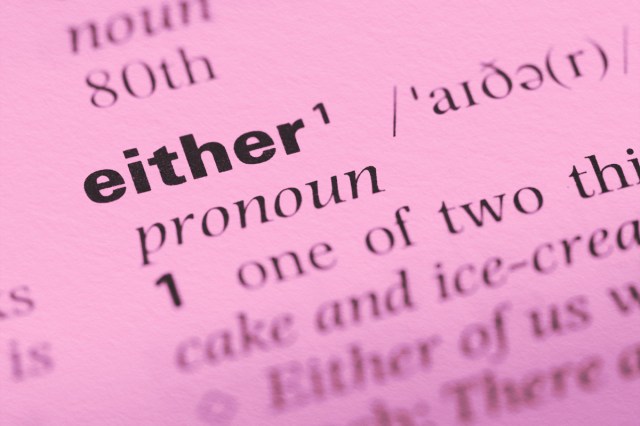
Close up of old English dictionary page with word either

How do you pronounce the first vowel sound in “either”? It’s one of the most commonly used English words, yet its pronunciation isn’t settled, as is apparent in popular movies. In The Lion King, for instance, Rafiki tells Simba, “The past can hurt. But the way I see it, either [EYE-thur] you run from it or learn from it.” But in The Dark Knight, Harvey Dent notoriously claims, “You either [EE-thur] die a hero, or you live long enough to see yourself become the villain.” So, which Hollywood blockbuster got it wrong? Neither. (“NEE-thur” or “NYE-thur”?)

As it turns out, both pronunciations are perfectly acceptable. According to Merriam-Webster‘s pronunciation guide, this word can be pronounced /ˈē-t͟hər/ (“EE-thur”) or /ˈī-t͟hər/ (“EYE-thur”). Similarly, the Oxford English Dictionary pronunciation guide states that the word can be pronounced two ways: /ˈiːðə/ (“EE-thuh”) or /ˈʌɪðə/ (“EYE-thuh”). The ending syllables differ between dictionaries, based on American and British English vowels.

An English teacher and translator who hosts a YouTube show called “English with Max” addressed the issue in a recent episode. She explained that “EE-thur” is more popular among Americans, while “EYE-thuh” is slightly more common among the British. In her home country of Australia, both pronunciations seem to be used equally. This rule applies similarly to “neither“: Both versions, “NEE-thur” and “NYE-thur” are correct.

The vowel shift appears to have occurred naturally over centuries, but a closer look at the etymology of “either” reveals what could be the original pronunciation. The word stems from the Old English ægðer, a contraction of æghwæðer, meaning “each of two, both.” In Old English, the vowel æ was pronounced like the “a” in “bad,” the consonant “g” could be pronounced like “y” (Old English ġeard is “yard”), and the letter ð (known as “eth”) was pronounced like the “th” in “then.” Putting all of this together, the supposed Old English pronunciation sounds closer to the modern “EYE-thur.” 

Featured image credit: TungCheung/ Adobe Stock