Mastering the use of “may” is crucial for polite conversation, but throwing “might” into the mix makes everything more complicated. When and where do you use each?
Correctly using “may” is an important lesson in politeness. If you ever asked a teacher, “Can I use the restroom?” only to receive a response of “I don’t know, can you?,” that was likely frustrating, but that teacher was looking for you to ask, “May I use the restroom?” “May” refers to possibility while “can” is about one’s ability to do something. Once you’ve mastered that lesson, the next step is to learn the difference between “may” and “might.”
“May” and “Might” are both modal verbs, meaning they are used with a primary verb to express situations of possibility, necessity, and permission. Other modal verbs include “can,” “could,” “should,” “ought to,” and “would.” With “may” and “might,” the meanings to express permission and possibility are similar, and some people use them interchangeably. However, “may” is mostly used in the present and future tenses, while “might” is often used in the past when expressing possibility. When you say, “I may go to the store,” it’s happening soon or about to happen. “I might have gone to the store if I had more time” is the past tense, but it also addresses the possibility that something could have happened, but it didn’t.
In the context of permission, “may” is usually the right call, because asking if you “might” do something indicates something that is unlikely to happen. “May I have another piece of cake?” is a polite question. “Might I have another piece of cake?” sends the situation into the hypothetical. However, British people use “might” in place of “may” as a request for permission. But in American English, stick to “may.”
Finally, “may” and “might” address two different versions of hypotheticals. A famous nursery rhyme shows this overlap:
Star light, star bright,
First star I see tonight;
I wish I may, I wish I might
Have the wish I wish tonight
“May” usually refers to a hypothetical statement that is actually possible, but “might” indicates you’re reasonably sure that something will not occur. For example, I may be able to still do a cartwheel. But might I suddenly master a backbend? Past experience points to the unlikeliness of the possibility.
Saying “you might remember” implies they likely don’t remember that situation, so keep your tone in mind. Likewise, giving a warning of “I might be late” is polite, but it suggests that it’s unlikely. Do these strictly apply to casual conversations? Not always — but these are the slight nuances in how “may” and “might” differ from each other.
Featured image credit: monkeybusinessimages/ iStock
Advertisement
More from our network
Word Smarts is part of Inbox Studio, which publishes content that uplifts, informs, and inspires.
When perusing an older edition of a dictionary, you might find a definition of a word that’s entirely different from how you use it today. What is the “semantic shift” that makes this happen?
If scientists get busy developing time travel, we’re going to have some very confusing conversations between people from different eras. Slang is constantly updating and developing with new generations, and even existing words change meaning over time. A conversation can get derailed by a single word when the participants don’t agree on its meaning. For example, describing a sunset as “awful” could have two distinct meanings. In its original usage, the meaning was “inspiring reverential wonder or fear,” describing anything that inspired the feeling of awe in a person. But these days, “awful” has shifted to mean “very bad or unpleasant.” This didn’t happen because a bunch of dictionary professionals (lexicographers) suddenly changed their mind about a definition; instead, these changes are a result of a phenomenon called semantic shift.
“Semantic” means “relating to meaning in language or logic.” It comes from the ancient Greek words sēmantikos (“significant”) and sēmainein (“signify”). Semantics are about the words we use to point out what we mean. When someone claims “it’s just semantics,” they’re not saying that the words don’t matter. They’re pointing out that the meaning is more important than the specific word choice. In the case of semantic shift, it usually occurs because of societal forces happening around the words.
The funniest instances of semantic shift happen when a word ends up with an entirely opposite meaning to what it started with. For example, the original definition of “egregious,” documented back in the 1500s, was positive: “distinguished, eminent, great, or renowned.” From its literal Latin origin, it meant “standing out from the flock.”
However, the Oxford English Dictionary identifies an ironic use of that positive definition even back in the day. Since “egregious” was a synonym for “exceptional,” calling someone an “egregious liar” was an effective juxtaposition. That was the beginning of the semantic shift: winking irony to the understood meaning. A new, widely understood meaning of “egregious” shifted to “bad, wrong, outrageous, or offensive,” and eventually that became the primary use of the word.
There are a lot of different ways for semantics to shift, but popular culture is a major factor. Think of the recent update to the definition of “literally” — while the literal definition still stands, we now use it to also stand in for “figuratively.” As words’ meanings shift, so do our perceptions.
Featured image credit: Ljupco/ iStock
Advertisement
More from our network
Word Smarts is part of Inbox Studio, which publishes content that uplifts, informs, and inspires.
“Madam, I’m Adam” — an introduction, and a well-known example of a palindrome. A palindrome is a word or phrase that reads the same forward and backward.
There’s common sense in many of the grammar rules we’ve memorized over the years. Sentences start with a capital letter, questions end with a question mark, and apostrophes are used for possessives and contractions. But what about the more whimsical aspects of language? Some literary devices exist solely to put constraints on language, so that those limitations might fuel creativity. For example, a palindrome is a word or phrase that reads the same backward as they do forward. They’re a symmetrical collection of letters (excluding punctuation and spaces). Our examples are fanciful, but a writer might purposely use the palindrome “civic” instead of “public” if they want to emphasize equality, or a poet might string together a palindrome in an effort to display a theme of duality. Composing a palindrome is no easy feat — the longer they run, the harder they get. Here are a few prime examples of palindromes that might win you big-time conversational points.
Race car
Two words, seven letters
We’re starting off small. The classic, two-word palindrome is appreciated by preschoolers and NASCAR fans everywhere.
Dammit, I’m mad
Three words, 11 letters
The curse word may be spelled incorrectly, but this is a popular palindrome on internet message boards. It’s a pure expression of frustration, either backward or forward.
Never odd or even
Four words, 14 letters
It’s another classic, but this palindrome might send you down an existential tangent.
Advertisement
Satan, oscillate my metallic sonatas
Five words, 31 letters
Just because it’s the same forward and backward doesn’t mean it has to make sense. Case in point: this abstract request for the devil himself. Satanoscillatemymetallicsonatas was the title of a bonus disc included in a limited edition release of a 1992 Soundgarden album, Badmotorfinger. Are metallic sonatas a metaphor? Is the speaker referring to the oscillations of the sonatas’ sound waves? Only the band knows.
Marge lets Norah see Sharon’s telegram
Six words, 32 letters
Did we miss this palindromic storyline on The Simpsons? Marge is betraying Sharon but letting Norah get in on all the gossip.
Doc, note: I dissent. A fast never prevents a fatness. I diet on cod.
Fourteen words, 51 letters
This palindrome might be as indecipherable as the doc’s handwriting. It’s interesting dietary advice from a patient who has taken nutrition into their own hands.
Woulda, Coulda, Shoulda: Why We Combine Certain Words
Elision — the act of dropping sounds in everyday speech — is a valuable tool for both native English speakers and learners. It allows speech to become more colloquial, resulting in a natural flow of words.
You’ll hear “I’d like an ice tea, please” in restaurants across America — but “ice tea” isn’t a new beverage that replaced the tried-and-true “iced tea.” The linguistic phenomenon of omitting sounds or syllables while speaking is called “elision,” and it’s pretty common. In fact, we’ve gained some of the most popular words in modern English from this practice. From our favorite contractions (“I’m” and “let’s”) to the most popular English word to express farewell wishes (can you guess what it is?), elisions are a staple of everyday English.
What Is an Elision?
“Elision” is a noun that derives from the Latinelisionem, meaning “a striking out” or “a pressing out.” This ancient usage continues to influence the word’s definition today. “Elision” can be the act of removing a passage in a book, speech, or film, or it can refer to the process of merging things, especially abstract ideas. If we join these definitions together in the context of grammar, we can conclude that an elision is the act of omitting a sound or syllable when speaking (to make pronunciation easier or faster), sometimes by merging two or more words. An elision can be the omission of a consonant, a vowel, or an entire syllable.
Isn't Elision Just a Contraction?
All contractions are examples of elision, but an elision isn’t always a contraction. That said, the most frequent examples of elision in modern English are contractions, which omit a sound from one or two of the words that are part of the contraction. For instance, “I’m” combines “I” and “am” while dropping the “a” sound, which is a type of elision. Informal contractions, such as “woulda” (“would have”) or “gonna” (“going to”), follow this same pattern of omission to facilitate easier pronunciation.
Advertisement
Everyday Examples of Elision
Elision takes on many forms. Take the earlier example of dropping the “d” in “iced tea.” This illustrates the idea that elision is based solely on pronunciation; it isn’t related to spelling (you wouldn’t spell “iced tea” without the “d,” but you might omit the letter when pronouncing it). “Family” is similar. The “i” in family isn’t silent, and if you pronounce it slowly, you’ll hear it, but when speaking casually or quickly, it probably sounds more like “fam-ly.” This is also true of the American English tendency to drop the “g” at the end of verbs, as in “gone fishin'” or Smash Mouth’s song “Walkin’ on the Sun.” These terms demonstrate that, although elision is a lesser-known phenomenon, it’s something we all use daily.
Finding the Good in Goodbye
Perhaps one of the most interesting instances of elision is the word “goodbye,” which is an elision of the longer phrase “God be with you,” a popular medieval farewell. A look into the etymology of “goodbye” shows elision in action. By the mid-17th century, the phrase had already morphed into a single word, “godb’w’ye,” and as time passed, letters continued to be omitted until the 18th century, when “goodbye” emerged. By 1709, a shorter word, “bye,” appeared, marking the end of the word’s centuries-long journey.
Advertisement
Why Do We Drop Certain Sounds?
According to Li‑hua MA, author of “An Analysis on the Phenomenon of English Elision and Its Formation,” the cause of elision is individualized. It depends on the context, spelling, and formation of the word. For instance, in the case of elision in unstressed vowels, such as the “i” in “family” or the “o” in “factory,” elision is caused by the location of the vowels. Here, the unstressed vowel is between two consonants, causing us to forgo its pronunciation naturally. It’s a mouthful to include another sound between two consonants.
This happens to unstressed consonants as well, especially “d” and “t,” as in the examples “next door” (the “t” in “next” is omitted) and “soundtrack” (the “d” in “sound” is omitted), because of the stressed consonant that follows them. This is what happens to “iced tea” — the “d” in “iced” is overpowered by the “t” in “tea,” causing us to skip the “d” when speaking naturally.
Elisions can be classified into two major categories: historical elision and contextual elision. Historical elision follows standard rules of English but adapts as the language changes. This can be seen in the example of “goodbye” — older forms such as “godb’w’ye” would not exist in modern English. Contextual elision is more common; these examples depend on adjacent sounds, as well as the speed, tone, and volume of the speech. Terms like “iced tea” fall under this category. While elision is an invisible force in our written words, it’s something we rely on daily in our conversations. These subtle sound shifts enable us to communicate more comfortably with each other.
Featured image credit: Atlas/ Adobe Stock
Advertisement
More from our network
Word Smarts is part of Inbox Studio, which publishes content that uplifts, informs, and inspires.
Everyday Items That Have Different Names Depending on Where You Live
Everyday objects might look the same around the world, but their names don’t always match. Even in different English dialects, items such as shopping carts, sprinkles, and swimwear go by various names.
Language isn’t just about what you say or how you say it — it’s also about where you say it. Some everyday objects are known by entirely different names depending on their geographical location, turning a simple conversation into a lesson in regional dialects. It’s why American tourists might wonder why there’s a “boot” in the trunk of a British car, while visitors in New England are puzzled by “jimmies” on their ice cream. Let’s explore some of the most distinctive regional vocabulary differences in the English language.
Knit Caps
What do you call a snug, cold-weather knitted hat that you pull over your ears? In the U.S., you’d most likely call it a “beanie,” a slang term derived from “bean” in the sense of “head.” But to the north in Canada, it’s a “toque” (also spelled “tuque“) — pronounced “toohk.” While the spelling links it to French, as many Canadian English words are, it was derived from the Spanish toca, meaning “woman’s headdress.” Nearby, “yoopers” (natives of the Upper Peninsula of Michigan) call their knit hats “chooks.” Over in England, you might hear “beanie” as well, but “bobble hats,” “woolly hats,” and “stocking caps” are also thrown into the mix, resulting in a laundry list of terms for one humble style of hat.
Sprinkles
Ordering an ice cream cone can be as simple as a scoop of vanilla, or it can be a complicated affair. Depending on where you are, there are different words for those tiny morsels of sugar on top. In most of the U.S., they’re “sprinkles,” derived from a late Middle English verb meaning “to scatter drops or particles.” But if you find yourself in certain parts of New England and the mid-Atlantic, “jimmies” are sprinkles. Some residents insist they’re specifically of the chocolate variety — that opinion has given rise to the question of if “jimmies” has a racist origin story. A Vice exploration of this question surfaced the possibility of a connection to Jim Crow laws of the post-Civil War era. However, a Philadelphia-based candy company claims it invented both the ice cream topping itself and the name “jimmie,” after the employee who made them. The debate remains open, as David Wilton, author of Word Myths: Debunking Linguistic Urban Legends, explains, “How the name jimmies for the ice-cream sprinkles arose is simply not known. Various explanations have been proffered. It may be from the name of a candy maker, or it may be from jim-jam, a term dating from the sixteenth century that can mean a knickknack or trivial item.” If you’re headed to England or Australia, don’t ask for jimmies or sprinkles — they’re “hundreds-and-thousands.”
Advertisement
Wheeled Carts at a Store
The name of the cart you push through the aisles of the grocery store depends on where you are. In much of the U.S., the terms “shopping cart” and “grocery cart” are right on the nose — straightforward and succinct. After all, the word “cart” itself is perennial, first seen in the Old English cræt of the same meaning. British and Australian shoppers follow a similar pattern, often referring to them as “shopping trolleys.” In the U.S., a trolley is a form of public transportation, but the British word “trolley” is akin to the American English term “cart.”
According to a Harvard Dialect Survey, however, there are a few outliers when it comes to regional shopping cart names in the United States. In New England, especially Massachusetts, “carriage” is the preferred term. Throughout Appalachia and the Deep South, you’ll likely hear “buggy,” which, to the rest of the country, denotes a stroller for a baby or an old-fashioned horse-drawn carriage.
Secondhand Sales
Looking for household treasures? Secondhand sales held at private homes or on neighborhood streets have various names across the United States. According to the Harvard survey, the most common is “garage sale,” which is used throughout the East Coast, Midwest, and parts of the West Coast. The second-most-used term? “Yard sale.” However, in New England (we’re sensing a pattern here), there is a different term: “tag sale.” This is a simple reference to the price tag on the items. “Rummage sale,” which is popular in the Northern Plains and Great Lakes region, refers to the act of rummaging through items to find potential purchases.
Advertisement
Swimwear
The English-speaking world has no shortage of names for clothing to wear while swimming. In North America, you’ll likely hear “swimsuit” or “bathing suit,” along with specified terms such as “one-piece,” “two-piece,” or “bikini” (named after Bikini Atoll in the Marshall Islands). In Australia, terminology varies by region. In the state of New South Wales, for instance, “swimmers” is common, while “bathers” and “cossies” (short for “costumes”) are used pretty much everywhere in Australia. “Togs” (an abbreviation of the 16th-century word “togeman,” meaning “coat”) is also standard across Australia, New Zealand, and Ireland, for both men’s and women’s swimwear.
Room With a Toilet
Knowing how to ask for the restroom is imperative, so you need to know the proper terminology, no matter where you are. In the U.S., “restroom” and “bathroom” are most common. “Powder room” is an American English euphemistic term originally intended to describe a women’s public restroom. Today, it typically refers to a small bathroom in a private home that lacks a shower or bathtub and is intended for guests. To the north in Canada, you’ll ask for the washroom, and across the pond, British English prefers the loo. The origins of “loo” remain a mystery, but it could be a pun on Waterloo, based on “water closet” — another common term in the U.K., sometimes shortened to “WC.” As for slang terms, “bog” (akin to a marsh) is popular in British English, while Australians have altered it slightly to “bogger.”
The word for the storage area of a car varies greatly depending on what type of English you’re speaking. In the U.S., “trunk” calls back to the older definition of the term, which is a large box with a hinged lid for storing or transporting clothes and other articles. Historically, trunks were attached to the back of early cars, which is where this term likely became connected with automobiles. In the U.K., the preferred term is “boot.” Before cars, horse-drawn carriages were the preferred mode of transportation, and they had “boot lockers” where coachmen could store items. The name for this storage space evolved with carriages to modern cars. In South Asia (especially in Indian English) and among older Brits, you might hear the boot called a “dickie.” It comes from the British word for the rumble seat, which folded into the back of early 20th-century cars. When it was folded, it could be used to store luggage.
Featured image credit: Alinakho/ iStock
Advertisement
More from our network
Word Smarts is part of Inbox Studio, which publishes content that uplifts, informs, and inspires.
Rhyming is not only for poetry — in parts of London, it makes its way into slang. How did this “rhyming slang” get developed, and is it still relevant today?
When you’re talking to a person speaking British English, you may be able to catch every word they’re saying but still be at a loss for what they mean. Or perhaps you’ve watched a movie with British characters and turned on the captions to make sure you understood the dialogue, but found there were words inserted into sentences that seemed to make no sense at all — say, what should have been the word “wig” was actually the word “syrup.” These confusing situations could be due to a unique form of British English called “rhyming slang.”
It’s not exactly a fully distinct dialect, but it’s a pattern of speaking that cropped up in the 19th century in the East End of London, and is often called “Cockney rhyming slang.” The basic idea is to pick a phrase that rhymes with a word, but then drop the rhyming word and use the rest of the phrase as a stand-in for the meaning of the original word. It was developed as a code among workers and criminals to keep outsiders and law enforcement from understanding what they were saying. For example, the word “frog” is a stand-in for the word “road” in Cockney rhyming slang. The substitution starts with the phrase “frog and toad,” but “and toad” — the part of the phrase that rhymes with “road” — is dropped. When someone says they’re “driving up the frog,” they mean they’re coming up the road. When someone says “syrup,” that comes from “syrup of figs,” rhyming with the intended meaning, “wig.”
Sometimes the shortened phrase isn’t necessary and the full rhyme stays: In rhyming slang, “Apples and pears” stands for “stairs” and “bees and honey” means “money.” And while many of these rhymes may seem nonsensical, some of them were created with a bit more meaning than others. “Early hours” means “flowers,” and it refers to the early morning hours that flower buyers would have to keep. “Rats and mice” means “dice” because throwing dice looks like rodents scurrying out of sight.
Cockney rhyming slang is still heard on the streets in the East End of London, but it became well known worldwide because of the popularity of the BBC soap opera EastEnders, which began airing in 1985. Today, rhyming slang is slowly declining, especially among the younger generation, and being replaced with a dialect called Multicultural London English, which has Caribbean and South Asian influences.
Because of the confusion that rhyming slang can cause when people don’t know the meanings, there has been an active effort to create a rhyming slang dictionary, which is also important for preserving the history of the community. Until then, know that when you’re chatting with a London friend and they call you “treacle,” it’s a compliment: They’re calling you “sweetheart,” derived from “treacle tart.”
Featured image credit: tagphoto/ iStock
Advertisement
More from our network
Word Smarts is part of Inbox Studio, which publishes content that uplifts, informs, and inspires.
Whether you’re feeling formal or keeping it casual, the adjectives “many” and “a lot” are two of the most common ways to describe an abundance. Here’s how to choose the right one.
You’ve probably heard the expression “many hands make light work,” meaning that when we work together, more gets done. It might sound a little weird to your ears if you’ve heard the other version countless times, but “a lot of hands make light work” also makes grammatical sense. That’s because “many” and “a lot” are often interchangeable. Now take the expression “many moons ago” (meaning “a very long time ago”) — it’s not a treasured aphorism, but this wording is still preferred over “a lot of moons ago.” While the terms are largely synonymous, there’s a reason “many” is preferred in this context — a subtle distinction in tone and usage is at play.
When describing countable nouns (things with a specified quantity), “many” and “a lot” can be used interchangeably; they are both adjectives meaning “a large number of.” For instance, “I have many friends” and “I have a lot of friends” are both grammatically correct phrases because “friends” is a countable noun. The same rule applies to nouns such as “books,” “dogs,” “apples,” and “dreams.” However, the reason “many” is often favored by style guides, dictionaries, and universities is that it’s perceived as the more formal option. That’s why “many” also tends to be preferred for idioms and aphorisms like our examples above. So, in academic or professional settings, choose “many,” and when the tone is more conversational, opt for the unpretentious “a lot.”
There is an exception to this rule of thumb, however. When describing uncountable nouns (those that can’t be counted individually), “a lot” is the only correct choice. This is why we say “a lot of” rain, rice, water, gold, or air, for example. “Many” cannot quantify uncountable things, regardless of tone.
Featured image credit: Suzi Media Production/ iStock
Advertisement
More from our network
Word Smarts is part of Inbox Studio, which publishes content that uplifts, informs, and inspires.
While writers often worry about forgetting a comma, these examples reveal just how detrimental an unnecessary one can be. Here’s how to spot and fix this overused punctuation mark.
A children’s book called Eats, Shoots & Leaves: Why, Commas Really Do Make a Difference! is about the power of punctuation. The title might be puzzling, but one glance at the cover reveals the joke: It’s about pandas. It also gives an example of how an unnecessary comma can completely alter a sentence’s meaning. The comma after “eats” turns it from a panda “eating bamboo shoots and leaves” to a panda performing three separate actions: eating, shooting, and leaving. Commas are a bit like salt in the kitchen — necessary, but too much can ruin the whole dish. Superfluous commas can be found scattered across emails, texts, and documents, skewing meanings and confusing messages.
A common mistake is inserting an unnecessary comma before a coordinating conjunction (e.g., “and,” “but,” “so,” “or”). A comma is only needed when the conjunction joins two independent clauses (each can stand alone as a complete sentence). If one of the clauses is dependent (it can’t stand alone), the comma should be left out.
I visited the San Diego Zoo, but missed the giant panda exhibit.
I visited the San Diego Zoo but missed the giant panda exhibit. (The second clause, “missed the giant panda exhibit,” is a dependent clause, so the comma before “but” is unnecessary.)
Another frequent misstep is offsetting essential information with commas. Writers often confuse this with the correct practice of placing commas around nonessential details: “The zoo had many animals, including elephants and tigers, that the children were excited to see.” Here, the extra details are optional, so commas are appropriate. But when the information is essential, commas interrupt the flow: “My friend, loves ring-tail lemurs, the most.” These pauses feel unnatural. Often, unnecessary commas are a result of overcorrection attempts to follow grammar rules. But trust your ear — if a sentence feels disjointed, try removing the comma or rephrasing.
Featured image credit: Jamesmcq24/ iStock
Advertisement
More from our network
Word Smarts is part of Inbox Studio, which publishes content that uplifts, informs, and inspires.
One of my favorite poems about summer is Emily Dickinson’s “My Garden — like the Beach.” In just a few lines, Dickinson illustrates the power of comparison and different techniques that can be used to achieve it:
My Garden — like the Beach —
Denotes there be — a Sea —
That’s Summer —
Such as These — the Pearls
She fetches — such as Me
Just as the presence of a beach suggests the sea is near, Dickinson’s garden signals that summer has arrived. In the first line, the poet employs “like” to compare her garden to the beach. Later, Dickinson uses “such as” to anchor something more specific: The summer brings forth a poet, just as the sea brings forth pearls. These lines demonstrate the strengths of both “like” and “such as,” but the uses of these comparative words extend beyond 19th-century poetry.
Although the terms are often used interchangeably, they serve distinct purposes. “Such as” introduces specific examples and is preferred in formal and academic writing. For example: “Writers such as Emily Dickinson used vivid imagery.” It’s clear and direct. “Like,” meanwhile, suggests similarity rather than inclusion and is used as a frame of reference. While “like” is commonly used to imply the following examples are part of the whole, it actually excludes them from the group. Saying “19th-century poets like Dickinson used vivid imagery” technically implies that poets similar to Dickinson, but not Dickinson herself, used vivid imagery.
But in modern, casual language, “like” is frequently used to introduce examples. As Dr. Paul Brians, author of Common Errors in English Usage, points out, avoiding “like” for introducing examples altogether can be overkill. He uses the sentence “Ice cream flavors like vanilla and strawberry always sell well” as an example. Rule followers, he explains, would use “such as,” but he assures us that “like” is fine when the meaning of the examples (the taste of vanilla and strawberry) involves verbs of perception, such as “look,” “feel,” “sound,” “seem,” or “taste.” So, when should you use which preposition? To play it safe, stick with “such as” for formal settings or precise examples, and use “like” when drawing comparisons or setting a conversational tone.
Featured image credit: rvlsoft/ iStock
Advertisement
More from our network
Word Smarts is part of Inbox Studio, which publishes content that uplifts, informs, and inspires.
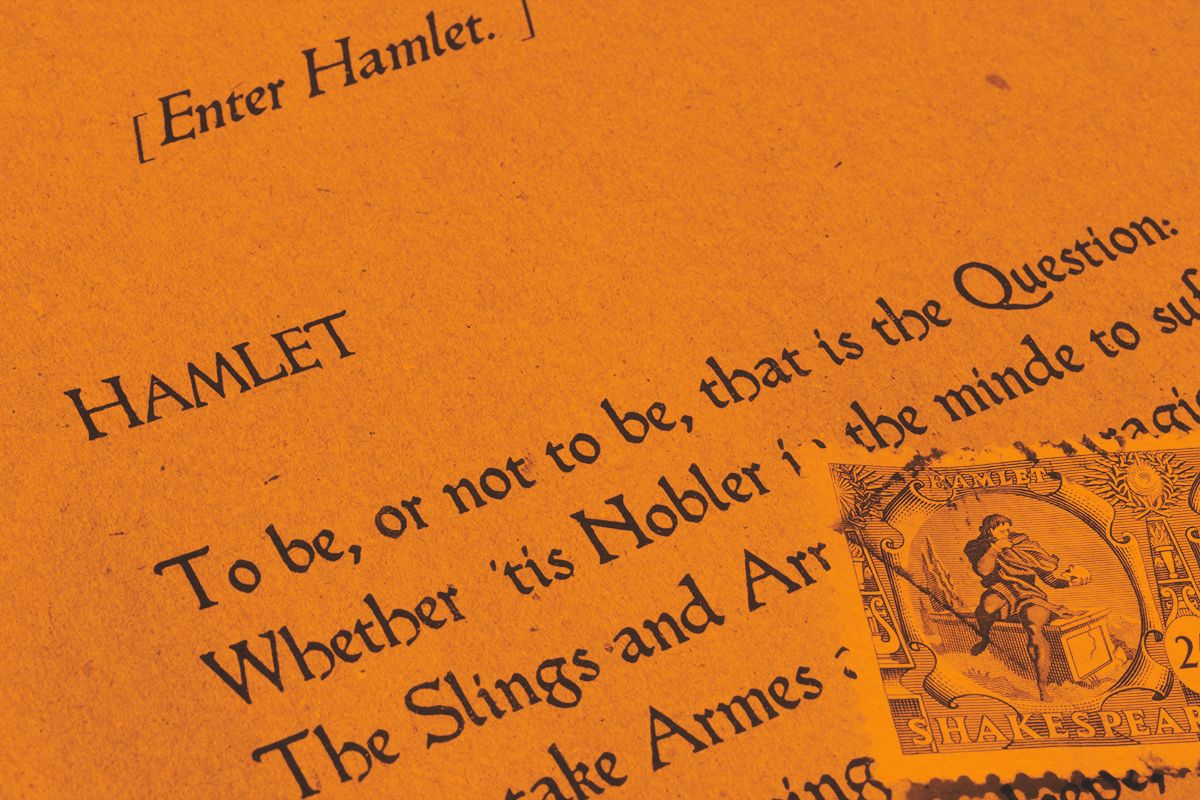
What does Hamlet have to do with the Micronesian language of Mokilese? They both differ from modern English in the way they handle verb aspect — an important part of how verbs work.
“Oh, I die, Horatio” is a memorable line from Shakespeare’s Hamlet, but not just for its drama. For contemporary readers, the verb “die” feels starkly out of place. In modern English, we’d expect “I am dying, Horatio.” The difference lies in a lesser-known yet essential part of a verb’s tense: the aspect.
When it comes to how a verb is presented, the tense will be past, present, or future — but that’s only part of the grammatical picture. The verb’s aspect reveals how the action unfolds over time. There are four main verb aspects in English, each existing in present, past, and future tenses:
Simple: an action occurring at a specific time; general or habitual (“I paint,” “I painted,” “I will paint”)
Progressive: an unfinished or ongoing action (“I am reading,” “I was reading,” “I will be reading”)
Perfect: a finished action (“I have hiked,” “I had hiked,” “I will have hiked”)
Perfect progressive: an action that was in progress but was then finished or is still happening (“I have been cooking,” “I had been cooking,” “I will have been cooking”)
The most versatile aspect is “simple”: “I die, Horatio.” In Shakespeare’s time, the simple aspect denoted present-tense action. But it sounds funny to us today because now simple verb aspects describe habitual actions (“I bake” or “I painted watercolors when I was younger”), general truths (“I hike on the weekends”), or scheduled events (“I will paint at the studio on Monday nights”). This aspect has the most variety of them all.
Other languages treat aspect differently. For example, in the Mokilese language of Micronesia, aspect is shown by the repetition of the verb:
Rik sakai = “to gather stones” (rik is the verb for “to gather/collect”)
If English worked that way, “I have been reading all weekend” might become: “I read read read all weekend.” Straightforward or more confusing? You decide.
Featured image credit: claudiodivizia/ iStock
Advertisement
More from our network
Word Smarts is part of Inbox Studio, which publishes content that uplifts, informs, and inspires.
Enter your email to receive daily lessons that dive into what makes English so fascinating. Each email is packed with odd rules, etymologies, and the tools you need to be a better communicator.
Sorry, your email address is not valid. Please try again.
Sorry, your email address is not valid. Please try again.