


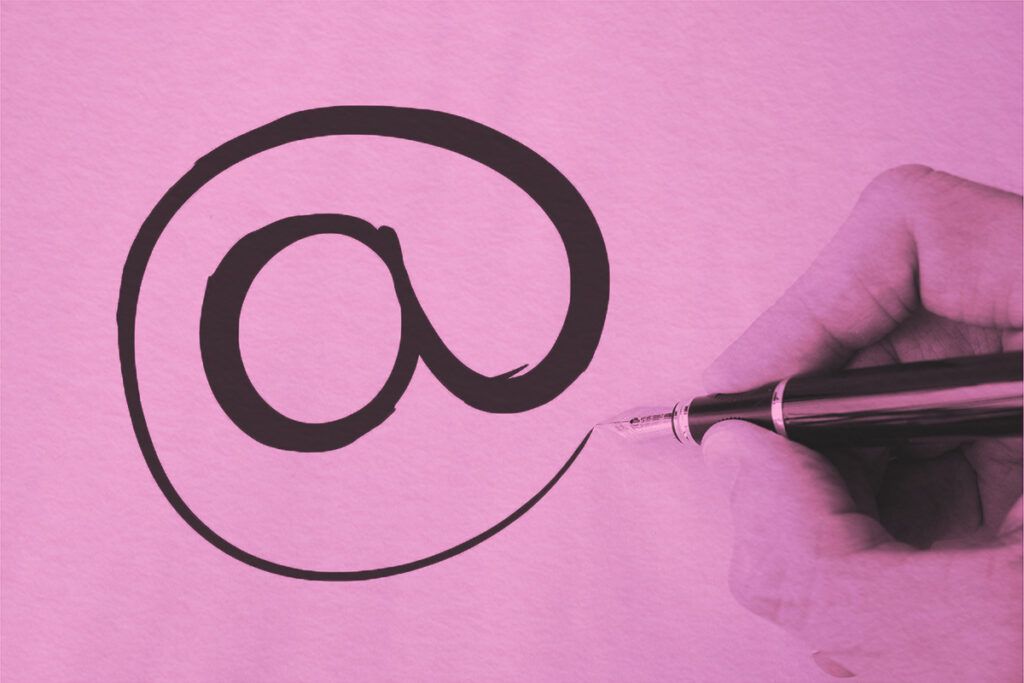
The @ symbol is now one of the most easily recognizable characters on Earth — as familiar to modern eyes as any letter of the alphabet. Every email address contains one and most social media handles are preceded by one — but the majority of us have probably never thought about what it actually means or where it comes from.
It may come as a surprise that the @ symbol existed for centuries before computer engineer Ray Tomlinson used it to send the world’s first networked email in 1971 — and its predigital history is a lot more interesting than its current function suggests. The exact origins of the symbol remain obscure, but long before it connected usernames to servers, @ appeared in monastic manuscripts, merchants’ ledgers, and the invoices of traders who dealt in wine, grain, and spices.
One theory about the origin of @ dates back to medieval monasteries, where monks copied manuscripts by hand using quill and ink. Copying was a labor-intensive process, so scribes developed a range of shorthand marks to save both time and precious writing materials. Several historians and linguists, including the classicist Berthold Ullman, have suggested that @ originated as a ligature — a combined letter form — merging the Latin word “ad” (meaning “to,” “toward,” or “at”) into a single fluid mark. To achieve this, the monks would have written the lowercase “a” before sweeping the quill around it in a single movement to suggest the “d,” resulting in something very close to the @ we use today.
The monk theory is compelling, but as Encyclopaedia Britannica notes, it lacks definitive documentary proof — Ullman himself never gave any significant evidence to support his hypothesis. But the earliest use of @ is still tied to religion. The first known appearance of the symbol is found in a 1345 Bulgarian translation of a Greek chronicle. This translation, held today in the Vatican Apostolic Library, features @ in place of the “a” in the word “amen.” But historians don’t know why exactly it was used — was it simply a flourish or did it have greater significance? That will likely remain a tantalizing mystery.
The most thoroughly documented use of the @ symbol before the digital age was in the world of commerce. The earliest known use of the symbol in this context is found in 15th-century customs records between Aragon and Castile. According to Spanish journalist Jorge Romance, who discovered the documents, @ in this case was shorthand for the Spanish arroba, a weight measure — in this instance, one arroba of wheat.
The commercial use of @ is further supported by the research of Italian academic Giorgio Stabile, who discovered a 1536 Spanish-language letter from a Florentine merchant. The merchant used a looping, stylized “a” as shorthand once again for the volume unit arroba, which represented the capacity of an amphora — a standard-sized clay jar used to ship wine and grain across the Mediterranean. According to Stabile, the @ symbol became a common medieval shorthand for units of measurement in southern Europe, but the precise units may not have always been the same. Nonetheless, the symbol was so common in Mediterranean trade that @ — in its modern, online usage — is still called arroba in Spanish and Portuguese today.
The story doesn’t end there. At some point in the post-medieval period, the symbol evolved to mean, more generally, “at the rate of.” Merchants, bookkeepers, and traders used it in invoices and ledgers to indicate price per unit — so an entry might read “6 barrels @ 3 florins,” meaning six barrels at the rate of three florins apiece. The symbol therefore did the work of several words in a single pen stroke.
Its usage continued in accounting and trade documents well into the 20th century and can still be understood in a commercial sense today — a receipt showing “2 items @ $5.00 each” requires no explanation. The @ symbol’s connection with trade is so strong that its formal name in English is the “commercial at.”
@ in the Modern World
By the late 19th century, the @ symbol had earned enough importance to make it onto some — but not all — of the earliest typewriters. It wasn’t present on the first typewriter, invented in 1867, but it did make its first appearance on a typewriter in 1885. The @ key on these early QWERTY keyboards had the same commercial meaning of “at the rate of.”
The symbol’s inclusion on typewriters was intermittent, but it became standard enough to be included on keyboards for early computers. Still, most people, unless they were involved in trade or accounting, would largely have ignored the strange looping “a” key. That changed forever in 1971 when an American computer scientist invented the first email program.
Ray Tomlinson had to figure out how best to address a message to be sent through his Arpanet network to someone at a different computer. Looking at his keyboard, he spotted the @ key and decided it was perfect for separating the username and computer name. Not only was it rarely used in computing at the time (meaning it wouldn’t confuse existing programs), but it also had the added convenience of already being known as “at.” And so @ — a symbol with centuries of largely forgotten history — made its way into the modern world as one of the most iconic symbols of the internet age.
More from our network
Word Smarts is part of Inbox Studio, which publishes content that uplifts, informs, and inspires.