


In 1486, the St. Albans Press in England published a work about heraldry, falconry, and hunting, titled the Boke of Seynt Albans — or Book of Saint Albans in modern spelling. Traditionally attributed to Dame Juliana Berners, the book is most famous for publicizing a list of collective nouns to denote certain animal groups. These collective nouns — known more specifically as terms of venery — have maintained lasting appeal, and some of them remain a part of our collective lexicon centuries later. We covered some of our favorites in a previous piece, but here are a few more that caught our eye.
It may seem oxymoronic to suggest that a group of boars could be described by the term “singular.” But in this case, the word is derived from the French sanglier, which refers to a full-grown wild boar. Adult boars do indeed have a reputation for living on their own, but that didn’t stop Dame Berners from co-opting the term to refer to groups of them.
Marshmallow Peeps are a popular Easter confection. But the term “peep” can also refer to a group of actual chickens instead of ones made from sugar. The term is a reference to the sound that young chicks often make, which is known as peeping.
The collective noun “leap of leopards” sounds perfectly pleasant rolling off the tongue. But this term of venery is more than just a playful case of alliteration. It references the incredible leaping ability of leopards, which can jump up to 10 feet in the air or 20 feet leaping ahead.
The word “murmuration” has two definitions, one of which relates to low noises called murmurs. But in this case it refers to big flocks of birds, specifically starlings. A murmuration can consist of several hundred or even thousands of starlings, which can be seen soaring into the sky as if part of a giant wave.
Donkeys — or asses, as they’re sometimes known — are among the most reliable pack animals that exist. For this reason, a group of donkeys is called a pace, referring to the slow and steady nature of their gait as they tote materials around.
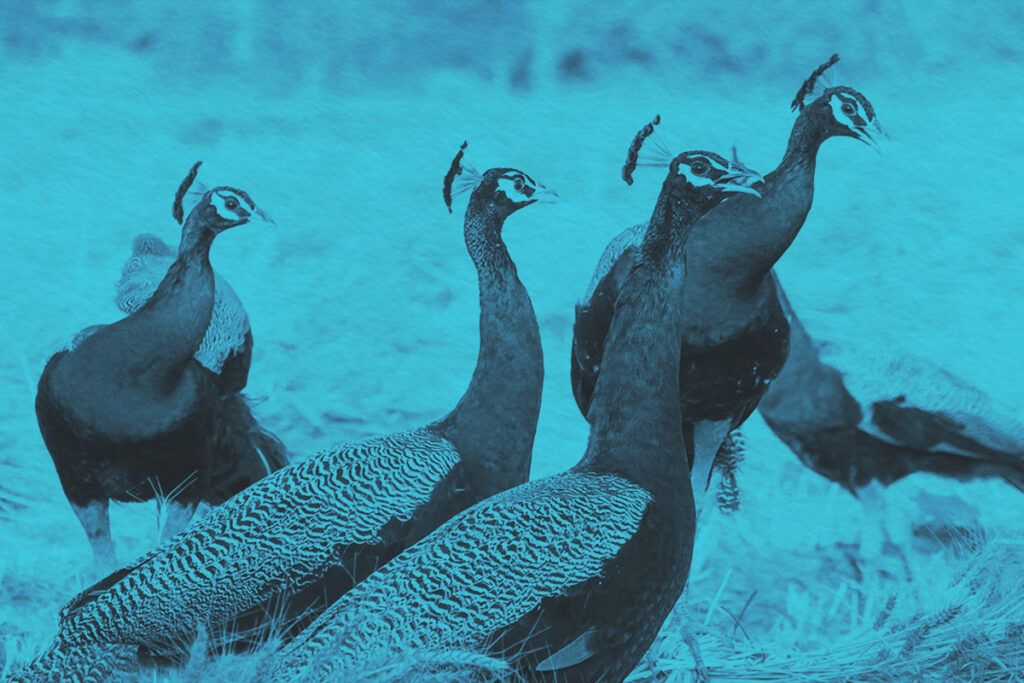
The word “muster” can be defined as “the act of assembling.” It’s commonly used when talking about military formations, though according to the Book of St. Albans, it can also be used to refer to groups of peacocks. An alternative term for a group of peacocks is “ostentation,” which is defined as “an excessive display” — much like a peacock’s set of showy feathers.
Long before the Book of Saint Albans was published, other authors wrote about the hardworking nature of moles. Take the Roman poet Virgil, who wrote of the animal, “For gather’d Grain the blind laborious Mole.” “Labour of moles” uses the British spelling of “labor.”
The word “dule” (or “dole”) means “grief” or “sorrow.” In folklore, turtledoves — a bird native to parts of Eurasia — were thought to have a melancholy voice that evoked senses of sorrow in mourners. So it made sense to call a group of turtledoves a dule or dole, playing off their reputation.
This collective noun has nothing to do with horses going around harassing people who don’t provide apples. It comes from the Middle English haras, referring to an enclosure for herds of stud horses. That word comes from the Old French haraz, meaning “troop of horses.”
If you’re dealing with birds but don’t quite know what type, you can refer to the group as a dissimulation. This term means “the act of dissembling” or “to hide under a false appearance.” Given the Book of St. Albans tackles the topic of hunting, it’s thought to come from the idea that birds fly in large packs to give off a false perception of being much larger, which might confuse predators and hunters.
More from our network
Word Smarts is part of Inbox Studio, which publishes content that uplifts, informs, and inspires.