


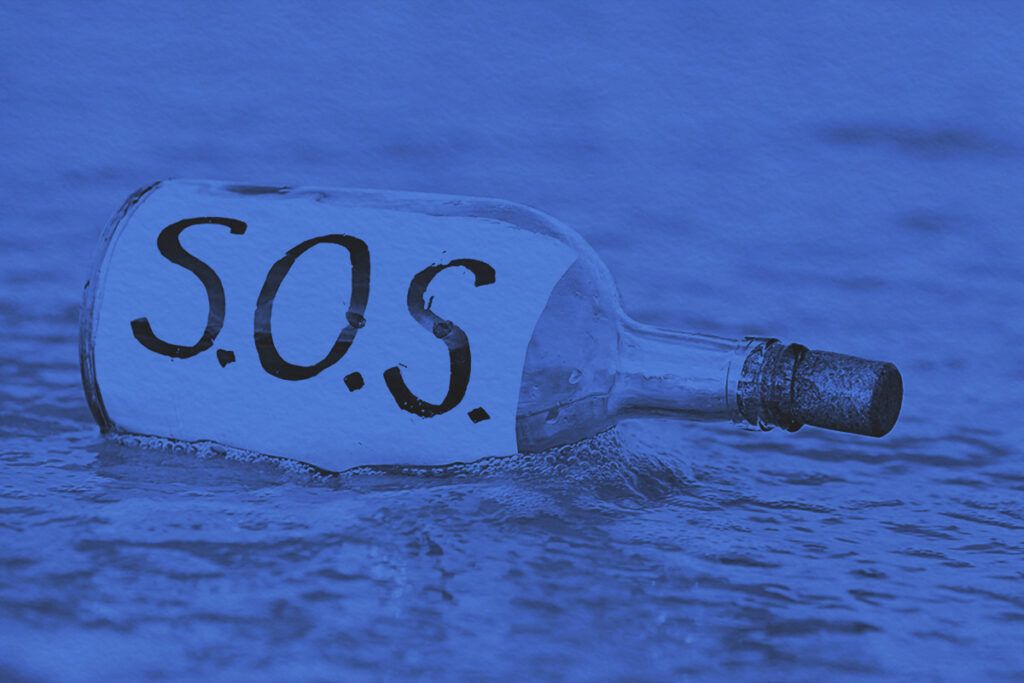
SOS — used as a distress signal from sinking ships, castaways on a desert island, hikers lost in the wilderness, and others in emergency situations — is the most universally understood cry for help on the planet. But ask someone what it stands for and there’s a good chance you’ll receive an answer that is both common and completely wrong. “SOS” does not stand for “save our souls” or “save our ship.” In fact, it wasn’t built from words at all. Here we take a look at the roots of the famous three-letter sequence and how it became so ingrained in the global consciousness.
In the mid-1800s, nations used different distress signals, primarily at sea, designed to be sent via Morse code, flag signals, or both. Morse code — a signaling system using dots, dashes, and spaces — was created in the 1830s by Samuel F.B. Morse and Alfred Lewis Vail, and was well established by the turn of the century, making it a natural choice for calling for help.
The British, who were the preeminent maritime and naval power during the 19th century, used the code CQD. This sequence was established by the Marconi Company, a British telecommunications and engineering company. Its wireless operators used CQ as a code to signal all stations along a telegraph line, and the distress code CQD was an extension of this, meaning “All stations. Distress!” (It did not stand for “Come Quick, Danger,” an apt phrase that was applied later.)
The Germans, meanwhile, used the code SOE as a general inquiry call; the Americans used NC (meaning “call for help without delay”); and various other nations had their own unique codes. But having different signals was not ideal, especially in emergency situations, and eventually an international conference was arranged to do something about it.
In 1906, the International Radiotelegraph Conference was held in Berlin, Germany. On the agenda was the standardization of ship-to-shore communications. During the conference, 27 countries signed one notable provision: the adoption of SOS as a truly international distress signal.
The code wasn’t chosen to spell out a particular word or abbreviate a specific phrase. It didn’t even take into account individual letters. It was adopted purely for its simplicity within the Morse code system that Vail and Morse had built decades earlier. Radio conditions at sea were often poor, and any signal chosen needed to be short, unmistakable, and impossible to confuse with routine chatter. The solution was a continuous string of three dots, three dashes, and three dots — easy to remember, quick to type, and clear in its interpretation.
The sequence came to be called SOS only after it was selected, because that particular pattern matches the individual Morse code sequences for S (three dots), O (three dashes), and S (three dots) again. In other words, the letters were a readable side effect of a pattern telecommunications engineers deemed effective, not a phrase someone chose first and then translated into code.
The first confirmed use of SOS in a genuine emergency came in June 1909, when the RMS Slavonia ran aground near the Azores. Nearby ships picked up the distress signal and rescued everyone aboard. Then, on August 11, 1909, the steamer SS Arapahoe ran into problems off the coast of Cape Hatteras, North Carolina. The telegraph operator was initially confused about which distress signal to send, as SOS had only recently replaced the CQD signal he was more familiar with. He decided to send both signals, in what became the first transmission of SOS in America. Three years later, the RMS Titanic sank in the North Atlantic Ocean. Its operator also sent out both CQD and SOS calls for help, in the most widely reported and tragic use of SOS after its adoption.
From there, SOS spread far beyond maritime radio. Its rhythm is so simple and distinct that it can be tapped out audibly or flashed with a light, making it just as useful for earthquake survivors trapped under rubble as for stranded hikers stuck on a mountaintop. The letters are also instantly recognizable when written out — perhaps most famously by castaways who spell out “SOS” on sandy beaches in the hope of signaling passing aircraft. And this isn’t just a trope in Hollywood movies. Numerous real-life cases exist, including a recent 2020 stranding on the tiny Pikelot Island in the South Pacific, from which three men were rescued after writing “SOS” on the beach using foliage and debris.
SOS has since grown to be a universally recognized signal for distress — not only in actual emergencies but also in pop culture. ABBA used it to great effect in their 1975 hit song “SOS,” while the classic 1979 rock track “Message in a Bottle” by The Police features Sting singing, “I’ll send an SOS to the world.” More recently, Rihanna and the Jonas Brothers have released tracks featuring the famous distress code.
Despite the universal nature of SOS, the actual meaning of the letters is still widely misunderstood. Many people believe that they stand for something — typically “save our souls,” “save our ship,” or even “send out succor” — when in fact they stand for nothing at all. These are all instances of what is called a backronym — a phrase made up to fit the letters of an existing word (or sequence of letters, in the case of SOS), treating it as if it’s an abbreviation when it’s not.
Another example of a backronym is “Amber Alert,” originally named after a missing child, Amber Hagerman, but later given the backronym “America’s Missing: Broadcast Emergency Response.”
In any case, SOS has proved to be incredibly effective, not only by its continued use in emergency situations but also by its widespread adoption in popular culture. But its success has little to do with any hidden meaning and everything to do with simplicity. A signal designed to be heard clearly through static, using a code invented decades earlier, is still just as easy to recognize a century later, whether it’s tapped out in Morse code, stomped into snow, sung by Sting, or texted to a friend to request immediate extraction from an awkward date.
More from our network
Word Smarts is part of Inbox Studio, which publishes content that uplifts, informs, and inspires.