


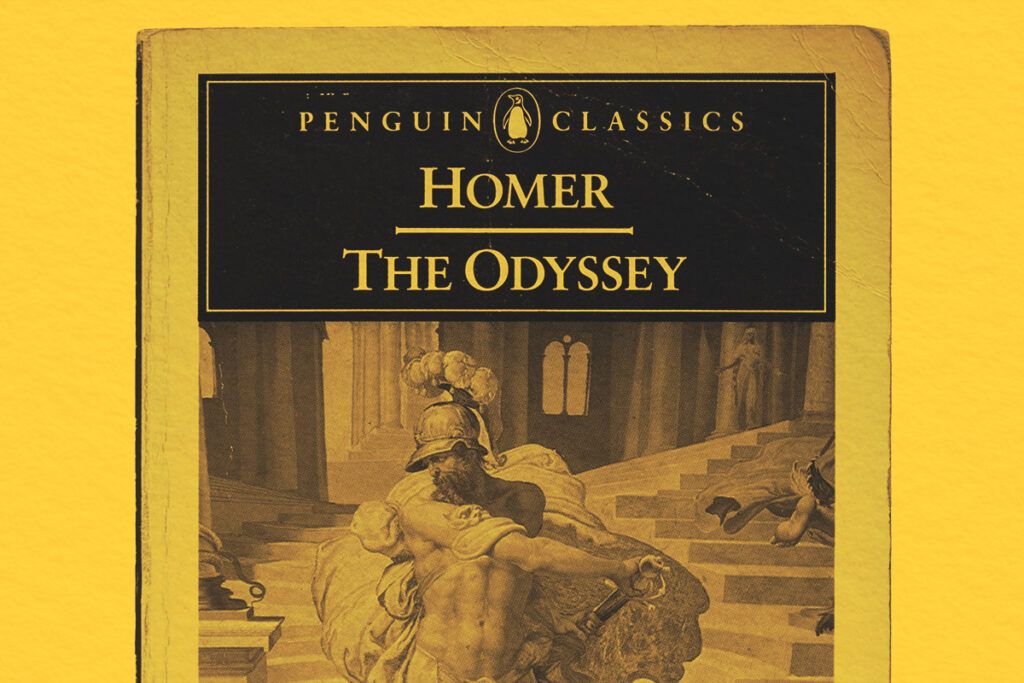
Written almost 3,000 years ago, the “Odyssey,” attributed to Greek poet Homer, tells the story of Odysseus, the Greek hero of the Trojan War, on his 10-year adventure returning home to his wife, Penelope, and their son, Telemachus. The epic tale has inspired countless adaptations in literature, art, film, and television — including a 2026 movie by Christopher Nolan — and has also firmly stamped its influence on many words and idioms we use today. Here are a few examples.
Derived from the name of the hero Odysseus, “odyssey” refers to a long, adventurous journey marked by changes in fortune. The first recorded use of the word in English in that context was in Robert Louis Stevenson’s novel Kidnapped. In the last chapter, the protagonist’s perilous Scottish Highlands journey is described as a “great Odyssey.” The word went on to be adopted into the English lexicon as a common noun.
While Odysseus was on his odyssey, he left his son, Telemachus, in the care of his trusted friend Mentor. Mentor’s name is from the Greek mentos, meaning “intent, purpose, spirit, passion.” This root is related to the modern words “mental,” “mention,” “mind,” and “mnemonic.”
”Mentor” left the pages of the “Odyssey” and entered the English lexicon around 1750. Today the word refers to any wise adviser, especially in the role of guiding someone young or inexperienced.
However, there is irony in this etymology, because initially Mentor was ineffectual in his role as a mentor to Telemachus. Only by the intervention of Athena, the Greek goddess of wisdom, who disguised herself as Mentor, was he effective.
If you’ve ever been caught in a no-win situation, you were “between Scylla and Charybdis” — a more erudite way to say “between a rock and a hard place.”
Scylla was a terrifying, six-headed sea monster with long, snakelike necks, each head featuring a triple row of razor-sharp teeth. She lived in a cave along a narrow channel and had a nasty habit of snatching and devouring passing sailors — in the “Odyssey” she devoured six of Odysseus’ men. Scylla wasn’t an invention of Homer; she is present throughout Greek mythology. She can also be found in Ovid’s Metamorphosis as a young maiden who was turned into her monstrous form by the witch Circe.
Charybdis, meanwhile, was a huge whirlpool on the opposite side of that narrow channel, across from Scylla. Three times a day, she swallowed massive amounts of water, spewing it out and capsizing any ship in its wake.
This fanciful chapter in Odysseus’ adventures is based on an actual channel, the Strait of Messina, which separates Sicily to the west and Italy to the east. It is 20 miles long and was feared by sailors in antiquity because of the rocks, whirlpools, and crosscurrents, all of which present considerable dangers.
As if the perils of Scylla and Charybdis weren’t enough to challenge Odysseus, he also was forced to confront the Sirens. Half-bird and half-woman creatures, they lured sailors to their destruction with their sweet singing.
Fortunately for Odysseus, the sorceress Circe had advised him of the dangers the Sirens posed. He required his crew to stop up their ears with wax to be protected from their enticing singing, but he wanted to hear the Sirens song himself because it was supposed to contain gifts of wisdom and knowledge of the future. So he had his crew lash him to the mast and instructed them to not release him, no matter how urgent his entreaties.
“Siren” entered our lexicon in the late 19th century, referring to a mechanical device that makes a warning sound, specifically for steamboats. That word was then extended to refer to such devices that blared warnings for factory shifts, emergency vehicles, and air raids, to name a few usages. The mellifluous song of the Sirens instead became an unsettling blast of sirens.
But the beauty of their song is still present in the notion of siren singers — captivating chanteuses such as Ella Fitzgerald, Billie Holiday, Nina Simone, and Sarah Vaughan.
So, you can see the influence that a centuries-old tale has had on the English language, through words inspired by the characters and idioms that recall the hero’s epic journey.
More from our network
Word Smarts is part of Inbox Studio, which publishes content that uplifts, informs, and inspires.