


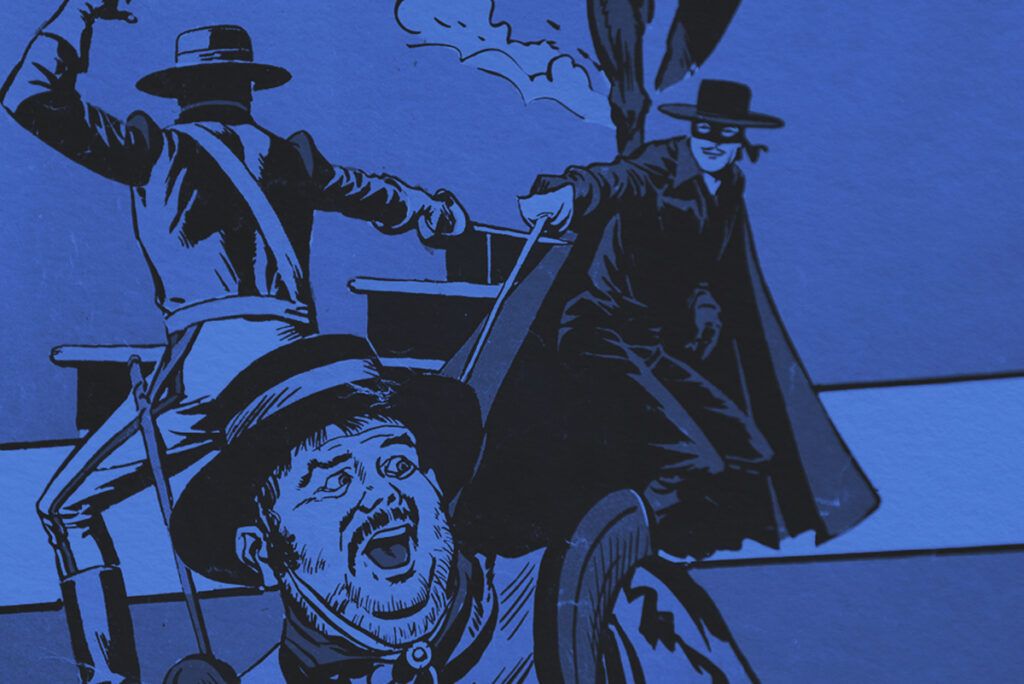
The word “swashbuckler” conjures up images of a particular type of stock character: a heroic figure skilled in swordsmanship and acrobatics, who partakes in daring deeds with guile and charm, and who might be chivalrous but could just as well be something of a rogue. This flamboyant protagonist has long appeared in tales of adventure on both page and screen, leaping across ship decks, dueling on staircases, and charging into danger with a grin. Think Peter Pan, Sinbad, Zorro, and the three musketeers.
But what exactly is a swash and why is it so prone to buckling? As it turns out, the roots of “swashbuckler” are far more literal — and somewhat less glamorous — than we might expect.
The noun “swashbuckler” appeared in English around the 1550s as a straightforward compound of “swash” and “buckler.” Back then, “swash” was an imitative, or onomatopoeic, word — one that tries to sound like the thing it describes. In the early 1500s it referred to the fall of a heavy blow, such as the clash of steel on steel. It could be used to refer to the sound of swords striking one another or hammering against armor. A buckler, meanwhile, was a small, round shield made of iron, steel, or wood and typically held by a handgrip rather than strapped to the arm. Light and handy, it was popular with swordsmen who wanted to parry quickly without being weighed down.
At some point during the 1500s, the two words were put together to form a vivid image: a fighter who made a show of striking his own or his opponent’s buckler with his sword (the former to intimidate, the latter when attacking). But there was nothing inherently glamorous or heroic about the fighter, and early uses of “swashbuckler” were rarely complimentary. The term often pointed to a crude, blustering, boastful type — more a ruffian than a true hero.
One of the earliest recorded uses of the word is found in Thomas Nashe’s 1593 work Christs teares ouer Ierusalem, and it is far from laudative: “No Smithfield ruffianly Swashbuckler, will come of with such harshe hell-raking othes as they.” By the late 17th century, the related adjective “swashbuckling” had emerged to describe the noisy, swaggering style of the swordsmen described above. It took a lot longer for the modern verb “swashbuckle” to appear; it was first recorded in 1897.
It took centuries for “swashbuckling” to take on a romantic connotation, first through literature and then through film. According to movie critic Matthew M. Foster, “Modern novels, and then Hollywood, altered the word, keeping the definition, but changing the connotation.” The swashbuckler, he explained, could still be a loudmouthed braggart, but in a good way — he (or in rare cases, she) could be irresponsible and impetuous, but in a charming or dashing manner.
In the 19th and early 20th centuries, adventure novelists defined the modern swashbuckler. Alexandre Dumas (The Three Musketeers, published in 1844) and especially Rafael Sabatini — whose adventure novels include Scaramouche (1921) and Captain Blood (1922) — took the blustering, shield-thumping swordsman archetype and recast him as a dashing, honorable hero. The character kept the swagger, the recklessness, and the flair, but turned it into a charming virtue rather than a flaw.
Hollywood cemented the image of the heroic swashbuckler in the 1920s. The word became attached to an actual film genre — simply known as the swashbuckler — largely through the silent films of actor Douglas Fairbanks. His movies, such as The Mark of Zorro (1920) and The Black Pirate (1926), are generally credited with defining the swashbuckler as a cinematic archetype. Then came Errol Flynn, whose roles fully crystallized the image of the swashbuckler, especially in Captain Blood (1935, based on Sabatini’s novel) and The Adventures of Robin Hood (1938). This is the version most people picture today: a charismatic swordsman, courtly and honorable, rescuing the damsel in distress and outwitting the villain. It’s a world away from the noisy, shield-banging brute of old.
More from our network
Word Smarts is part of Inbox Studio, which publishes content that uplifts, informs, and inspires.