


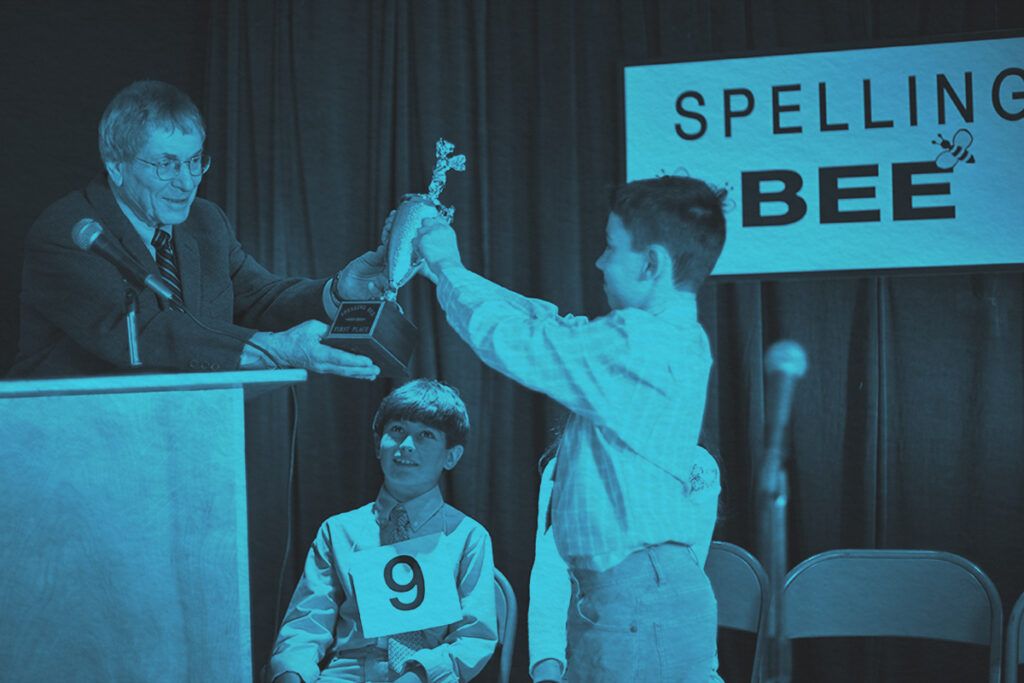
The Scripps National Spelling Bee has been testing young minds since 1925. The first winner was 11-year-old Frank Neuhauser of Louisville, Kentucky, who correctly spelled “gladiolus” (a genus of perennial plant) to claim a prize of $500 and the chance to meet President Calvin Coolidge. Since then, the contest has been held almost every year, pausing only for World War II and the COVID-19 pandemic.
The winning words correctly spelled by these young scholars have, at times, been quite simple — especially in the early years. “Knack,” “torsion,” “intelligible,” and “canonical” were among the final words prior to World War II. The difficulty then began to increase, with more obscure words selected to challenge the knowledge of well-prepared teenagers. Here we take a look at some of the less common words that have won Scripps over the decades.
“Abrogate” means “to abolish by authoritative action.”
Example: “The new government moved swiftly to abrogate the treaties signed by its predecessor.”
Meerschaum is a soft white or yellowish mineral that looks a bit like hardened clay. It is most commonly associated with meerschaum tobacco pipes, which have a bowl made of the mineral. The name comes from German, literally meaning “sea foam.”
Example: “The old professor kept a carved meerschaum pipe on his desk, though he hadn’t smoked in years.”
If you want to add a little elegance to your vocabulary, you could do a lot worse than “insouciant.” It means “exhibiting or characterized by insouciance,” which is “lighthearted unconcern.”
Example: “Bruni and fellow icons like Jane Birkin and Françoise Hardy boast the sort of in-her-face fringe that oozes insouciance, a hallmark of the French aesthetic.” (Calin Van Paris, InStyle, 2026)
Syllepsis is a rhetorical figure of speech in which a single word governs or modifies two others in different ways, often for comic effect — as in, “She lost her purse and her temper,” or “She blew my nose and then she blew my mind” (the latter from the Rolling Stones’ 1969 hit song “Honky Tonk Women”).
Example: “The comedian’s use of syllepsis drew a laugh from the audience, which appreciated the double meaning.”
The “daemonic” in “eudaemonic” may be misleading, as the word is far from demonic. It actually refers to anything that is conducive to happiness. It comes from the Greek eudaimonikos, in which eu means “good” and daimōn means “guardian” or “genius.”
Example: “The philosopher argued that a eudaemonic life required not pleasure but purpose.”
A ratoon is a new shoot or sprout growing from the root of a plant after it has been cropped. It is most commonly used when referring to the harvest of sugarcane.
Example: “On the banks of the Essequebo, thirty crops of ratoon canes have been raised successively.” (W. Robertson, History of America, 1778)
“Elucubrate” is considered an obsolete word by the Oxford English Dictionary, but it’s worth reviving. It means “to work out or express by studious effort,” especially late into the night and, traditionally, by candlelight or lamplight.
Example: “She elucubrated for months in her study, burning the midnight oil before finally finishing her first novel.”
This word refers to one who plunders, pillages, robs, or despoils. Genghis Khan is a prime example of a historic spoliator.
Example: “It might be, that a successful spoliator thus deprived the possessors of the means of future defence.” (G. Petrie, Ecclesiastical Architecture of Ireland, 1845)
“Vivisepulture” is a rather grim word to include in a spelling competition for teens, but it won the day in 1996. It refers to the act or practice of burying someone alive.
Example: “They are a superstitious brood and have many cruel practices — human sacrifices and vivisepulture.” (Richard Francis Burton, City of Saints, 1861)
If you’ve ever thought that Usain Bolt has a very fitting name for an Olympic track star, there’s a word for that: “euonym.” It means “a name well suited to the person, place, or thing named.”
Example: “‘William Headline’ struck many as a remarkable euonym for CNN’s former Washington bureau chief.”
Prospicience is the act of looking forward or having foresight. The word dates back to at least the 1500s but is rarely used today.
Example: “The report praised the urban planners for their prospicience in preserving green space before the city expanded.”
Italian speakers will likely recognize this word, used to refer to a careless, indifferent, or nonchalant person. It comes from the Italian poco (“little”) and curante (“caring”).
Example: “He was such a pococurante that even news of the company’s collapse failed to provoke any real emotion.”
In the world of anthropology, “cymotrichous” simply describes having wavy hair — as opposed to having leiotrichous (smooth or straight) or ulotrichous (crisp or woolly) hair. Some humans can be described as cymotrichous, as can dog breeds such as spaniels and poodles, and a whole array of other wavy-haired mammals.
Example: “The astronauts discovered a population of bipedal creatures that were predominantly cymotrichous, with green, wavy hair.”
“Nunatak” means “a hill or mountain completely surrounded by glacial ice.” The word comes from the Greenlandic Inuit nunataq.
Example: “There are several nunataks at Graves, all peaks of the same mountain.” (Barry Lopez, Harper’s magazine, 2019)
“Cernuous” means “inclining or nodding.” It is primarily used in botany to describe the drooping heads of flowers.
Example: “After the rain, the snowdrops appeared cernuous, their white heads hanging low with the weight of water.”
This recent winning word from the Scripps National Spelling Bee is one of the most challenging in the history of the competition. A loanword from French, “éclaircissement” refers to a clarification or explanation — the clearing up of a misunderstanding or the revelation of something that was unknown.
Example: “When the éclaircissement comes there will be a scene.” (William Makepeace Thackeray, Vanity Fair: A Novel Without a Hero, 1848)
More from our network
Word Smarts is part of Inbox Studio, which publishes content that uplifts, informs, and inspires.