







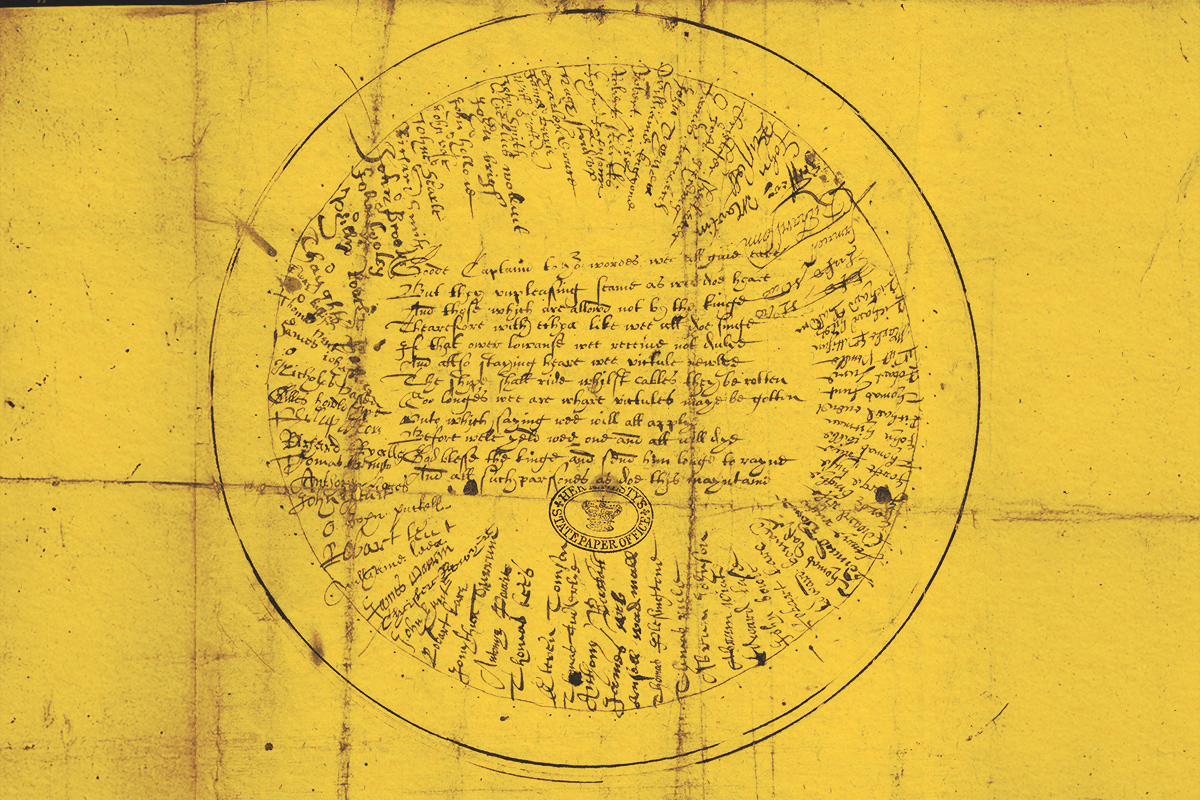
“Round robin” is a versatile noun phrase in modern English, but it has a long history. It originated in the late 17th century as a nautical term for a document signed by sailors. The signatures were arranged in a circle to disguise the order of signing. This process was detailed in a witness deposition from a maritime case in England, published in 1698: “Some of them drew up a paper commonly called a Round Robin, and signed the same whereby they intimated that if the Captaine would not give them leave to goe a shore, they would take leave.” This form of round robin seems like an early method of collective bargaining.
By the mid-18th century, the term took on a more general definition: “Any document signed by many people, sometimes in a way that conceals their order.” It is still used this way today, as well as in a context for editing documents within a group.
The most common modern usage, however, refers to a round robin sports tournament in which each contestant who is entered in a competition meets every other participant in turn. This sports and competition usage originated in the United States during the late 19th century, and it remains popular for tournaments. The FIFA World Cup begins with a round robin group stage, followed by single-elimination matches.


The “round” comes about from the circular nature of the activities, but why “robin”? The Oxford English Dictionary proposes that alliteration has played a role in the success of the phrase, but its exact origin is not well documented. A leading theory is that it originated in the French phrase rond ruban, or “round ribbon,” a different type of written petition with names signed on a ribbon for anonymity. This tradition was then likely adapted for English maritime use, and its pronunciation shifted. The phrase’s long history — from French tradition to its use across the English Channel and, eventually, its key role in professional sports — reminds us just how versatile language can be.
More from our network
Word Smarts is part of Inbox Studio, which publishes content that uplifts, informs, and inspires.





