


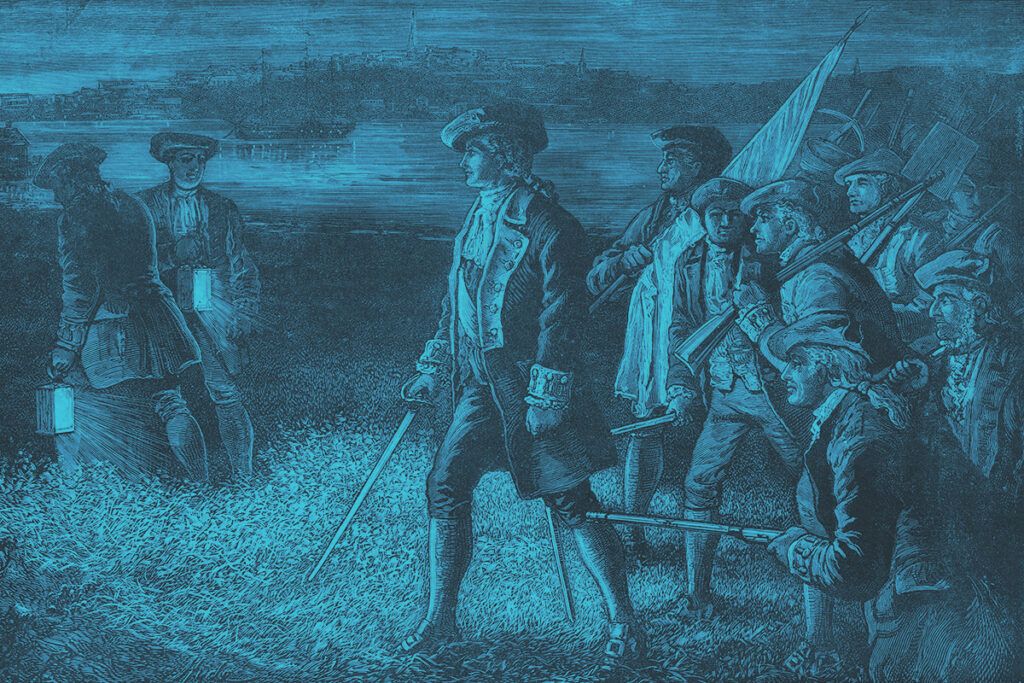
The American Revolution caused a seismic shift in the geopolitical world, but it also had a notable effect on the world of linguistics. It was an era that helped popularize a number of formal and slang terms for various types of artillery, fortifications, groups of soldiers, and other concepts you’d associate with battle. While many of the words have fallen into disuse or obscurity, they were essential to wartime communication during the Revolutionary era. Here’s a look at 10 terms you may have encountered back then.
The minutemen were a subset of larger New England-based militias who fought for American independence. Their name comes from the idea that they were primed and ready to fight with no more than a minute’s warning. They were often first on site at any battle, stalling enemy forces until additional units could arrive in support.
The term “rampart” was immortalized in the lyrics of “The Star-Spangled Banner,” but that song was about the War of 1812. Decades before then, ramparts played a useful role in the American Revolution. These large protective mounds used as fortifications against enemy fire were frequently made of earth or sometimes sandbags. The word is derived from the French verb remparer, meaning “to fortify.”
A grasshopper was a 3-pound cannon that was easily maneuverable while still being relatively powerful. However, its light weight meant that it wasn’t stable during launch. The cannon would “hop” up into the air while recoiling, inspiring the nickname related to the jumping insect.
The most famous Liberty Tree was an elm tree located near Boston Common. It served as a meeting point for revolutionaries and a rallying point for those promoting resistance to the British crown. While this first Liberty Tree was felled by British loyalists in 1775, its existence inspired other American communities to adopt liberty trees for themselves.
On the other side of the conflict, the British had trees of their own. The King’s Trees were any number of trees reserved by the government to be cut down and used to fortify royal naval vessels. King’s Trees were marked with an arrow on the trunk to inform members of the public that the trees were not for general use.
During the Revolution, a life guard wasn’t someone who patrolled beaches or kept a watchful eye on pools. Instead, the role of a life guard was specifically to protect George Washington. In 1776, Washington ordered that all commanding officers select four men from each regiment to serve as his personal guards. Washington’s life guards were required to be born in North America (not Britain) so as to encourage loyalty to the American cause.
You’ve probably heard the term “brigade” to mean “a large body of troops.” It comes from the Italian brigare, meaning “to fight.” While “large body” is a bit vague, brigades were pretty clearly defined in Revolutionary times.
According to the American Battlefield Trust, a company was made up of 50 to 100 men, 10 companies composed a single regiment, and four regiments made up one brigade. Two to five brigades made up a division, and two or more divisions made up one corps. And finally, one or more corps made up an army.
The Mechanics are considered the first known American intelligence group, and Paul Revere was arguably the most famous member. The group operated in secret in Boston, made up of members who were skilled artisans or tradesmen who could fix anything — hence the nickname. But as they performed their daily labors, they also moonlighted as spies. Not only would they gather intel about the locations of British troops, but men like Revere — a trained silversmith — would intentionally sabotage British equipment.
The term “picket,” referring to wooden posts or stakes, dates to the 1680s. But before any picket fences or picket lines existed, Revolutionary forces deployed a strategy of creating defensive pickets. In this context, the term “picket” typically referred to a group of 40 to 50 men who would stand in a rough line at the entrance of an army camp. This was meant to protect the camp from surprise attacks and to hold off enemy forces long enough for those within the camp to get ready to join the fight.
More from our network
Word Smarts is part of Inbox Studio, which publishes content that uplifts, informs, and inspires.