


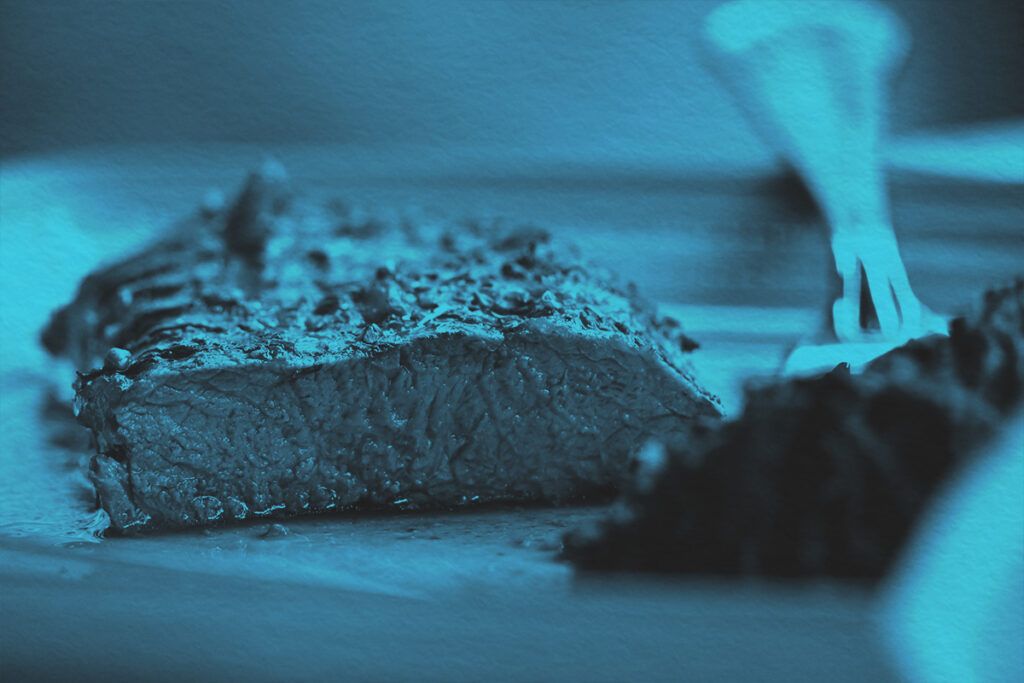
If you walk into most diners, bistros, or fine dining establishments, you’ll find steak on the menu. This culinary staple is served far and wide, but despite its prevalence, steak is still sometimes described as rare. Of course, in this context, “rare” refers to the doneness of the steak rather than its scarcity. But how did a word like “rare,” which normally means “uncommon,” come to describe a lightly charred steak with a cool red center?
The culinary term “rare” is derived from the Old English hrêr, meaning “lightly boiled,” and the verb hrēran, meaning “to move, stir, shake.” As Old English evolved to Middle English, the spelling of hrêr became “rere.” Initially, the word was used not for cooking meat, but for undercooked foods such as eggs. You were likely to see “rere egges” listed as an ingredient in purported health remedies.
“Rare” came to describe the doneness of meat by the early 17th century. The Oxford English Dictionary cites one of the earliest known examples in 1615’s The English Huswife by Gervase Markham: “To know when meate is rosted enough, for as too much rareness is vnwholsome, so too much drinesse is not nourishing.” “Rare” was the earliest version of all the modern terms now commonly used to describe meat’s doneness.
But there’s another type of steak that’s cooked for even less time than rare steak, and it’s called “bleu” steak. According to executive chef Sean Thompson, the French word for “blue” refers to the bluish shade of meat before it’s exposed to air. Before being removed from the animal, meat has myoglobin proteins that contain oxygen, giving it an indigo-like color. When the meat is cut and the myoglobin is exposed to air, it quickly turns red and loses that bluish hue.
At the other end of the cooking spectrum you have “well done,” which refers to meat cooked for the longest period of time. This term was adopted in the culinary world by 1747, with “well” meaning “thoroughly” in this context. “Medium” describes meat cooked between rare and well done, but it was in use much later than the other terms, appearing in the 1930s.Today, you can ask for a medium-rare or medium-well steak, placing the doneness closer to one end or the other.
More from our network
Word Smarts is part of Inbox Studio, which publishes content that uplifts, informs, and inspires.