


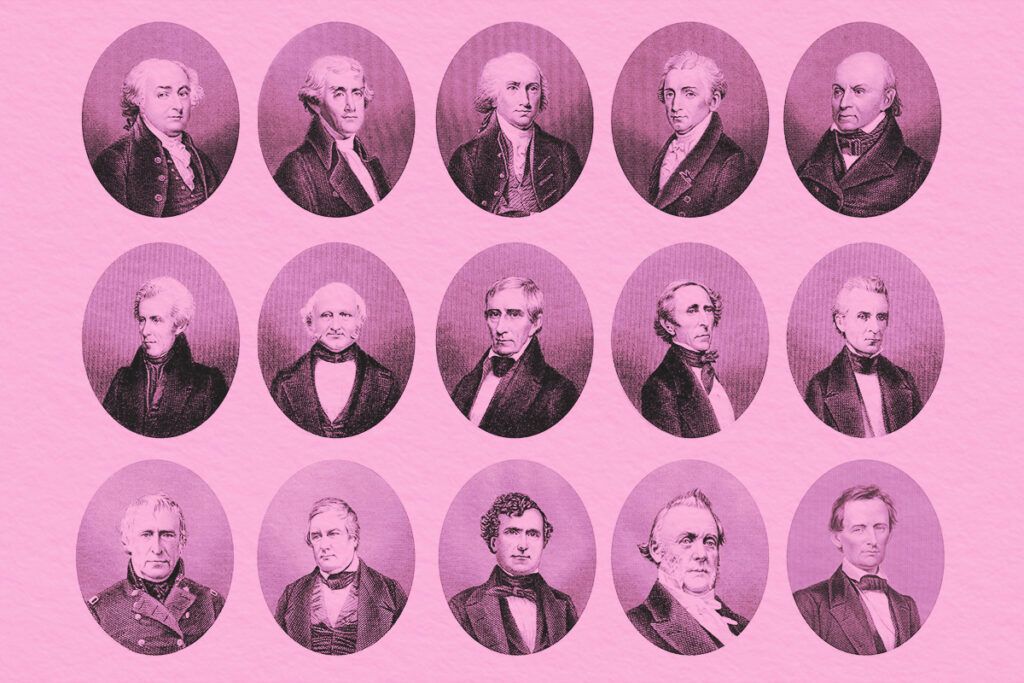
Forty-five individuals have held the role of president of the United States, and their names have been etched into the annals of history. While those monikers hold historical importance, they also possess etymological significance — each presidential surname provides us with a fascinating glimpse into the clans and cultures that past POTUSes were born into. Here’s a look at the origins and meanings behind every president’s last name.
The surname of the very first president is a habitational (meaning related to a place) name of English origin. According to Ancestry.com, it likely refers to the town of Washington in County Durham. The name of that town is derived from the Old English personal name Hwassa, combined with the connective -ing-, and finally the suffix –tūn (which means “estate” or “farmstead”).
Two presidents — John Adams and his son John Quincy Adams — share the surname Adams. Their name is a patronymic (meaning from the father’s heritage) of English origin, derived from the personal name Adam.
The name Jefferson — as in Thomas Jefferson — is a patronymic that originated in Middle English. It combines the personal name Jeffrey with the suffix “–son,” as in the phrase “Jeffrey’s son.” The name was pronounced as Jeffrason during the Middle Ages, but the vowel sound was shortened over time, resulting in the modern pronunciation.
Madison is a patronymic variant of the names Mattison and Mattinson, both meaning “son of Matthew.” The middle consonant shifted from a /t/ sound to a /d/ sound over time, resulting in the surname of President James Madison.
The surname of President James Monroe is a variant of the Scottish name Munro. The latter is a nickname of the Gaelic Rothach, which means “man from Ro” — referring to the river Roe in Derry.
While Andrew Jackson was born in the land that would become the Carolinas, his father migrated from Carrickfergus in Northern Ireland. From there they brought the last name Jackson — a patronymic meaning “Jack’s son.”
Van Buren is of Dutch origin, and in fact, President Martin Van Buren spoke Dutch as a child before he learned English. The name features two parts — Van means “from” or “by,” while Buren refers to the Dutch municipality of Buren.
The surname Harrison is shared by President William Henry Harrison and his grandson Benjamin. It’s a patronymic of English origin that means “Harry’s son” — Harry being a popular variant/pronunciation of the name Henry.
President John Tyler has the first occupational surname of any past POTUS. It’s derived from the Old French tieuleor or the Middle English tiler(e), both of which mean “tiler,” a person who lays floor or roof tiles.
James K. Polk was of Scots-Irish descent. Polk is a shortened variant of the name Pollock, which is a habitational name referring to an area in Glasgow.
President Zachary Taylor’s surname is widely used throughout the British Isles. It’s an occupational surname that comes from the Middle English word “taillour,” which is derived from the Latin verb taliare, meaning “to cut” — something a tailor does often.
The last name of President Millard Fillmore is of English origin. It’s believed to be a habitational name that refers to a place called Fyllymore in the village of Slimbridge, Gloucestershire.
President Franklin Pierce’s surname comes from the Middle English name “Piers,” which is a variant of the Old French names Pierre and Per (the French forms of Peter). The name is commonly spelled “Pearce” throughout England, while “Pierce” is the more common spelling in Wales and the United States.
The surname of the 15th president, James Buchanan, originated in Scotland. It’s a habitational name that refers to the parish of Buchanan in Stirlingshire.
Honest Abe’s last name is a habitational name of English origin. It comes from the town of Lincoln, a place that combines the British term Lindo- (“lake”) and the Latin colonia (“settlement”).
Johnson is yet another English patronymic to make this list of presidential surnames. It means “John’s son,” and it applies to both Andrew Johnson of the Reconstruction era as well as Lyndon B. Johnson of the Civil Rights era.
Ulysses S. Grant was far from the tallest president, measuring just 5 feet, 8, but his surname suggests the opposite. Grant is a word of Norman origin derived from graund,meaning “tall or large.”
The surname Hayes — as in that of the 19th president, Rutherford B. Hayes — is a habitational name of Norman origin. It comes from the Old English hǣse, which means “land overgrown with brushwood.”
In addition to being the name of a U.S. president and a grumpy cartoon cat, Garfield is a topographic name of English origin. It combines the Middle English “gor(e)” (“triangular piece”) with “feld” (“open field”) to describe those who lived on open swaths of land.
There’s no denying that Chester A. Arthur was America’s 21st president, but there is a bit of dispute over the origins of his surname. Some believe it’s derived from the Gaelic term art or the Welsh arth, both meaning “bear.” Others say it comes from the Latin family name Artorius, which is defined as “noble.”
Cleveland is an English habitational surname, and it refers to several British locations throughout Devon, Essex, and North Yorkshire. It’s a combination of the Old English words clif-, meaning “bank,” and –land, which (unsurprisingly) means “land.”
William McKinley’s last name is an anglicized form of the Gaelic Mac Fhionnlaigh. That name is a patronymic derived from Fionnlaoch — a popular Gaelic personal name that’s more commonly spelled as “Finley” today.
Presidential cousins Theodore and Franklin share the last name Roosevelt. The name is a habitational surname of Dutch origins. It refers to either a farm called Rozenveld or a farm called Ruiseveld. Those names combine the Middle Dutch terms rose (“wild rose”) with velt (“open country”).
Taft is a variant of the English surname Toft, which is derived from the Old Norman term Topt, denoting those who lived in the forest. In the U.S., it’s best known as the surname of the 27th president, William Howard Taft.
President Woodrow Wilson brought the trend of patronymic presidential surnames into the 20th century. His last name comes from Middle English and means “Will’s son.”
The last name Harding — as in that of President Warren G. Harding — comes from the Old English heard, meaning “hard, harsh, strong, etc.” This evolved to Hearding, which means “the hard one,” and was eventually Americanized to Harding.
Silent Cal’s surname has uncertain origins, though there are some probable theories. It’s believed that Coolidge may refer to tenant farmers who worked on college farms across England, which were owned by universities (hence their name).
The last name Hoover is an anglicized version of the German Huber. That word refers to any prosperous farm or land owner, as Hube is a German term for a large tract of land.
Truman is said to be an Americanized version of the German Trumann or Trautmann. Those are the words for someone who can be described as a “true man” — i.e., a reliable and trustworthy person.
Ike’s surname is an Americanized version of the German Eisenhauer. That last name is an occupational name used for iron workers. Īsen means “iron,” whereas houwaære is a version of the verb houwen, meaning “to cut.”
The famed Kennedy family is notably of Irish descent. Their last name comes from the Gaelic Ó Ceannéidigh, which is a combination of the words ceann, meaning “head,” and éidigh, meaning “ugly” — a bit surprising since President John F. Kennedy and his descendants are regarded for their good looks.
Richard Nixon’s last name is a Middle English patronymic. It’s derived from the name Nik(k)e — a shortened form of the name Nicholas — and essentially means “Nick’s son.”
The surname Ford is a topographic name that describes people living near a ford, a shallow part of any river or stream. It’s derived from Middle English and is widely used to describe places throughout Britain.
However, President Gerald Ford was actually born under a different name: Leslie Lynch King Jr. That birth surname comes from the Old English cyning, meaning “ruler.” He changed his name to honor his stepfather, who raised him.
The name Carter is an English occupational surname, referring to someone transporting goods using a cart. While the name comes directly from Middle English, it evolved from the Anglo-Norman French caretier and the Latin carettarius.
Reagan is a variant of the Irish Regan, which is a shortened form of O’Regan. That name is an anglicized take on the Gaelic Ó Ríagáin, referring to descendents of Ríagán, which is a personal name meaning “impulsive” or “furious.”
The name Bush applies to two former U.S. presidents: George H. W. and his son George W. It’s an English topographical surname referring to people who live near bushy areas. It comes from the Middle English “bushe,” which is derived from the Old Norse buskr.
The surname Clinton likely originated in the British Isles. One theory is that it refers to the settlement Glympton in Oxfordshire, with that name meaning a settlement (tūn) located on the River Glyme (glym being Celtic for “bright stream”).
The surname Obama is associated with the Luo people of Kenya, where it translates to “slightly bent.” It holds great resonance in that culture, signifying the power of destiny, even with all of life’s twists and turns.
The Trump surname can be traced back to the German name Drumpf, which originated in the 16th century. It’s associated with the nickname Rumpf — a Middle High German term meaning “trunk body” that was used to describe large men.
Biden is believed to be a habitational name from English, specifically referring to the village of Baydon in Wiltshire. There are also occupational connections; the name could refer to button-makers, as it may be derived from the French boton, meaning “button.”
More from our network
Word Smarts is part of Inbox Studio, which publishes content that uplifts, informs, and inspires.