


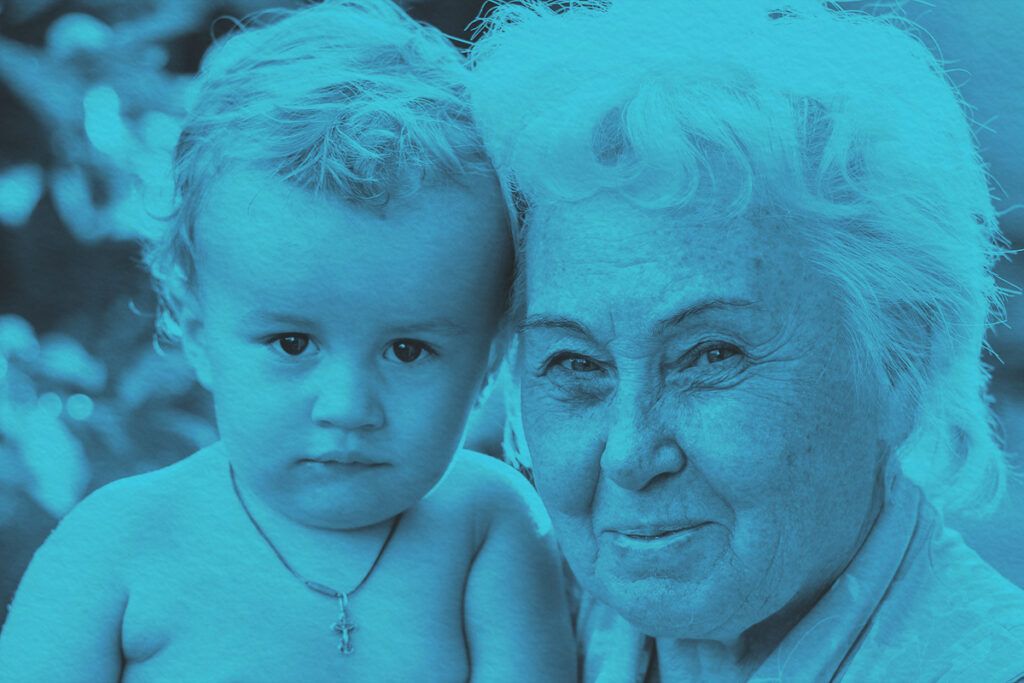
Your grandparents may occupy roughly the same place on the family tree as someone else’s, but what you call them could depend on where that tree took root.
In Pennsylvania, a grandmother and grandfather might be Mom-Mom and Pop-Pop, respectively. Head north into New England, and you’re more likely to encounter Grammy and Grampy; head south and Meemaw and Pawpaw enter the conversation. Elsewhere, grandparents answer to Nana, Papa, and an ever-expanding collection of family-specific monikers.
These names aren’t random. Some reflect regional speech patterns or the influence of immigrant communities; others are variations on words for mothers and fathers. And many are simply the linguistic handiwork of kids, who have a long history of turning difficult words into easier — and often much cuter — options.
A grandparent’s nickname can offer clues about where their family is from, what languages they speak, and sometimes even which generation got to decide what everyone would call their parents’ parents. Here are some of the most popular and distinctive regional names for grandparents and the stories behind them.
Few grandparent names announce a Mid-Atlantic connection quite like Mom-Mom (also spelled as MomMom or Mom Mom) and Pop-Pop (also PopPop or Pop Pop). The names are particularly associated with Pennsylvania and neighboring states, according to a survey by baby gear brand Chicco, although their reach extends beyond the region.
The doubled syllables sound like baby talk, and in a sense, that’s exactly what they are: Reduplication, the repetition of a sound or syllable, is common in words used by and with young children. Nana, Mimi, Maw-Maw, and Paw-Paw follow the same pattern.
But Pennsylvania’s grandparent vocabulary has also been linked to the region’s German and Pennsylvania Dutch population, signalling that familial names sometimes come from a family’s country of origin.
In New England, Grampy has long been a familiar alternative to Grandpa, while Grammy joins the broader American collection of names for grandmothers.
The “-y” ending is another way English speakers turn names into affectionate diminutives: Compare Daddy, Mommy, Granny, and Nanny.
The American South has perhaps the richest collection of grandparent names. Meemaw, Mamaw, Maw-Maw, and Memaw are particularly associated with Southern speakers. They appear alongside Granny, Grandma, and Nana, with a particular name often held as tradition in a family.
These names may look like completely different words, but many are variations on Mama and Ma, reshaped to distinguish a grandmother from a child’s mother.
In Southern-speak, Pawpaw and Papaw are Meemaw’s grandfather counterparts.
The spellings vary, as do the pronunciations, but the underlying construction is familiar: a child-friendly repetition or alteration of Pa or Papa.
While pawpaw is also the name of a fruit, the two words have different histories. In American English, Pawpaw is a family term, while the fruit name ultimately comes from the Spanish papaya.
Unlike some of its more geographically distinctive cousins, Nana refuses to stay in one place. It is one of the most popular grandmother names in the U.S., appearing across regions and generations. That ubiquity makes it harder to pin to a single American origin, though its first known usage dates back to the end of the 19th century.
Pa and Papa are similarly widespread, particularly across the Midwest and South. Both are short, easily pronounced words that have equivalents in numerous languages, making it difficult to assign them to one particular American region or ethnic group — which might help explain their staying power. Papa, which is also commonly used for one’s father in British English, originated in 1677.
Not all regional grandparent names are variations on English words. In parts of the U.S. where there are large Spanish-speaking populations, such as Florida, Abuelo and the less formal Abuelito are natural terms for one’s grandfather. Abuela and Abuelita are the female equivalents.
Similarly, families with German backgrounds may refer to a grandfather as Opa and a grandmother as Oma. According to a Preply survey, Opa is the most popular name for grandfathers in Nebraska, while Oma rules for grandmothers in Pennsylvania and New Mexico.
In Hawaii, Tūtū is a familiar term for a grandparent, with Tūtū kāne and Tūtū wahine used to specify grandfather and grandmother, respectively.
Like Abuelo, it is a reminder that the country’s familial vocabulary reflects the many languages and cultures that have shaped American communities.
More from our network
Word Smarts is part of Inbox Studio, which publishes content that uplifts, informs, and inspires.