







An idiom is a common turn of phrase that has a metaphorical meaning different from the individual definitions of each of the words. For example, someone with a bleeding heart is not suffering a medical emergency, and actors aren’t actually wishing for their fellow cast members to break a leg.
The magic of idioms is in their ability to compress a story into just a few words, and some of the most vivid such expressions in English are tied to names — of legendary heroes, historical figures, religious characters, and fictional creations. These names act as shorthand, instantly evoking a trait, situation, or outcome without needing much explanation.
What makes these idioms especially interesting is how their original stories are often far richer, or even quite different, than their modern usages suggest. Over time, details get simplified, lessons get blurred, and what remains is a memorable phrase. The following examples highlight how some name-based idioms came to be, and the surprising origins behind the expressions we still use today.
This idiom, using the name of the ancient Greek hero Achilles, refers to a weakness or vulnerable point. In Greek myth, Achilles’ mother, Thetis, dipped her infant son into the River Styx to make him immortal, holding him by the heel, which remained dry. During the Trojan War, he was killed when struck by a poisoned arrow in that vulnerable spot.
When someone mentions an Annie Oakley, they might be talking about a free ticket or pass — as in “I got an Annie Oakley for the festival.” Phoebe Anne Oakley Moses (1860-1926) was a featured performer in Buffalo Bill’s Wild West Show. She had the uncanny skill of shooting the spots out of playing cards. Those punched cards were similar to tickets that train conductors punched — proof of payment. And so, an Annie Oakley is a free ticket or pass.
Greek myths are rife with idiomatic fodder, including this one, which describes being trapped between two equally difficult, even dangerous, choices. In Greek myth, Scylla was a monster living on one side of a narrow strait, and Charybdis was a whirlpool on the other side. To avoid Charybdis, sailors navigated closer to Scylla, who had an unquenchable appetite for devouring sailors. This myth is based on the narrow Strait of Messina between Italy and Sicily.
Call someone a doubting Thomas, and you’re saying they’re a skeptic. In the Book of John, the Apostle Thomas doubted the story of Jesus’ resurrection until he had proof. According to the New Testament, not until Thomas saw Jesus in the flesh, after his resurrection, were his doubts eliminated.
Invoke the name of Pete when you need to express frustration or annoyance. To avoid blasphemy, this substitute for “for Christ’s sake” evolved as a euphemism, alongside the similar idioms “for the love of Pete” and “in the name of Pete.” These idioms refer to St. Peter, one of the Twelve Apostles of Jesus, according to the New Testament.
The 2026 space movie Project Hail Mary demonstrates the meaning of this idiom as a desperate, last-minute attempt that is probably unlikely to succeed. In the context of football, the term “Hail Mary pass” was coined by Notre Dame players in their 1922 win over Georgia Tech. Lineman Noble Kizer recited the Hail Mary prayer (to the Virgin Mary, asking for her intercession during a time of need) in the huddle before scoring two touchdowns. The idiom was further popularized in 1975, when Dallas Cowboys quarterback Roger Staubach used it to describe his desperate 50-yard pass with only 32 seconds remaining in the game, which gave the Cowboys a 17-14 win over the Minnesota Vikings.
Use this idiom to describe any extremely difficult endeavor. According to Greek myth, Hercules was required to perform 12 superhuman tasks to atone for killing his family. These included cleaning the Augean Stables, uncleaned in 30 years; slaying a monstrous lion with impenetrable fur and razor-sharp claws; slaying the Lernaean Hydra, a fearsome multiheaded venomous monster; and capturing Cerberus, a multiheaded vicious dog.
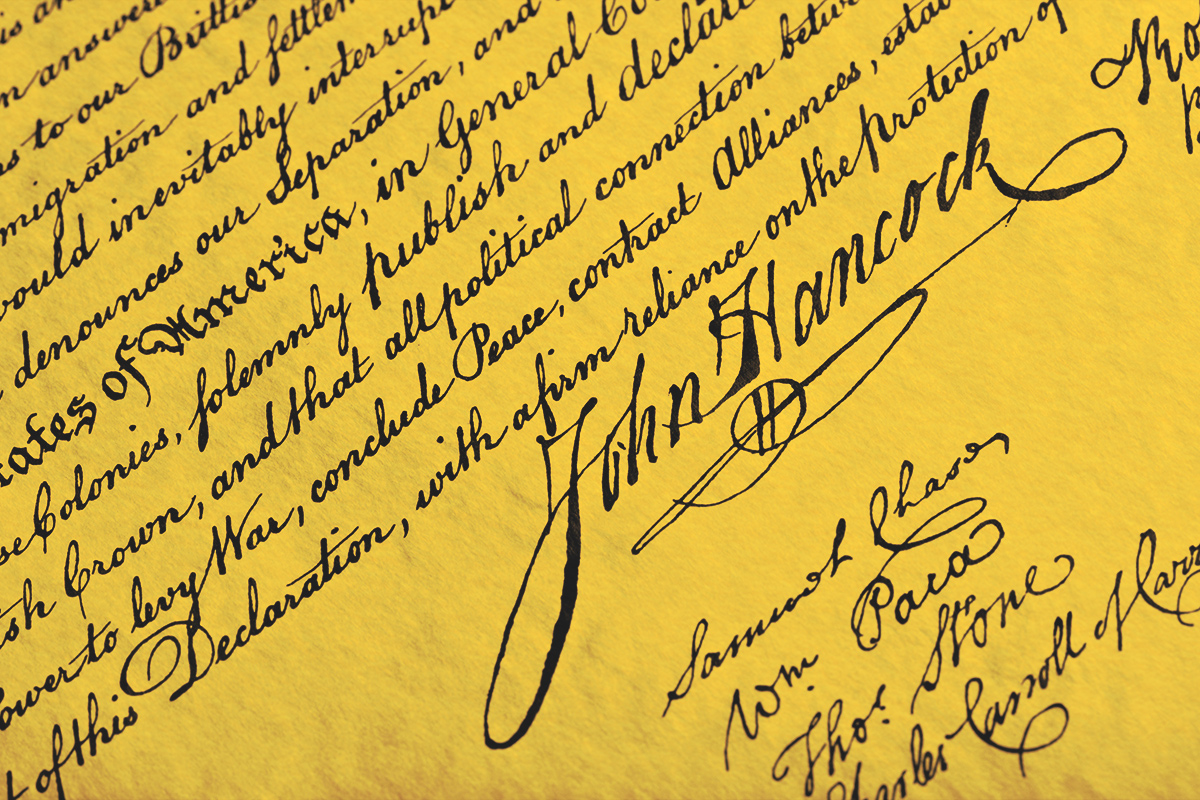
A lawyer might ask you to put your John Hancock on the dotted line, which is another way of requesting your signature. John Hancock (1736-1793) was the first person to sign the Declaration of Independence, doing so in large, bold handwriting. “There, John Bull [Britain] can read my name without spectacles,” he said. “Now let him double the price on my head, for this is my defiance.” Britain never did offer a bounty on Hancock, but his patriotic gesture gave rise to this idiom.
Those with an uncanny ability to make money are said to have the Midas touch. Midas, a real eighth-century BCE king of Phrygia (now Turkey) has been immortalized in myth. As the story goes, he was very kind to Silenus, a satyr who was a companion of Dionysus, god of wine. As a reward, Dionysus granted Midas one wish. The king’s wish was to have the power to turn anything he touched into gold. It seemed like a great idea, until Midas realized, to his horror, that his wish had been taken literally: Every single thing he touched, including his food, drink, and even his daughter, did turn into gold. Realizing his mistake, Midas asked Dionysus to reverse the gift, and he did so — but that lesson is lost in this idiom.
Murphy’s law promises that anything that can go wrong will go wrong — or at least it seems that way on a bad day. Edward Murphy was a U.S. Air Force captain and aeronautical engineer. In 1949, he worked as a lead scientist on a project to test human endurance against extreme deceleration, as in high-speed emergency aircraft ejections. Those tests worked only if accelerometer sensors were installed correctly. In one test, they were mistakenly installed incorrectly. This idiom comes from that experience when it seemed like nothing could go right.
Someone opening Pandora’s box — perhaps by bringing up a touchy subject or taking a seemingly innocent action with unforeseen consequences — is unleashing a whole host of potential problems. According to myth, Pandora, the first mortal woman, was married to Epimetheus, Titan brother of Prometheus. He gave her a large jar (not a box), with explicit instructions not to open it. Intrigued, Pandora opened the jar anyway, releasing the world’s evils. The last thing released, though, was hope. The lesson, lost in this idiom, is that even in hardship, hope can carry us through the worst of times.
A Sadie Hawkins dance is an old-fashioned tradition where girls would ask boys to a dance (instead of the other way around). The expression can be traced back to cartoonist Al Capp, who started his “Li’l Abner” comic strip, set in the fictional Appalachian town of Dogpatch, Kentucky, in 1934. In 1937, Capp created a town race so that Sadie Hawkins (“the homeliest gal in all them hills”) could marry. In that race, men got a head start, but any man Sadie caught before sundown had to marry her. This popular story is the basis for the Sadie Hawkins dance.
More from our network
Word Smarts is part of Inbox Studio, which publishes content that uplifts, informs, and inspires.





