


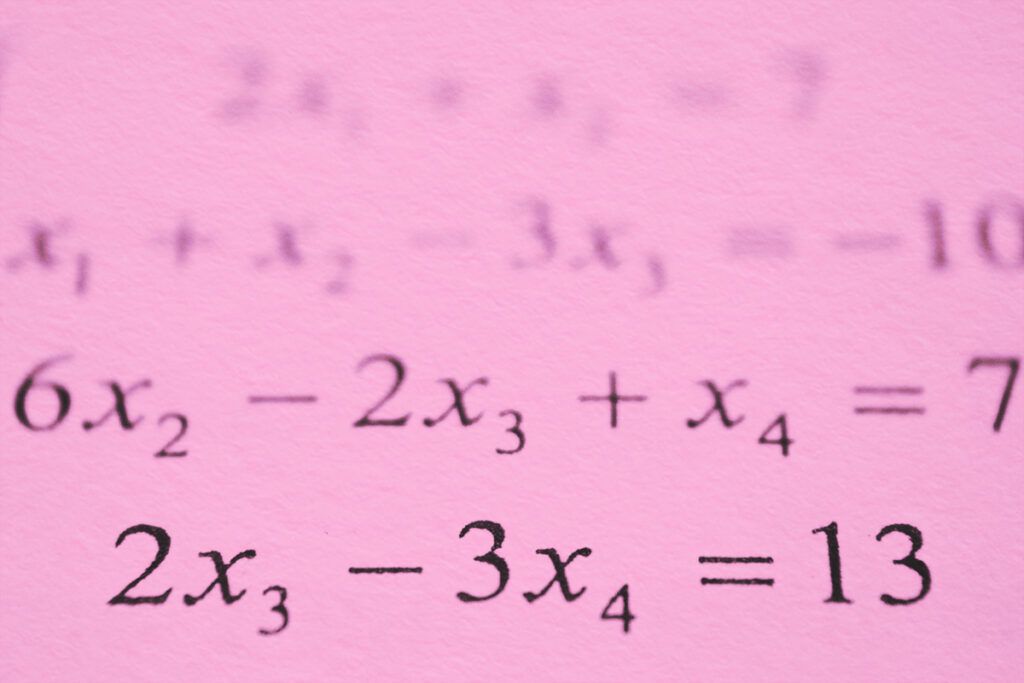
The individual letters of our alphabet can serve many purposes beyond the formation of words. But few, if any, lead as many lives as “X.” While some letters are happy to sit on the page making up sounds, “X” moonlights in all manner of roles, whether it be as a mathematical mystery, a chromosome, or a kiss. Here we look at some of the many jobs that “X” has taken on, and the stories behind each.
Every math student eventually has to “solve for x,” but the origin of that convention isn’t entirely clear. One popular theory claims it traces back to the Arabic word šay’ or al-shay, meaning “the unknown thing.” When translated into Spanish — a language with no equivalent to the Arabic word — it was replaced by the letter “X,” which had a similar sound. It’s a compelling story, but historians have found no solid evidence to support it. A perhaps more credible explanation points to René Descartes, who in his 1637 work La Géométrie used letters from the end of the alphabet — “X,” “Y,” and “Z” — for unknown quantities, while reserving letters from the beginning for known ones. Either way, “X” became the standard symbol for the unknown in algebra.
“X” eventually found its way into the wider world of science. In 1891, the cytologist Hermann Henking discovered the X chromosome, but he didn’t understand its function. In keeping with the same “unknown” tradition found in algebra, he simply labeled it “X,” and it was never renamed. Similarly, in 1895, when German physicist Wilhelm Röntgen discovered a form of radiation that could pass through solid objects, he called it X-radiation, again borrowing from the mathematical convention.
The “X” of the algebraic unknown also made its way into sociology and popular culture. The moniker Generation X arose in the 1950s, referring in general to a generation whose future was yet undetermined. It was later popularized by author Douglas Coupland in his 1991 novel Generation X: Tales for an Accelerated Culture to refer to people born in the 1960s and 1970s. The name describes a generation that felt lost, undefined, and hard to categorize, with the “X” chosen to represent an unknown, unnamed, or resistant identity.
Apart from representing an entire generation, “X” also came to prominence with one of the most popular TV series of the 1990s: The X-Files, in which Special Agents Fox Mulder and Dana Scully go down a paranormal rabbit hole into the unknown.
We know that “X” refers to the unknown in algebra, but it also shows up elsewhere in mathematics. The “X” in multiplication equations such as 3 x 4 isn’t technically the same character as the letter — it’s a separate symbol called a saltire. It should really be written as 3 × 4 — with the × raised above the line — rather than 3 x 4, but the latter has become entirely acceptable. Historically, the saltire symbol was a common symbol in heraldry called the St. Andrew’s Cross; it appears, for example, on the flag of Scotland. Historians believe the saltire was introduced as a symbol for multiplication by the English mathematician William Oughtred in the early 17th century, and was widely popularized following the publication of his 1631 textbook Clavis Mathematicae.
The idea of pirates marking treasure maps with an “X” is basically a myth. While “X” may have been used to mark locations on maps — it is, after all, a simple, logical, and easily recognizable symbol for marking a specific point — the concept of “‘X’ marks the spot” has more to do with fiction than reality. Robert Louis Stevenson’s 1883 adventure novel Treasure Island helped popularize the idea, although it never once mentions the letter “X” marking anything — it instead mentions “three red crosses” on a map. But such was the popularity of Treasure Island and the many adaptations that followed that it nonetheless helped establish the widespread notion of using “X” to mark an important spot — particularly buried treasure — on maps.
The practice of signing off a note with an “X” to represent a kiss is old enough that its exact origin is debated, but one common explanation ties it back to an age when illiteracy was widespread. In the Middle Ages, people who couldn’t write their own name signed documents with an “X” instead, and some would kiss the mark as a show of sincerity (similar to swearing on a Bible). Examples of using an “X” or a string of “X’s” as a blessing are found in letters from the 18th century. According to the Oxford English Dictionary, the first clear example of “X” to mean a kiss comes from an 1878 novel by Florence Montgomery: “This letter..ends with the inevitable row of kisses,—sometimes expressed by X X X X X, and sometimes by O O O O O, according to the taste of the young scribbler” — strikingly similar to the XOXO still used today.
“Xmas” isn’t some modern abbreviation that strips the “Christ” out of Christmas. The “X” actually represents the Greek letter chi, which is the first letter in Christos — the Greek word for Christ. Christian scribes have been using the chi symbol as an entirely acceptable shorthand for “Christ” for centuries — meaning that “Xmas” has a much older and more religious pedigree than its casual modern usage suggests.
If something is referred to as X-rated, it’s likely suitable for adults only and might contain content or scenes of a titillating nature. This comes from movie classifications, beginning when the British Board of Film Classification introduced an X certificate in 1951 for anything unsuitable for viewers under the age of 16. (The BBFC never directly stated why “X” was selected, but it was likely inspired by the “X” in “explicit content.”) The adult film industry soon adopted “X” — and “XXX” — as a badge of explicitness, forcing film boards to rename their classifications (to NC-17, for example). But “X-rated” had already become a common term and still serves as a catchall expression for anything of a particularly naughty nature.
More from our network
Word Smarts is part of Inbox Studio, which publishes content that uplifts, informs, and inspires.