




If you want to add some literary flair to your writing, or simply sound more well-read, learning a few clever quotes and cerebral idioms goes a long way. From witty Shakespearean lines to references to classical mythology and timeless novels, these expressions can be used in modern conversation, bringing their rich history into daily life. Knowing their precise meanings can make your everyday speech sharper and more interesting. Whether contemplating bold decisions or acknowledging thankless tasks, these phrases replace dull words with more meaningful ones.
Meaning: To pass a limit or point that is reached when the results of one’s actions cannot be changed.
Example: “The age of AI has crossed the Rubicon — there is no going back.”
To cross the Rubicon is to take a decisive step at a critical moment. It comes from a real historical event: In 49 BCE, Julius Caesar and his army crossed the Rubicon River, which formed the border between Italy and Gaul. This violated Roman law and marked the start of a civil war. “Crossing the Rubicon” (or “passing the Rubicon”) has been used to refer to a metaphorical boundary since at least the 17th century, as seen in this 1626 letter cited in the Oxford English Dictionary: “Queen Dido did never more importune Æneas’s stay at Carthage, than his mother and sister do his continuance here at London … But now he is past the Rubicon.”
Meaning: A process or course of action has been started and it cannot be stopped or changed.
Example: “The die was cast when the company announced the merger today.”
The Rubicon wasn’t the only metaphor born from Julius Caesar’s famous river crossing. As the legend goes, Caesar waded into the water and said, “alea jacta est,” meaning “the die is cast.” This saying refers to the literal action of rolling a die or dice. Once it is rolled, the outcome cannot be changed. Caesar was possibly quoting a line from a Greek play by Meander: anerriphtho kybos, meaning “let the die be cast.”
Meaning: Severely mentally unsound.
Example: “I can feel mad as a hatter when I’ve worked 10 days in a row with no break.”
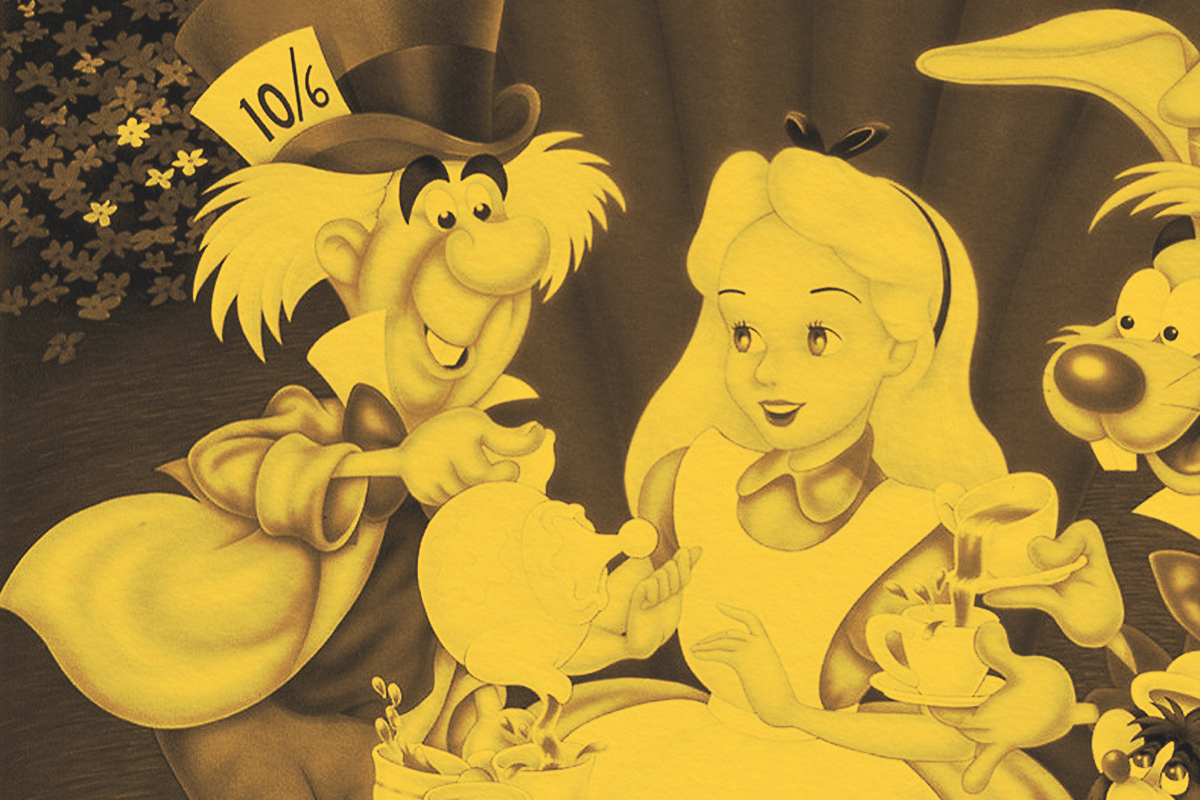
“Mad as a hatter” is an old-fashioned saying that describes someone as mentally unsound, though today it can be an idiom for calling someone or something unpredictable or absurd. The saying has a grim origin, dating back to the 18th-century hat-making industry. Safety standards were nonexistent at the time, and workers were exposed to toxic substances that resulted in physical symptoms and hallucinations. Though the saying predates the novel, Lewis Carroll popularized the idea in 1865 as a metaphor in Alice’s Adventures in Wonderland. The Hatter character, as he is called in the book, became known popularly as the Mad Hatter, furthering the phrase’s association with unpredictable behavior.
Meaning: Foolishly impractical especially in the pursuit of ideals.
Example: “Her plan to save the old theater from demolition was quixotic, yet noble.”
The word “quixotic” is actually an eponym, from the name of Don Quixote, the protagonist in Spanish author Miguel de Cervantes’ 17th-century novel of the same name. This adjective describes something that is “foolishly impractical, especially in the pursuit of ideals.” It can also carry an air of lofty or extravagant romantic ideas, marked by rash actions that are doomed to fail. Don Quixote was known for these very traits. “Quixotic” has been used in English since at least the 18th century.
Meaning: The outcome is mixed.
Example: “Today was eventful. I lost my phone on the train, but then I got a promotion. It was the best of times, it was the worst of times.”
In the opening line of the 1859 novel A Tale of Two Cities, Charles Dickens’ clever phrasing captures contradictions in a way that has withstood the test of time. This saying is still used when both good and bad things are happening at the same time. The rest of the opening is often discarded, but in it, Dickens continues to make contrasting comparisons: “It was the best of times, it was the worst of times, it was the age of wisdom, it was the age of foolishness, it was the epoch of belief, it was the epoch of incredulity, it was the season of Light, it was the season of Darkness, it was the spring of hope, it was the winter of despair …”
Meaning: There are good reasons for one’s actions even though they may seem foolish or strange.
Example: “I keep a dozen tabs open on my computer, but trust me, there’s method in my madness.”
This Shakespearean saying is a clever way to say, “There’s a reason behind these actions.” It likely comes from a line in Act 2, Scene 2 of Hamlet: “Though this be madness, there is method in’t.” Polonius says this in reference to Hamlet’s strange behavior since his father’s death, and the “method” in the idiom refers to Hamlet’s plan to feign madness to gain revenge. Later, Oscar Wilde used the phrase “method in his madness” in reference to the protagonist in his 1890 novel The Picture of Dorian Gray, further popularizing the saying.

Meaning: A task requiring continual and often ineffective effort.
Example: “Trying to clear my inbox after the holidays is a Sisyphean task.”
A Sisyphean task is something that requires continual effort, though it is often unsuccessful. It comes from a story in Greek mythology, derived from the name of King Sisyphus of Corinth. When condemned to Hades, Sisyphus was given a grueling, eternal sentence: to roll a large boulder up a long, steep hill in the underworld. However, the boulder would roll back down every time, making the task endless and impossible. The adjective “Sisyphean” has been used metaphorically in English since the mid-17th century.
More from our network
Word Smarts is part of Inbox Studio, which publishes content that uplifts, informs, and inspires.