







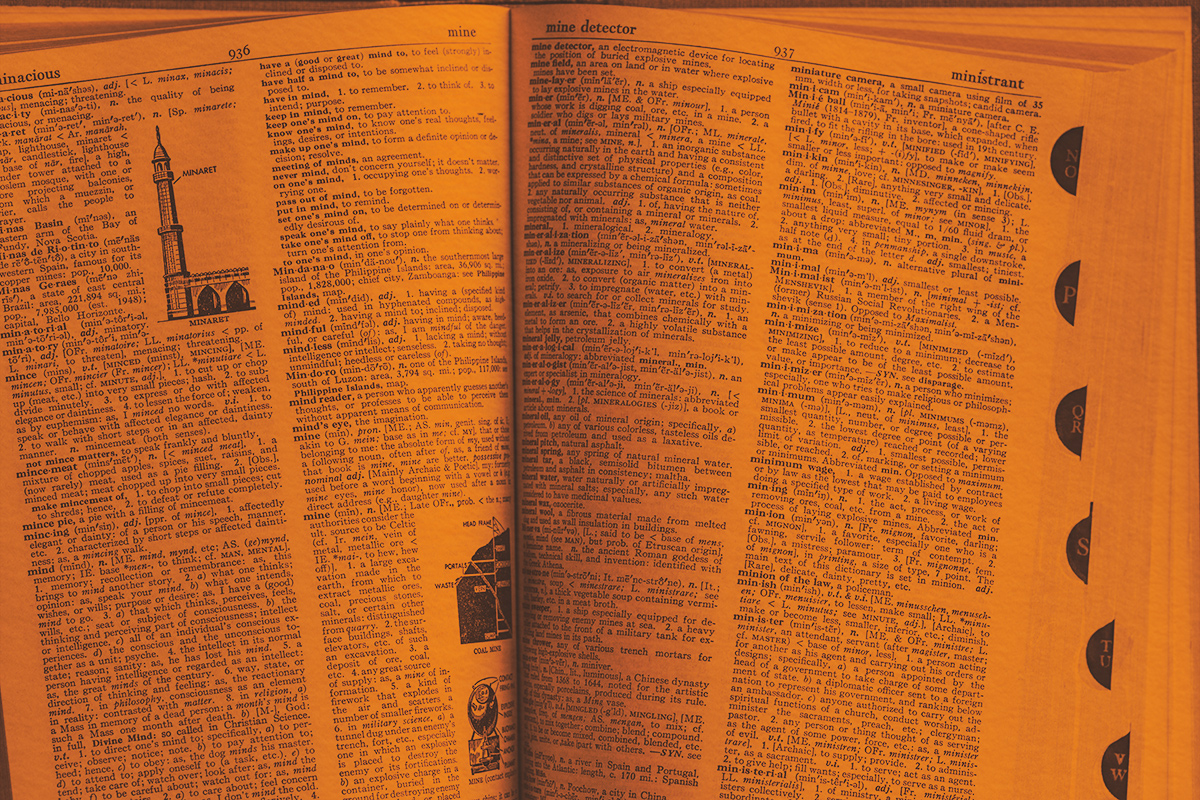
Language doesn’t stand still. In fact, most dictionaries are updated regularly to reflect the latest developments. (The Merriam-Webster Collegiate Dictionary, 12th Edition, was released in late 2025.) Words we were once told never to use and rules we were warned not to break have worked their way into everyday speech and eventually into the pages of official dictionaries. Let’s review some of the words and rules that many traditional grammar sticklers balk at, but that have been deemed acceptable on the pages of the dictionary.
A sore spot for many, the term “literally” has taken on a life of its own, especially among younger users. When the term first entered English during the 15th century, it meant “in a literal sense or manner,” emphasizing truth or accuracy, as in, “The dictionary literally contains hundreds of thousands of definitions.”
But another (and some would argue more popular) usage has emerged: “an exaggerated way to emphasize a statement or description that is not literally true or possible.” For instance, “I literally have five dollars in my bank account” might not be an accurate statement, but it’s more dramatic and creative than telling your friends, “I’m broke.”
Merriam-Webster and other language authorities have added this figurative definition to their pages because enough people are using it to warrant an explanation. But surprisingly, this definition isn’t that new. Evidence of “literally” as an exaggeration dates to the mid-18th century; millennials simply resurrected the usage.
When it first entered English in the mid-17th century, “data” was strictly plural, as in, “The data are limited.” It comes from the Latin datum, meaning “something given,” and it follows the Latin plural rules, turning one piece of datum into many sets of data. Because it was plural, it called for plural modifiers and verb tenses. In technical and academic writing, this is still the appropriate usage. The singular “datum” is formally used to denote a piece of data, as in, “We are missing a crucial unit of datum.”
However, in the dictionary, there is a modern update to this rule of thumb. In informal contexts, “data” is used in the same way “information” is, as a singular mass noun to describe collections of figures, details, or statistics. In this way, the term takes a singular verb, as in, “The data is accurate.” Both the plural and singular uses are now standard, but the latter is increasingly common.
Most grammar sticklers would cringe at hearing someone say, “I’m like, ‘Sure, I’ll meet you there after work,'” but using “like” interjectionally to introduce a thought or a statement has become accepted in a conversational setting. Another casual usage is to introduce commonly held beliefs, such as “It’s like, who cares what he thinks.” Merriam-Webster documents this usage: “used interjectionally in informal speech often with the verb be to introduce a quotation, paraphrase, or thought expressed by or imputed to the subject of the verb, or with it’s to report a generally held opinion.” While it’s still frowned upon in formal and technical writing, it seems that “like” is here to stay.
While the new usage is documented by Merriam-Webster, it’s with the caveat that “irregardless” is nonstandard and widely disliked. That’s because it’s seen as a double negative, and grammar standards say that “regardless” does the same job without the prefix. However, in the dictionary, “irregardless” is listed as a synonym of “regardless,” both meaning “despite everything.” Both options are valid: “Our flight left on time, regardless/irregardless of the storm.”
“Irregardless” came into use during the mid-19th century. While usually the prefix “ir-” employs negation, in the case of “irregardless,” it acts as an intensifier. For this reason, it has slipped through the cracks of strict grammar protocol and landed in a gray area where it’s defined in the dictionary, yet scoffed at by grammar officials.
Although increasingly popular in modern English, traditional grammar rules state that “impact” shouldn’t be used as a verb, especially in the meaning “to directly affect.” According to this line of thought, “The book positively impacted my life” is technically a faux pas. Instead, traditional grammarists would rather “impact” remain a noun, as in, “The book had a positive impact on my life.” Here, “had” is the main verb.


However, especially in casual conversation, using “impact” as a verb can feel more natural. In fact, one verb form of “impact” (meaning “to strike forcefully”) is nearly 200 years older than the noun form; the former emerged in 1601 and the latter in 1781. The verb usage of “to have a direct effect upon” came about in the 20th century, and that’s what some object to. However, Merriam-Webster considers this verbal use perfectly acceptable, though you should omit it if your audience finds it problematic.
More from our network
Word Smarts is part of Inbox Studio, which publishes content that uplifts, informs, and inspires.





