


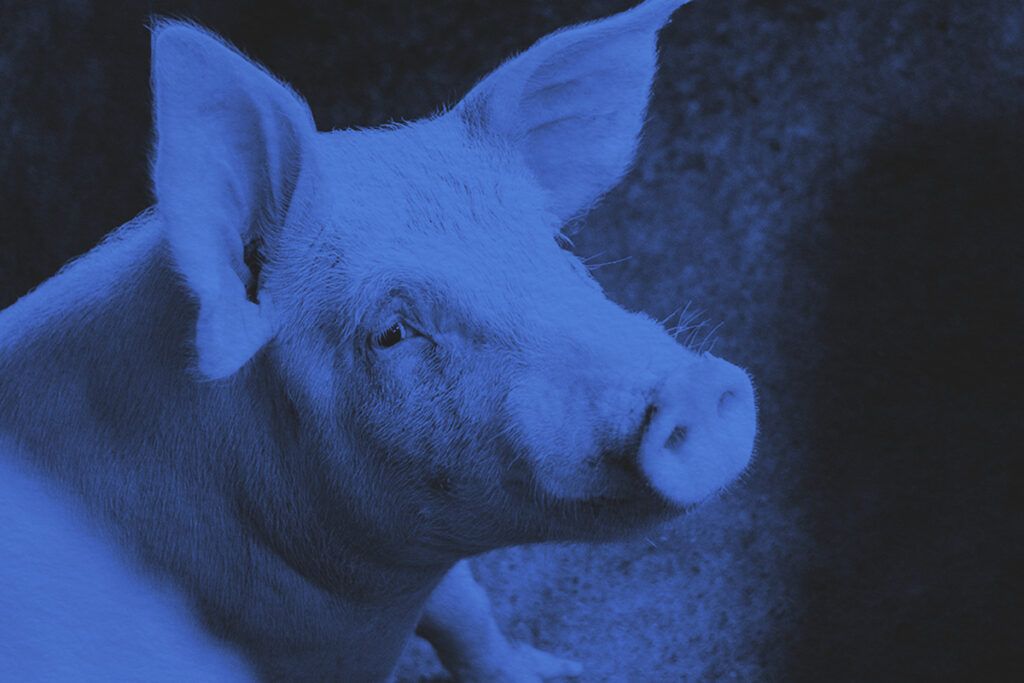
From “pig out” and “pigheaded” to “road hog” and “hog wild,” the English language is full of swine-themed words, phrases, and idioms — though not all of them are necessarily accurate. (We often say someone is “sweating like a pig” to describe excessive perspiration, for instance, but pigs actually have very few sweat glands, making the comparison scientifically dubious.)
Then there’s “hogwash,” a word that’s fun to say but whose meaning — “nonsense or balderdash” — seems to have little to do with pigs at all.
So how did “hogwash” come to be something we say when we don’t believe what someone else is saying?
The word dates back to the 15th century, when “hogwash” had a much more literal meaning: food for hogs. More specifically, it referred to the kitchen scraps, garbage, and other leftovers that were mixed with water or sour milk and fed to pigs. In other words, “hogwash” was the stuff that was barely fit to eat — even for a hog.
By the 17th century, the word had taken on a broader meaning: “Hogwash” could refer to weak or inferior liquor, as well as anything considered worthless or of poor quality. From there, it wasn’t a massive leap to begin applying the word to worthless writing, ideas, or speech.
That kind of figurative shift is fairly common in language. Words for things considered dirty, useless, cheap, or otherwise undesirable often end up being used to describe ideas that people similarly consider worthless. For example, bologna sausage was viewed in early 20th-century America as a cheap food made from leftover meat scraps, and by the 1920s, “baloney” became popular slang for pretentious nonsense. And hogwash had a particularly vivid image built right into it. If something was literally slop fed to pigs, calling something else hogwash was a colorful way of dismissing it as similarly low-grade.
By the late 19th century, especially in American English, “hogwash” settled into the meaning we know today: utter nonsense. Mark Twain wrote in 1870, “I will remark, in the way of general information, that in California, that land of felicitous nomenclature, the literary name of this sort of stuff is ‘hogwash.’”
So the next time someone tries to sell you a load of hogwash, you can think of the word’s decidedly unappetizing past and remember that, linguistically speaking, nonsense has been pig slop for centuries.
More from our network
Word Smarts is part of Inbox Studio, which publishes content that uplifts, informs, and inspires.