


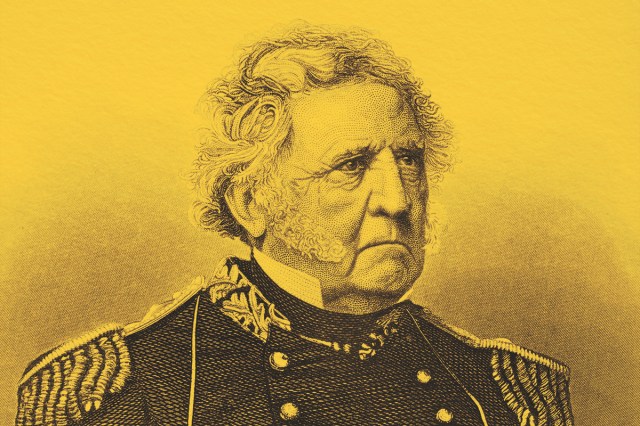
If you grew up watching the Back to the Future movies, you’ll be familiar with “Great Scott!” as Emmett “Doc” Brown’s exclamation of choice for every surprise, mishap, and temporal paradox that occurs during the trilogy. But Christopher Lloyd’s character was far from the first to use the phrase. The antiquated expression of astonishment emerged in the mid-1800s and remained popular through at least the early 1900s before falling out of fashion — until Doc Brown gave it a second life.
But who, exactly, is the Scott in question, and what was so great about him? While a few notable individuals with the surname Scott have been linked with the phrase, including the Scottish novelist and historian Sir Walter Scott, etymologists tend to point to one man as the inspiration behind the idiom: General Winfield Scott. This Scott was a towering figure in his day. He was a hero of the Mexican-American War, became the last Whig Party candidate to run (unsuccessfully) for U.S. president, and served as the commanding general of the United States Army when the Civil War began in 1861. He was also 6 feet, 5 inches tall and weighed about 230 pounds in his prime, making him physically a great figure.
General Scott was connected with the exclamatory phrase at least as far back as 1852, when a reporter for the Madison Daily Banner wrote, “The exclamation of ‘great Scott’, so frequently used by many people, is said to allude to Gen. Scott, the Whig candidate for President.” It was also used to emphasize an oath or a promise — in Miss Ravenel’s Conversion From Secession to Loyalty, an 1867 Civil War novel by veteran John William De Forest, the author wrote, “I follow General Scott… We used to swear by him in the army. Great Scott! the fellows said.”


Today, “Great Scott!” sounds delightfully quaint and eccentric, a relic from a bygone era to express a sense of amazement or shock without harsher curse words. But the real Scott had nothing quaint about him — he was a military figure of great renown who inspired his soldiers, quite literally, to swear by his name.
More from our network
Word Smarts is part of Inbox Studio, which publishes content that uplifts, informs, and inspires.