




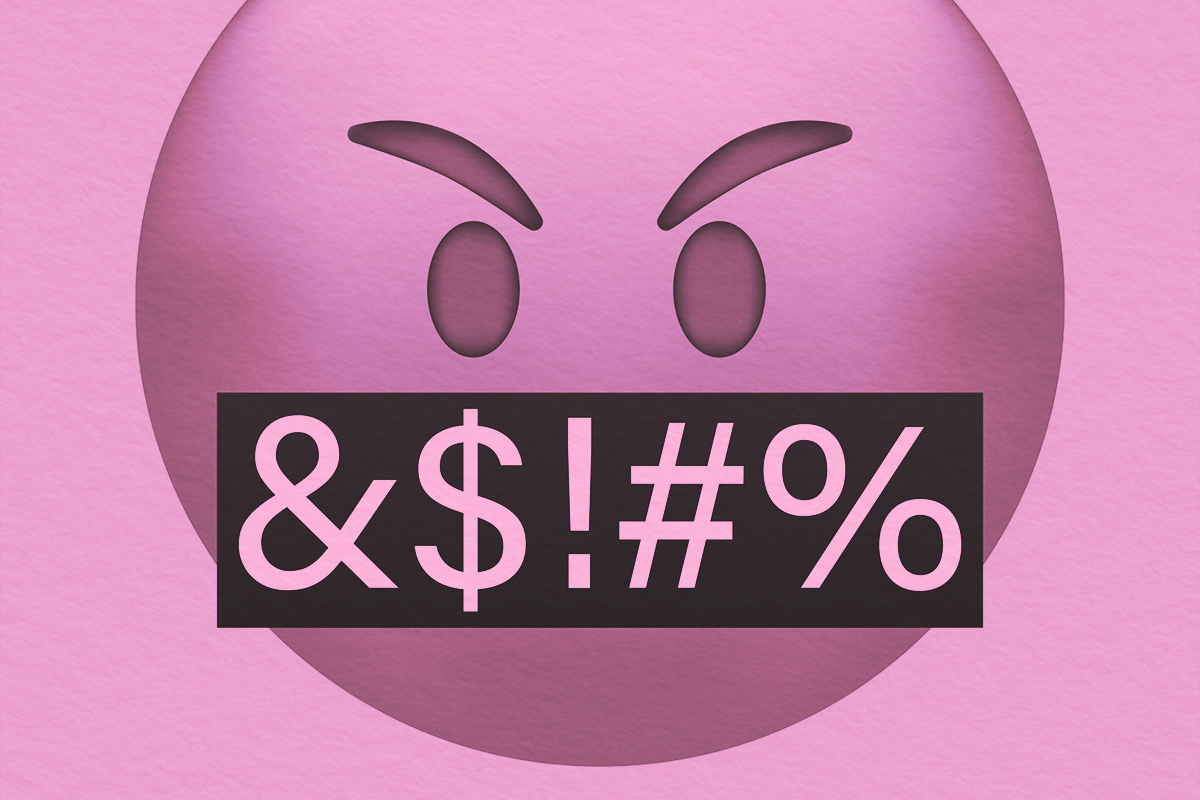
Before emojis, there were grawlixes. Imagine you’re doing some home repairs, and as you’re pounding a nail into a piece of wood, you mistakenly bash your thumb. You don’t respond calmly with, “Oh darn. I do believe I just hit my thumb with a hammer. It is rather painful.” No, if you smash your thumb with a hammer, you’re going to shout, “#@*&!%@!” This isn’t the type of publication to spell out curse words — those handy symbols used to replace an expletive are a grawlix.
A grawlix is a string of symbols (glyphs) often used in cartoons and comic books, either to convey an obscenity or a variety of emotions. Grawlixes are not limited to what you find in the top row of your keyboard. They can include a variety of symbols, such as lightning bolts, storm clouds, explosions, skulls and crossbones, shaking fists, and hammers, depending on the emotion to be conveyed. In graphic novels, these might be drawn by an artist, but in digital communication they can be conveyed with a graphical font such as Wingdings, or with emojis.
Cartoonist Mort Walker, who created the “Beetle Bailey” and “Hi and Lois” comic strips, coined “grawlix” in a 1964 article, “Let’s Get Down to Grawlixes,” for the National Cartoonists Society’s magazine. In a 2000 book called Mort Walker’s Private Scrapbook, he elaborated on how some cartoon-specific terms came to be: “It started out as a joke for the National Cartoonists Society magazine. I spoofed the tricks cartoonists use, like dust clouds when characters are running or light bulbs over their heads when they get an idea. … I created pseudoscientific names for each cartoon cliché, like the sweat marks cartoon characters radiate. I called them ‘plewds,’ after the god of rain, ‘Joe Pluvius.'”
So, how did Walker get to “grawlix”? To break it down linguistically, it sounds similar to the word “growling,” an appropriate expression of emotion for a cartoon character. “Graw” is akin to “draw, which is what cartoonists do. And “-lix” gives it a Latinate air of authority, as in calix (“cup”), helix (“spiral”), and prolix (“drawn out”). But Walker might not have been thinking of etymology when he added to the artists’ vocabulary.
Walker also coined some words for the symbols used in a grawlix in comic strips: “jarn” (spiral), “quimp” (ringed planet), “nittle” (star), and “squean” (starburst).
But while Walker was the first to name such cartoon symbols, he wasn’t the first to use them. Examples can be traced back to newspaper comics around the turn of the 20th century, including “The Katzenjammer Kids” by German immigrant Rudolf Dirks, first published in 1897, and “Lady Bountiful” by Gene Carr, first published in 1901.
More from our network
Word Smarts is part of Inbox Studio, which publishes content that uplifts, informs, and inspires.