


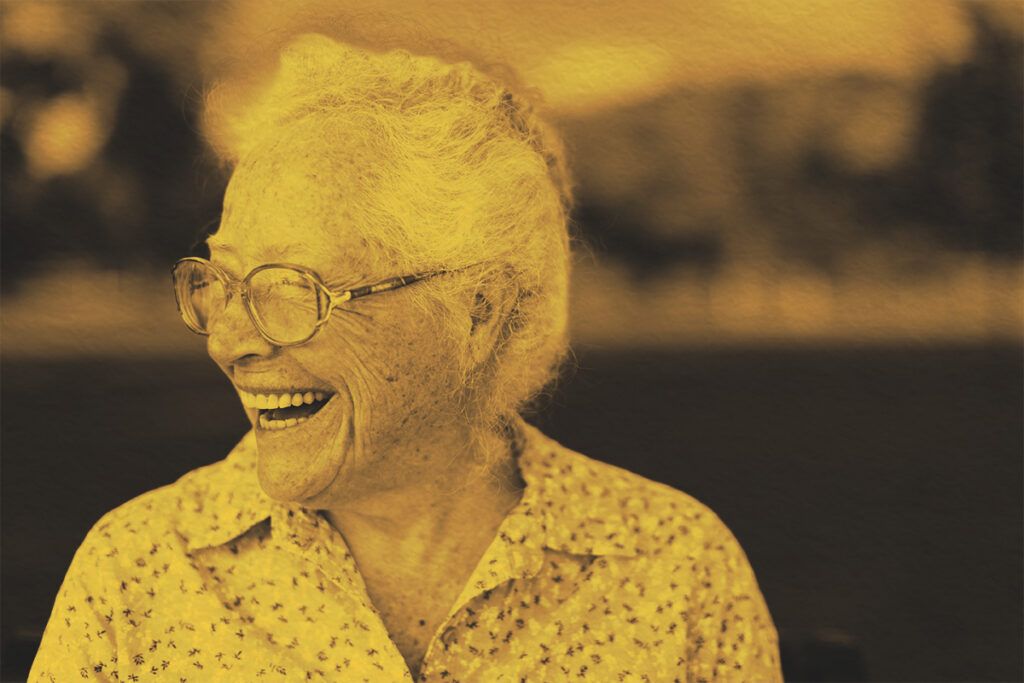
Many folks have fond memories of spending time with Grandma, whether it’s baking cookies together or paging through old photographs. You might also recall that she had a specific and charming way of speaking, including the use of some old-fashioned sayings, or aphorisms. While many of these expressions sound dated to the modern ear, they once held a strong place in day-to-day vocabulary and continue to occupy a nostalgic spot in our hearts. Here are nine folksy expressions from your grandmother’s time.
“To travel by shank’s mare” means “to walk to your desired destination.” This saying was coined around 1795, when people more commonly traveled by horse. A shank is the lower part of the leg, and a mare is a female horse. Essentially, to travel by shank’s mare means the travel is thanks to a horse’s legs, but your grandmother may have still used the phrase if she was walking to the store on her own legs, as in “I’ll travel by a shank’s mare faster than if I take the bus.”
Grandma might have used this phrase when her grandchildren were scarfing down plentiful amounts of her home cooking. The idea of having hollow legs is an old idiom dating to the mid-19th century. To say someone has hollow legs means they can eat or drink absurd amounts without feeling any negative side effects, implying they’re stashing all of that food in their vacant appendages.
“The Wreck of the Hesperus” is an 1842 poem by Henry Wadsworth Longfellow, which describes the ill-fated voyage of a ship that’s destroyed in a storm. The poem was the inspiration for the idiom “wreck of the Hesperus,” which refers to a chaotic situation. For instance, Grandma may have likened a messy room to the wreck.
The word “druthers” essentially means “free choice.” It was coined by Mark Twain in the late 1800s in a conversation between Huck Finn and Tom Sawyer, in which the former said, “Any way you druther have it, that is the way I druther have it.” (In the line, “druther” is a contraction of “would rather.”) If Grandma had her druthers, she might say she’d enjoy spending all day with her grandkids.
The word “davenport” refers to a “large, upholstered couch.” It came about in the 19th century, thanks to the popularity of the sofa maker A.H. Davenport and Company. Eventually the word came to be used for any sofa, not just those made by the Davenport company, much like how Sharpie is now universally used to mean “marker,” or Kleenex to mean “tissue.” Odds are Grandma may have had her davenport covered with protective plastic or doilies.
Whenever Grandma had to deal with pouting children, she may have said that she could “walk to town on that lip” — especially if she lived in the South. The saying refers to the dramatic facial expression kids make when frowning — their protruding lower lip looks so big that someone could figuratively walk on it all the way into town.
This phrase and similar variations likely come from the King James Bible in 2 Kings 20:1, which warns, “Set thine house in order.” It means to take care of your own situation before criticizing others — a popular sentiment among any grandmothers who are known to give common sense advice. If she were to say this to you, she was probably implying that it would be in your best interest to look ar yourself before judging others.
Instead of saying “How are you?” or “How’s it going?” Grandma may have turned to the late-19th-century phrase “How’s tricks?” The origins of this phrase are murky, with one theory placing a “trick” as nautical slang for a sailor’s turn at the wheel. But whatever the origin may be, many people of Grandma’s generation used this phrase as a standard greeting.
This phrase is attributed to the notorious gangster Al Capone, though we’re not suggesting that your grandmother was also caught up in organized crime. It’s a positive saying, suggesting that it’s better to have high-quality relationships with fewer people than shallow relationships with a larger group of people. It’s essentially another way to say “quality over quantity.”
More from our network
Word Smarts is part of Inbox Studio, which publishes content that uplifts, informs, and inspires.