


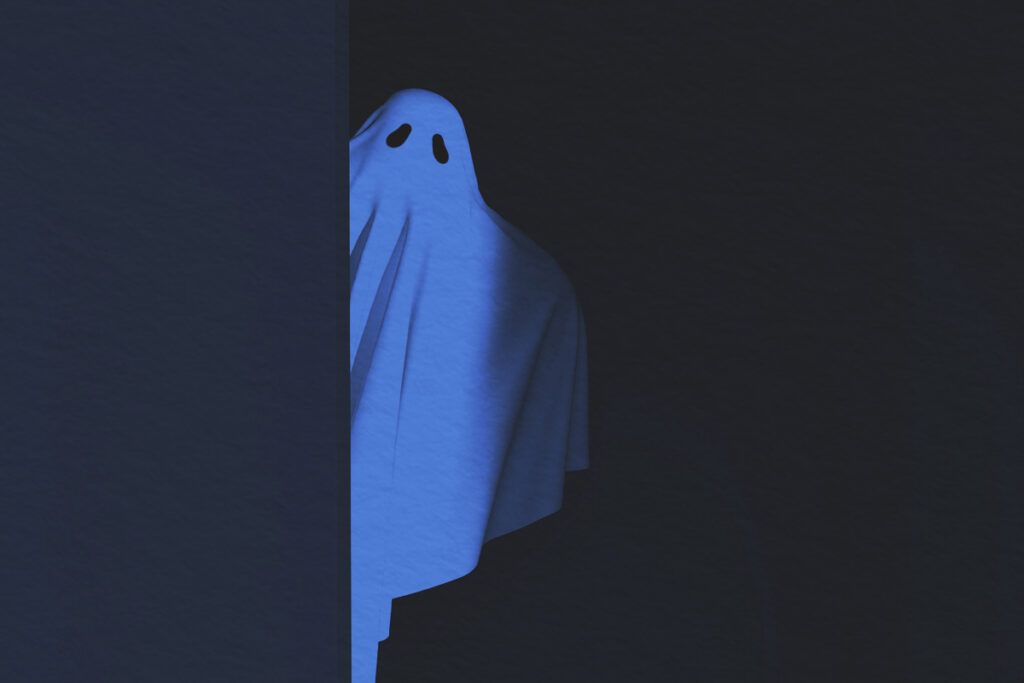
You don’t have to encounter a ghost to know what it would say to you if you did: “Boo!”
In English-speaking countries around the world, “Boo!” is the utterance most closely associated with otherworldly entities. Even in other languages, the sound a ghost supposedly makes is surprisingly similar. In French it’s Bouh!, while Spanish opts for ¡Bu!, the Dutch have Boe!, and German ghosts say Buh!
How did this single-syllable interjection become so closely associated with ghosts and other spooky creatures?
As it turns out, “boo” was born less as a word and more as a sound — and its earliest history is considerably less supernatural than its current usage.
The Oxford English Dictionary traces the word to the early 15th century in the form “boh,” describing it as “a combination of sounds particularly suited to producing a loud, startling noise.” The word’s ultimate origin, however, is uncertain. The OED compares it to the Latin boare and Greek boaō, words meaning “to cry aloud, roar, or shout.”
That doesn’t mean “boo” descended directly from either of those ancient words, though. The OED presents them as possible comparisons, not a definitive family tree. Like many very old interjections, “boo” may simply have emerged from a sound humans instinctively made when calling out, shouting, or trying to startle someone.
The written evidence gets particularly interesting in the 16th century. In A Treatyse of the Smyth Whych That Forged Hym a New Dame, a story printed in 1565 but apparently based on a much older tale, a character tells someone to “say ones bo.” In this context, “bo” is essentially a demand to speak — to make some noise and show that you’re there. In other words, “bo” was already doing what interjections do best: making a little noise and getting someone’s attention.
By the 17th century, “bo” and “boh” had acquired a more distinctly startling quality. In George Wither’s “Britain’s Remembrancer,” a 1628 poem about the plague, he wrote of a child crying “boh” to frighten a nurse. That is one of the earliest documented examples of the sound being explicitly used to scare someone.
By the 18th century, “boo” was being used as a word to frighten children. Gilbert Crokatt’s Scotch Presbyterian Eloquence Display’d, published in 1738, described “boo” as a word used in northern Scotland “to frighten crying children.” In other words, long before ghosts claimed the word, humans were already deploying it as an instant jump scare.
That Scottish connection may also help explain why “boo” became entwined with supernatural creatures. Scottish dictionaries record compounds such as bu-kow, meaning “something frightening or a hobgoblin,” and bu-man or boo-man, meaning “a goblin or other frightening creature.” The Scottish National Dictionary notes that bu-man was used for a bogey or a creature meant to frighten children.
In other words, “boo” wasn’t merely the sound used to frighten someone; it became attached to the very creatures imagined to do the frightening. The connection was almost inevitable: If “Boo!” is what a person says when trying to frighten someone, and ghosts are supposed to frighten people by suddenly appearing, why wouldn’t a ghost say “Boo!” too?
By the 19th century, ghosts were beginning to do exactly that in popular culture. A Punch and Judy script from 1863 gives a particularly delightful example. When a ghost appears, its entire dialogue consists of repeated cries of “Boo-o-o-oh!” while Punch responds with terrified screams.
The sound also proved remarkably useful outside the spirit world. “Peekaboo,” the children’s game in which someone hides and suddenly reappears, has been documented since the 1590s. Its name captures the same basic formula as a ghostly “boo”: hide, appear suddenly, startle the other person.
Then there’s the other modern “boo”: the sound audiences make to express disapproval. That meaning developed much later than the frightful interjection, with “boo” appearing as an expression of contempt or disapproval in the 19th century. The verb “to boo” followed, eventually giving us the familiar spectacle of audiences booing performers, politicians, athletes, or anyone else who managed to get on their bad side.
They don’t have an ancient ghostly language that dictates it; humans taught them. “Boo” began as a short, punchy sound used to command attention or startle someone. Over centuries, it became associated first with frightening children, then with the frightening creatures used to scare them — and eventually with the quintessential creature that does the frightening.
So when a ghost pops out from behind a tombstone and yells “Boo!,” it’s really just carrying on a centuries-old human tradition.
More from our network
Word Smarts is part of Inbox Studio, which publishes content that uplifts, informs, and inspires.