


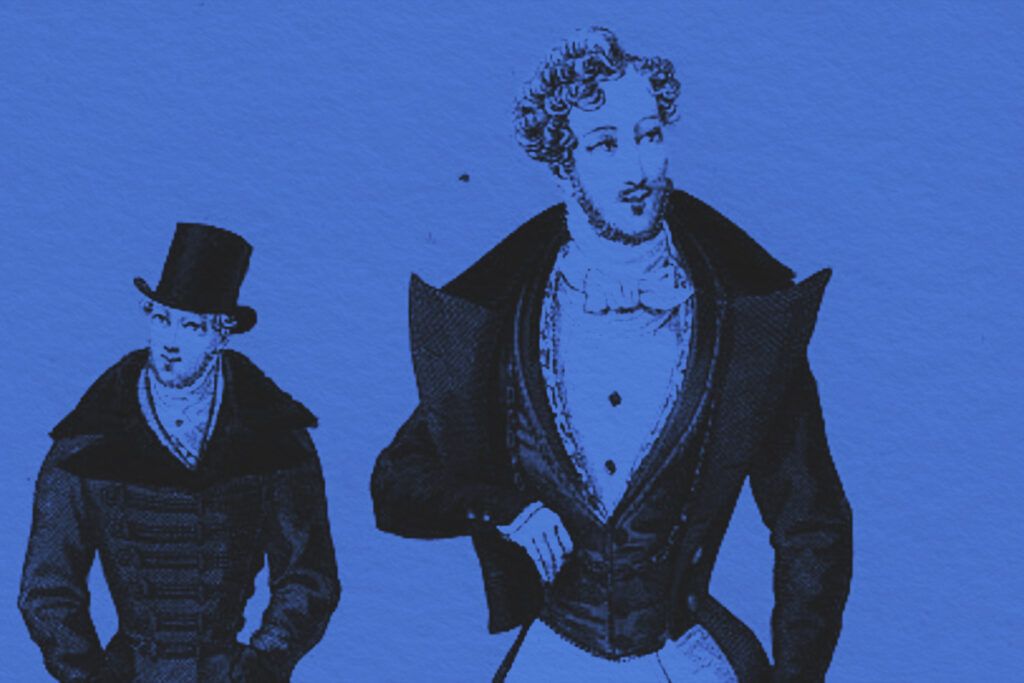
The slang term “dude” is as versatile as a plain white T-shirt or utility baseball player. You can use it to greet a good friend (“What’s up, dude?”), as a generic synonym for “guy” (“Some dude just paid for my coffee”), or in common expressions to convey approval or emotion (“Rock on, dude” or “No way, dude”). Or maybe someone did you wrong, causing you to shout, “Dude, why did you do that?”
But as wide-ranging as the uses of “dude” may be today, the term was once much more specific and came with an insulting connotation. Let’s look at the origins of this word, which some believe goes back to before the American Revolution.
One theory, from linguists Barry Popik and Gerald Cohen in 2013, claims “dude” was likely derived from “doodle,” as in the 18th-century folk song “Yankee Doodle.” While the song is considered patriotic by many today, it was initially a song of mockery by the Brits toward Americans.
The lyrics of that ditty mention a “yankee doodle dandy,” where “yankee” referred to New Englanders, “doodle” came from the German Dödel (meaning “fool”), and “dandy” was and still is defined as “a man who gives exaggerated attention to personal appearance.” Essentially, the character Yankee Doodle was an oafish American who tried to emulate his fancy European counterparts by sticking a feather in his cap.
“Dude” is believed to be a variant of “dood,” a shortened version of the word “doodle,” but it wasn’t coined until more than a century later, in the 1880s. Residents of New York City began using it in a derisive manner to describe foppish men — those who were very concerned with their appearance and wore the height of fashion. The word became more and more popular by the day, appearing in poems and New York Times articles.
Linguistics professor Michael Adams is less sure of the connection to “Yankee Doodle” than Popik and Cohen, but Adams concurs that the word “dude” was firmly established as an insult by the late 19th century. “It’s not a friendly term at that point,” he told Reader’s Digest.
As the decades went on, however, “dude” shed its insulting connotation. The change didn’t happen overnight, of course: There was a brief transition in the 19th century where “dude” was used by Westerners to describe visitors from big cities on the East coast. This gave rise to touristy attractions called dude ranches, where city slickers (or dudes) could stay and pay to experience the cowboy lifestyle.
During the 20th century, “dude” shifted from its original meaning even further as younger generations embraced the term as a generic way to refer to a person. While traditionally male, it has become fairly gender-neutral. Linguist Michael Adams believes “dude” is popular today because of the term’s use in 1980s cinema such as Fast Times at Ridgemont High, Bill & Ted’s Excellent Adventure, and Ferris Bueller’s Day Off. These films helped forever change the definition of “dude,” Adams told Reader’s Digest, “from an East Coast person who doesn’t know a saddle from a stirrup to a guy who is righteous and whom everybody admires.”
More from our network
Word Smarts is part of Inbox Studio, which publishes content that uplifts, informs, and inspires.