


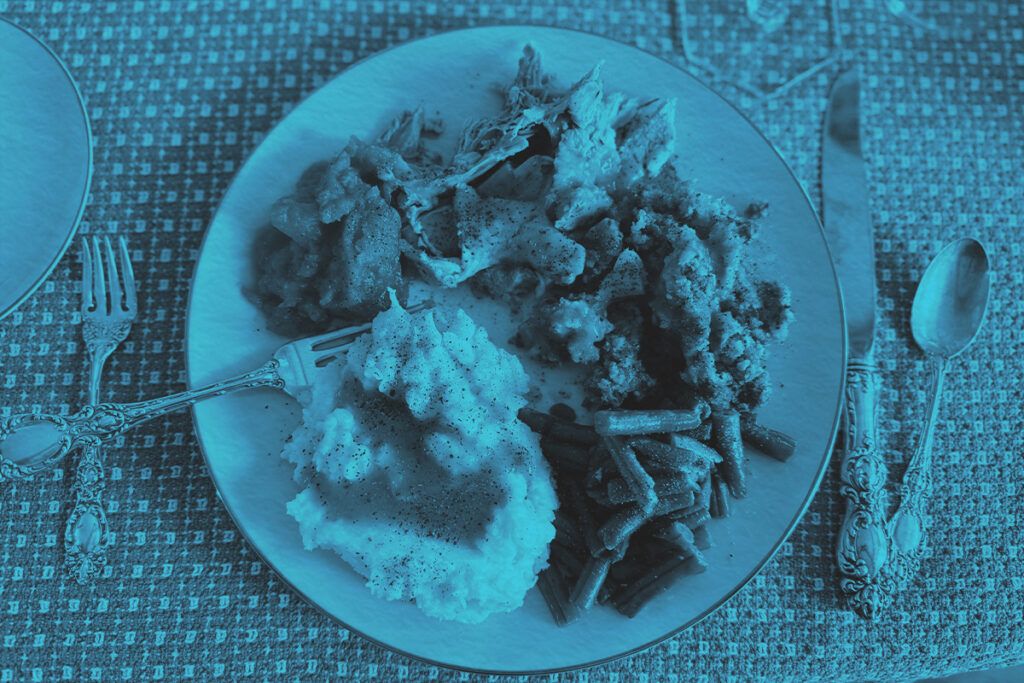
Every November, one of America’s great regional food debates surfaces alongside the Thanksgiving turkey and cranberry sauce. For much of the country, the savory bread mixture that accompanies the bird is called stuffing. Across the South, however, it’s almost always dressing. And it’s not a simple question of whether the stuffing/dressing goes inside the bird or beside it. Trying to explain the divide involves centuries-old etymology, Victorian manners, and a deep Southern devotion to cornbread — all of which are theories less concrete than woefully overbaked stuffing.
An oft-repeated guideline states that stuffing is cooked inside the bird, and dressing is baked in a separate dish. Some cookbooks and food writers lay it out exactly that way, and plenty of families follow it. But at the actual dinner table, this rule often falls apart. A 2015 survey conducted for Butterball found that 11 states (Indiana, Nebraska, Washington, Nevada, Iowa, Oklahoma, Texas, Kentucky, Alabama, Tennessee, and Florida) favored the term “dressing,” while “stuffing” was far more common in the remaining 39 — regardless of how the dish was actually cooked. Southerners call it dressing even when it spends time in the turkey, while in the North people tend to say “stuffing” even when it’s baked in a dish. So, something else is going on beyond the in-or-out-of-the-bird scenario.
English speakers have been using “stuffing” in a cookery sense since at least the 1500s. The first written instance recorded by the Oxford English Dictionary dates back to The Dictionary of Syr Thomas Eliot Knyght in 1538: “stuffynge, or that wherewith any foule is crammed or franked” (“franked” being an obsolete English word for fattened livestock).
According to one popular explanation, it was the Victorians who started using “dressing” instead of “stuffing,” simply because they found the latter word rather crude and unseemly. It’s a charming story, and one that shows up in plenty of articles, but it’s best treated as a theory rather than a documented fact.
“Dressing” was already an Old English word for seasoning and preparing food, used widely and continuously in this way from at least the 14th century. The word didn’t need prim and prudish Victorians for it to exist as part of our culinary vocabulary. It is possible that the Victorians helped popularize “dressing” over “stuffing” when referring specifically to the seasoned mixture of bread and herbs, but there’s no clear proof that’s the whole story.
Both “dressing” and “stuffing” were in use in America by the 1800s, with many Southern households embracing the former term while Northern cooks largely stuck with “stuffing.” The regional pattern became clear, but a definitive, single explanation as to why one region went with “dressing” and the other stuck with “stuffing” remains a bit elusive.
One possible regional difference that might have reinforced (but doesn’t fully explain) the use of “dressing” in the South involves a very particular Southern staple: cornbread. Traditional Southern dressing is usually built on cornbread rather than the soft white or wheat bread common in Northern recipes. In many Southern households, the preferred method of cooking the cornbread-based mixture is outside the bird (primarily because baking it in a casserole dish allows for a better crust). As this method doesn’t actually involve stuffing a bird, it might have reinforced the use of “dressing” in the South — and according to many Southerners, if it’s not made of cornbread, it’s not worthy of being called dressing at all.
But this theory has its limits. As mentioned earlier, plenty of Southerners call it dressing even when it spends time in the turkey, and many Northerners call it stuffing even when nothing is stuffed. So, the honest — but perhaps unsatisfactory — answer is that Southerners say “dressing” for a mix of reasons, including regional habits based on age-old linguistic quirks, differences in ingredients, and the simple yet very powerful influence of family tradition.
More from our network
Word Smarts is part of Inbox Studio, which publishes content that uplifts, informs, and inspires.