


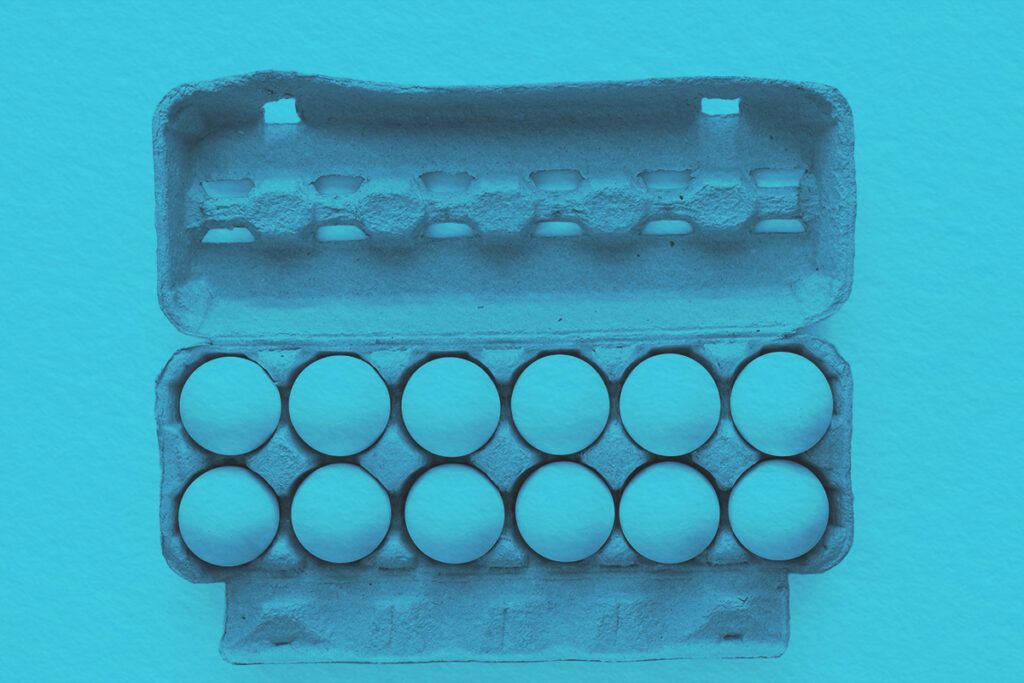
Whether you’re purchasing eggs or golf balls, you’ll often find them packaged by the dozen. The term “dozen” defines a group of 12, and it’s widely understood to mean that among English speakers around the globe. But while people know what a dozen is, they’re less familiar with why “dozen” came to refer to 12.
Use of the word “dozen” dates to the 14th century, though this exact spelling didn’t come about until the 1500s. It was preceded by spellings such as “dousen,” “dozyne,” “duzan,” and other similar variants. Regardless of the exact spelling, the word is derived from the Middle English dozeine, which comes from the Anglo-French duzeine. That came from the Latin duodecim, which combines duo, meaning “two,” and decem, meaning “10” — this is why “dozen” means 12.
Now that we’ve touched upon the etymology, it’s worth discussing why “dozen” has such lasting appeal. After all, those ancient languages had similar terms for other numbers, so it’s a bit curious why those didn’t also become widely used in English. For example, in Latin, undecim means “set of 11” and tredecim means “set of 13.” So if we were to follow the same logic that created “dozen,” why don’t we also use “unzen”or “trezen”?
The simple fact is that goods have long been sold in sets of 12. The reason can be traced back to the time of the Anglo-Saxons (roughly the fifth through eighth centuries), when the term “shilling” was coined as an accounting unit equivalent to 12 pence (one pence being roughly equal in value to one penny). A physical shilling coin was introduced in Britain at the beginning of the 16th century. The coin was discontinued in 1966, but when it was introduced, it was common for vendors to sell either one egg for a pence or 12 for a shilling, as there was no single coin valued in between those amounts.
As for “baker’s dozen,” it comes from medieval England and relates to a law called the Assize of Bread and Ale, which protected buyers from being ripped off by merchants selling underweight bread. The fines were so serious that many breadmakers would throw in a 13th loaf to avoid being accused of selling less than promised. The term “baker’s dozen,” describing a group of 13, was coined in reference to this practice.
More from our network
Word Smarts is part of Inbox Studio, which publishes content that uplifts, informs, and inspires.