







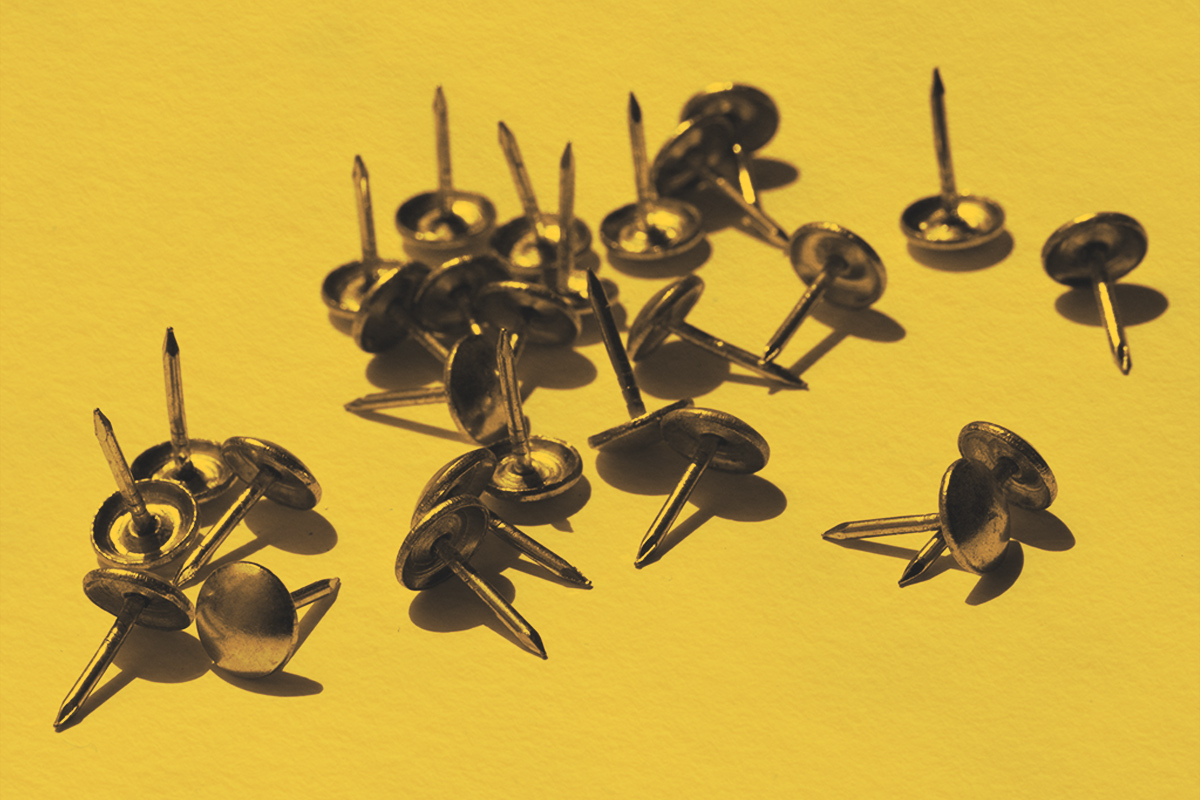
Pinning down the origin of certain turns of phrase can be a tricky task. Often they’re present in the verbal lexicon before being preserved in writing, so the original source is almost impossible to determine. There’s a lot of uncertainty, for example, when it comes to the phrase “down to brass tacks.”. First of all, it’s “brass tacks” and not “brass tax.” Secondly, it means to get down to business and focus on only the essential details. But while those two matters are clear, there’s a lot of debate over where the saying originated and why it exists. There are several theories dating to the 19th century.
One oft-repeated theory is that it’s possibly derived from the literal removal of brass tacks before a piece of upholstered furniture can be restored or reupholstered. Another idea is that it has to do with a method of measuring specific lengths of cloth. Tacks were sometimes nailed a yard’s length apart into the counter of a merchant’s shop, allowing the vendor to measure out precise amounts of fabric. Still another theory is that “brass tacks” is simply Cockney rhyming slang for “the facts.”
While these theories still float around, linguist David Wilton — the editor of WordOrigins.org — claims “there is no evidence to support any” of them. The argument may seem bold, but it could be true. The theories might be folk etymology, created or popularized by people looking for likely answers without a basis in fact.


Despite the mystery behind the saying’s origins, we’re still able to point to some of the earliest known examples of its use. It was preceded by the similar phrase “down to the brass,” which appeared in U.S. newspapers as far back as 1853. One of the earliest printed uses of the phrase “down to brass tacks” was in an 1863 edition of a Houston-area newspaper.
More from our network
Word Smarts is part of Inbox Studio, which publishes content that uplifts, informs, and inspires.





