




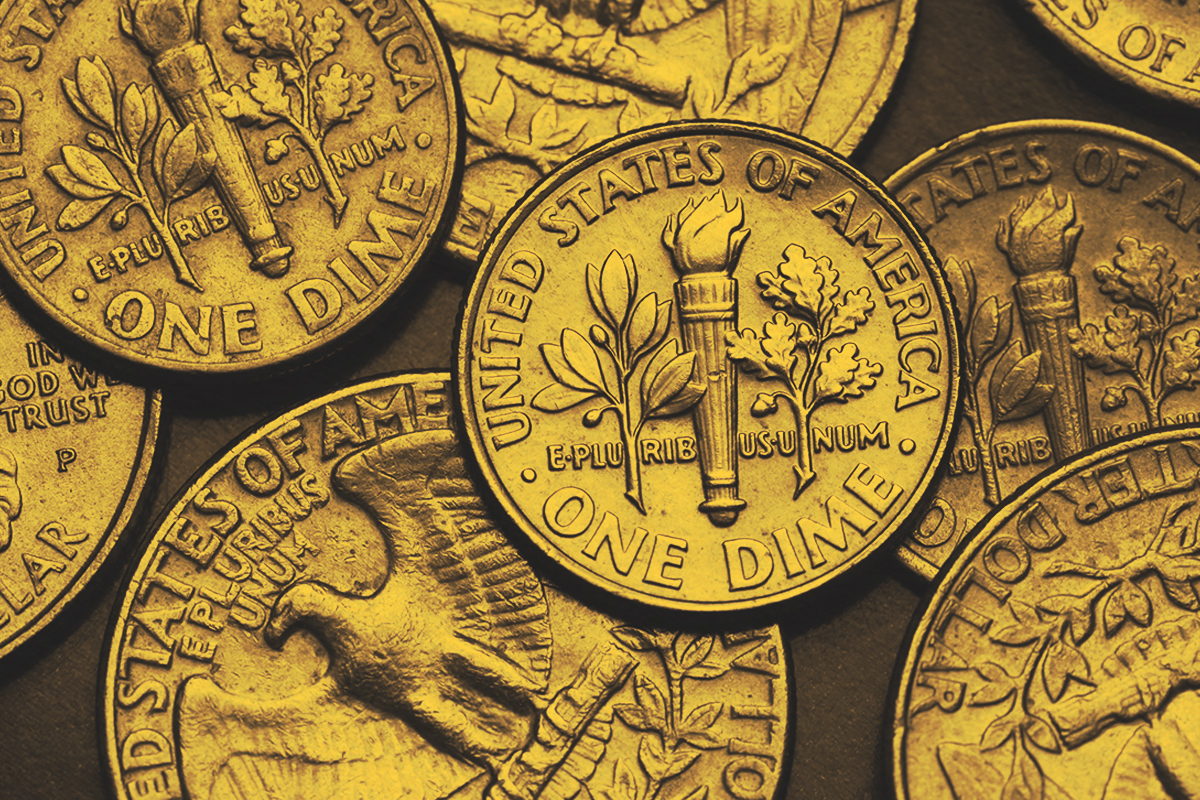
The dime was first minted in America in 1796, but it wasn’t until the 1930s that the idiom “a dime a dozen” come into use. In the early 20th century, “a dime a dozen” was a sales pitch for a good deal. When eggs were sold for 10 cents per dozen, the customer paid less than a penny an egg. What a bargain! By the 1920s, variety stores were known as “dime stores” and “5 & 10s” because they sold an assortment of inexpensive household goods for a nickel or dime. They were the equivalent of today’s dollar stores, and we can safely assume the phrase “dime a dozen” came out of these stores.
Today, a dozen eggs costs over $2.50 on average (except when they peaked at $6.22 in March 2025). A dime in the 1930s was worth as much as about $2.36 today, but “two-thirty-six a dozen” doesn’t have the alliterative allure of “a dime a dozen.”
The meaning of “a dime a dozen” evolved from signifying a bargain to refer figuratively to anything cheap, commonplace, or easy to come by. Instead of referring to the benefit of a great deal, the phrase transitioned to being used with a tone of dismissiveness or criticism — if something is so cheap, there must be a surplus. It was even used to describe people. For example, in 1931, The Northern Miner newspaper published an article about mediocre pugilists (boxers) as “nothing but dime a dozen fighters.”
“A dime a dozen” has been a handy idiom in pop culture, too. In the 1942 film Casablanca, Humphrey Bogart’s jaded character, Rick Blaine, says, “Beautiful women are a dime a dozen,” as he is fighting becoming emotionally involved with Ingrid Bergman’s Ilsa. More recently, in 2005, Margaret Atwood published the novella The Penelopiad, in which she describes the Daughters of Naiads as “a dime a dozen … the place was crawling with them.”


“A dime a dozen” remains a useful idiom in conversations today. For example, to promote individuality, you’ll find “#NotADimeADozen” in social media hashtags. Someone describing Instagram influencers? “A dime a dozen.” A review might state, “New coffee shops are a dime a dozen in Seattle.” A commenter could complain, “These inspirational posts are a dime a dozen.”
More from our network
Word Smarts is part of Inbox Studio, which publishes content that uplifts, informs, and inspires.