


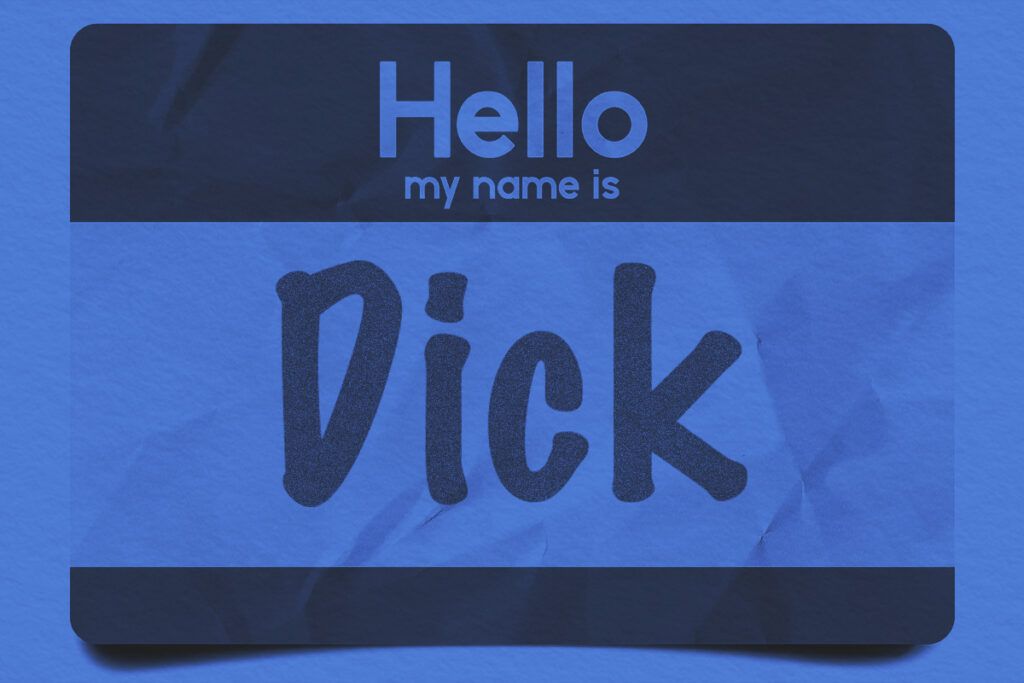
The name Richard doesn’t seem to have much in common with the nickname Dick, and yet the latter is still widely used as a shortened version of the former. This is just one of many cases where a full name is shortened to a seemingly peculiar abbreviation. We’re talking about Johns who go by Jack, Margarets known as Peggy, and Marys who are called Polly.
While these nicknames may seem odd based on their spelling, there’s a logical origin story behind many of them. During the Middle Ages, it was a popular practice to shorten names and swap certain letters, resulting in a playful rhyming nickname. Here are several examples of this phenomenon, and some other curious nickname origin stories that follow completely different trajectories.
The name Richard was among the most popular male names in medieval England. In fact, it was so common that scribes came up with several shorthand versions, including Rich and Rick, to save time and effort while writing. Then, in the early 13th century, the trend of rhyming sobriquets emerged. This produced nicknames such as Hitch, Hick, and, of course, Dick. While most of these rhymes have faded in terms of widespread use, the name Dick has experienced lasting popularity.
Deriving the nickname Bill from William is another example of this playful medieval naming mechanism. It follows the same logic as above — William was shortened to Will, and in time, people rhymed it with Bill.
Margaret was among the most popular female names in the Middle Ages, and it needed a playful nickname. Diminutive monikers such as Margot, Magge, Magot, Mog, and Meg soon appeared, and the latter two examples followed the rhyming shift that was popular at the time, giving us Pog and Peg. Sometimes a “-y” was tacked onto the nickname, giving us Poggy (not so common today) and Peggy, which was quite common in the mid-20th century.
Centuries ago, the nickname Mally was a common shorthand for people born Mary, but it largely fell out of use by the mid-18th century. Molly as a nickname for Mary also died out by the end of the 18th century, though it remains a common baby name on its own. But from Molly we got the rhyming moniker Polly, and that somehow stuck around long after Mally and Molly.
The shift from John to Jack is yet another example of medieval nicknames with lasting appeal. In the Middle Ages, John — an extremely popular male name — was made into nicknames such as Johnkin, Jankin, and Jackin. Eventually, Jackin was shortened to simply Jack, which has maintained its popularity all these years later.
Disconnected nicknames aren’t only an English-language phenomenon. In Russian culture, Sasha is a common nickname for Alexander (or the Russian equivalent Aleksandr). When it comes to Russian nicknames, it’s common to add “–sha” as a diminutive suffix. Take Aleksandr, shorten it to Sandr, and then replace the final few letters with the “–sha” suffix, resulting in Sasha.
The name José is the Spanish version of the English name Joseph. The original version was Josepe, which was shortened to José over time. This explains, in part, why Pepe is a common nickname for people named José. It’s an abbreviation of the old name José comes from, taking the end portion and doubling it.
You may be surprised to learn that Game of Thrones actor Kit Harington’s birth name is Christopher. It’s not as common a nickname today as it was centuries ago, but Kit is indeed a sobriquet for the given name Christopher. Meaning “bearing Christ,” this name is an abbreviated form of the first portion of Christopher, taking out three letters and changing the “C” to a “K” for a more prominent starting sound.
More from our network
Word Smarts is part of Inbox Studio, which publishes content that uplifts, informs, and inspires.