


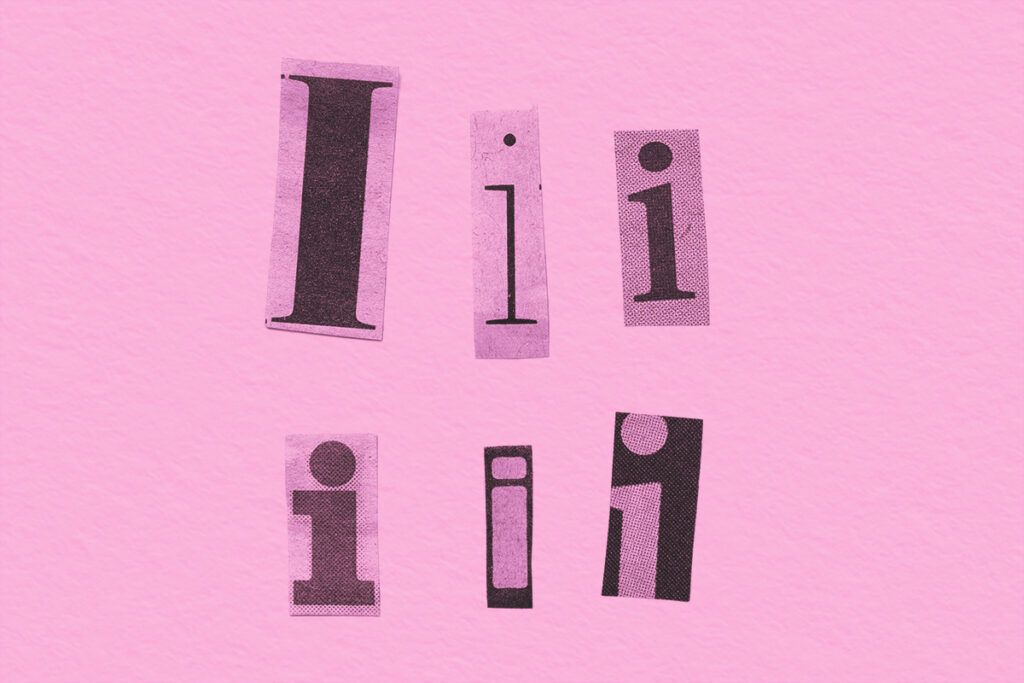
Texting habits have gotten us used to typing out everything in lowercase letters and even dropping punctuation. But when you’re using standard grammatical rules, the stand-alone “I” gets capitalized — autocorrect may even do this for you when you text. This rule is actually pretty unusual, as English is the only major language that capitalizes its first-person singular pronoun.
Capitalizing proper nouns, such as the names of people and places, is not uncommon in other languages, but English takes it a step further by giving one very ordinary pronoun a distinction that its counterparts elsewhere don’t get. Is it a case of ego-gone-mad? Hardly. In fact, the linguistic quirk happened almost by accident.
The most common theory about how “I” became so important has us going back to Old and Middle English, when the first-person pronoun looked quite different. It was often written as ic but later appeared in a variety of forms, including ich, ic, I, and i. And, importantly, there was nothing particularly special about its capitalization.
Over time, English pronunciation changed, and the “c” disappeared. That left English speakers with an extremely short word: “i.” When you’re writing an entire manuscript by hand, a single lowercase “i” doesn’t exactly command attention. It can be difficult to distinguish on the page, especially when it’s sitting by itself between other words. One theory is that medieval scribes began making the pronoun taller simply to make it easier to see. By the late 1300s, the stand-alone “i” had developed into the taller “I” we recognize today.
This beefed-up “I” grew in popularity throughout the 13th and 14th centuries. A manuscript of Geoffrey Chaucer’s The Canterbury Tales was among the first examples of the shift.
There is, admittedly, something amusing about English being the only major language in which the person speaking gets a capital letter every time they mention themselves. For example, the first-person pronoun is je in French and yo in Spanish.
Some scholars have proposed that the capitalization could have reflected the grammatical importance of “I,” as the pronoun is frequently the subject of a sentence. Others have suggested that capitalizing “I” gives the writer a visual reminder of their own importance.
It’s a fun theory, but it has an obvious problem.
If English speakers were really capitalizing pronouns to flatter themselves, why stop at “I”? Why not do the same to “me,” “my,” or “mine”? And, while we’re at it, why not capitalize “we” or “us”?
While there are many theories, the real answer may simply be that in the Middle Ages capitalization rules weren’t nearly as standardized as they are today.
For centuries, writers and printers used capital letters inconsistently. Capitals (or majuscules, in printing vernacular) could be used for emphasis, decoration, or simply because that was the convention a particular writer or printer happened to follow. Formal rules regarding capitalization didn’t arrive until much later, in the 1700s.
By the time those rules began to crystallize, the capital “I” had already established itself. There was no particular reason to change it, but there were plenty of practical reasons to keep it.
So while today’s capital “I” can look like a tiny monument to the self, its origins appear to be considerably less narcissistic. English didn’t necessarily decide that “I” was important. It just decided that “i” was too hard to see.
More from our network
Word Smarts is part of Inbox Studio, which publishes content that uplifts, informs, and inspires.