5 MIN READ

Follow These Do’s and Don’ts of the Apostrophe

Apostrophes are used in English for three main reasons: to show possession, to omit letters or numbers, and to pluralize singular letters or numbers. So why are they so confusing to use?

by Jennifer A. Freeman
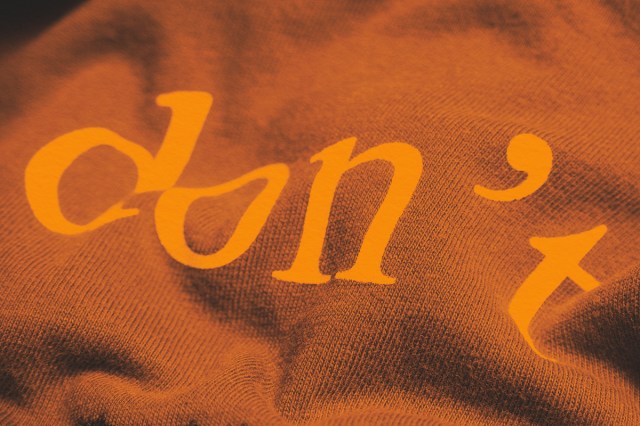
don't word printed on cotton shirt

The apostrophe emerged as a punctuation mark over 500 years ago in Western Europe, and its usage has confused people ever since. Prominent writers, including Jane Austen, Thomas Jefferson, and Benjamin Franklin, are known to be inconsistent with their apostrophe usage, and even Shakespeare had trouble with this pesky punctuation mark. Today, apostrophes are used in English for three main reasons: to show possession, to omit letters or numbers, and to pluralize singular letters or numbers. Let’s review the do’s and don’ts of how to use this tiny yet powerful punctuation mark.

Advertisement

1. To Show Possession

Apostrophes are the easiest way to show possession. Instead of saying, “That is the book of Sarah,” it’s much simpler to say, “That is Sarah’s book.” However, there are many nuances to using apostrophes for possession.

Showing Possession With Nouns

With all singular nouns: Add an apostrophe and the letter “s” to the end of the word (even if it ends in an “s”).

the bird’s nest, the witness’s testimony, Boston’s weather

Note: These guidelines depend on the chosen style guide. Most (AP, APA, MLA, and CMOS) advise adding an “-’s” when a singular common noun ends in an “s,” but individual publications or internal style guides might call for something else. For example, AP doesn’t add the “s” to singular proper nouns. It would be “the witness’s testimony,” but “Chris’ car.”

With plural nouns that do NOT end in “s”: Add “-’s”to the end of the word.

the children’s books, the sheep’s wool, the men’s clothing

With plural nouns that DO end in “s”: Add only an apostrophe.

my friends’ jobs, two weeks’ time, the Smiths’ new car

With nouns that end in “s” and are the same in singular and plural form: Add only an apostrophe.

the scissors’ blades, the species’ habitats

With two or more nouns that show joint possession: Add “-’s” to the last noun listed.

Mark and Andy’s house, mom and dad’s vacation

With hyphenated nouns: Add “-’s” to the end of the word.

my mother-in-law’s ring
Advertisement

Showing Possession With Pronouns

With singular AND plural possessive pronouns: Do NOT use an apostrophe with possessive pronouns such as “his,” “hers,” “its,” “theirs,” “ours,” and “yours” (which already imply possession).

That cooler is theirs.

With indefinite pronouns: Add an “-’s”to indefinite pronouns such as “anyone,” “anybody,” “everyone,” “nobody,” and “someone” to indicate possession.

someone’s book, one’s attitude, nobody’s business, each other’s faces (The latter is a common mistake. “Each” is always singular, so the apostrophe would never be on “each’s,” for example.)

With interrogative pronouns: Do NOT use an apostrophe.

Whose paper is this?
Advertisement

2. To Omit Letters or Numbers

Apostrophes are handy tools to shorten words or numbers, especially in casual conversation and writing.

Use an apostrophe to create contractions by omitting certain letters, thus combining two words into one.

are not = aren’t, let us = let’s, I would = I’d, you have = you’ve

Use an apostrophe to shorten numbers. Time periods, such as “the 1980s,” do not need apostrophes for pluralization — only for shortening, as in “the ’80s.” The exception is a possessive form of a specific year, as in, “The firm closed during 1929’s stock market crash.”

the class of 2012 = the class of ’12, the 1960s = the ’60s

Use an apostrophe to shorten the beginning or end of other words in informal writing or speech.

it is = ’tis, fishing = fishin’, rock and roll = rock ’n’ roll, because = ’cause
Advertisement

3. To Form Plurals of Letters or Numbers

The only time that an apostrophe should be used to pluralize something is for a singular letter or a number. However, some style guides, such as APA, advise against using an apostrophe this way.

Use an “-’s” to indicate the plural form of a singular letter or a number.

I got straight A’s last semester. (Using the term “As” is incorrect, because “as” is already a word.)
She received two 9’s and one 10 for her dance routine.

Using apostrophes to form plurals is also common in a lot of colloquial idioms and phrases.

Dot your i’s and cross your t’s.

(Pay attention to detail.)

X’s and O’s

(Abbreviation for “kisses and hugs”)

Mind your p’s and q’s.

(Be careful; avoid mistakes.)

the do’s and don’ts

(This common phrase is written differently depending on what style guide is used. AP and others recommend “do’s and don’ts” to pluralize the words, while CMOS says “dos and don’ts” is correct.)

Do NOT use an apostrophe to pluralize abbreviations. Simply add an “s.”

CDs, MP3s, DVDs, RNs

Other Guidelines

When using an apostrophe alongside other punctuation, the other punctuation mark(s) should come after the apostrophe. This is true for any punctuation, including commas in the middle of a sentence. (Note: This applies when the mark is used as an apostrophe, not when it is used as a single quotation mark.)

Jump in, let’s go swimmin’!
The award was the Williams’, but they left before the ceremony.

In quotation marks: The punctuation and quotation marks come after the apostrophe.

One of Tom Petty’s greatest hits was “Free Fallin’.”

At the end of double quotation marks: The punctuation and all quotation marks come after the apostrophe. (Note: The single quotation mark looks similar to the apostrophe, but it does not function as an apostrophe and the usage rules are different.)

She explained, “Tom Petty is the best — my favorite song is ‘Free Fallin’.’”

Obscure proper nouns: Some proper nouns omit an apostrophe without rhyme or reason. If you live near one of these places, or if you have another reason to use them, just memorize them.

Kings Mills, Pikes Peak
Featured image credit: Credit: Dario Pena/ Shutterstock
3 MIN READ

Do You Know What the “P” in “P.M.” Stands For?

Our lives are measured by rotating cycles of a.m. and p.m., but do you know what these abbreviations really mean?

by Jennifer A. Freeman
Wall clocks pattern

There’s a common axiom that we all have same 24 hours in a day. Some days seem to pass by faster than others, but whether we’re stopping to smell the roses on a summer day or watching the clock race by on a deadline, those 24 hours are the same. Each hour can be counted, from the first one (hour 0) to the last one (hour 23). That said, how people count and describe those hours around the world can vary. Let’s take a closer look at how to tell time around the world, with a particular focus on what different time abbreviations mean.

Advertisement
24-Hour Clock

The 24-hour clock simply counts how many hours have been completed that day. The first two digits are the hours, followed by a colon and then two digits for minutes. More precise timekeeping (for sports, countdowns, etc.) can add colons and digits to track seconds and milliseconds, too.

When a digital clock reads 00:00, it is midnight; 12:00 is noon; and 23:59 is the last minute of the day. Midnight could also be 24:00, but many timekeepers argue that the millisecond past 24:00 flips to the next day, and the time should be documented as 00:00. In places that use 24-hour time, the mechanical clocks will often have two rings of hour markings, o to 12 and 13 to 24.

Although 24-hour-time is widely used in Britain, the U.S. military, and many other places around the world, North Americans and Australians are far more accustomed to the simpler 12-hour clock.

12-Hour Clock

According to the 12-hour clock, the calendar day starts at 12, midnight, then ticks up to 1 a.m. The clock then pivots at 12, noon, around the time the sun is at its highest point in the sky. Everything in the day is either before noon (morning), or after noon (aptly named afternoon, and also evening and night).

Splitting the 24-hour clock in half creates two counts: how many hours have elapsed since midnight, and how many hours have passed since noon.

The abbreviations “a.m.” and “p.m.” differentiate between these counts. Since these times revolve around noon, we might expect to see “n” in the abbreviations, but 17th-century Englishmen opted to use Latin instead.

Advertisement

In Latin, “a.m.” stands for ante meridiem. Translated, this means “before midday.” The counterpart, “p.m.,” stands for post meridiem, which, naturally, translates to “after midday.” In establishing the timekeeping standards, midday was set to be 12, noon.

To further clarify, it was decided that 00:00, the start of the new day, would be known as 12, midnight. And 12, high noon, would be the transition to the p.m. hours. (Technically there is no 12 p.m. because it is not “post,” but there is a 12:01 p.m.) To avoid confusion, many say simply “midnight” or “noon” instead of the 12 o’clock times. While context (setting doctors appointments, requesting work meetings) usually clarifies whether someone is referring to 3 a.m. or 3 p.m., it’s always helpful to add a quick “in the morning” if the time is a bit more ambiguous. For example, a night owl may have no problem showing up for 10 p.m. plans, but their friends will be sitting at 10 a.m. brunch wondering why they got stood up.

Featured image credit: Credit: Unsplash+ via Getty Images
4 MIN READ

10 Common Phrases (Almost) Everyone Gets Wrong

If mistaken words are used often enough, people start to repeat and transmit them in different forms. Here are some of the most common idioms that people mishear and misunderstand.

by Jennifer A. Freeman
Side profile of a goat

If you hear Taylor Swift singing about “all the lonely Starbucks lovers” on “Blank Space,” that’s a mondegreen, which is a misheard lyric that gets repeated so often, it becomes almost as ubiquitous as the correct version (“got a long list of ex-lovers,” in Taylor’s case). The same thing happens with common idioms and phrases. If mistaken words are used enough, people start to repeat and transmit them in different forms. Here are some of the most common idioms that folks mishear and misunderstand.

Advertisement
Did a 360

Double-check your math on this one. There are 360 degrees in a circle, so performing a 360-degree revolution will land you back exactly at the beginning. Perhaps you meant that, but if you’re implying that you made a great change, the correct version is “did a 180.” In that case, you left your starting point to move as far away as possible. In other words, you completely shifted yourself, either metaphorically or physically.

Escape Goat

The word you’re looking for here is most likely “scapegoat.” This translation of a biblical phrase refers to a person or thing that can be blamed for the mistakes of others. An “escape goat” might be found if livestock gets loose on a farm, but it’s not a common idiom.

First-Come, First-Serve

The proper way to write this phrase is “first-come, first-served.” One little letter might not seem like a big deal, but “served” indicates that whoever arrives first will be waited on first. The “serve” variation implies the first guest to come will serve all the other guests, which would likely be an unwelcome surprise.

Advertisement
For All Intensive Purposes

The correct idiom — “for all intents and purposes” — comes from 16th-century English law as the longer phrase “to all intents, constructions, and purposes.” Essentially, it means “practically” or “in effect.” This is an example of an eggcorn, or a phrase people mishear and alter over time.

Hunger Pains

The original phrase is “hunger pangs,” although “pains” could technically be correct as well. The former is an older term that refers to the feeling of cramping that comes with an empty stomach. Since the word “pangs” is a bit outdated, it’s sometimes mispronounced as “pains,” though they essentially refer to the same idea.

I Could Care Less

This one stirs up a bit of debate. When the words are parsed out individually, the accurate version to imply that you care a minimal amount is “I couldn’t care less.” However, the American colloquialism of “I could care less” is so widely used that even dictionaries have accepted it.

Advertisement
Nip It in the Butt

While the thought of getting bit on the butt is pretty funny, the correct phrase is “nip it in the bud.” This idiom comes from the world of gardening. If you trim a plant while it’s in the budding stage, it won’t grow properly. That’s precisely what you might want to do with a dangerous idea or rumor — nip it right in the bud.

On Tender Hooks

While you might feel a little tender while nervous or tense, the correct version of this expression is “on tenterhooks.” These hooks were used to stretch fabrics, and that stretching concept was extended to feelings of anxiety or worry. “Tender hook” is just a mispronunciation of the real term.

Pass Mustard

“Pardon us. Do you have any Grey Poupon?” Forget that popular commercial — while you might ask someone to “pass the mustard” at the dinner table, the correct wording for the idiom meaning “to gain approval or acceptance” is “pass muster.” It comes from the military term “muster,” which describes a formal inspection.

You’ve Got Another Thing Coming

As with “could care less,” this alternative phrase has almost replaced the original, which is “you’ve got another think coming.” In other words, you’re wrong and must rethink what you’re saying or doing. The “think” version of the phrase is older and more likely to be used by British English speakers.

Featured image credit: Credit: Unsplash+ via Getty Images
4 MIN READ

Do You Think You Can Translate Gen Z Slang?

As hesitant as we are to appear cringe, here’s some insight into the Gen Z lexicon. But tread carefully in using, unless you are indeed a member of the group.

by Jennifer A. Freeman
Pouring tea from a pot into a cup

As hesitant as we are to appear “cringe” by trying to explain Gen Z, without actually being Gen Z, we can’t help but be fascinated by the linguistic changes brought about by this generation. One defining hallmark of Gen Z — which encompasses people born between 1997 and 2003 — is that they are the first generation to live entirely under the influence of the internet and in front of the glow of smartphone screens, and their language reflects that. Moreover, they look outside of their immediate age bracket and toward cultural groups, including the BIPOC and LGBTQ+ communities, for inspiration. Here are some terms embraced by Gen Z that you might want to know — but tread carefully in using, unless you are indeed a member of Gen Z.

Advertisement
Ate and Left No Crumbs

Who doesn’t love to eat? When you hear that a person “ate” something, it means they did an extremely good job. If you “ate and left no crumbs,” then you clearly astonished all of us with your talent and skills. When Pedro Pascal hosted Saturday Night Live in 2023, he starred in a sketch called “Fancam Assembly,” playing a teacher who “ate [students] up and left no crumbs.” (That sketch might help give some context clues for some other super-trendy Gen Z terms that haven’t made it to the dictionaries yet.)

In My ____ Era

The Napoleonic era. The Victorian era. The Atomic era. Traditionally, an era is “a long and distinct period of history with a particular feature or characteristic.” But for Gen Z, an “era” can describe a moment in time, no matter how short. Watching Bridgerton on repeat? You may be in your Lady Whistledown era. Stopping at Starbucks every morning? Enjoy your iced oat milk latte era.

Advertisement
Say Less

“Say less” isn’t an order to be quiet. Gen Z is all about acknowledging and amplifying the message. Think of it as shorthand for “say no more.” In other words, Gen Z gets you. They understand, and you don’t have to offer further explanation.

Sus

The online multiplayer game Among Us was published in 2018, but it really exploded in popularity in 2020 as people looked for ways to stay connected at home amid the pandemic. In a nutshell, the game allows groups of people (crewmates) to play together to solve puzzles in various space-themed settings. Some players are randomly assigned to be “impostors,” and during gameplay, crewmates have to identify the sabotaging impostors in each round. The game helped popularize the term “sus,” which stands for “suspicious” or “suspect.” Players can communicate in-game over text chat (though some go outside of the game to voice chat over Discord), and “sus” developed as common shorthand for determining the identity of the impostors. In 2022, Merriam-Webster officially added “sus” to its dictionary.

Tea

“Tea” (or “T”) is another word for “gossip.” Folks can “sip the tea” (hear all the news) or “spill the tea” (share secrets), but this usage predates Gen Z. The saying originated with LGBTQ+ culture, and specifically with Black trans women and drag performers. In John Berendt’s 1994 book Midnight in the Garden of Good and Evil, the Lady Chablis refers to “T” as an abbreviation for “my thing” or “my truth.” Thanks to the popularity of RuPaul’s Drag Race, “tea” entered the pop culture mainstream and Gen Z vocabulary. Where would we be without the GIF of Kermit the frog sipping a steaming hot cup of tea?

Understood the Assignment

Just as in school, if you “understood the assignment,” you followed the instructions, understood what was required of the situation, and likely received an “A.” Did you make a reservation at your spouse’s favorite restaurant, show up looking dapper, and bring a gift for your anniversary dinner? You understood the assignment. Rapper Tay Money popularized the phrase in her 2021 song “The Assignment.”

Featured image credit: Credit: YesPhotographers/ Shutterstock