5 MIN READ

Take the Bull by the Horns and Learn These Animal Idioms

With at least 25,000 known idioms in English, it’s no surprise that thousands are based on animals. So, why does it rain “cats and dogs” and not “zebras and giraffes”? Make a “beeline” to these explanations.

by Jennifer A. Freeman
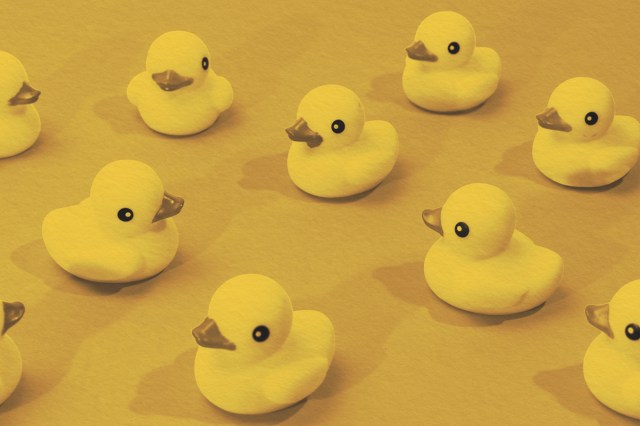
Yellow rubber ducks in a pattern

Tell a small child, “It’s raining cats and dogs!” and you might get a giggle or a confused look. While adult native English speakers know this just means it’s pouring, a child (or a new English learner) might not understand this or other idioms, which are nonliteral expressions whose meanings are not easily understood from the meanings of the individual words. Among the 25,000 known idioms in English, a wide swath are based on animals, a topic that everyone is familiar with. So, why does it rain “cats and dogs” and not “zebras and giraffes”? Make a “beeline” to these explanations below.

Advertisement
The Straw That Broke the Camel’s Back

Meaning: The last in a series of bad things, seen as the tipping point.
This idiom is essentially a more imaginative way to say “the final straw” (which is also an idiom, but more easily decipherable). “The straw that broke the camel’s back” has negative connotations, referring to the final element in a series of negative things that have already happened. For example, “After a long week of work, the dead car battery was the straw that broke the camel’s back.”

While the phrase has been seen in English publications dating back to the 1600s, it most likely comes from an ancient Arab proverb that translates as “the last straw breaks the camel’s back.” The wording sometimes varies slightly — as seen in the 1954 journal Publications of the Colonial Society of Massachusetts, in the line, “It is certainly true that the last feather will sink the camel” — but the usage carries the same meaning. Other animals, including monkeys and horses, have been used interchangeably in this idiom as well, but the camel is the most popular version.

Take the Bull by the Horns

Meaning: To deal with a difficult situation directly.
When the best course of action is to deal with something directly and confidently, one might say they are “taking the bull by the horns.” This is common advice to tell someone to face something head on. It might have originated with cowboys in the American West who often wrestled cattle, but it more likely came from farmers who controlled cattle by grabbing their horns to guide them. The earliest versions of the phrase appeared around the early 18th century.

Advertisement
I’ll Be a Monkey’s Uncle

Meaning: An exclamation of surprise or disbelief.
“Did you hear Mary won the lottery?” “Well, I’ll be a monkey’s uncle!” This idiom is bound to bemuse non-native English speakers, but it’s been used for at least a century as a display of astonishment (sometimes sarcastically). Its exact origin has never been pinned down, but one guess is that the phrase was a sarcastic response to Charles Darwin’s theory of evolution. One of its earliest recordings came in a 1917 ad in the El Paso Herald for the play A Brass Monkey — the small ad features the line, “Well, I’m a monkey’s uncle!”

It’s Raining Cats and Dogs

Meaning: A downpour of rain; a violent storm.
The first recorded use of “cats and dogs” to refer to heavy rain came in 1651 from British poet Henry Vaughan, who wrote, “dogs and cats rained in shower.” Nearly a century later, Jonathan Swift popularized the phrase “rain cats and dogs” in his 1738 satire Complete Collection of Genteel and Ingenious Conversation.

There are several leading theories as to why Swift and other writers chose “cats and dogs” over, say, “zebras and giraffes.” The most eccentric hypothesis deals with Odin, the Norse god of storms, who is often depicted with dogs (symbols of the wind). This idea was allegedly combined with the folklore of witches, who were associated with black cats and rainstorms. So, “raining cats and dogs” referred to the rain and wind, combining two mythologies. Another possible source is a perversion of the Old English word catadupe, meaning “cataract” (a large waterfall), and yet another theory stems from the perversion of the Greek phrase cata doxa, meaning “contrary to belief,” as in, “it is raining beyond belief.”

Advertisement
One-Trick Pony

Meaning: Someone or something that is only good at one particular thing.
When someone or something is lacking diversity in abilities, they might be referred to as a “one-trick pony.” For example, “After decades of romance writing, the author released a new sci-fi novel, proving that she wasn’t just a one-trick pony.” This idiom was probably derived from a literal circus expression at the beginning of the 20th century, when a one-trick pony would have been rather boring to the audience. By the mid-20th century, it had transformed into the idiom we still use today.

Make a Beeline For

Meaning: Go directly to.
If you’ve been told you make a beeline to the coffee pot in the morning, you likely understand this idiom describes taking a quick and direct path. It relates to the science behind how bees travel back to their hives after they’ve had their fill of nectar and pollen. Research has shown that they take the fastest, most direct route home — in other words, a “beeline.” This saying has been around for centuries, as seen in an 1830 excerpt from The Massachusetts Spy: “The squirrel took a bee line, and reached the ground six feet ahead.”

Get Your Ducks in a Row

Meaning: Get organized or prepared.
This phrase was popularized in the 1970s as slang to tell someone to get ready for something. However, early variations date to the late 19th century. These references all pertain to the idea of ducks being in a literal row, but they point to real ducks, target ducks in a shooting gallery, and duckpins (a type of bowling pin), so take your pick on the origin of the idiom.

Featured image credit: Lynne Mitchell/ iStock
4 MIN READ

Bask in These Sun-Kissed Summer Idioms

What are the origins of common summer-related idioms? Explore how the dog days began in the stars, and why one swallow doesn’t make a summer.

by Megan Hennessey
Inflatable pool floats in water

While you’re trying to keep it cool on a shoestring budget, we have some trivia about the origins of summer-related idioms. Explore how the dog days began in the stars, why one swallow doesn’t make a summer, and why that beach vacation is happening rain or shine.

Advertisement
Dog Days of Summer

Meaning: The hottest part of the summer.
“Dog days of summer” is a colloquial expression used to describe the hottest part of the year. Technically, the dog days occur between July 3 and August 11 in the Northern Hemisphere, due to an astronomical occurrence. This period of reliably hot and humid weather coincides with the rising of Sirius, the Dog Star, part of the Canis Major (Greater Dog) constellation, after which it is named. The ancient Greeks believed that the rising of this star caused the summer heat. Even the name of the star, “Sirius,” is derived from the Greek seirios, meaning “scorching.”

Today, we know that this star has no impact on the summertime heat, but the nickname for the time period has persisted nonetheless. In the early 16th century, the phrase “dog days” began appearing in English to describe the hot summer months. It was a direct translation of the Latin dies caniculares, but English speakers were the first to use it as an idiom.

Rain or Shine

Meaning: Something will happen regardless of the circumstances.
While summer is often depicted with sunny skies, showers are common in many places. Thus, the phrase “rain or shine” is used both literally and metaphorically, as in, “The parade starts at noon, rain or shine,” or, “She’s always been there for me, come rain or shine.” The exact origin is unknown, but a figurative usage shows up as early as 1622 in a poem called “Faire-virtue” by George Wither: “Or shine, or raine, or Blow, I, my Resolutions know.” Almost 300 years later, a 1908 Sears Roebuck catalog demonstrated the literal usage in an ad for coats: “These overcoats do double service, being adapted for all kinds of chilly weather, rain or shine.”

Advertisement
Traveling on a Shoestring

Meaning: To travel using a very small amount of money.
Summer is for adventuring, so you might hear backpackers or campers talk about their “shoestring budget,” which is an idiom to describe low-cost travel. The concept of “shoestring” as a word to mean “small amount of money” emerged in the late 19th century. A possible source of the idiom came from wandering peddlers who offered small items such as fabric, trinkets, and shoelaces to townspeople as they passed through. These items were low cost, and soon shoelaces or “shoestrings” became associated with very small amounts of money. It’s unknown who coined the term, but today, anything involving low costs or using a small budget can be described as “shoestring.”

Sun-Kissed

Meaning: Made warm or brown by the sun.
Although “sun-kissed” might be a modern makeup trend, the adjective was first recorded 200 years ago in the early 19th century. It can describe people, places, and things that have been touched by the sun (or at least look like they have been). An early example of this comes from an 1899 edition of the National Audubon Society’s Bird-Lore magazine, which included the line, “[Swallows] have gained enormous heights, and are soaring majestically in the sun-kissed zenith.”

One Swallow Does Not a Summer Make

Meaning: The situation is not certain to improve just because one good thing has happened; a single instance does not indicate a trend.
Speaking of swallows, Greek philosopher Aristotle popularized this idiom more than 2,000 years ago in Book I of Nicomachean Ethics, with the line, “For one swallow does not make a summer, nor does one day; and so too one day, or a short time, does not make a man blessed and happy.” This is in reference to the migration of swallows at the beginning of summer, relating to the idea that the arrival of a single bird does not indicate that the entire flock will migrate. Aristotle might have been inspired by one of Aesop’s fables, “The Spindrift & the Swallow.”

Featured image credit: Credit: Toni Cuenca/ Unsplash+
4 MIN READ

Why British and American English Have Different Names for the Same Foods

Here’s a sampling of different words in American English and British English for the exact same foods, and some possible linguistic explanations for them. Bon appétit!

by Mandy Brownholtz
hand in a cookie jar

While American English and British English are very much the same language, the dialects differ in terms of vocabulary. The category with perhaps the most differences is food words — in particular, fruits and vegetables. This list is a sampling of different words in American English and British English for the exact same foods, and some possible linguistic explanations for them. Bon appétit!

Advertisement
Aubergine / Eggplant

The scientifically named Solanum melongena comes from the Indian subcontinent and first appeared in England by the end of the 16th century. The British (and Germans) borrowed the French word aubergine (which actually traces back to the Sanskrit vatinganah) to name the plant. The American word for it, “eggplant,” originated in English in the mid-18th century and is derived from the white and yellow versions of the vegetable, which apparently resemble goose eggs.

Arugula / Rocket

Both of these words come from the same place, and while they appear quite different, “arugula” and “rocket” follow the same linguistic path. Both names for the plant species Eruca sativa share the common Latin root eruca, meaning “a cabbage-like plant.” The native Mediterranean plant was originally called ruchetta by the ancient Romans, eventually becoming rucola in Italian. By the 16th century, fellow Romance language speakers in France called it roquette. When the leafy green made it to England, the British replaced the French-sounding “qu” with the more Anglican-sounding “ck” in “rocket.” Meanwhile, Italian immigrants brought what they called rucola to the United States, where it evolved in American English to “arugula.”

Advertisement
Coriander / Cilantro

Coriander is the plant that produces the zesty green herb we know in North America as “cilantro,” but most Europeans call “coriander.” In the U.S., “cilantro” refers to the leafy part of the plant used as an herb or garnish, while “coriander” refers to the seeds that are ground into a cooking spice. In Europe, “coriander” refers to the leaves, seeds, and stem of the same plant. Interestingly, the linguistic root of “coriander” is the Greek koriannon, which botanists say is related to koris (“bedbug”), for the bad smell of unripe fruit. Folks who have the gene that makes cilantro taste like soap can identify with this particular naming convention.

Courgette / Zucchini

Much like the “aubergine”/”eggplant” and “arugula”/”rocket” dichotomies, the split between “courgette” and “zucchini” has a lot to do with geographical location and emigration. Both words refer to a type of green squash from the Cucurbita pepo family. The vegetable, native to Central and South America, was cultivated for thousands of years before it was adopted into European cuisine as a result of colonization. The French called it courgette, and the Italians called it zucchini. “Courgette” made it to British English by way of geographic proximity, while “zucchini” came into American English with the wave of Italian immigration to the United States from about 1880 to 1920.

Biscuit / Cookie

In the U.S., a biscuit is a flaky, buttery pastry often served for breakfast. In England, a biscuit is what Americans call a “cookie” — a sweet, baked dessert ranging in texture and density. When Dutch settlers arrived in New Amsterdam (now New York City), they brought with them koekjes, what we now call “cookies.” The root is koek, the Dutch word for “cake,” with the suffix -je added to designate “little cakes.” Meanwhile, the British get “biscuit” from the French bescuit, meaning “twice cooked.” The Italian word biscotti also comes from the same Latin root.

Advertisement
Prawn / Shrimp

Scientifically, shrimp and prawns are different species: Shrimp have one pair of legs with a claw at the end, whereas prawns have three pairs of legs with claws. However, in terms of language and cooking, Americans use the word “shrimp” as a blanket term for both species, while British English speakers say “prawns” for both.

Featured image credit: Credit: Peter Dazeley/ The Image Bank via Getty Images
5 MIN READ

How To Pronounce Common (and Commonly Confused) Irish Names

While traditional Irish names can be tricky to sound out, they are very popular — so let’s take a closer look at the correct pronunciation for some names that may be difficult for those outside of Ireland to pronounce.

by Jennifer A. Freeman
A top hat, pot of gold coins and four leaf clovers.

Around 4.5 million Irish immigrants entered America between 1820 and 1930, and with them came an influx of lasting Irish culture. Case in point: In 2023, the Irish name Liam became the most popular baby boy name in the U.S. Other Irish names including Connor, Claire, Riley, Nora, Logan, and Rowan also have risen through the ranks.

Advertisement

But some Irish names aren’t as easy for Americans to pronounce. This is perhaps most notable in the case of Irish American actress Saoirse Ronan. The Oscar-nominated star playfully jokes about her name (pronounced “SUR-sha,” which rhymes with “inertia”) in interviews, and acknowledges that Americans have trouble saying it correctly. While traditional Irish names can be tricky to sound out, they show no signs of waning in popularity — so let’s take a closer look at the correct pronunciation for some that might be difficult for those outside of Ireland to pronounce.

Aoife

Pronunciation: EE-fuh
Aoife is one of the most popular baby girl names in Ireland today, but in a recent British poll, it ranked among the hardest words to pronounce (along with Saoirse and Kyiv). It’s perhaps so tricky because in the Irish language, vowels have different sounds than in English. The common vowel pairing “ao” actually sounds like the “ee” in “tree.” Combine that with a silent “i” and an accentuated “uh” sound at the end, and Aoife is a conundrum for those outside of Ireland.

Caitríona

Pronunciation: Ka-TREE-nah
The Irish name Caitríona is pronounced the same way as the name Katrina. Notice the accent mark above the “i”— this changes the vowel sound in Irish. The mark above means it’s called a “slender vowel,” and the “í” is pronounced as a long “e” sound, as in “tree.”

Advertisement
Caoimhe

Pronunciation: KEE-vah or KWEE-vah
This is a traditional Irish girl’s name that comes from the same root as the boy’s name Kevin. It follows the rule of pronouncing “ao” as a long “e” (as in “tree”). The consonant pair “mh” is sometimes pronounced as “v” in Irish, which adds to the complexity of this name.

Cillian

Pronunciation: KIL-ee-an
Peaky Blinders star Cillian Murphy is likely the cause of this name’s recent popularity. Before his fame, the other spelling of the name, Killian, was more popular in the United States. In Cillian, the “c” is pronounced with a hard “c” (or “k”) sound, rather than an “s” sound.

Eoghan

Pronunciation: OH-in
Eoghan is a traditional Gaelic name that features a lot of silent letters. It is pronounced like the English name Owen, and can also be spelled as Eoin.

Advertisement
Fionn

Pronunciation: FIN
Often in Irish, “io” is pronounced as “ih” (as in “mist”). This holds true for the name Fionn (sometimes spelled Finn). There is no “e” or “o” sound traditionally in the name, but many American speakers might incorrectly say, “FEE-on.”

Maebh

Pronunciation: MAY-ve
This alternate spelling of the English name Maeve is popular in Ireland. It follows the Irish rule that “bh” can be pronounced with a “v” sound.

Ruaidhri

Pronunciation: RUE-ree or RUR-ree
At first glance to an American, this might look like one of the hardest Irish names to pronounce, but it’s actually one of the simplest. It’s pronounced “RUR-ee,” very similar to the name Rory. The name features many silent vowels and consonants, resulting in a simple, two-syllable word.

Saoirse

Pronunciation: SUR-sha or SEER-sha
There is some debate about the pronunciation of one of today’s most popular traditional Irish names. The Hollywood actress Saoirse Ronan pronounces her name “SUR-sha,” but it can also be pronounced with a different vowel sound at the front, “SEER-sha.” The “sha” sound at the end correlates to the common rule of using a “sh” sound for “se” or “si” in Irish names, as seen in the name Sean, pronounced “Shawn.”

Sinéad

Pronunciation: shi-NAYD
Irish singer Sinéad O’Connor introduced this name to American pop culture in the ’80s, and although it’s not as popular as some other Irish names today, it’s still recognizable. Just as in Sean (and the second “s” of Saoirse), the “s” in Sinéad is pronounced with a “sh” sound. The letter “é” is a slender vowel in Irish that is pronounced as “ay” (as in “hay”).

Advertisement
Síle

Pronunciation: SHE-luh
This Irish girl’s name is pronounced like the name Sheila. It uses the common Irish “sh” sound for “s,” and the long “ee” sound for “í.” The “e” at the end takes on the common short “eh” sound, for a surprisingly familiar name for English speakers, despite its Irish spelling.

Siobhan

Pronunciation: shiv-AWN
HBO’s hit series Succession did well to popularize the name of one of its lead characters, Siobhan “Shiv” Roy. Thanks to her nickname, many viewers learned how to pronounce that surprising first syllable of the name. We know that in Irish names, a “bh” results in a “v” sound, and here that’s coupled with another rule: “io” can be pronounced as “ih.” This results in “Shiv-AWN” — not “See-oh-BAWN,” as one might try to sound out in American English.

Featured image credit: Credit: Alexander Mils/ Unsplash+
4 MIN READ

Why We Say ‘It’s All Greek to Me,’ and Other International Idioms

From “doing as the Romans do” to your date insisting on “going Dutch,” there is no shortage of international idioms in English.

by Megan Hennessey
Ancient Roman statue in Italy

From “doing as the Romans do” to your date insisting on “going Dutch,” there is no shortage of international idioms in English. People from all walks of life — William Shakespeare, Italian saints, and American emigrants included — have played a role in coining these well-known expressions.

Advertisement
It’s All Greek to Me

Current usage: To not comprehend something.

William Shakespeare popularized this phrase in Act 1, Scene 2 of Julius Caesar, first performed in 1599. It is spoken by Casca:

Cassius: Did Cicero say anything? Casca: Ay, he spoke Greek. Cassius: To what effect? Casca: Nay, an I tell you that, I’ll ne’er look you i’ th’ face again. But those that understood him smiled at one another and shook their heads; but, for mine own part, it was Greek to me.

In these lines, Casca describes a speech that was deliberately given in Greek so not everyone could understand it. Ancient Romans were usually bilingual in Latin and Greek, but Greek usage had declined by the Middle Ages. Around this time, the phrase “Graecum est; non legitur” — “It is Greek and therefore is impossible to read” — began popping up. Eventually, “Greek” was used to refer to anything that couldn’t be understood. The idiom was translated from Latin into English, and by the 16th-century Elizabethan era, it was a popular phrase that would have been understood by anyone watching Shakespeare’s play. Today, other languages have adopted the idiom and made it their own, with a few tweaks.

Advertisement

International equivalents of “It’s all Greek to me”:

Czech: To je pro mě španělská vesnice (“It’s a Spanish village to me”)

German: Das kommt mir spanisch vor (“That seems Spanish to me”)

Greek: Εμένα, αυτά μου φαίνονται Κινέζικα (“To me, this appears like Chinese”)

Bulgarian: Все едно ми говориш на патагонски (“It’s like you’re talking to me in Patagonian”; but Spanish is the primary language in the Patagonian countries of Chile and Argentina.)

Pardon My French/Excuse My French

Current usage: To apologize for using profane or offensive language.

Why don’t we say “Pardon my Spanish” or “Excuse my Italian”? This idiom originated in the Middle Ages, when the French-speaking Duke of Normandy — better known as William the Conqueror — invaded England in 1066 CE and brought the French language with him. French influenced many aspects of English because it was seen as the fancier language, and everyday words were flipped into terms of prestige — “house” became “mansion,” “pig” was “pork,” and “offspring” was “progeny.” So, in everyday conversations, English speakers were saying “Pardon my French” in a literal way, to highlight their use of French.

By the mid-18th century, the phrase was used more metaphorically. An example of this is found in an 1895 edition of Harper’s Weekly in a discussion with an American tourist: “‘Do not the palaces interest you?’ I asked, inquiringly. ‘Palaces be durned! Excuse my French.’”

Nearly 100 years later, one of the most memorable modern uses of the phrase appeared in the 1986 film Ferris Bueller’s Day Off, when Cameron (Ferris’ best friend) says, “Pardon my French, but you’re an a**h***!” while on the phone with the dean of students, Ed Rooney.

When in Rome, Do as the Romans Do

Current usage: To embrace local customs and habits in an unfamiliar place or situation.

Often shortened to “When in Rome…,” this idiom is usually said lightheartedly while trying new things. Unsure about trying that unfamiliar regional food delicacy on your vacation? “When in Rome…” The expression is not exclusive to usage in Rome, though — it can refer to new places and experiences around the world.

The phrase might have been coined in the fourth century by St. Ambrose (of Milan) during a conversation with St. Augustine, who had just arrived in Milan and was unfamiliar with the local customs. He was reportedly shocked to find that the clergy did not fast on Saturdays (as they did in Rome). St. Ambrose gave him a bit of advice: In a new place, it is essential to adapt to the local customs. The phrase as we know it first appeared in English centuries later, around 1530.

Advertisement
Going Dutch

Current usage: To split the bill; to pay for yourself.

If you go to the movies with a friend and each pay for your own ticket, you could say you’re “going Dutch” — but the phrase likely has nothing to do with Dutch people from the Netherlands. It actually originated in the U.S. from the phrase “Dutch treat” (or “Dutch lunch/supper”), after the Pennsylvania Dutch (immigrants from Germany and Switzerland, not the Netherlands) tradition of bringing their own food to potlucks. The idiom “going Dutch” is slightly newer, dating to at least 1914.

Featured image credit: Credit: Virginia Marinova/ Unsplash+
4 MIN READ

Are You Mispronouncing the Names of These Famous Figures?

No one is safe from having their name mispronounced — and that includes some of the most famous figures in history. Avoid these pronunciation blunders during your next trip to the museum.

by Jennifer A. Freeman
Leonardo Da Vinci statue

Not everyone is blessed with an instantly recognizable name. Some of us have been correcting people’s pronunciation of our names since the first attendance roll call in kindergarten. And this list proves that no one is safe from having their name mispronounced — and that includes some of the most famous figures in history. Avoid these pronunciation blunders during your next trip to the museum.

Advertisement

(Note: The pronunciations provided below are given using phonetic spellings for English speakers, but dictionaries often use IPA pronunciations, which provide consistent guidance across languages and accents.)

Leonardo da Vinci

Pronunciation: lay-uh-NARD-oh duh-VIN-chee

Renaissance artist Leonardo da Vinci is best known for creating two of the most famous paintings of all time, the “Mona Lisa” and “The Last Supper.” So, how does one of the world’s most renowned artists get his name botched? It comes down to the difference in American English and Italian vowel pronunciations. In Italian, “e” is often pronounced as “eh” or “ay” (and “i” has more of an “ee” sound). This means that in Leonardo’s native language, the first syllable of his name is pronounced “lay,” not “lee” (as we say it in American English).

Vincent Van Gogh

Pronunciation: VIN-suhnt van KHOKH

People all around the world pronounce the “Starry Night” painter’s name incorrectly. Americans say “Van Go,” the French say “Van Gog,” and the British say “Van Gof” — but in the Netherlands (where Van Gogh was from), they pronounce it as “Van Khokh.” The Dutch “g” is a guttural sound that is pronounced similarly to the “ch” in the Scottish word for “lake,” loch, which uses a sound made in the back of the throat. While this pronunciation is unfamiliar to most of the world, it is the traditional way according to Van Gogh experts.

Advertisement
Dr. Seuss

Pronunciation: SOYS or SOICE

Perhaps author Theodor Seuss Geisel should have written a children’s book of rhymes to help pronounce his pen name (which was also his Bavarian mother’s maiden name). Readers almost always pronounce Dr. Seuss’ name as “Soos,” which rhymes with “goose,” but it should be pronounced as “Soys,” which rhymes with “voice.” This comes down to the origin of the name “Seuss,” which is German and should be pronounced using traditional German sounds. It seems that the author never corrected the masses, but people who were close to him knew the real pronunciation. A former college classmate wrote about the mix-up in Dartmouth’s alumni magazine: “You’re wrong as the deuce / And you shouldn’t rejoice / If you’re calling him Seuss. / He pronounces it Soice.”

Julius Caesar

Pronunciation: YOO-lee-oos KAI-sar

It’s perfectly acceptable to pronounce the name of this famed Roman general as “JOO-lee-uhs SEE-zr,” but when he was alive, the Roman (Classical Latin) pronunciation would have sounded very different. Old Latin slowly transformed into Classical Latin through the first century BCE (during the time of Julius Caesar’s reign in 46 BCE), causing “Caesar” to sound very different. In Classical Latin, the “c” would have taken on a hard “k” sound, and the diphthong “ae” sounded like “eye,” resulting in the pronunciation “KAI-sar” — a far cry from the modern “SEE-zar.” As for his first name, Classical Latin did not have a distinct “j” sound, so the letter typically took on a slight “y” sound, resulting in a name pronounced as “YOO-lee-oos.”

Edvard Munch

Pronunciation: ed-VARD MONK

This Norwegian painter, known for “The Scream,” has one of the most mispronounced names in English. It is not “Munch,” like taking a bite of an apple, but “Monk,” like someone who lives in a monastery. The faux pas is caused by Norwegian and English vowel pronunciation differences. In Norwegian, when a “u” comes before an “n,” it takes on a short sound, which in American English comes out closer to the “o” sound in the word “monk.” Additionally, “c” is not a true Norwegian letter (it is only part of their alphabet because of foreign loanwords), which results in the “k” sound at the end of “Munch,” as seen in the names “Christian” or “Chloe.”

Advertisement
Joseph Pulitzer

Pronunciation: JO-sef PULL-itzer

The coveted Pulitzer Prize for achievements in journalism, literature, and music composition is named after Hungarian American publisher Joseph Pulitzer. But Pulitzer’s name has a different fate than others on this list: The most obvious pronunciation is actually the correct one. It is said just as it is spelled — “PULL-itzer” — but oftentimes, even historians and linguists get it wrong by using the incorrect “PEW-lit-zer.” Where this mispronunciation myth began is anyone’s guess, but just ahead of the 2018 Pulitzer Prize announcement, Emily Rauh Pulitzer, wife of the late Joseph Pulitzer Jr., set the record straight: “My husband said that his father told people to say ‘Pull it sir.’”

Featured image credit: Credit: Federico Magonio/ Shutterstock
3 MIN READ

Where Did These Internet Abbreviations Come From?

While older shortcuts are still in use, the internet age has given us plenty of new acronyms for a wide variety of digital and real-life scenarios.

by Megan Hennessey
Close up of texted conversation

As more of our communication occurs on keyboards of various sizes, abbreviations and acronyms take up more of the quotidian lexicon (daily lingo). Some folks bemoan this as the demise of the English language, but that’s just a matter of perspective. To others, it shows the adaptability of the English language as we evolve to use different forms of technology to communicate — and it’s not a new practice either.

Advertisement

Abbreviations were used long before the internet for other forms of technologically aided communication. For example, “10-4” was coined by the Illinois State Police in 1937 to indicate “message received,” and the initialism “FYI,” meaning “for your information,” was the name of a breaking-news radio program in the 1940s. Both of these older shortcuts are still in use, but the internet age has given us plenty of new acronyms and abbreviations for a wide variety of digital and real-life scenarios.

LOL

“LOL” is the king of internet acronyms — it jumped from the screen to people saying it aloud, either spelled out “L-O-L” or as a word (pronounced “lawl”), and it was added to the Oxford English Dictionary in 2011. It stands for “laugh out loud” and is used to communicate amusement. It was introduced in its current form as far back as 1989, when it was used in an early internet newsletter. Pre-internet, some folks would add “LOL” to correspondence to indicate “lots of love” (and it’s still used as such by less-internet-savvy folks).

NSFW

This is an important one to know — it means “not safe for work.” It’s fair to assume most of us occasionally look at content during work hours that is not 100% work-related, so when sending someone a link or an image, it’s considered proper etiquette to include a NSFW tag if the recipient should tread carefully before opening it in a public or professional place — the content might be risqué, or just plain loud. The tag is also used facetiously, such as with a recipe and image of a decadently rich slice of chocolate cake that someone might declare to be so sinful, it’s “NSFW.” The initialism dates back to 2000, right around the time many workers began to be able to connect to the internet on company time.

FTW

This initialism is used as shorthand for “for the win,” which itself can be traced back to game-show hosts of the 1970s, who would use it to precede a question that might reveal a victory for the contestant. The abbreviation was adopted into internet usage by online video game players in the early 2000s. The three letters can also suggest another NSFW phrase: “eff the world.”

Advertisement
OMG

OMG,” like “LOL,” is a power player of the online abbreviation lexicon, and folks use it in verbal communications as well. It stands, of course, for “oh my god” or “oh my gosh,” and it’s believed to have been first used by Lord John Fisher in a 1917 letter to Winston Churchill. He likely coined the initialism because he was familiar with using abbreviations in his naval career.

Featured image credit: Credit: Rawpixel/ Shutterstock
5 MIN READ

16 of the Most Common Emoji — and How They’ve Changed

As lexicographers can attest, the meaning of a word or an emoji only works if that is how people are using it. Here are some of the most commonly used emoji and what they mean — at least for now.

by Kristina Wright
Emojis displayed on a phone

Emojis — those ubiquitous icons used in texts, emails, and social media to indicate mood, the weather, interests, and even relationship status — have been around since 1997. In the decades since, the little pictures have gained a foothold in our increasingly tech-reliant lives. When communication occurs digitally, a small character (or a string of them) can add nuance and context in a way that a lengthy block of text cannot.

Advertisement

Much in the same way slang terms evolve with each new generation, however, the meanings of emojis have changed since the first pixelated set was introduced almost three decades ago. Often, the intended meaning of an icon is all but forgotten as users put their own spin on it. And as lexicographers can attest, the meaning of a word (or an emoji) only works if that is how people are using it. Here are some of the most commonly used emojis and what they mean — at least for now.

🔥 Fire

The flame emoji can represent a real fire, but it’s more frequently used now to convey the message that someone or something is “hot” (attractive) or “lit” (excellent).

🤣 Rolling on the Floor Laughing

The smiling face tilted on its side with tears is a reference to the popular internet acronym “ROFL,” which stands for “rolling on the floor laughing.” However, this emoji has fallen out of use recently — the Gen Z crowd is more likely to use a skull emoji (💀) to suggest they’re “dead from laughter.” (There could even be another emoji on the rise that we’re not yet clued into.)

🏠 House Building

Demonstrating how certain emoji can gain (or lose) definitions over time, this icon gained traction in recent years as more workers made use of home offices when their companies went remote during the pandemic. The house emoji serves as a reminder on calendars and work-related chat programs that someone is working from home.

👍 Thumbs Up Sign

In a work chat or text, the thumbs-up emoji can be used to show quick and enthusiastic approval or agreement. In some contexts, however, particularly for Gen Z, it can be read as passive-aggressive or sarcastic.

Advertisement

🙃 Upside-Down Face

The upside-down smiling face emoji can be used to mean sarcasm or silliness. While texting can leave something to be desired in regard to tone, a quick upside-down face can imply a joking quality to the message.

💅 Nail Polish

The nail polish emoji can be a calendar reminder for a mani-pedi appointment, but is now more frequently used to suggest indifference toward something or someone.

🚩 Triangular Flag on Post

The triangular flag on a pole may have been included in the original emojis set for sporting reasons, but today, it’s more commonly used to signal a “red flag” problem or situation. When reviewing dating prospects with your friends, the red flag means you should get out of the situation quickly.

🗿 Moyai (or Moai)

This emoji, modeled after one of the giant stone statues on Easter Island, is used to indicate a stoic, deadpan response to something the sender doesn’t find amusing. It’s similar to the usage of the painted nails emoji, but even more serious.

Advertisement

🐐 Goat

The goat emoji is used as the visual representation for the slang acronym “GOAT” (“Greatest of All Time”), often in reference to athletes. It might also be sent to a friend after a particularly impressive accomplishment, or perhaps sarcastically after a major slip-up.

🫖 Teapot

The teapot emoji can be used to represent drinking tea or tea time, but it’s popularly used as a stand-in for the slang phrase “spill the tea,” referring to gossip.

💪 Flexed Biceps

The flexed bicep emoji is used to reference physical strength or working out, but it can also be used to refer to perseverance or to offer support.

👏 Clapping Hands Sign

The meaning of the clapping hands emoji depends on its usage. Used multiple times in a row, it indicates a round of applause. Using it as a staccato beat in between words, however, is a passive-aggressive way of emphasizing a point.

💯 Hundred Points Symbol

The 100 emoji, red and underlined, indicates something is real or authentic. It can be used to show agreement or support, or to represent pride in an accomplishment. Line it up with a few flexed biceps for a super-strong show of support.

Advertisement

🙏 Person With Folded Hands

The folded hands emoji can mean “please” or “thank you,” or be used as a gesture of prayer, hope, or respect. It’s rarely used to mean “high five,” so expect confusion if you send it as a form of congratulations.

💡 Electric Lightbulb

The lightbulb emoji is used to indicate an idea or the act of thinking, as in “a lightbulb went on in my head.” With a dash of self-deprecating sarcasm, it can imply that something should have been an easy idea to understand.

🤔 Thinking Face

The thinking face emoji is one of the few emoji faces to include a hand. This emoji can represent thinking, but it can also be used to indicate the sender is questioning or mocking something, depending on the context.

Featured image credit: Credit: Denis Cherkashin/ Unsplash
4 MIN READ

How ‘OK’ Became a Presidential Abbreviation

“OK.” These two letters take up a lot of space in our everyday conversations and serve a variety of uses. Did you know they came about from a U.S. President?

by Jennifer A. Freeman
USA flag

OK — these two letters take up a lot of space in our everyday conversations and serve a variety of uses. “How are you?” “OK” (for small talk and pleasantries). “Can you pick up the kids after work?” “OK” (for quick agreement). “How was the movie?” “OK” (implying ambivalence or even distaste). What started off as an initialism — an abbreviation in which the letters are pronounced individually — has evolved into one of the most widely used words in American English, and the subject of entire books (Allan Metcalf’s The Improbable Story of America’s Greatest Word).

Advertisement

In a similar fashion to how 21st-century text speak plays with punny spellings (LOLZ), mid-1800s newspaper editors would often write with misspellings and then create acronyms from those “mistakes.” The Boston Morning Post, for example, used “OW” to stand in for “oll wright” (meaning “all right”). Not all of these alternate spellings took hold, but an 1839 satirical article about grammar included an intentional misspelling of “oll korrect,” and the course of American English was changed.

The Presidential Roots of “OK”

Around the same time, President Martin Van Buren was on his 1840 reelection tour with the campaign nickname of “Old Kinderhook,” which referred to his New York hometown. Campaign organizers picked up on the Boston newspaper’s use of “OK,” and turned it into a slogan — “OK is OK.” Around the country, “OK clubs” sprung up to promote the President’s reelection. Unfortunately, the slogan was easily co-opted by the opposition, with nicknames such as “Orful Konspiracy” and “Orful Katastrophe.” After incumbent Van Buren lost the election, the connection to his campaign faded away, but the usage for “oll korrect” continued to expand.

The Kraze for K

Since the mid-1800s, “OK” has been through many edits as writers have dropped and added periods, elongated it to “okay,” and explored other spelling variations. President Woodrow Wilson used the spelling “okeh” to sign off on documents — this version comes from the spelling of a Choctaw word that sounds similar to “OK” and means “it is so.”

The popularity of the smacky and final “k” sound represents a greater trend in advertising to prioritize “k” over “c” whenever possible, even at the expense of changing actual spellings. It was called “the kraze for K,” outlined in 1925 by Louise Pound, who pointed to President Andrew Jackson’s advisers referring to the cabinet as the “Kitchen Kabinet.”

While it seems to be primarily American English in origin, the term has variations in many languages, most with a sense of confirmation. The Scots say och aye for “yes, indeed,” the Greeks have ola kala for “everything is well,” and the Finnish use oikea for “correct, exact.”

Advertisement

Confirming Receipt as Quickly as Possible

In 1844, the telegraph was invented, and the two-letter “OK” strengthened as a fast and easy way to communicate via the new technology. The letters became a standard response to confirm a transmission was received. Its punchiness gave folks the ability to quickly convey that everything was “all right” or “good to go,” but in fewer characters.

Not everyone loved the fun, catchy word, though. Many 19th-century writers, including Mark Twain and Bret Harte, steered away from its use, and Little Women author Louisa May Alcott used it once in the original 1868 draft of the book, but switched from “I’m OK with that” to “I’m cozy with that” in the next version.

Losing a Letter, and Gaining Some Attitude

“OK,” in recent use, isn’t always innocent and agreeable. In texting, messaging, and on social media, it’s often shortened to “k” and can be interpreted in a variety of ways, thereby increasing its allure. A brisk and solo “k” can indicate some irritation, or an abrupt end to a conversation where there’s perhaps more to be said later. It also easily conveys sarcasm, in place of “sure” or “yeah, right,” such as when a teenager says they cleaned their room and the parent says “k” in a highly doubtful tone. In fact, ending a text conversation with just a “k” and not a “sounds good” and a friendly emoji can be disconcerting for the recipient. In recent years, tone-aware texters have doubled up with “kk” to show that they are, in fact, saying “OK” without any hint of sarcasm. Think of it as “OK’s” friendlier little cousin.

Featured image credit:
3 MIN READ

Great Horn Spoon! And Other Vintage Vulgarities

Cursing used to be more taboo, and the library of replacement words was more varied. Let’s take a dive into the world of old-fashioned curse words. These words may have been considered on the verge of profanity at one point in time, but today they sound almost quaint.

by Jennifer A. Freeman
Woman cursing in bubble to a man

There’s a school of thought in linguistics called the poverty of vocabulary (POV) hypothesis. The assumption is that if a person is lacking in their vocabulary, they might fill in with curse words. This perspective has led people to view cursing as a sign of poor education, bad manners, or even being lower on the socio-economic ladder. However, recent linguistic research has shown that the exact opposite might be true. Greater fluency with curse words might be a sign of general verbal fluency, and those who are exceptionally vulgar might also be exceptionally eloquent in other ways. Additional research shows that swearing can boost pain tolerance, make people more emotionally resilient, and be a signal for positive personality traits such as honesty and directness.

Advertisement
What Makes a Curse Word?

Legendary stand-up comedian George Carlin had a famous act called “Seven Words You Can Never Say on Television,” which was based on his premise that everyone has a different list of curse words, and the lists can change over time (and by context). In fact, linguists trace the concept of profanity back to ancient Rome, but in general, it’s connected to religion. In Judeo-Christian and Muslim traditions, a word becomes profane when it’s stripped of its intent and used outside of religious contexts.

Other curse words were created as euphemisms for lewd or provocative terms, but became vulgar terms themselves. The most modern iteration of curse words comes from social media apps: As a way of getting around community standards that ban certain words or topics, users create new words, which then become profanity on their own.

Grow Your Cursing Vocabulary

Bejabbers

This English word, primarily used in Ireland, appeared in 1821. The interjection is a corruption of the blasphemous “by Jesus.”

Consarn it

Oxford traces this regional expression to the early 1800s, used “in the optative” (expressing a wish) to indicate annoyance, hatred, or dismissal. It’s a mild version of “damn.”

Advertisement

Great horn spoon

This charming phrase is a less blasphemous alternative to “by God!” or any of its variants. Linguists believe it comes from sailor slang and may refer to the Big Dipper.

’Snails

The OED tracks the earliest usage of this word to the late 1500s. It’s an example of linguistic clipping, or shortening a word — it’s an abbreviated form of the expression “God’s nails.” This is also how we get the curses “zounds” (“God’s wounds”), “strewth” (“God’s truth”), and “ods bodikins” (“God’s little body”).

Gosh-all-Potomac

Rather than clip the word, some folks prefer to replace “God” with “gosh,” as evidenced by the range of “gosh” options. But of all the expressions in the “gosh all” category — “Goshalmighty,” “gosh-all-hemlock,” “gosh all fish-hooks” — “gosh-all-Potomac” is the earliest one tracked in the Dictionary of American English on Historical Principles, a reference book that defines the usages of words and phrases in American English versus British English (published from 1936 to 1944).

Gadzooks!

Gadzooks” appeared in English in the mid-1600s, used to express surprise, alarm, or to affirm the truth of a statement. Like “’snails,” it’s an example of clipping: It’s an abbreviated form of the expression “God’s hooks.”

Advertisement

Zooterkins

This is less of an insult, and more something you’d yell after someone insults you. It’s related to the expression “zounds” and dates back to the 1600s.

Featured image credit: Credit: Linaimages/ Shutterstock