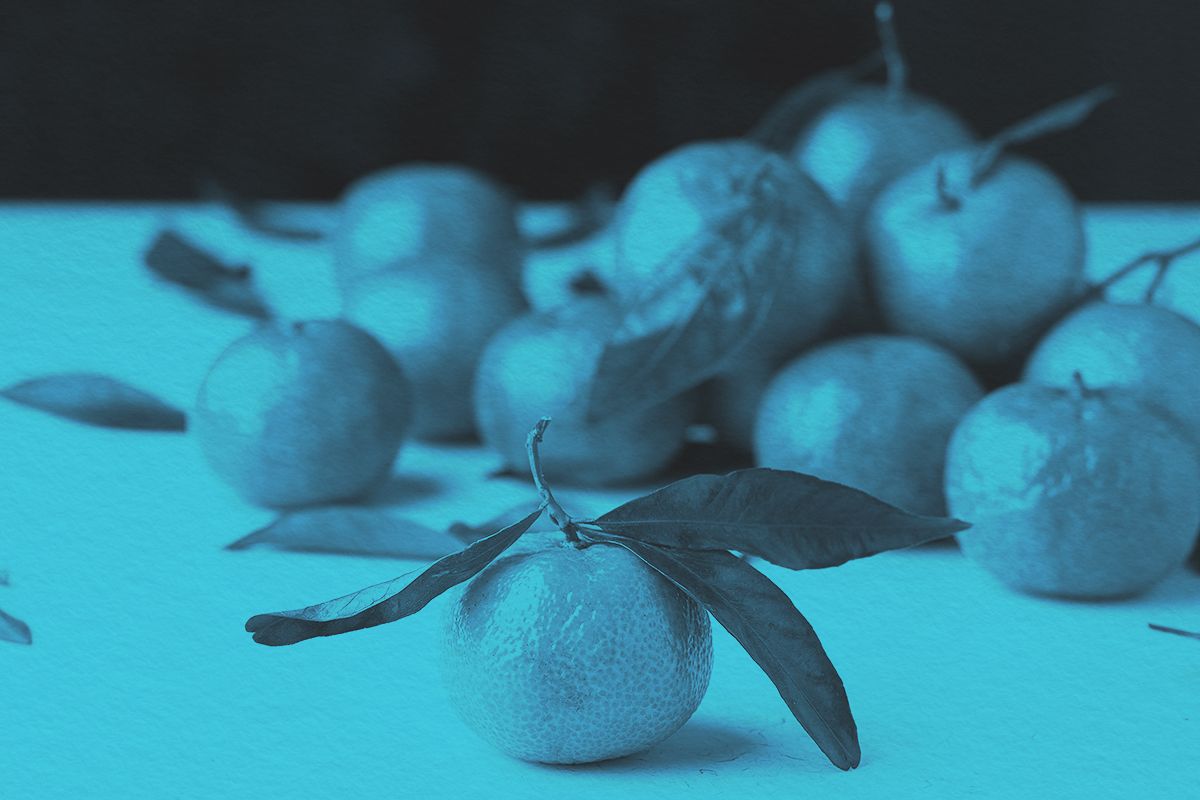
People have long debated which came first: the chicken or the egg? But in the world of language, there’s a similar debate raging on: Did orange the fruit or orange the color come first?
Advertisement
The simple answer is that people have been enjoying the fruit since long before it was ever called an “orange,” but it was indeed the fruit name that ended up inspiring the color name. The etymology can be traced back to a first-century CE Indian medical text, which makes reference to a naranga tree. This Sanskrit word once meant “fruit like elephants” — possibly in reference to how the tough and dimpled skin of the fruit felt similar to that of the giant mammal. The word later showed up as orange in French and arancia in Italian around the 12th century, solely referring to the fruit.
As language developed, people used a variety of words to describe colors that didn’t have their own names. Geoluhred — “yellow-red” in Old English — was the 14th-century word for what we know today as “orange.” In the 1390s, Chaucer described the color of a fox in a Nun’s Priest’s Tale as “betwixe yellow and reed.” Later, in the 16th century, people started using the word “orange,” and in 1605, Shakespeare described an “orange tawny beard” in A Midsummer Night’s Dream. Sir Isaac Newton left orange and indigo out of the first color wheel, but added them in the 1660s to reach seven colors to mirror an octave, as he saw colors and music intrinsically connected. This endorsement proved to be the orange-flavored icing on the cake, as the color orange lives on in ROY G BIV.
Featured image credit: Olivie Strauss/ Unsplash+
Advertisement
More from our network
Word Smarts is part of Inbox Studio, which publishes content that uplifts, informs, and inspires.
Grandparents hold a unique place in our families and are fondly referred to with a wide variety of special nicknames. Few other family titles have so many variations in English — “Granny,” “Gramps,” “Mimi,” “PopPop,” “MawMaw,” and “PawPaw” are just a few of the terms families might use to distinguish between sets of grandparents. (With today’s blended families and chosen families, folks might be lucky enough to have many people in the role of a grandparent.) The choices of names for these cherished people often reflect a family’s ancestral ties. The most popular nicknames for grandparents in the U.S. are “Nana” and “Papa,” but if your family isn’t using a standard American English title, you’re likely using a name from a different language.
Advertisement
With Spanish as the second-most-spoken language in the U.S., the Spanish translations of “grandmother” and “grandfather” also are popular: abuela and abuelo and abuelita and abuelito (equivalent to “grandma” and “grandpa”).
The French terms grand-mère and grand-père require no translation, but other languages aren’t so obvious. Some cultures have different words for maternal and paternal grandparents. In Swedish, the maternal grandma and grandpa are called mormor and morfar, respectively, while the paternal grandparents are called farmor and farfar. Hindi follows a similar structure: Nani is the maternal grandma and nana is the maternal grandpa, while dadi and dada are the paternal grandparents. It might sound a bit strange to native English speakers, but dadi means “grandma.”
This term might sound more familiar to English speakers: “Babushka” is an English word for a headscarf, but it was borrowed for its association with older women, because it’s the Russian word for “grandmother.” The similar-sounding dedushka means “grandfather,” and the informal versions of these Russian names are baba and dedu. Another word pair frequently used in American English is yia yia and pappoús, Greek for “grandma” and “grandpa.” In Japanese, the words for “grandmother” and “grandfather” are sobo and sofu, but within families, the informal terms of obaachan (“grandmother”) and ojiichan (“grandfather”) are more commonly used. In Filipino, lola and lolo are “grandmother” and “grandfather,” and in Swahili, Africa’s most widely spoken language, the titles are bibi and babu (these terms are also used as a generic, but respectful form of address to an elderly woman or man).
The affection attached to all of these terms from around the world is universal. If you’re pondering what to call yourself when a new grandchild enters the family, “Grandpa” and “Grandma” are always classic, but you might want to look abroad for some inspiration.
Featured image credit: Pixabay/ Pexels
Advertisement
More from our network
Word Smarts is part of Inbox Studio, which publishes content that uplifts, informs, and inspires.
What Are the Most Popular Last Names Around the World?
While names like Skywalker and Targaryen may reign supreme in fiction, the most prevalent surnames globally are far more grounded, with millions sharing common last names like Smith, Wang, and Nguyen.
As common as fanciful names are in the land of fiction, Skywalker, Targaryen, and McFly aren’t too prevalent in the real world. Instead, you’re more likely to encounter someone named Smith, Wang, or any of the other eminently popular surnames that are shared by millions of people around the globe.
Advertisement
The practice of classifying families by surname started in China in 2852 BCE, for organizational reasons. Today, surnames tend to fall into five categories: patronymics (names referring to fathers or ancestors), personal characteristics, occupations, toponymics (home region), and clans and tribes. Census data shows that surnames generally vary by region: Occupational surnames are more of a European or Western tradition, patronymics dominate much of Asia and Latin America, and names related to personal characteristics are common in much of Africa. There are, of course, exceptions to the rule; enslaved people often had to take the surnames of their subjugators, which is why many Black families in the U.S. have European surnames.
In English-speaking countries, the most popular surname is Smith, with around 2.5 million people named Smith in America alone. This name developed to designate an occupation, such as a blacksmith or silversmith.
In China, more than 92 million people go by the surname Wang, making it the most common last name in the world. The name is believed to have exploded in popularity around 250 BCE, when many royal families changed their name to Wang — meaning “king” in Mandarin — after the Zhou dynasty fell to the first Qin dynasty emperor. Li, Zhang, and Chen are other Chinese surnames shared by tens of millions of people.
In India, Devi, from the Sanskrit word for the Hindu mother goddess, is particularly common. Even when it’s not an official surname, Devi is sometimes used after the first name of a Hindu woman as a sign of respect. In Vietnam, about 40% of the population shares the last name Nguyen, and in South Korea, around 20% of the population goes by the surname Kim.
Many of these names are hundreds or thousands of years old, but new names are being created all the time. It’s become more of a common practice in Western countries to hyphenate or combine surnames when people get married, which has created brand-new names that bridge cultures and name origins.
Featured image credit: Devonyu/ iStock
Advertisement
More from our network
Word Smarts is part of Inbox Studio, which publishes content that uplifts, informs, and inspires.

There are some phrases we’ve likely said a million times without thinking about how they’re written. Is it “bear with me” or “bare with me”? “Bows of holly” or “boughs of holly”? “Hear, hear!” or “here, here!”? (The answers, in order, are “bear,” “boughs,” and “here,” but we’ll review these and more in another edition.) Today, let’s talk about one confusing phrase in particular: Is it “that doesn’t phase me” or “that doesn’t faze me”?
Advertisement
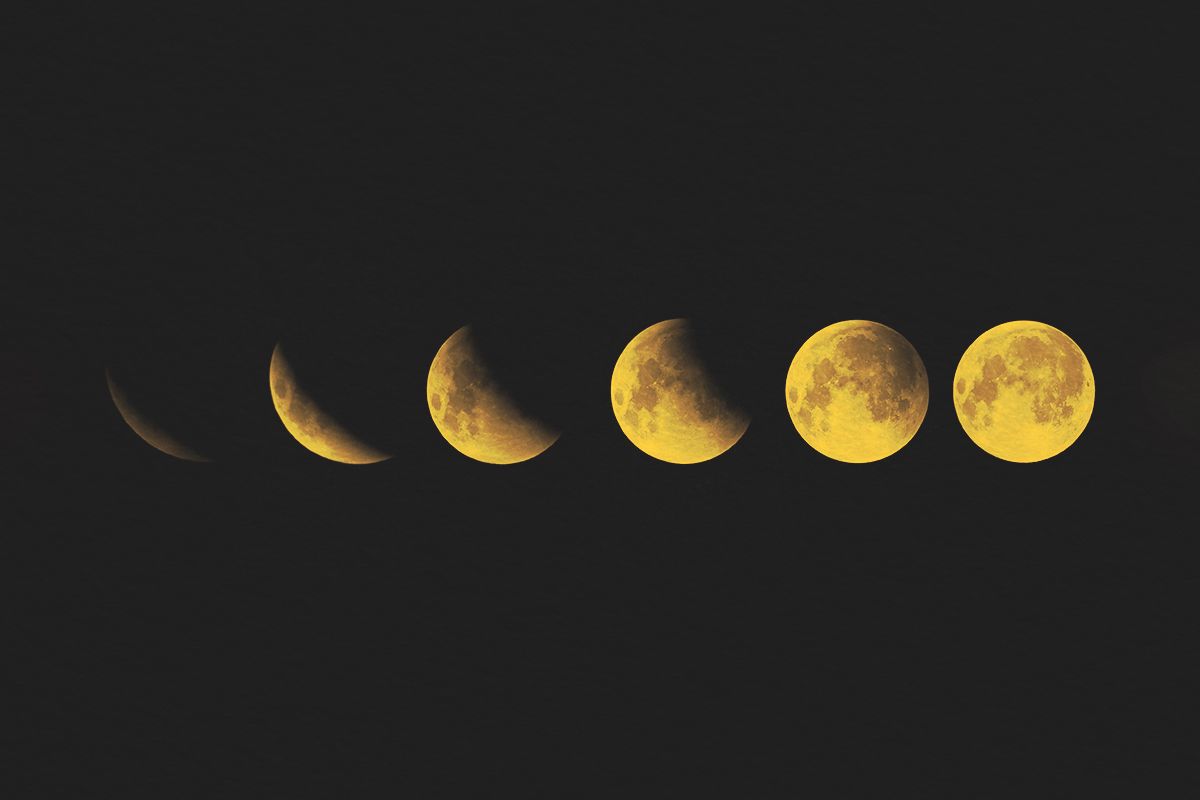
“Phase” and “faze” sound identical, but, like all homophones, they have distinct meanings and uses. “Phase” is a noun that means “a distinct period or stage in a series of events or a process of change or development” — think of the phases of the moon. It can also be used as a verb, as in “phase out,” but that’s a newer 20th-century term, related to eliminating something in phases. “Faze” is a verb that means “to disturb or disconcert (someone).” The early 19th-century word is a variant of the Old English feeze, which meant “to frighten” or “to alarm.”
When determining which homophone to use, it’s important to look at the intent of the overall phrase and the part of speech needed. If you say that something “doesn’t phase/faze you,” you’re looking for a verb that implies it has no effect on your actions or emotions. Given that intended meaning, it’s as clear as a full moon that “faze” is the proper word to use in this context.
Featured image credit: PROtoys/ Shutterstock
Advertisement
More from our network
Word Smarts is part of Inbox Studio, which publishes content that uplifts, informs, and inspires.

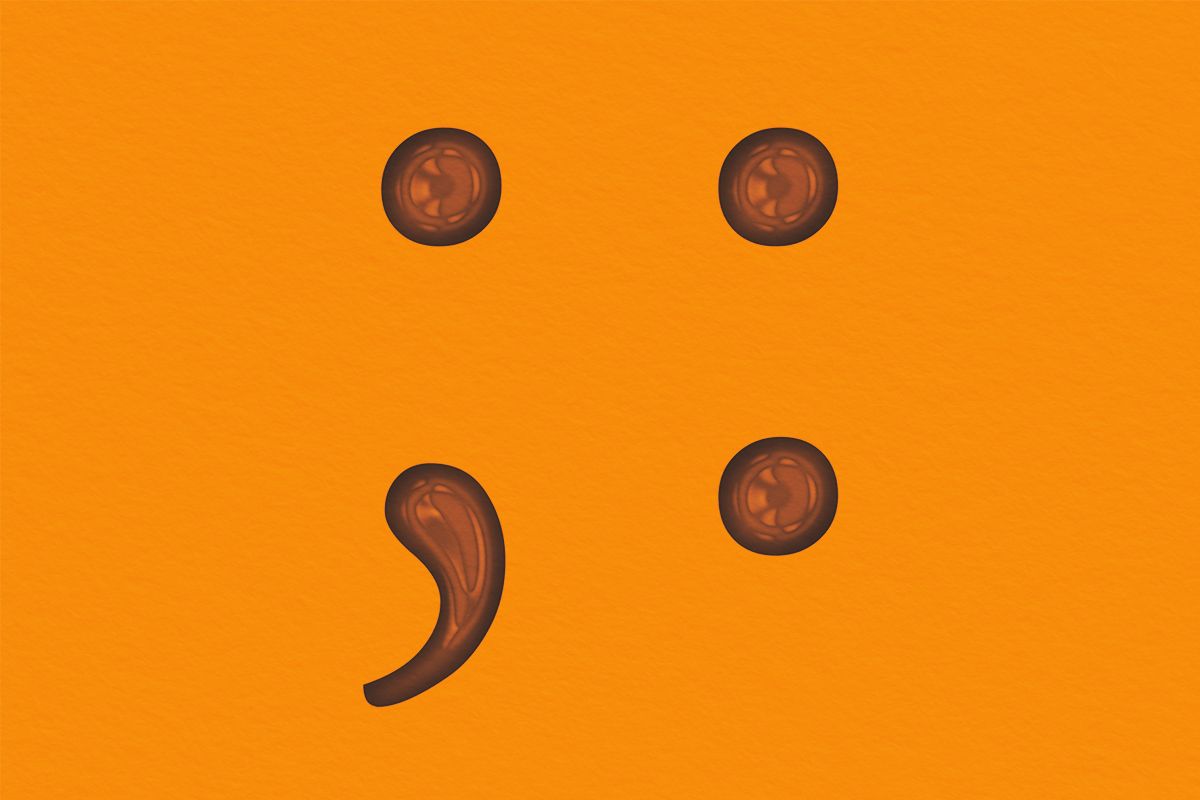
Colons (:) and semicolons (;) may look similar, and even live on the same key on your keyboard, but how they are used can be quite different. Both can help clarify information, and both represent a pause in the sentence; however, different punctuation needs call for each of them at different times. If we could narrow it down to a single key difference: A colon introduces information; a semicolon separates information.
Advertisement
You can use a colon in the following ways:
When starting a list (as we did here).
When distinguishing a word or clause from the rest of the sentence: like this.
When titling a book or movie, as in Jaws 4: The Revenge.
When introducing a quote, such as when Mark Twain said: “The unspoken word is capital.”
The colon is also used for nongrammatical purposes in several contexts: times (8:15 p.m.), ratios (1:3), bibliographies (Publisher’s City: Publisher), and Bible verses (1 Corinthians 13:4), to name a few.
The semicolon is primarily used to join two connected complete sentences. It replaces a conjunction (such as “but” or “and”) and is most appropriate when the thoughts in the sentences are connected. For example, “I had a late breakfast today; I probably won’t eat lunch.” The semicolon is not needed if there are not two complete sentences. “I had a late breakfast today; about 10 a.m.” is incorrect, and the semicolon should be a comma instead.
A less common use of the semicolon is when there’s a complicated list that has commas within the items. Using a semicolon between the items in such a series helps to clear things up. For example: “I visited Pittsburgh, Pennsylvania; Knoxville, Tennessee; and Lawrence, Kansas. I brought Dan, an architect; Susan, a teacher; and Frank, a nuclear physicist.
A final note: If the words after the colon are a complete sentence (like this) make sure to start with a capital letter. You don’t need a capital letter after a semicolon unless it’s a proper noun.
Featured image credit: Alluvion Stock/ Shutterstock
Advertisement
More from our network
Word Smarts is part of Inbox Studio, which publishes content that uplifts, informs, and inspires.
Learning the alphabet is as easy as ABC … or AБB, ABΓ, and ႠႡႢ, depending on your language (those examples being from Cyrillic, Greek, and Georgian). English, Spanish, French, and many other languages use the 26-letter Latin alphabet that you likely learned in preschool, along with a handy song. But there are eight standard alphabet groups worldwide: Arabic, Aramaic, Armenian, Brahmi, Cyrillic, Georgian, Greek, and Latin.
Advertisement
Most Western languages (English, the Romance languages, Germanic languages) use the Latin alphabet, with one notable exception. The Greek language is considered a Western language, but it’s an outlier in that it has its own alphabet. This ancient alphabet, developed around 1000 BCE, is the ancestor of all modern European languages. The word “alphabet” itself comes from the first and second letters of the Greek lettering system: “alpha” and “beta.” There are 24 letters in the Greek system, and while many of them look similar to Latin letters (Alpha is “A,” Epsilon is “E,” Kappa is “K,” Chi is “X,” for example), they have different names. We see evidence of the Greek alphabet adorning fraternities and sororities all over the United States, but we often use the Latin alphabet to write the words (Phi Beta Sigma is ΦΒΣ in the Greek, for example).
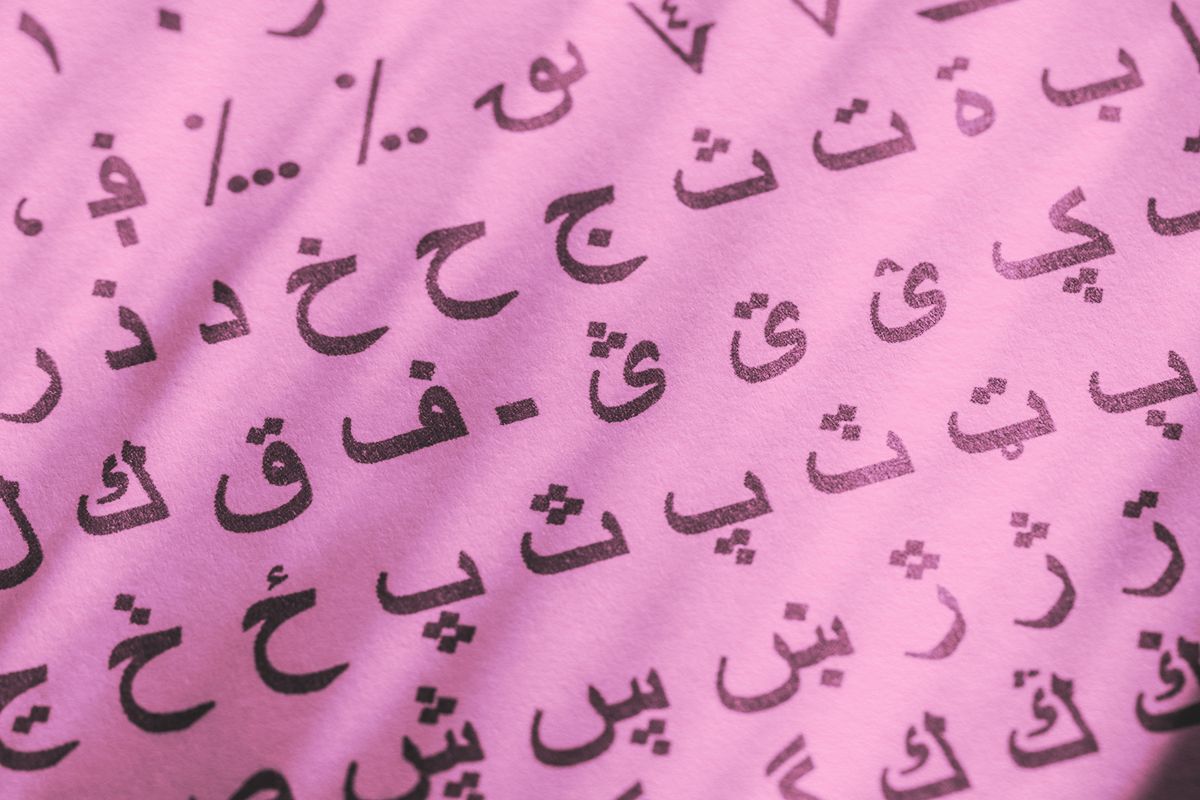
Arabic is an alphabet composed of 18 shapes and 28 phonetic sounds. This alphabet is used by Arabic speakers and those who speak Farsi, Dari, Tajik, Pashto, Kurdish, Urdu, and other Middle Eastern languages and dialects. Aramaic is an ancient language spoken on a smaller scale in the Middle East, and the alphabet consists of 22 letters that indicate consonants (but some can stand in for vowels). It’s used mainly in a liturgical sense by religious communities in Iraq, Lebanon, and Syria. Aramaic has close ties to Brahmi, an ancient script used throughout Asia and the Indian subcontinent. The Brahmi script is used by many language families, including Mongolic, Tai, and Dravidian. Sanskrit and Hindi developed out of the Brahmi script.
Advertisement
The Armenian alphabet and the Georgian alphabet are widely used throughout the Caucasus region. The Armenian script, with 31 consonants and seven vowels, developed in the fifth century. The unique Georgian alphabet, meanwhile, is used only to write the Georgian language. This alphabet, comprised of 33 letters without any distinction between upper or lower case, has three variations still in use: mrgvlovani, nuskhuri, and mkhedruli. The Cyrillic script, consisting of 20 consonants, 10 vowels, a semivowel, and two modifier letters, was developed in the ninth or 10th century. It forms the basis for more than 50 languages, including Russian, Kazakh, and Serbian.
Some languages — Mandarin and Japanese, for example — don’t use a traditional alphabet, but use logosyllabic icons to represent different sounds. Written characters in Chinese languages are called hanzi, whereas Japanese has three different sets of phonetic symbols: hiragana, katakana, and kanji.
Appreciating that world language systems are vast, with incredibly rich histories, goes a long way toward understanding the melting pot that is the English language.
Featured image credit: JLGutierrez/ iStock
Advertisement
More from our network
Word Smarts is part of Inbox Studio, which publishes content that uplifts, informs, and inspires.
You may know Mercury, Venus, and Mars, but did you know those monikers can change depending on the language? Learn more about the linguistic diversity behind the celestial bodies.
There are eight planets in our solar system — nine if you’re still clinging to those nostalgic memories of Pluto. For millennia, these planets were unnamed orbs floating around space. But once they were spotted by humans, the celestial bodies needed names. Depending on which language you speak, those names may slightly differ.
Advertisement
In most Western languages, planet names derive from Roman and Greek gods, with Earth being the only exception. Mercury, Venus, Mars, Jupiter, Saturn, and Neptune are based on Roman mythological figures, while Uranus is named after the Greek god of the heavens. Earth’s name comes from Old English and Germanic words for “ground” and “soil.”
All major Romance languages follow a similar naming mechanism. French uses Mercure, Vénus, Terre, Mars, Jupiter, Saturne, Uranus, and Neptune, while Portuguese uses Mercúrio, Vênus, Terra, Marte, Júpiter, Saturno, Urano, and Netuno. Major Germanic languages (German, Afrikaans, Swedish, and Dutch) also use similar variations. In Dutch, for example, the planets are named Mercurius, Venus, Aarde, Mars, Jupiter, Saturnus, Uranus, and Neptunus.
While North American Indigenous languages are geographically placed in the Western world, they’re not derived from the same sources. In Navajo, the word Nahasdzáán — meaning “our woman” — is used for Earth. The other planets in order are: Mókiwii (Mercury), Biinis (Venus), Máaz (Mars), Jíbitoo (Jupiter), Séetin (Saturn), Yoowéinis (Uranus), and Néʼtoon (Neptune). You might notice phonetic relations to the Western language terminology, but there’s no deliberate tie to the Greek and Roman gods.
In the Eastern Hemisphere, Chinese, Japanese, and Korean use names for the planets based on natural elements, other deities, or characteristics of the celestial bodies. (You’ll notice the symbols used to represent the words in Chinese and Japanese are the same.) To give a few examples:
Mercury: Water Star — Chinese: 水星 (Shuǐxīng); Japanese: 水星 (Suisei); Korean: 수성 (Suseong)
Earth: Ball of land — Chinese: 地球 (Dìqiú); Japanese: 地球 (Chikyū); Korean: / 지구 (Jigu)
Neptune: King of the Sea Star — Chinese: 海王星 (Hǎiwángxīng); Japanese: 海王星 (Kaiousei); Korean: 해왕성 (Haewangseong)
The naming conventions for celestial bodies across world languages demonstrates the shared connections between tongues. Whether the inspiration was drawn from the gods or the elements, the majesty of the planets generated names full of reverence.
Featured image credit:
Advertisement
More from our network
Word Smarts is part of Inbox Studio, which publishes content that uplifts, informs, and inspires.
Have you ever wondered why “pound” is abbreviated as “lb”? The surprising origins of this and other common weight abbreviations trace back to ancient Rome.
The late great comedian Norm Macdonald commented: “ID… there’s a strange abbreviation when you think about it. ‘I’ is short for ‘I,’ and then ‘D’ is short for dentification.'”
Advertisement
Macdonald wasn’t quite right with his assessment, but he was correct in that some abbreviations can be more confusing than they are helpful. If you can’t decipher what an abbreviation stands for, should the word or phrase be shortened at all? Even everyday terms may boggle the mind: For example, why is “pound” abbreviated as “lb”? Maybe you memorized the term in school, or maybe one day you asked the deli manager what that “LB” on the sticker meant, but it’s not an easy one to decipher on its own, because the word and its abbreviation don’t share a single letter. There is an answer as to why it’s shortened that way, though, and it dates back to ancient Rome.
The Romans used a basic unit of weight called a libra (~0.722 pounds), derived from the Latin for “scale” or “balance.” Libra pondo is a Latin phrase that translates to “a pound by weight.” When these terms reached Britain, they became the standard for weighing gold and silver. The abbreviation “lb” is a shortening of libra that was carried over to the English word “pound.” The British currency is also called the pound, and the £ symbol represents libra.
Another concept worth mentioning is the Roman uncia, a Latin word that translates to “one-twelfth.” It was used by the Romans as a unit of measurement for one-twelfth of a libra, and it became the inspiration for the English word “ounce.” So, where did that “z” in the abbreviation “oz” come from? On the journey from Latin to English, there was a detour with the Italian word onza.
Featured image credit: bonniev.photos/ Shutterstock
Advertisement
More from our network
Word Smarts is part of Inbox Studio, which publishes content that uplifts, informs, and inspires.

A “bleeding heart” may sound like something you’d see a cardiologist for, but it isn’t a medical malady. Rather, it’s a term that was originally coined to positively describe an outpouring of emotion, but over time evolved to take on a more derogatory context, specifically when referencing a person’s political beliefs. Let’s examine the etymological evolution of this uniquely diverse phrase.
Advertisement
One of the earliest written examples of “bleeding heart” is found in Geoffrey Chaucer’s 14th-century poem Troilus and Criseyde. In this work, Chaucer writes, “For which him thought he felte his herte blede,” using the metaphorical bleeding heart to convey the character’s emotional anguish. By the 16th century, the phrase began to take on a religious meaning, as Jesus was often described to have a “bleeding heart” for those who were suffering. And by the late 17th century, the phrase took on a botanical use to describe a pink and white heart-shaped plant with droopy flowers.
In the 20th century, the phrase “bleeding heart” got completely turned on its head, when it was used by conservative writer Westbrook Pegler to ridicule those who supported liberal President Franklin D. Roosevelt. Pegler frequently used the phrase to lambast the “bleeding-heart liberals” he disagreed with. Before long, the phrase was being used by right-leaning rhetoricians around the country, including Senator Joe McCarthy, who used it to attack newsmen he disagreed with, such as Edward R. Murrow. “Bleeding heart” continues to have a political connotation today as it describes passionate people on all sides, though the phrase has lost some of its staunchly negative reputation.
Featured image credit: Maik Schroeder/ iStock
Advertisement
More from our network
Word Smarts is part of Inbox Studio, which publishes content that uplifts, informs, and inspires.
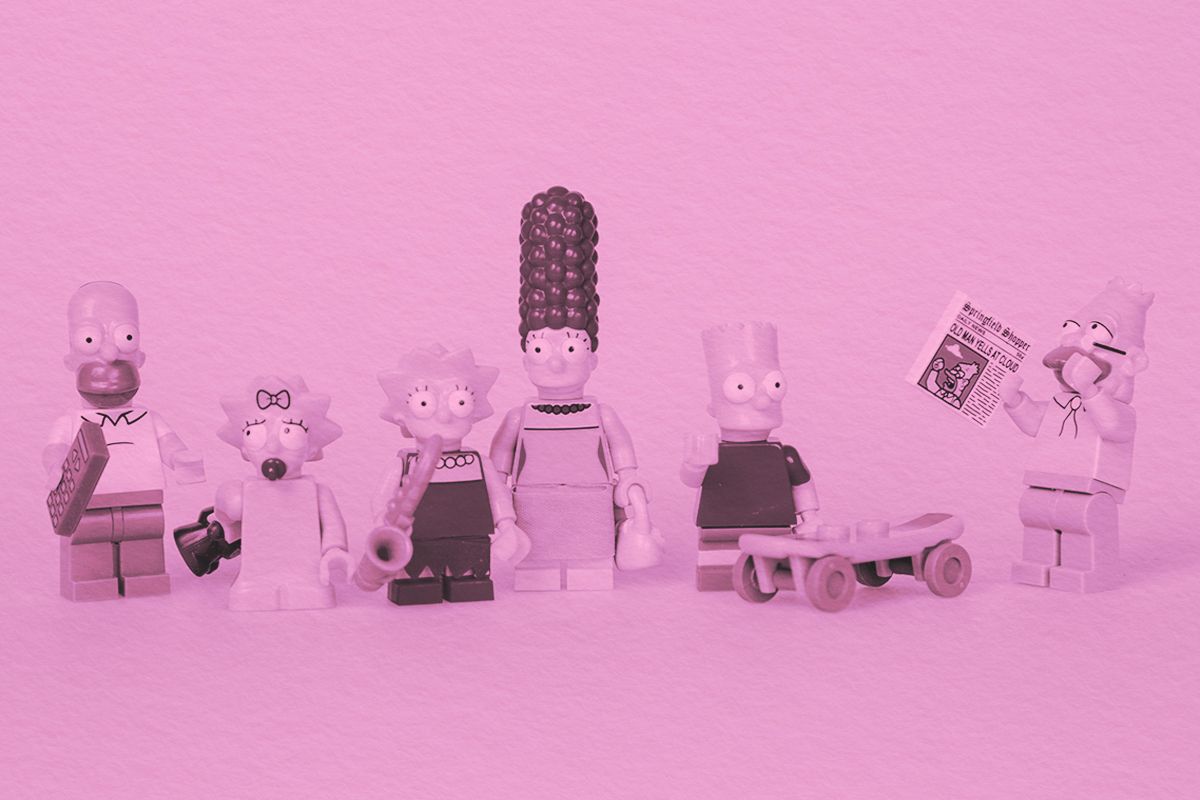
In a 1996 episode of The Simpsons entitled “Lisa the Iconoclast,” teachers Edna Krabappel and Elizabeth Hoover show their students a film about Springfield’s founder, Jebediah Springfield. When asked how he achieved such greatness, Jebediah says, “A noble spirit embiggens the smallest man.” Krabappel then remarks, “‘Embiggens’? Hmm, I never heard that word before I moved to Springfield,” to which Hoover replies, “I don’t know why. It’s a perfectly cromulent word.”
Embiggens? Cromulent? Where did these words come from?
Advertisement
All for Nonce
While the Merriam-Webster entry for “embiggen” gives no mention of the animated series, it does mark the first usage as 1996, which is when The Simpsons showrunners asked the show’s writers to come up with two “nonce words,” or “word[s] or expression[s] coined for or used on one occasion.”
The verb “embiggen,” which means “to make bigger or more expansive,” was cleverly paired with “cromulent,” an adjective that means “acceptable” or “fine.” The Simpsons fans are well accustomed to layers of smart humor in the seemingly mindless animated comedy, but even this joke might have slipped by those without linguistic knowledge. But “the perfectly cromulent” lines launched the journey for these made-up words to become a part of the popular lexicon. “Embiggen” was added to the Merriam-Webster dictionary in 2018, and “cromulent” was added to the corpus in 2023, after being listed as a “word we’re watching” for several years.
Published appearances of “cromulent” include a 2013 Supreme Court amicus brief over a matter of copyright infringement, and aNew York Times article in 2020, when Deb Amlen wrote: “I suspect that one of the scariest moments for new [crossword] solvers is when they discover that it is perfectly cromulent for constructors to clue answers in a way that means one thing, but twists the answers into real words that mean something totally different.”
You, Too, Can Embiggen the English Language
It’s not as though the New York Times crossword desk has a monopoly on playing with language in cromulent ways. People make up new words all the time — in etymology, this is called a “neologism,” or a word or phrase coined to adapt to meet changes occurring in the life and culture of its speakers. The nonce (one-use) words of “embiggen” and “cromulent” turned into neologisms as more people and publications continued to use them.
Such linguistic behavior has been going on for centuries; this isn’t even the first time The Simpsons has made it into the dictionary. The Oxford English Dictionary added Homer’s catchphrase “D’oh!” to the dictionary in 2001. Alice in Wonderland writer Lewis Carroll also was a notorious neologist — we can thank him for embiggening the English language with “chortle,” “bandersnatch,” and “snark,” to name a few.
So take this as a challenge to create your own neologism — “There Should Be a Word for That! (So Make One Up.)” offers a helpful primer, including the concepts of compounding (“duckface,” “manspreading”) and blending (“brunch,” “listicle”). We’ll eagerly await your creations to become the next “cromulent” and “embiggen.”
Featured image credit: Stefan Grage/ Unsplash
Advertisement
More from our network
Word Smarts is part of Inbox Studio, which publishes content that uplifts, informs, and inspires.
Enter your email to receive daily lessons that dive into what makes English so fascinating. Each email is packed with odd rules, etymologies, and the tools you need to be a better communicator.
Sorry, your email address is not valid. Please try again.