English is chock-full of tricky spellings. Because it pulls together inspiration from a lot of different languages, including Greek, Latin, French, German, and more, there are many words that defy standard phonetic rules. And to further complicate things, English is rife with homonyms, silent letters, and obscure meanings.
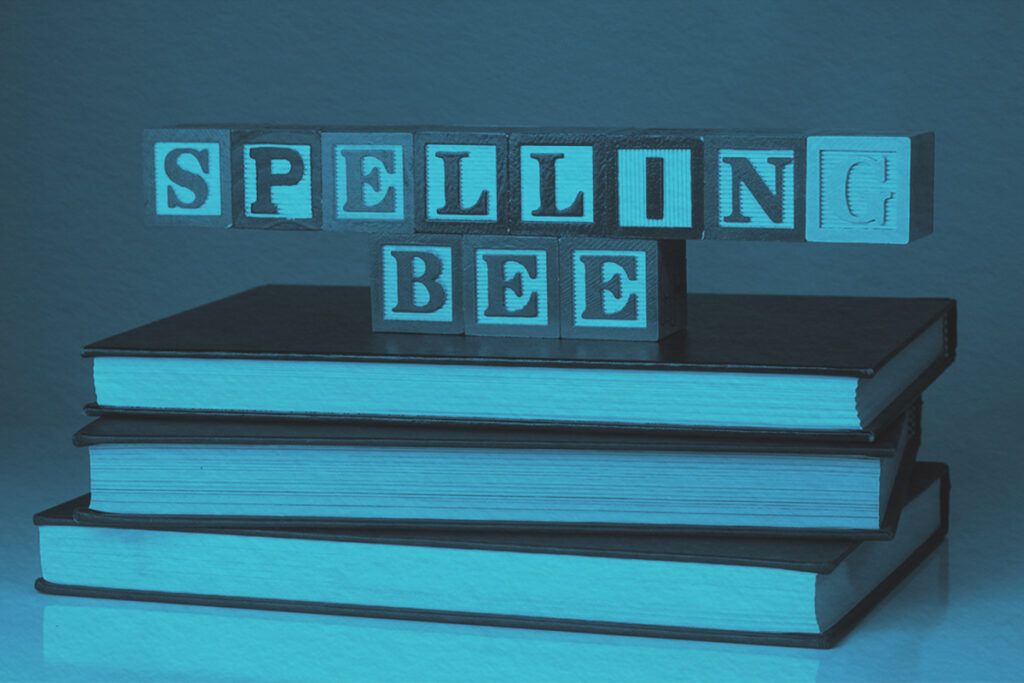
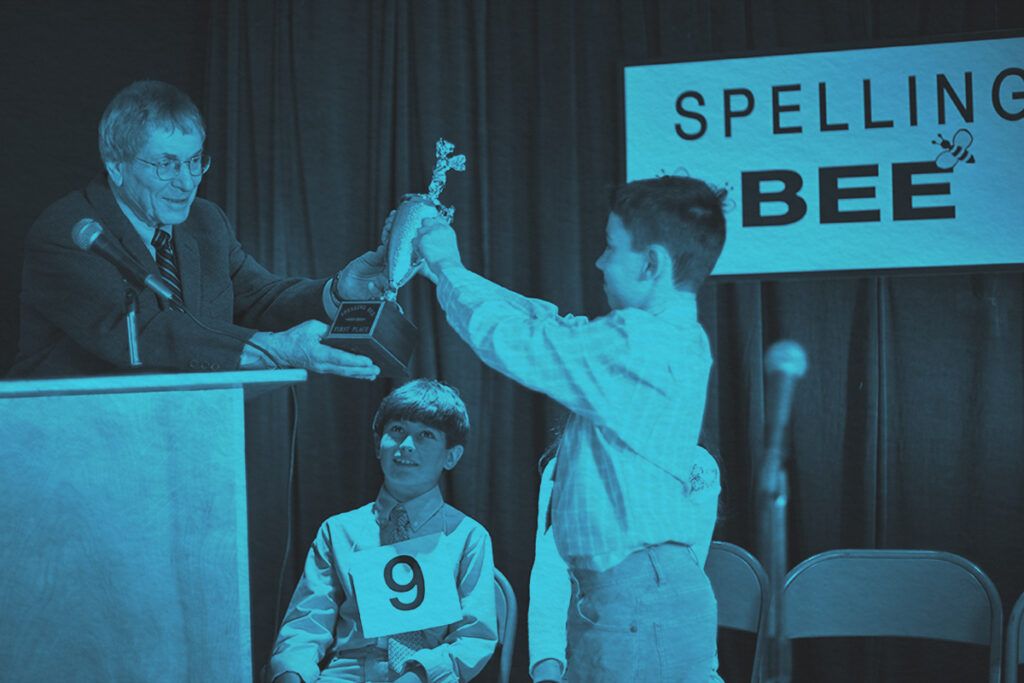
Nowhere are these challenges more evident than in the ritual of the school spelling bee. Spelling competitions have been documented in American literature since the 19th century; Mark Twain briefly referenced a “spelling fight” in The Adventures of Tom Sawyer in 1876. The most famous such bee today, of course, is the yearly Scripps National Spelling Bee, which celebrated its 100th anniversary last year.
The winning words from the Scripps National Spelling Bee follow the pattern of diverse language origins and esoteric meanings. The first winning word (in 1925), “gladiolus,” comes from Latin and refers to a type of iris plant. The most recent winning word (in 2025), “éclaircissement,” is a direct carryover from French — it means “a clearing up of something obscure.” In the 2023 Spelling Bee, stumpers such as “pataca” (a monetary unit in China) and “pharetrone” (a sponge of the group Pharetrones) eliminated contestants in the final rounds. In 2024, the very first word, “desmotrope” (a form of a chemical element related to another by desmotropism), was misspelled as “desmatrope.”
Advertisement
In the history of the Scripps bee, there have been just two words that no finalists were able to spell, and so the competitions ended in a draw: “schappe” (German origin, “a yarn or fabric of spun silk”) in 1957 and “esquamulose” (Latin, related to a very specific plant leaf structure) in 1962.
Other spelling games show similar trends. TheNew York Times’ Spelling Bee game, for example, analyzed the puzzles that stumped readers the most, and identified the hardest words from 2025 as “pellicle,” “lacteal,” and “hamartia.” These words follow the general pattern of obscure words with French, Latin, and Greek roots, respectively.
Spelling is a weirdly and consistently difficult part of English. Participants in the Scripps National Spelling Bee study for months, memorizing thousands of words and linguistic patterns. Most of us have no reason to do that as adults, but you can continue to improve your skills by reading to learn new words and playing some of the many online spelling games out there, including Quordle and Blossom, from Merriam-Webster.
If you follow political commentary, you may have come across an idiom that seems like it might use the wrong homonym: “toe” versus “tow.” The phrase “toe the line” — not to be confused with the common misspelling “tow the line” — means “to conform rigorously to a rule or standard.” In this expression, “toe” functions as a verb meaning “to touch or reach with the toe.” Originally, the phrase was meant quite literally.
One of the earliest-written records appears in an 18th-century military memoir,in which an officer orders soldiers, “Silence, you dogs, toe the line, you puppies ….” The expression likely comes from military drills and other settings (schooling, sports, etc.) where participants were required to stand in formation during inspection with the tips of their toes exactly on a line or mark as a sign of obedience. The related phrase “toe the mark” was used similarly through the 19th century, though it is now seldom seen.
Advertisement
The sense of discipline and conformity in “toe the line” carried into a figurative sense by the end of the 19th century, as seen in an 1895 edition of Westminster Gazette:“The phrase ‘toeing the line’ is very much in favour with some Liberals.” By then, it had become shorthand for political conformity. It now often appears as “toe the party line,” implying that someone is following an authority figure’s rules, regardless of whether they actually agree with those rules.
The idiom carries a strict sense of adherence to authority in other areas, too. For example, “All employees must toe the line and follow the new procedures” suggests that people must adhere to the standards set by their employers. The phrase “toe the line” skyrocketed in popularity in the U.S. during the 1940s, spreading from military drill grounds to political commentary and corporate jargon.
16 Winning Words of the Scripps National Spelling Bee
Wordies watch the Scripps National Spelling Bee with fascination every year, wondering which words will stump the young scholars. Here are some of the winning words over the past 100 years of the competition.
The Scripps National Spelling Bee has been testing young minds since 1925. The first winner was 11-year-old Frank Neuhauser of Louisville, Kentucky, who correctly spelled “gladiolus” (a genus of perennial plant) to claim a prize of $500 and the chance to meet President Calvin Coolidge. Since then, the contest has been held almost every year, pausing only for World War II and the COVID-19 pandemic.
The winning words correctly spelled by these young scholars have, at times, been quite simple — especially in the early years. “Knack,” “torsion,” “intelligible,” and “canonical” were among the final words prior to World War II. The difficulty then began to increase, with more obscure words selected to challenge the knowledge of well-prepared teenagers. Here we take a look at some of the less common words that have won Scripps over the decades.
Abrogate (1926)
“Abrogate” means “to abolish by authoritative action.”
Example: “The new government moved swiftly to abrogate the treaties signed by its predecessor.”
Meerschaum (1950)
Meerschaum is a soft white or yellowish mineral that looks a bit like hardened clay. It is most commonly associated with meerschaum tobacco pipes, which have a bowl made of the mineral. The name comes from German, literally meaning “sea foam.”
Example: “The old professor kept a carved meerschaum pipe on his desk, though he hadn’t smoked in years.”
Insouciant (1951)
If you want to add a little elegance to your vocabulary, you could do a lot worse than “insouciant.” It means “exhibiting or characterized by insouciance,” which is “lighthearted unconcern.”
Example: “Bruni and fellow icons like Jane Birkin and Françoise Hardy boast the sort of in-her-face fringe that oozes insouciance, a hallmark of the French aesthetic.” (Calin Van Paris, InStyle, 2026)
Advertisement
Syllepsis (1958)
Syllepsis is a rhetorical figure of speech in which a single word governs or modifies two others in different ways, often for comic effect — as in, “She lost her purse and her temper,” or “She blew my nose and then she blew my mind” (the latter from the Rolling Stones’ 1969 hit song “Honky Tonk Women”).
Example: “The comedian’s use of syllepsis drew a laugh from the audience, which appreciated the double meaning.”
Eudaemonic (1960)
The “daemonic” in “eudaemonic” may be misleading, as the word is far from demonic. It actually refers to anything that is conducive to happiness. It comes from the Greek eudaimonikos, in which eu means “good” and daimōn means “guardian” or “genius.”
Example: “The philosopher argued that a eudaemonic life required not pleasure but purpose.”
Ratoon (1966)
A ratoon is a new shoot or sprout growing from the root of a plant after it has been cropped. It is most commonly used when referring to the harvest of sugarcane.
Example: “On the banks of the Essequebo, thirty crops of ratoon canes have been raised successively.” (W. Robertson, History of America, 1778)
Elucubrate (1980)
“Elucubrate” is considered an obsolete word by the Oxford English Dictionary, but it’s worth reviving. It means “to work out or express by studious effort,” especially late into the night and, traditionally, by candlelight or lamplight.
Example: “She elucubrated for months in her study, burning the midnight oil before finally finishing her first novel.”
Advertisement
Spoliator (1989)
This word refers to one who plunders, pillages, robs, or despoils. Genghis Khan is a prime example of a historic spoliator.
Example: “It might be, that a successful spoliator thus deprived the possessors of the means of future defence.” (G. Petrie, Ecclesiastical Architecture of Ireland, 1845)
Vivisepulture (1996)
“Vivisepulture” is a rather grim word to include in a spelling competition for teens, but it won the day in 1996. It refers to the act or practice of burying someone alive.
Example: “They are a superstitious brood and have many cruel practices — human sacrifices and vivisepulture.” (Richard Francis Burton, City of Saints, 1861)
Euonym (1997)
If you’ve ever thought that Usain Bolt has a very fitting name for an Olympic track star, there’s a word for that: “euonym.” It means “a name well suited to the person, place, or thing named.”
Example: “‘William Headline’ struck many as a remarkable euonym for CNN’s former Washington bureau chief.”
Prospicience (2002)
Prospicience is the act of looking forward or having foresight. The word dates back to at least the 1500s but is rarely used today.
Example: “The report praised the urban planners for their prospicience in preserving green space before the city expanded.”
Advertisement
Pococurante (2003)
Italian speakers will likely recognize this word, used to refer to a careless, indifferent, or nonchalant person. It comes from the Italian poco (“little”) and curante (“caring”).
Example: “He was such a pococurante that even news of the company’s collapse failed to provoke any real emotion.”
Cymotrichous (2011)
In the world of anthropology, “cymotrichous” simply describes having wavy hair — as opposed to having leiotrichous (smooth or straight) or ulotrichous (crisp or woolly) hair. Some humans can be described as cymotrichous, as can dog breeds such as spaniels and poodles, and a whole array of other wavy-haired mammals.
Example: “The astronauts discovered a population of bipedal creatures that were predominantly cymotrichous, with green, wavy hair.”
Nunatak (2015)
“Nunatak” means “a hill or mountain completely surrounded by glacial ice.” The word comes from the Greenlandic Inuit nunataq.
Example: “There are several nunataks at Graves, all peaks of the same mountain.” (Barry Lopez, Harper’s magazine, 2019)
Cernuous (2019)
“Cernuous” means “inclining or nodding.” It is primarily used in botany to describe the drooping heads of flowers.
Example: “After the rain, the snowdrops appeared cernuous, their white heads hanging low with the weight of water.”
Advertisement
Éclaircissement (2025)
This recent winning word from the Scripps National Spelling Bee is one of the most challenging in the history of the competition. A loanword from French, “éclaircissement” refers to a clarification or explanation — the clearing up of a misunderstanding or the revelation of something that was unknown.
Example: “When the éclaircissement comes there will be a scene.” (William Makepeace Thackeray, Vanity Fair: A Novel Without a Hero, 1848)
We’ve all done it: You’re thinking about one thing, and then you decide to say another, creating a mishmash of words and syllables. Perhaps you were thinking “surprised” and then “excited,” so it came out of your mouth as “exprised.” Extend it to full phrases, and that’s how we get the humorous figure of speech called the malaphor.
And no, we didn’t misspell “metaphor.” Whereas a metaphor is a figure of speech in which a word or phrase is applied to an object or action to which it is not literally applicable, a malaphor twists up well-known phrasing to humorous effect.
It’s a mashing together of two or more idioms into a single expression that is surprising or confusingly amusing. Take the common metaphors “burning bridges” and “we’ll cross that bridge when we come to it.” Mash them up as “burn that bridge when we come to it,” and we have a malaphor. It takes familiar phrasing and alters it, drawing attention to the incorrect wording.
Malapropism Into Malaphor
“Malaphor” is a literary term that combines “mal-,” meaning “bad,” with the Greek pherein, meaning “to carry, bear.” Put together, these two elements literally mean “to carry two distinct things, and doing so badly.” The word was coined by Lawrence Harrison in a 1976 Washington Post article titled “Searching for Malaphors.” His idea was to combine “metaphor” with “malapropism.”
A malapropism is an unintentional misuse of a word or phrase, usually to humorous effect. “Malapropism” derives from the name of Mrs. Malaprop, a character in Richard Brinsley Sheridan’s 1775 play, The Rivals, noted for her ridiculous misuse of words. Her name came from the French phrase mal à propos, meaning “inappropriately, inopportunely.”
Advertisement
The play has plenty of examples of Mrs. Malaprop misspeaking, including “He is the very pineapple [pinnacle] of politeness” and “She’s as headstrong as an allegory [alligator] on the banks of the Nile.”
One of Mrs. Malaprop’s descendants is Archie Bunker, the bigoted character in the 1970s sitcom All in the Family, who demonstrates crass malapropisms such as “patience is a virgin [virtue],” “a menstrual [minstrel] show,” and “I ain’t a man of carnival instinctuals [carnal instincts] like you.” The show used Bunker’s prejudiced views as a way to discuss important cultural issues, and the malapropisms were a needed humorous counterpoint.
The difference between a malapropism and a malaphor is the latter is created by blending two or more idioms or phrases, whereas the former substitutes a similar-sounding but different-meaning word for the correct one.
Examples of Malaphors
“It’s not rocket surgery” combines “It’s not rocket science” and “It’s not brain surgery.”
“Don’t count your chickens in one basket” combines “Don’t count your chickens before they hatch” and “Don’t put all your eggs in one basket.”
“We’re barking up the wrong horse” combines “We’re barking up the wrong tree” and “We’re betting on the wrong horse.”
“It tickled my fancy bone” combines “tickled my fancy” and “tickled my funny bone.”
Advertisement
Malaphors in Real Life
Public figures, as well-spoken as they might be, have been caught blurting out malaphors. In a 2019 interview, U.S. Representative Nancy Pelosi combined “hit the ground running” and “hit the nail on the head,” resulting in a confusing statement: “We’re going to hit the ground on the head.”
More recently, Steve Blass, a retired Pittsburgh Pirates pitcher and TV broadcaster, commented in a June 2025 interview on the ability of Pirates pitcher Paul Skenes to keep his focus during games: “He just keeps his head to the grindstone,” mixing “keep your nose to the grindstone” and “keep your head in the game.”
So the next time you can’t remember the exact wording of a phrase, or you mix up your idioms, now you can say you’re using a malaphor on purpose.
English has a funny way of rewarding what sounds natural over what is technically correct. Some grammar mistakes have become so common in everyday speech and writing that they no longer sound like errors. In some cases, the wrong version feels even more polished than the grammatically correct one. Many mistakes come from confusing verb forms, not knowing tricky exceptions, or overlooking grammar rules that seem counterintuitive. All of these slipups have one thing in common: They’re surprisingly understandable. Here’s how to spot and correct them.
I laid on the couch.
Correction: “I lay on the couch.”
The verbs “lay” and “lie” have caused headaches for generations of English speakers. “Lie” is an intransitive verb meaning “to be or stay at rest,” as in, “I need to lie down.” Because it is intransitive, it does not require an object to be acted upon. Meanwhile, “lay” is a transitive verb meaning “to put something down,” as in, “Can I lay my bag on this table?” It requires an object — something being placed somewhere — which in this case is “my bag.”
Unfortunately, their past-tense forms overlap in a very unhelpful way, resulting in one of the most confusing verb duos in English. The past tense of “lie” is “lay,” and the past tense of “lay” is “laid.” This is why the sentence “Yesterday, I laid on the couch” is grammatically incorrect — it should be “Yesterday, I lay on the couch.”
However, “I laid the bag on the table” is correct because “laid” is the past tense of “lay.” Keep an eye out for an object in the sentence. If there is one, use the present “lay” or the past “laid.”
Advertisement
Each of them have …
Correction: “Each of them has …”
In the above example, the plural pronoun “them” is closest to the verb, which makes “have” sound more natural. However, the subject is actually “each” — a singular pronoun. Subject-verb agreement says that the verb must also be singular: “has.” For that reason, “Each of them has a ticket” is correct, while “Each of them have a ticket” is not.
When this kind of phrase becomes confusing, it helps to simplify it. Remove the extra words and look at the core grammatical structure: “Each has a ticket.” The correct subject-verb combination becomes easier to hear.
A large amount of people showed up.
Correction: “A large number of people showed up.”
While it doesn’t change the meaning of the sentence, using the word “amount” to refer to people is grammatically incorrect. This is because “people” is a countable noun, referring to items that can be counted one by one, just like cars or apples. Uncountable nouns (or mass nouns) refer to things that can’t be counted individually, such as water, air, or time.
Certain words are used alongside countable nouns, while others are reserved for uncountable nouns, and “amount” is traditionally paired with the latter. A correct usage of “amount” is: “We have a small amount of time.” On the other hand, “number” is used with countable nouns: “I borrowed a large number of books.”
That said, many native speakers are unaware of these rules and use “amount” informally with countable nouns, so the incorrect version often slips by unnoticed.
Advertisement
Between you and I …
Correction: “Between you and me …”
“Between you and I, I hated the restaurant.” This mistake often happens because speakers try to sound more grammatically correct, but in fact, this overcorrection is wrong. It comes down to a very specific grammar rule: The word “between” is a preposition, and prepositions must be followed by object pronouns such as “me,” “him,” “her,” “us,” or “them.”
“I,” on the other hand, is a subject pronoun and should be used only when it’s the subject of the sentence. The correct version is, “Between you and me, I hated the restaurant,” because “I” is the subject and “between you and me” is a prepositional phrase.
The confusion stems from phrases like “You and I went to the store” and “Perhaps you and I have different opinions.” These are correct because “you and I” functions as the subject of the sentence. Over time, many speakers began assuming that “you and I” is proper in all situations.
The trick is to use “I” (subject pronoun) when the subject is doing the action and “me” (object pronoun) when the object receives the action or follows a preposition.
The best way to experience a city is to try to live like a local. To take the first step, make sure you’re pronouncing city names correctly as you travel.
For those who find travel stressful, feeling like an outsider is just one of the worries. If you’re in search of the right train platform and can’t parse the signs, you want to know how to pronounce the name of your destination correctly, especially to anyone kind enough to help out a tourist. Languages around the world use vastly different pronunciations from standard English. Accent marks and unfamiliar letter pairings can confuse travelers, as can city names that don’t match what Americans know them by. Though learning a new language is difficult, practicing local pronunciation is an important step for visiting a new place.
Budapest, Hungary
The largest city in Hungary is an excellent tourist destination for history nerds because of its prewar classical architecture. The city used to be split into Buda and Pest by the Danube River, but they came together as the official capital in 1873. The final syllable of the city’s name has a slight trick to it: The “s” should actually be pronounced as an “sh,” so it sounds like “booda-pesht.”
Edinburgh, Scotland
Even though it’s been an active metropolis since the Middle Ages, confusion persists about how to refer to Scotland’s capital city. Instead of saying “edin-berg,” locals drop the final “g” and end with an aspirated “h.” If you can’t pull off an authentic Scottish brogue, practice “ed-in-bur-uh” a few times before talking to a local.
Marseille, France
If you’re unfamiliar with the French language, the abundance of double vowels and double consonants might give you pause. An English speaker might pronounce Marseille, the capital of the Provence-Alpes-Côte d’Azur region, as “mar-sell” or “mar-sell-ee,” but approaching this phonetically is a mistake. The “ei” in the town name is a diphthong, which is two vowel sounds meant to be pronounced together. The double “l,” followed by the “e,” is not pronounced at all. When you visit the South of France, take a stop in the beautiful city of “marsay.”
Advertisement
Leicester, England
This British town is in the county of Leicestershire in England. The name comes from the Old English name of the town, written in 924 CE as Ligera ceastre, which translates to “city of the Ligore people.” In modern English, the middle section of the word is essentially just for show. To sound like a born-and-bred Briton, you have to say “lester.”
Shanghai, China
The largest city in China is home to eye-popping skyscrapers contrasted with beautiful historic places, such as the Yuyuan Garden, dating back to the 16th-century Ming dynasty. English speakers tend to pronounce the first “a” as “ay”: “shayng-hi.” Instead, you should pronounce the city name as “shahng-hi.”
Brisbane, Australia
Even in English-speaking countries, city names are subject to the various English accents around the world. Brisbane is the capital city of Queensland, popular with visitors because of the Brisbane Riverwalk and many national parks. Instead of saying “briz-bay-n,” Australians elide the “a” out of the word. Aussies will thank you for pronouncing it “bris-bn” — no final vowel necessary.
Advertisement
Phuket, Thailand
This beautiful city in Thailand is known for its various beach resorts and historic Buddhist temples. In English, we pronounce “ph” as an “f” sound, but that doesn’t apply here. Instead, let the “h” stay silent, and tell the locals how glad you are to be visiting “poo-ket.”
Toledo, Spain
This city in Spain is a UNESCO World Heritage Site because of its importance to Christian, Islamic, and Jewish history. The city was called Toletum in the days of the Roman Empire, which led to the modern name, Toledo — a name also found in five U.S. states and other countries around the world. If you’re visiting the Gothic cathedral in Toledo, Spain, make sure to soften the “e” and say “toh-leh-doh.”
Porvoo, Finland
Finnish and other Scandinavian languages are notoriously tricky for English speakers. Their spelling structure and pronunciation are very different from those in English, since they evolved from Old Norse and North Germanic languages. Though Porvoo looks like it should be simple, the double vowels do not follow English-speaking trends. Say “por-vo” instead of “por-voo.”
Merriam-Webster is constantly updating and adding to the dictionary. We spoke with an expert lexicographer to learn more about how each new entry qualifies.
The English language is always evolving, and dictionaries need to be updated frequently to keep up with changing times. But not all neologisms earn a permanent place in the dictionary — their lexicographical immortality is entirely dependent on meeting a set of certain criteria.
To learn more about how words get added to the dictionary, we spoke with senior editor Emily Brewster of Merriam-Webster. As a lexicographer, Brewster plays a key role in deciding which terms make it into the dictionary each year and which fall by the wayside. Here’s a look at what she had to say in our interview, which has been edited for clarity.
Word Smarts: What makes a word worthy of being added to the dictionary?
Brewster: Words have to meet three criteria: a significant amount of evidence of a word in use, in a variety of publications and contexts, over a period of time. All of those three criteria are intentionally vague. Every word meets those criteria, but in a different way. For example, the word “COVID-19” was entered only 34 days after the word had been coined. It was the fastest that any word has ever been entered in a Merriam-Webster dictionary.
The amount of time we let a word germinate and show that it’s really an official member of the language is more like five or even 10 years, and there are plenty of words where it’s significantly longer. But that amount of time has been shrinking because words are now able to proliferate and show widespread use geographically in an amount of time that keeps getting shorter and shorter.
Advertisement
Word Smarts: How often are new words added?
Brewster: For the Merriam-Webster.com dictionary, we usually do two updates a year. COVID-19 [the time period] got a special edition; it was a special release just for COVID-related words. I think there were maybe about 50 terms that got in for that; that’s very unusual. It just seemed pretty urgent, as there were a lot of words that people were having questions about, and so we made an exception to the usual schedule.
But in general, it’s usually two updates a year that we do, and there are usually several hundred words that are being updated [or added]. We could just put in one word at a time, but that would be a very clunky, impractical sort of process because any new addition to the dictionary is likely to have implications on other parts of the dictionary. Anytime we use a word in defining text or in an example sentence [in a new usage], that use of that word also has to be entered in the dictionary. A dictionary is necessarily circular. Everything in it has to be defined by something else in it.
So we do not make just one-off changes. We are able to correct typos, but in general, we do what we call our releases and will be working on a whole batch of words. Sometimes they relate to a particular topic, but more often they’re from all over the lexical field.
Word Smarts: What’s the difference between something that needs to be updated versus a brand-new word being added?
Brewster: We’re constantly doing both. Any definition that is in one of our dictionaries is possibly in need of revision at any time. We’re constantly examining these things. I have notes that I’ve made to myself to see if this new meaning of this word is ready [for an update] yet, and I will return to it and see if it is or not. We’re also examining words that come up because we can see what people search for at Merriam-Webster.com and [decide] whether we enter it or not.
Then we also have different resources that we use to see new vocabulary that’s kind of percolating in the language. It really just varies. As a definer, we’re always updating definitions and adding new definitions. Depends on what kind of project we’re working on and what words we’re coming across and that sort of thing. Sometimes an editor is working on a group defining project [meaning working on a specific category of words], and sometimes they’re just going through and examining the list of words that we’re tracking to see if they’re fully established yet.
Advertisement
Word Smarts: You just released the 12th edition of Merriam-Webster’s Collegiate Dictionary. What makes you decide it’s time for a new physical dictionary?
Brewster: For a long time, it was every 10 years that we would do a new edition of the Collegiate Dictionary. But the 11th edition came out in 2003, so this was a much longer period of time. That’s just because of practical matters regarding the publishing industry, really. We were very busy updating the Merriam-Webster.com dictionary, and we also spent years producing another very new kind of dictionary called Merriam-Webster’s Advanced Learner’s English Dictionary; it’s a monolingual dictionary for non-native English speakers.
And we make updates; the 11th Collegiate actually had regular [printed] updates being made all the time. And the 12th Collegiate will also be updated. But a new edition means cover to cover, every entry is potentially open to being reexamined. Really broad changes can be made to the style of the dictionary.
Word Smarts: Is there ever a case where you’ll remove a word?
Brewster: For the Merriam-Webster.com dictionary, we do not usually remove words because we don’t need to. There are no space constraints. The reason for removing words from a print dictionary is that you really want it to be affordable and relatively portable. The 12th edition is actually a bigger book. The idea of it being portable and affordable has shifted a little bit, because these days, people who are likely to buy a print dictionary are going to be interested in the object itself. It’s not the kind of thing people are going to be toting around in their backpacks with them. But a print dictionary is necessarily subject to space constraints and you can only fit so much between the covers, so we do remove words in that case.
Most of the time, words that get removed are related to outdated technologies. The word “wagonette” was a word that was removed between the 11th and 12th Collegiate editions. Nobody rides in a wagonette anymore, and it’s not even a word that you’re likely to come across in old literature. We wanted to keep words that you’re still likely to come across in 19th-century literature, which is still widely read. But we didn’t need to include words that were very obscure, that were only used by a limited number of botanists, for example.
Sometimes we will systematically make a change in how we are covering vocabulary. So, we might decide that a term that currently has its own entry is now better addressed in an entry for a related word. I remember at one point, we had the word “color film” and the word “black and white film.” They each got their own entry. They don’t need to both have their own entries now, right? You can cover color film and black and white film in the entry for “film,” and that is an adequate way to cover it.
Advertisement
Word Smarts: Are there some words that are so inherently hateful that you would avoid including them in the dictionary?
Brewster: Our perspective is that if you come across one of these hateful, terrible words, you should be able to understand what it means coming from a neutral, authoritative source like a dictionary. And we are very careful to include usage information that tells the reader: This is deeply offensive, or this term is very disparaging.
We see it very much as our job to include those words because they’re established, but then also to give really solid information to the reader about the qualities that these words carry and how they’re likely to be received. We will provide the information for you to do what you decide to do, knowing what you need to know to make a decision about whether to use that word or not.
Word Smarts: Are there any words that could be added in the near future that you’re currently keeping an eye on?
Brewster: We’re constantly monitoring all of the words. That’s just a huge part of being a lexicographer. We have these files that have been going for more than a century where we’re watching words come and go. Sometimes they never really become established, so then there are just these relics in our files that you think, “Oh, well, that word was used for a little while and it never made it in.”
You can look at our slang page on Merriam-Webster.com, and these words are not in the official dictionary, but they are treated specifically as new slang. That’s a good source to see what words may qualify. We also have a feature called “Words We’re Watching,” where we’ll write articles about new words that haven’t yet met our criteria for entry. A lot of these then go on to be entered, and so the article will be updated to say this word was entered into the dictionary at this particular time.
Word Smarts: Say somebody lives in Philadelphia, and they hear a term all around their city that isn’t in the dictionary. Is there a way for a reader to submit a word and say that it deserves to be looked at?
Brewster: Sure, people can and do email us, and they can also contact us on social media and say, “Hey, you should really put this one in.” These things do get read, but you won’t always get a reply. But regionalisms take longer to get in because we don’t want to define regionalisms that are still very much restricted to their region. So it’s not that a regionalism isn’t a word; it can be a word a long time before it gets into the dictionary. But we aim to cover words that are established more broadly in the language.
Advertisement
Word Smarts: How does one become a lexicographer and get to work on the dictionary?
Brewster: Well, openings don’t come up all that often, but keep an eye out. As far as being qualified for the position, you need to have a great facility with English — since we do English-language dictionaries. You also have to have a really good feel for language, and you have to be OK with spending hours and hours and hours analyzing what any particular word means.
My own background is in linguistics and philosophy, but any background is useful because the vocabulary of the language covers any field. So having a math background could be helpful, or having a sociology background can be useful. It’s really the mind that is drawn to analyzing language, and that is interested in pulling words apart.
Word Smarts: Do you have a favorite word?
Brewster: I do like the word “noctivagant,” meaning “going about at night.” Sometimes I talk to schools, and it’s a word that kids can pull apart by its parts to understand what it means. So I think that’s a fun word.
The English language is full of surprises, including words that don’t mean what they seem at first glance. In fact, some terms actually mean the complete opposite of how they look. Thanks to misleading prefixes, historical quirks, and other etymological twists, these linguistic idiosyncrasies can leave readers feeling duped. Let’s explore 10 commonly misunderstood terms whose true meanings might change how you use them.
Inflammable
There are many ways to describe something that easily catches fire — “combustible,” “ignitable,” “flammable” — yet “inflammable,” the perceived opposite of “flammable,” means the same thing. The confusion stems from the prefix “in-,” which typically means “not,” “without,” “opposite of,” or “reverse of,” as in the pairings “active/inactive” and “correct/incorrect.”
Based on this pattern, many people label “flammable/inflammable” as antonyms, but they’re actually synonyms. Here, the prefix “in-” means “to cause to be,” as seen in “inject” and “include.” If you need a clear opposite for “flammable,” use “nonflammable.”
Droll
To describe someone as droll might sound negative — akin to “dull” or “drab.” In reality, it means the opposite: “amusing in a quirky or odd way.” For example, “The host had a droll personality that kept the whole room laughing.” Think of it as a descriptor for a class clown or a jester.
“Droll” has had an interesting etymological evolution. It first entered English as the French loanword “drôle,” meaning “odd” or “comical,” which is related to the French noun drolle
(or draule) for “a merry fellow” or “a buffoon.” Early versions of the term point to two possible sources: the Middle Dutch drol, meaning “a fat little fellow” or “a goblin,” or the Middle High German trolle for “clown,” both far from boring.
Enervate
If you describe a hike as enervating, it may sound like your adventure was invigorating or energizing — but in reality, it means the opposite. Saying, “The long, difficult hike to the summit left them completely enervated,” actually means the hikers were exhausted.
“Enervate” means “to drain someone’s energy, either physically or mentally.” The confusion likely comes from its resemblance to “energize,” but a look into the term’s etymology reveals its true meaning. It stems from the Latin enervatus, meaning “to weaken.”
Advertisement
Spendthrift
Contrary to its appearance, the term “spendthrift” doesn’t refer to someone frugal or conservative with money. Instead, it’s someone who spends lavishly to the point of being wasteful — more Jay Gatsby than Ebenezer Scrooge. For example, “His spendthrift habits put him into debt.”
Here, “thrift” isn’t used in the sense of its most popular definition — “careful spending,” as seen in the term “thrift store.” Instead, it refers to savings, profit, or wealth, with “spend” tacked on at the beginning to denote a reckless manner of managing that wealth.
Restive
The adjective “restive” is anything but restful. Instead, it describes impatience or uneasiness, as in, “We grew restive after being stuck in the airport terminal for hours during a delay.” It comes from the Anglo-French verb rester, meaning “to resist.”
During the 15th century, “restive” initially meant “stubbornly resisting control or guidance,” and it was most often used in the context of horses and other animals. Over time, this evolved into other usages, such as “inflexible,” which became “impatient” by the 19th century.
Firmament
The noun “firmament” may sound like solid ground, but it has a more fantastical definition — it refers to the sky. From the Latin firmamentum, meaning “support,” it means “the vault or arch of the sky,” synonymous with “the heavens.”
Historically, “firmament” was the eighth and outermost celestial sphere in ancient astronomy, and in biblical terms, it refers to a dome-like structure said to have been created by God to separate the waters above from those below.
Advertisement
Gruntled
“Gruntled” is an adjective that describes being in good humor. It’s synonymous with “happy” and “contented,” as in, “After returning from their vacation, they were thoroughly gruntled.” Dating to the early 20th century, this word is a back-formation of the older word “disgruntled,” used to describe someone who is unhappy or annoyed.
Often used humorously, “gruntled” is intended to mean the opposite of “disgruntled,” though the terms are sometimes confused because “gruntled” is unfamiliar to many.
Factoid
Coined by American journalist Norman Mailer in his 1973 book, Marilyn, about Marilyn Monroe, “factoid” originally meant “a false statement presented as a fact.” He used the suffix “-oid” (meaning “appearance” or “form”) in the same way it is used in “humanoid” — to describe something that looks one way but isn’t actually that thing.
A classic example of a factoid is the claim that the Great Wall of China is visible from the moon — this is a myth. Today, the usage of “factoid” is changing. It now has a secondary definition, often used to mean “a trivial fact or a fun fact.”
Fastidious
“Fastidious” has nothing to do with speed. Instead, it describes someone who is extremely attentive to detail and even hard to please — qualities that generally call for slowing down, the opposite of fast. Consider this example: “The professor is known for her fastidious research on the subject.”
It may also describe someone or something that is excessively particular about accuracy, details, or neatness, as in a fastidiously clean home. The word comes from the Latin fastidium, meaning “aversion” or “disgust.”
Advertisement
Nonplussed
“The rabbit disappeared, and the magician left the audience completely nonplussed.” To some, this statement may be confusing — why would a magician leave an audience unfazed? But the original definition of “nonplussed” is “confused” or even “bewildered.” This is the past participle of “nonplus,” meaning “a state of bafflement” or “to cause to be at a loss as to what to say.” It comes from the Latin non plus,meaning “no more” or “no further.”
However, this word has been misused so many times that it’s evolving. The dictionary now accepts the opposite as a valid secondary meaning — “unfazed.”It’s a nonstandard definition of “not bothered, surprised, or impressed by something,” as in, “She remained nonplussed about the harsh critique.”
Beauty is highly subjective, whether you’re talking about physical appearance, emotional resonance, or in this case, the world of linguistics. We’ve previously touched on the most beautiful English words according to linguists, but we wanted to ask the members of our editorial staff for their picks, too. Based on their replies, there are many traits that play a role in elevating a word’s beauty, but there’s a shared characteristic that seems to connect each word: the letter “l.” Here’s what our editorial team had to say.
Soliloquy
Interesting Facts editor Brooke Robinson was the first to point out that all of our team’s answers included a lilting “l” sound. Her choice was the word “soliloquy,” defined as “the act of talking to oneself.” Soliloquies are often used in dramatic productions — they are similar to monologues, although other characters cannot hear the contents of a soliloquy. “I think the ‘l’ sound is the most beautiful one in the alphabet,” Robinson said of her choice. “It rolls off the tongue so nicely, and I’m also a big fan of theater and literature, so it evokes a lot of images I’m fond of anyway.”
Mellifluous
As the editor of Better Report, Erin McCarthy knows what makes articles flow smoothly. So it’s no surprise that her choice for the most beautiful word is “mellifluous,” meaning “having a smooth rich flow.” As McCarthy said, “It’s fun to say and, even better, it sounds like what it means.”
Lyrical
Assistant photo editor Rachel Callahan selected the term “lyrical” as one that stands out from the pack for its pleasing nature. In fact, this word’s pulchritude is baked right into its definition: “having an artistically beautiful or expressive quality suggestive of song.” Callahan concurred, saying that it “invokes music, song, and art, and I find it pleasing to say!”
Advertisement
Heirloom
From family treasures to juicy tomatoes, the word “heirloom” can be used in a variety of ways. Movie Brief editor Michael Nordine finds it beautiful in any context: “It has an ethereal quality that likewise speaks to its meaning.” As for its definition, it can mean “something of special value handed down from one generation to another,” or alternatively, “a variety of plant that has originated under cultivation and that has survived for several generations.”
Lustrous
Word Smarts editor Jennifer Freeman selected the word “lustrous” as her choice, saying, “The sounds match the soft glow it evokes.” It’s defined as “radiant in character or reputation,” or “reflecting light evenly and efficiently without glitter or sparkle.” You may use the term “lustrous” to describe freshly polished metal, a varnished table, or an elegant satin gown whose beauty is enhanced by the light bouncing off of it.
Clandestine
House Outlook editor Kelsey Morrison turned to a trusted muse: “Did I look to Taylor Swift lyrics for inspiration for this prompt? Yes, I did.” Morrison chose the word “clandestine” (used in the lyrics of the song “Illicit Affairs” from Swift’s Folklore album). This term means “marked by, held in, or conducted with secrecy.” Coincidentally, Morrison noted that she thinks “illicit” (meaning “not permitted”) is another beautiful word.
Advertisement
Ephemeral
Having seen each one of my colleagues choose a word with the letter “l,” I didn’t want to feel like the odd one out. So I embraced “ephemeral” — a term that means “lasting a very short time.” I find the word to flow off the tongue quite nicely and enjoy how the “ph” makes that soft “f” sound at the start. This term could describe fleeting memories of days gone by, beautiful plants that blossom for merely a brief period each year, or morning dew that dissolves from the grass as the sun rises.
Learning that “a” is the first letter of the alphabet is one of the earliest and simplest lessons we’re taught, but the letter’s origin story is more complicated.
Our modern English alphabet, consisting of 26 letters, is sometimes taken for granted. But if someone were to say that the letter “a” was no longer the first letter in the sequence, the outcry and ensuing chaos would be swift and widespread. For all of us, “a” naturally comes first — in the alphabet, in school grades, and in expressions such as “A to Z” and “A-list.” Even the word “alphabet” comes from the Greek alphabetos, itself from alpha and beta, the first two letters of the alphabet.
But why is “a” the first letter, and not “b,” or “m,” or any other? After all, we don’t have to stick to an established sequence — QWERTY keyboards do away with alphabetic order altogether, and we use them every day. Here we take a voyage of discovery spanning thousands of years to find out how our alphabet evolved, where the letter “a” comes from, and why it is first in our alphabet.
A Brief History of Our Alphabet
The evolution of our modern alphabet begins somewhere between 1700 and 1500 BCE on the eastern shores of the Mediterranean. Here, a group of Semitic-speaking people, quite likely the Phoenicians, developed a writing system that would change the world: a streamlined alphabet of 22 letters that was vastly more efficient and easier to learn than pictographic symbols such as Egyptian hieroglyphs, which required hundreds of individual symbols.
This new system of letters was highly practical and soon spread across the region. But the Phoenician alphabet was what linguists call an “abjad” — it contained only consonants and no vowels. Readers were expected to supply the vowel sounds from context, which worked fairly well for Semitic languages in which vowels were largely predictable from the consonant root of a word. But it didn’t work so well for other languages.
Advertisement
So, when the Greeks encountered the alphabet sometime around 1000 BCE, they recognized its potential but had to spruce it up a little: They added vowels. The result was the world’s first true alphabet, one with both consonants and vowels. This new, refined alphabet became the foundation for Latin (via the Romans), which became the basis for virtually every alphabet used in Europe today, including ours.
The modern English alphabet is more accurately called the Germanic alphabet. It developed from the Latin alphabet to be used in English, German, Swedish, Dutch, Danish, and related languages. Other alphabets that developed from Latin include the Romance (Italian, French, Spanish, Portuguese, etc.), Slavic (Polish, Czech, Slovak, etc.), Baltic (Lithuanian, Latvian), and Finno-Ugric (Finnish, Hungarian, etc.) alphabets.
The Letter “A”
Like most letters, the letter “a” began life as a picture — its roots can be traced to an Egyptian hieroglyph that represents an ox’s head. In early Semitic writing, this symbol was turned into the letter aleph — the ancestor of “a” — which also took the form of an ox’s head. Fascinatingly, the ox can still be seen today. If you take the modern capital letter “A” and turn it upside down, you can clearly see an ox’s head with its two horns.
When the Greeks adopted aleph, they used it to represent the vowel “a” and renamed it alpha. They also changed the letter’s orientation: Where the Phoenicians drew the letter with the ox’s nose pointing sideways, the Greeks remodeled it on geometrical lines and rotated it upright, so it stood on its horns — the modern capital “A.” So, while the original ox head symbol of “a” has been rotated and abstracted over three millennia, its root symbology has never entirely disappeared.
Advertisement
Why Does “A” Come First?
And now we get to the crux of the matter: Why does the letter “a” come first in the alphabet? We know that “a” has stood at the head of the alphabet throughout its known history. But here, somewhat unsatisfactorily, is where certainty runs out. “A” has been first since at least the Phoenician alphabet and possibly in earlier Semitic writing systems that preceded it. But why exactly it sat in first place originally, we cannot say for sure. The Phoenicians left no record explaining their letter order, and the question has been debated by linguists and historians for generations.
Several theories exist, but none of them are proven. It’s possible that the Semitic alphabet followed some kind of order established by earlier Egyptian hieroglyphics, or that each letter had some kind of numerical equivalent that determined the sequence. It’s also possible that there was some kind of mnemonic device that gave rise to the arrangement, but if that was the case, any evidence has long been lost to time.
Advertisement
Another common theory highlights the importance of the ox in ancient civilizations. In these agricultural societies, the ox was the most valuable animal a family could own — used for plowing, a source of food, and a clear measure of wealth. It could be that aleph — the ox — gained its primacy simply because of the animal’s high status. However, this theory is impossible to verify.
Of course, as with many things in history, it may be that the order of the alphabet was largely or entirely accidental — just a quirk of historical fate. What we do know for sure is that once it had been established, the order became self-reinforcing: Each generation learned the alphabet and passed it down to the next, with “a” firmly in place at the start. No matter how it earned its place at the head of the alphabet, it steadfastly maintained it — becoming one of the most long-lasting human conventions still in daily use.
Enter your email to receive daily lessons that dive into what makes English so fascinating. Each email is packed with odd rules, etymologies, and the tools you need to be a better communicator.
Sorry, your email address is not valid. Please try again.
Sorry, your email address is not valid. Please try again.