


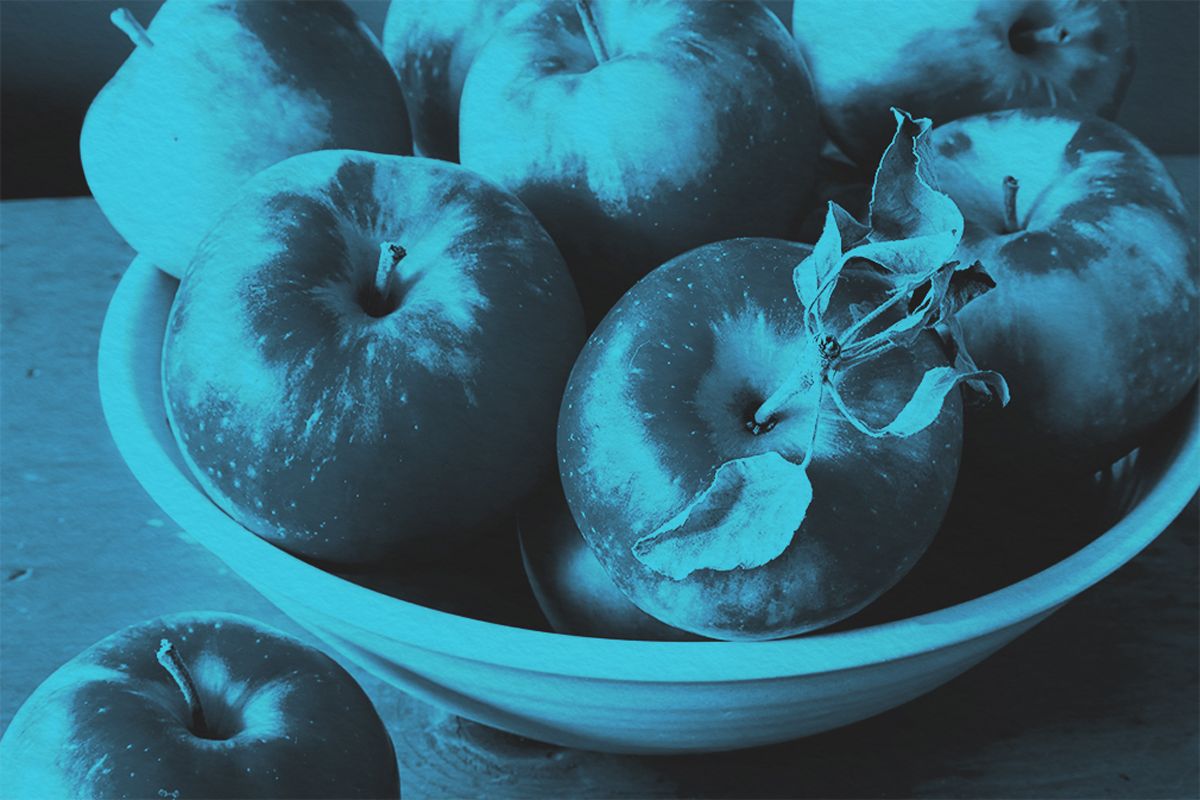
When shoppers peruse the apple section of their local supermarket or farm stand this autumn, one of the first things they’ll notice is branding. An apple’s name can sway buyers just as easily as its appearance. And while the reason for some monikers is self-evident, others may inspire intrigue.
Many of the apple varieties you see today were developed by horticulturists through trial and error, discovery, and innovation. After cultivating a product worthy of the wider market, they then had to come up with an appropriate label for it. Here are some of the most interesting origin stories behind the names of seven apple varieties.
Though the Red Delicious apple isn’t necessarily prized for its taste or texture, it’s an undeniable American classic. But it didn’t always go by the name we know today; when American farmer Jesse Hiatt submitted the new cultivar to an apple competition held by Stark Brothers’ Nursery in 1893, he called it Hawkeye after his home state of Iowa. The agricultural company selected Hiatt’s submission as the winner but began selling it under the name Stark Delicious. When the nursery introduced its Golden Delicious apple in 1914, it rebranded Stark Delicious as Red Delicious to help differentiate it.
And why was it called “delicious” in the first place? Apparently early Red Delicious apples really were delicious, but years of selection for uniform red color and thick, durable skins have reduced it to a bland, mealy shadow of its former self.
Given its name, it should be no surprise that this yellow, brown-spotted apple ends up in apple ciders. According to 19th-century horticulturalist William Coxe, the Harrison Cider apple was named after a family in Essex County, New Jersey, where it originated during the American Revolution. The second part of its moniker is owed to its dry, tart flavor, an excellent quality for making cider.
The apple had fallen out of fashion by the 20th century, possibly because of a reduction in cider production related to the temperance movement. However, it was rediscovered ata cider mill in Livingston, New Jersey, in 1976, and today the sturdy Harrison Cider is widely used in commercial ciders around the country.
If you’re eating an apple pie in the United States, it was probably made with Granny Smiths. The Granny Smith variety is the third most popular apple in the country, and its firm texture and tart, sweet flavor make it an especially common choice for baking.
The light green apple’s namesake Granny was a real woman: Maria Ann Smith. After moving from England to New South Wales, Australia, in 1838, she and her husband bought an orchard and developed a new cultivar. Decades later, Farmers and Settlers published the story of how Smith saw the apple’s potential, and thus the name “Granny Smith” was born.
The Honeycrisp is one of the most recent additions to the apple world — and one of the most beloved. In 1982, research scientist David Bedford was working on the apple breeding program at the University of Minnesota’s Horticultural Research Center when he tasted the hybrid fruit of a tree that was set to be discarded and was enchanted by its light, sweet crispness.
Bedford rightly saw that the tree warranted more attention, and by 1998, the Honeycrisp apple was patented, produced, and being sold in grocery stores. The research center chose the name to evoke the fruit’s flavor and texture. These days, the Honeycrisp apple is one of the most produced in the United States. It even became Minnesota’s state fruit in 2006 — not bad for a young apple.
The McIntosh apple has humble farm origins. Before it became the national apple of Canada, farmer John McIntosh developed the cultivar on his land in modern-day Ontario in 1811 and started selling it in 1835.
While it’s no longer the most popular apple in circulation, its legacy endures in a different industry entirely. Jef Raskin, who helped develop the first Apple computers, gave them the name Macintosh, after the fruit. Like the computer, the apple has the nickname “Mac.”
The Fuji apple is the most popular apple in Japan and the ninth most popular apple in the United States. It’s easy to see why: The crisp texture and light taste are perfect for snacking.
A cross between the Red Delicious and Ralls Janet apple varieties, the Fuji was developed around 1940 by the Ministry of Agriculture and Forestry in Japan. The creators named the apple after the town where it was cultivated: Fujisaki.
Also called the Knobbed Russet, Winter Russet, Old Maid, or Winter Apple, this variety is far from the platonic idea of an apple. Russet apples in general have a brownish hue and rough skin, closer to the appearance of potatoes. And the Knobby Russet in particular has a warty-looking surface. Despite its offputting exterior, it’s quite soft on the inside and has a fresh, sweet taste.
While the name can’t be traced to any one person, it was clearly inspired by the fruit’s appearance. The apple was first documented by the London Horticultural Society in 1820 after being donated by a man named Haslar Capron. Well suited to storage, Knobby Russets were popular in the 19th century but fell out of fashion when more visually pleasing apples took over the market. These days, the National Collection of Sussex Apples in England grows Knobby Russets and other historical varieties to help historians and horticulturalists understand the history of apple cultivation and create future cultivars.
More from our network
Word Smarts is part of Inbox Studio, which publishes content that uplifts, informs, and inspires.