


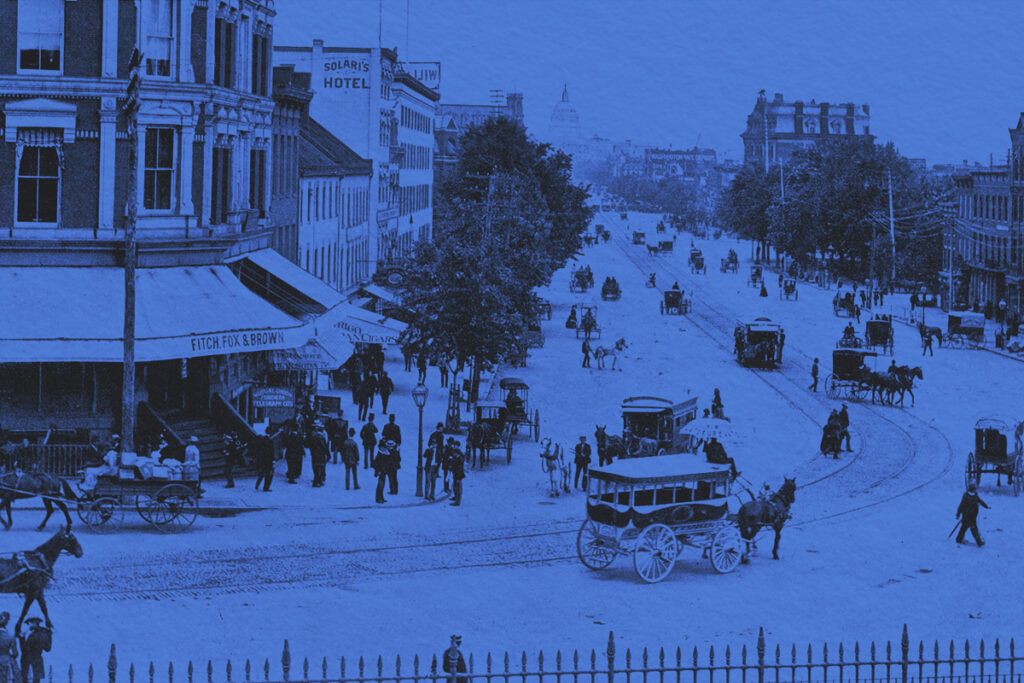
Life in 19th-century America was far different from life in America today. U.S. society was characterized by its rapid industrialization, vast westward expansion, and the devastating plights of slavery and civil war. But for all the trends that have been left behind — many for the best — it’s still worth revisiting how Americans communicated back then. One particularly fascinating topic is 19th-century slang. To learn more about it, we consulted an 1891 text, The American Slang Dictionary. Here are 12 instances of lost 1800s slang that caught our eye.
The slang phrase “according to Gunter” references a 17th-century English clergyman and mathematician, Edmund Gunter. He created a measuring device called “Gunter’s chain,” which was used to accurately survey plots of land. Thus this phrase was coined to reference anything done reliably and in accordance with an established rule.
If you’re offered a Hobson’s choice, you might think you have free will to decide. But this type of choice is actually an illusion, and you have only one real option. The Hobson in question is a stable owner named Thomas Hobson from Cambridge, England. As the tale goes, Hobson would always make his customers choose the horse nearest the door, regardless of their personal preference. “Hobson’s choice” then refers to being pushed into only one option, under the guise of open selection.
The phrase “two upon ten” means “to be especially watchful and attentive.” It was based on the idea of shop owners with suspicions that a customer was shoplifting. The vendor would use their two eyes to keep an eye on the suspected thief’s 10 fingers, ensuring the wannabe robber didn’t make off with any stolen goods.
“Mugwump” first appeared around the 1884 presidential election. It described all voters who went against party politics and voted for a candidate from across the aisle. The first use of “mugwump” was applied to Republicans who chose to vote for the Democrat Grover Cleveland over their own party’s candidate, James G. Blaine. The word comes from the Alonguin mugquomp, meaning “leader.”
This odd phrase can be applied to petty quarrels or melees. Its origins sound like a bit of a fantastical tale — as the story goes, a woman left her favorite bird in the same room as a monkey, and when she left, the two animals began to fight. When the woman returned, the parrot purportedly said, “We’ve been having a hell of a time.”
In the 19th century, train robberies were a valid concern — thieves would sneakily pick the pockets of sleeping travelers. But once in a while they’d accidentally wake up a passenger who would opt to fight back. This gave rise to the slang phrase “wake up the wrong passenger,” which refers to rousing a person who puts up resistance after being bothered.
“Shoddyocracy” refers to a person or business that accrues wealth by selling inferior services and goods. It combines the word “shoddy” — meaning “inferior” — with “–cracy,” a suffix that comes from the Greek kratos, meaning “power.”
People who “walk their chalks” are behaving properly. It comes from the idea that a drunk man would have a tough time walking in a straight chalk line drawn on the ground, whereas someone who is well behaved would have little issue.
If you were to button-hole someone, that person would rather be anywhere else than listening to you talk. It stems from the idea of holding the button of a victim’s coat to prevent their ability to escape. Anyone being button-holed would have a tough time escaping unwanted conversation.
Back in the 19th century, strong, cheap, and potentially dangerous whiskey was known as “forty-rod.” The idea was that the whiskey was so potent that its fumes could kill from a distance of 40 rods away; each rod equaled 5.5 yards, and 40 rods equaled 220 yards.
If someone is dyed in the wool, they’ve held on to their faith and principles. Home-spun clothing was dyed by hand, which became a rarity as industrialization and mass production became more common. The phrase was often used to describe well-intentioned politicians, as it was rare to find one who hadn’t been corrupted.
If you’ve been Chicagoed, you’ve been trounced in competition. The term refers to a 19th-century Chicago baseball team that was extremely talented and known for walloping their opponents. The teams that failed to score against them were said to have been Chicagoed.
More from our network
Word Smarts is part of Inbox Studio, which publishes content that uplifts, informs, and inspires.